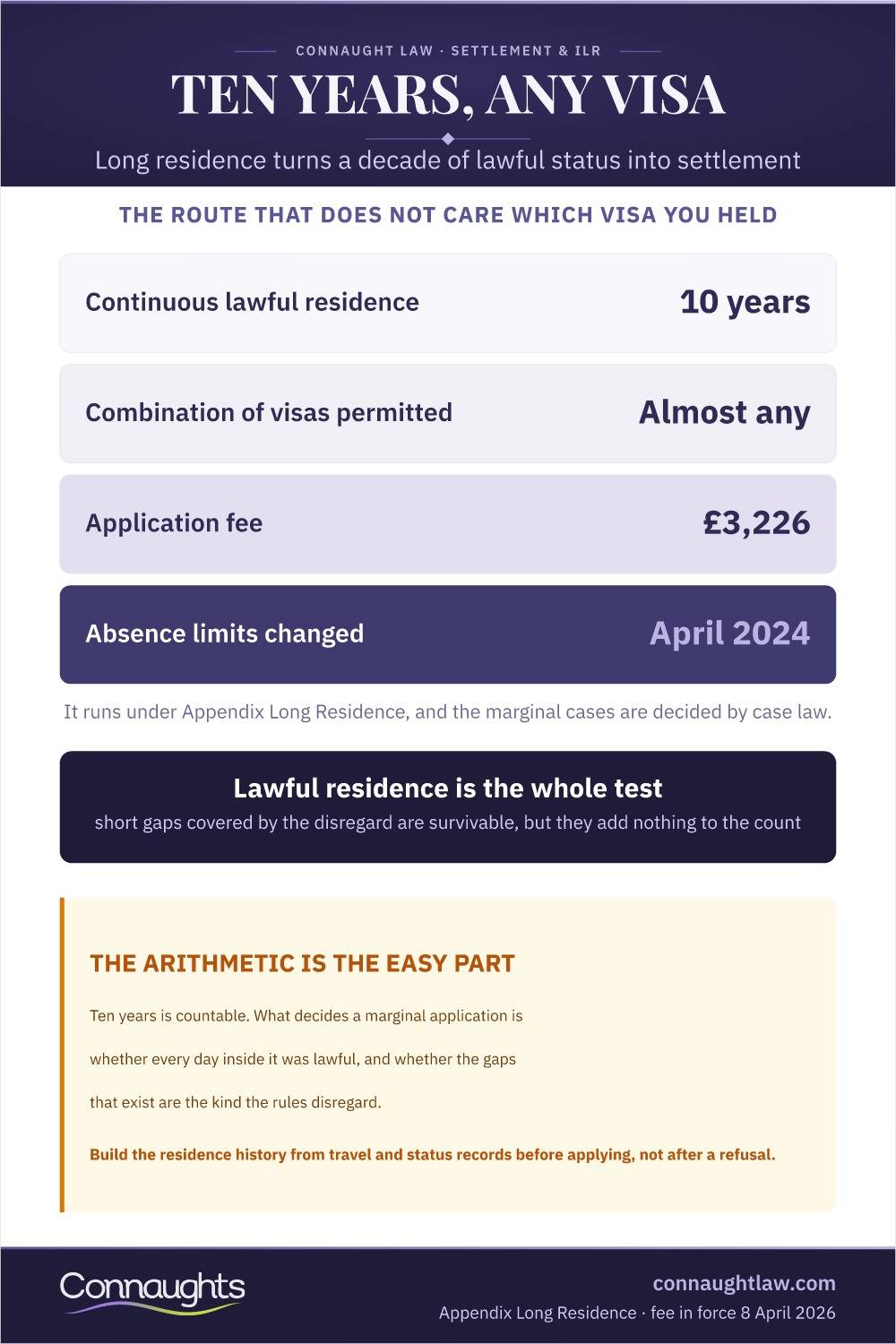
Ten years of continuous lawful residence in the UK — on almost any combination of visas — earns indefinite leave to remain under Appendix Long Residence: a £3,226 application, absence limits that changed in April 2024, and case law that decides the marginal cases. This consolidated guide covers eligibility, the lawful residence and absence rules, the Afzal line of authority, evidence, costs, and where the government's ten-year "earned settlement" proposals now stand.
On This Page

A Decade of Lawful Life, Counted Strictly
The long residence route rewards persistence rather than category: students who became workers, workers who switched employers, families who moved between routes — ten continuous lawful years qualifies them all under Appendix Long Residence. The generosity ends at the counting rules: what counts as lawful, what breaks continuity, and how absences add up are where a decade's residence is won or lost on paper.
Route Overview
Core Eligibility
Requirements at a Glance
| Requirement | The rule |
|---|---|
| Qualifying period | 10 years' continuous lawful residence in the UK |
| Current status | Valid permission — not as a visitor, short-term student or seasonal worker |
| Absences | Within the limits for each part of the period (see below) |
| Knowledge of life and language | English at B1 and the Life in the UK test |
| Suitability | No falling foul of the general grounds — criminality, deception, breaches |
Qualifying Visa Categories
Almost any lawful time counts and combines — student, work, family, discretionary — with the modern exceptions carved out: time as a visitor, short-term student or seasonal worker neither counts nor supports the application at the end. Time on immigration bail does not count; time under section 3C protection while an in-time application pends does.
Lawful Residence
What Counts as Lawful
Lawful residence means holding permission for every day of the ten years — and the route's casualties are nearly always gap cases: an application filed late, a refusal followed by regularisation, a period everyone assumed was covered. Short gaps can be survivable where the overstaying disregard applied to the late application, but the arithmetic changed with the case law: disregarded gaps stop the clock without resetting it, so the ten years must still be found in actual lawful residence either side.
Exceptions and Protections
Three protections do the heavy lifting: section 3C leave continues status during in-time applications, the overstaying disregard — paragraph 39E until the 3 August 2026 restructure, now SUI 13.1 of Part Suitability — excuses defined short periods of overstaying from triggering refusal, and the appendix's transitional provisions preserve the old, more generous treatment for periods predating April 2024. Each is technical, each is regularly misunderstood, and our paragraph 39E guide and breaks in lawful leave guide take them in detail.
Case Law and Rule Changes
The Afzal Line of Authority
In Afzal v SSHD [2021] EWCA Civ 1909 — affirmed by the Supreme Court in R (Afzal) v SSHD [2023] UKSC 46 — the courts settled how excused overstaying interacts with the ten-year count: the disregard prevents a short gap from defeating the application, but the gap itself is not lawful residence and adds nothing to the clock. "Book-ended" overstaying — a gap sandwiched between grants — is disregarded, not credited. The companion question of when a break destroys the whole accumulated period is governed by the Ahmed litigation, analysed in our continuous residence case note.
April 2024's Restructure
From 11 April 2024 the old paragraph 276B framework became Appendix Long Residence, tightening two things: the current-permission requirement (excluding visitor-type statuses) and the absence regime, which moved to the modern rolling test for time from that date. The transition matters practically because most 2026 applicants straddle it — their decade is assessed under two absence regimes at once.
Absence Limits
The Two-Regime Framework
Absence Limits by Period
| Period | Limit | How it is applied |
|---|---|---|
| Residence before 11 April 2024 | 548 days total, 184 per absence | The legacy whole-period allowances |
| Residence from 11 April 2024 | 180 days in any rolling 12 months | The Appendix Continuous Residence test |
The rolling test's mechanics — how entry and exit days count, how the 12-month window moves, and what evidence excuses an overshoot — are shared with the five-year routes and worked through in our 180-day rule guide. Long residence applicants should reconstruct their full travel history early: a decade of trips is a spreadsheet project, not a memory exercise.
Evidence
Application Evidence
Core Documentary Requirements
- Every grant letter, visa and status document across the decade.
- Complete travel history with passports and, where gaps exist, boarding passes or entry stamps.
- Residence corroboration by year: tax records, employment, tenancy, utilities, GP registration.
- English language qualification at B1 and the Life in the UK pass certificate.
- Explanations, with contemporaneous evidence, for any late application or excused gap.
Compiling It Strategically
Build the file chronologically and audit it against the two questions a caseworker asks: was every day lawful, and were the absences within the applicable regime? Subject access requests to the Home Office fill documentary holes for old grants, and the time to file one is months before the application, not after a request for evidence lands.
Costs and Fees
The settlement application fee is £3,226 per applicant, with the Life in the UK test at £50 and English testing where needed — dependants apply on their own routes with their own fees. The standard decision timescale is six months; the £500 priority and £1,000 super priority services compress clean cases to days, though a decade-spanning file with excused gaps is precisely the kind that keeps its checks whatever is paid. Character questions — including drink-driving and points — are assessed under the suitability rules examined in our driving offences and ILR guide, and the Life in the UK test guide covers the knowledge requirement.
Proposed Changes
The immigration white paper proposed making ten years the standard qualifying period for most settlement — an "earned settlement" framework with acceleration for contribution — and the consultation on it has closed with the outcome awaited. Two things follow for long residence applicants: nothing has changed in force, and the direction of travel makes prompt applications wise for anyone already qualified. Parliamentary petitions and sector pressure continue over retrospective application to people mid-route; the policy detail sits in our white paper analysis, and the current all-routes map in our settlement routes guide.
Common Challenges
Documentation Challenges
Recurring Problems and Fixes
The classic failure points: a forgotten late application a decade ago surfacing as a continuity break; travel history that cannot be reconstructed; old statuses evidenced only by vanished stamps — cured through Home Office records requests; and absence overshoots discovered at the counting stage. Each is survivable when found early and framed honestly, which is the argument for a professional file review months before filing; our settlement team runs exactly that exercise.
Application Timing
File at the earliest date the ten years complete — 28 days early at most — with the evidence assembled in the preceding quarter. Waiting costs nothing legally but everything strategically while the earned settlement question hangs; qualified applicants who delay are volunteering for whatever regime replaces the current one.
Frequently askedQuestions about 10-year long residence
What is ILR after 10 years long residence?
Settlement earned by ten continuous years of lawful residence in the UK on any combination of qualifying visas, under Appendix Long Residence — no sponsor, no salary test, but strict counting of lawfulness and absences.
Do all my visas count toward the 10 years?
Most combine freely — student, work, family, discretionary. Time as a visitor, short-term student or seasonal worker does not count, and your current permission at application must not be in those categories either.
What are the absence limits for long residence?
Two regimes: 548 days total (184 per trip) for residence before 11 April 2024, and 180 days in any rolling 12 months from that date. Most current applicants are assessed under both, split at the changeover.
Does a gap in my leave ruin the whole 10 years?
Not always. Short gaps covered by the disregard (SUI 13.1) are treated as disregarded rather than fatal — but after Afzal they add nothing to the count, so the full ten years must exist in actually lawful residence around them. Longer or uncovered gaps restart the clock.
How much does a long residence ILR application cost?
£3,226 per applicant, plus £50 for the Life in the UK test and any English test fees. Priority (£500) and super priority (£1,000) services exist, though complex decade-spanning files often keep their checks regardless.
Will the 10-year rule change under earned settlement?
The white paper proposed ten years as the standard period for most routes, with the consultation now closed and no rules yet made. Long residence already runs on ten years — the live risk sits with transitional treatment, which is another reason qualified applicants should file promptly.
Send us your status history and travel record. We'll audit the decade against both absence regimes and the case law — and tell you the earliest safe filing date.
Get Expert Advice