A non-EEA national whose marriage to an EU, EEA or Swiss citizen ends can keep their status in their own right rather than losing it with the relationship. That is a retained right of residence, and it now sits in Appendix EU rather than in the old EEA Regulations. There is also a separate route for someone whose relationship broke down permanently because of domestic violence or abuse, and it does not require a divorce at all.
On This Page

Keeping Status After the Marriage Ends
A retained right of residence lets a non-EEA former spouse or civil partner stay in the UK on their own footing once the marriage has ended. It is not a discretionary concession — it is a defined category in Appendix EU, with conditions that either are met or are not.
The most important practical point comes first, because it is the one that decides most cases: the application must have been made by 1 July 2021, or later with reasonable grounds for the delay. Everything else on this page is secondary to that, and a person who has never applied should deal with the deadline question before anything else.
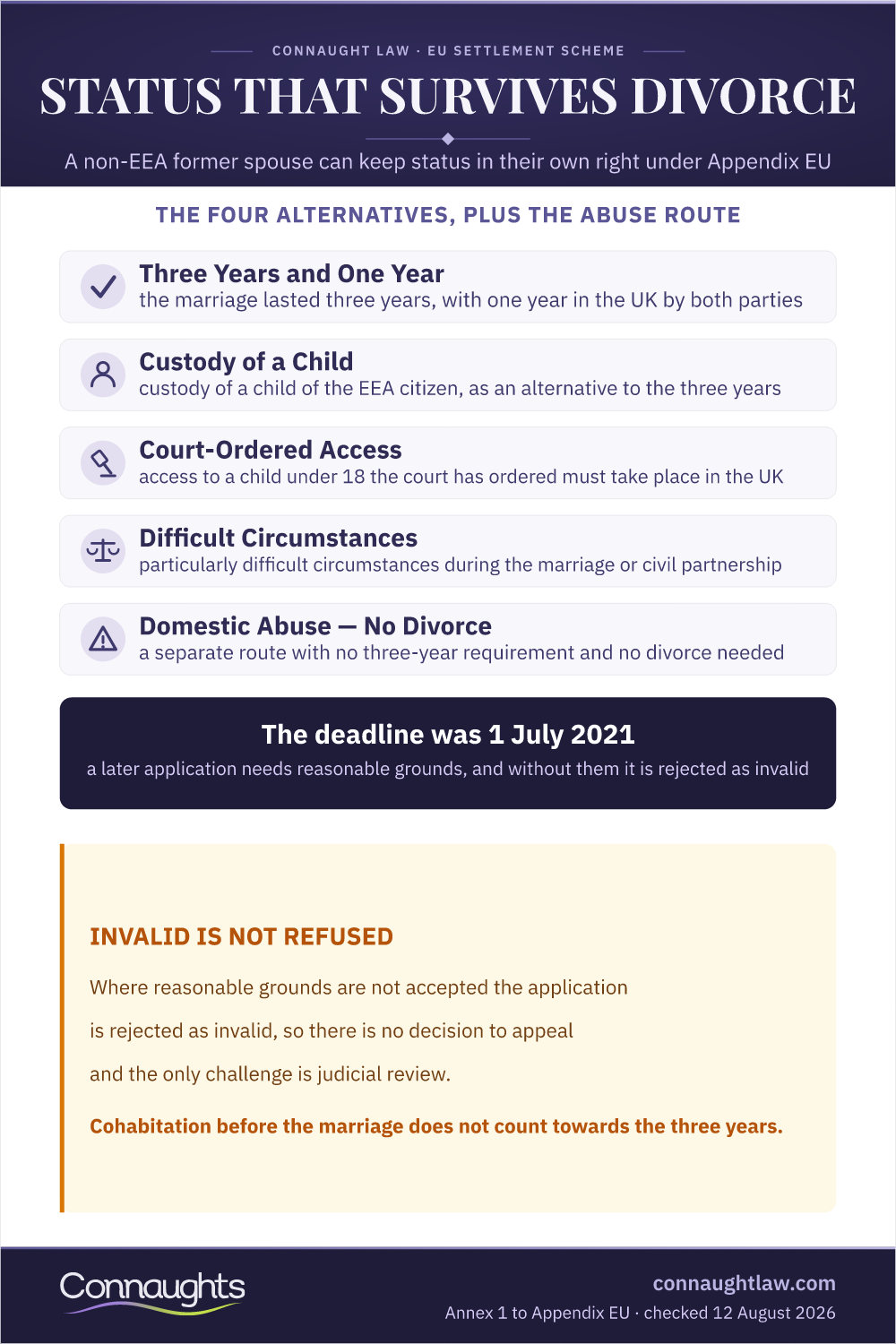
Two categories exist. The first depends on a divorce or dissolution and on one of four alternative limbs. The second is for a relationship that broke down permanently because of domestic violence or abuse — and it does not require the marriage to have ended in law at all.
The Legal Basis, and What It Is Not
Retained rights are defined at Annex 1 to Appendix EU and applied through rules EU11, EU11A, EU12, EU14 and EU14A — see the settlement scheme for how the application itself is made. That is the operative law.
What it is not is regulation 10 of the Immigration (European Economic Area) Regulations 2016. Those Regulations were revoked on 31 December 2020, and a great deal of published guidance — including the previous version of this page — still describes them as though they governed. Nor is Article 13(2) of Directive 2004/38 the operative test: Appendix EU imposes no Treaty rights or qualified person requirement at all.
The practical consequence is a real one. Under the old Regulations you had to show the EEA sponsor was exercising Treaty rights. Under Appendix EU you have to show they were a relevant EEA citizen — in practice, someone granted settled or pre-settled status under EU2 or EU3, or an Irish citizen. Whether they were working is beside the point.
Four Ways to Qualify After Divorce
Where the marriage or civil partnership has been dissolved, one of four alternatives must be satisfied.
- Three years and one year. Before the proceedings began, the marriage or civil partnership had lasted at least three years, and both parties had lived in the UK for at least one year during it. Cohabitation before the marriage does not count towards the three years.
- Custody of a child of the EEA citizen.
- Court-ordered access. A right of access to a child under 18 where a court has ordered that the access must take place in the UK. An informal contact arrangement is not enough.
- Particularly difficult circumstances during the marriage or civil partnership.
There is also a timing rule that saves a great many applications. Under limb (d)(i), what matters is that the divorce proceedings were started while the sponsor still held their status — the divorce being finalised afterwards does not defeat the claim. The Court of Appeal reached that position in Baigazieva in 2018, on a basis the Secretary of State conceded rather than contested.
Where There Has Been Domestic Abuse
Sub-paragraph (e) of the Annex 1 definition is a separate route, and it is materially easier than the divorce limbs in three respects that are worth stating plainly.
No divorce is required. What must be shown is that the relationship broke down permanently as a result of domestic violence or abuse. The marriage or civil partnership need not have been dissolved, and there is no three-year requirement to satisfy.
No mandatory evidence is specified. The rules do not prescribe a police report, a conviction or a court order. Any evidence capable of establishing the position can be relied on, which matters because abuse is frequently unreported.
The standard is the balance of probabilities. It is the ordinary civil standard, not something higher, and it applies to the breakdown and its cause.
Anyone in this position should not wait for a divorce to be concluded before applying. Waiting has no advantage under (e) and it consumes time against the deadline discussed below.
The Deadline
Applications had to be made by 1 July 2021. A later application can still be made where there are reasonable grounds for the delay, and that test is now the practical gateway for anyone who has not yet applied.
The reasonable grounds test asks about the whole delay to the date of application, not only about why the deadline was missed, and the longer the elapsed time the harder it becomes. Where someone was prevented from applying by a controlling partner, that is exactly the kind of ground the guidance recognises — and it commonly runs alongside a claim under sub-paragraph (e).
If the grounds are not accepted the application is rejected as invalid rather than refused, which means there is no decision to appeal and the challenge is judicial review. Our litigation team handles that, and the derivative rights guide covers the neighbouring categories.
Evidence, and the Sponsor Problem
The hard part of a retained rights application is rarely your own documents. It is proving the ex-spouse’s position — that they were a relevant EEA citizen throughout the relevant period — at a point when the relationship has broken down and they may be unwilling to help.
What is needed is their passport or national identity card, or confirmation that they hold a grant under EU2 or EU3. Where that cannot be obtained, the caseworker has a discretion to accept alternative evidence, and can make enquiries directly. Say so in the application rather than leaving a gap: an application that explains why the sponsor’s document is unavailable is in a better position than one that is silent.
Gather what you can before separating where that is safe to do — copies of the sponsor’s identity documents, evidence of the marriage, and evidence of joint residence during it. Where safety is the issue, that advice does not apply, and the discretion above exists precisely for those cases.
Frequently askedQuestions about retained rights of residence
What is a retained right of residence?
The right of a non-EEA former spouse or civil partner of an EU, EEA or Swiss citizen to keep their status in their own right after the relationship ends. It is defined in Annex 1 to Appendix EU.
Do I need to have been married for three years?
Only on one of the four limbs. Three years' marriage before the proceedings began, with one year's UK residence by both parties during it, is the commonest — but custody, court-ordered access to a child, and particularly difficult circumstances are alternatives.
Does living together before marriage count?
No. The Annex 1 wording refers to the marriage or civil partnership having lasted three years. Cohabitation before the marriage does not count towards it.
What if there was domestic abuse?
A separate route applies. If the relationship broke down permanently as a result of domestic violence or abuse, no divorce is needed, no three-year period applies, and no particular form of evidence is required.
Does my divorce have to be finished?
For the divorce-based limbs, proceedings must have started while your ex-spouse still held their status. The divorce being finalised afterwards does not defeat the application.
Is it too late to apply?
The deadline was 1 July 2021, but a later application can be made with reasonable grounds for the delay. Being prevented from applying by a controlling partner is a recognised ground.
What if my ex will not give me their documents?
Explain that in the application. The caseworker can accept alternative evidence and can make enquiries, and an explained gap is treated very differently from an unexplained one.
Do the old EEA Regulations still apply?
No. The Immigration (EEA) Regulations 2016 were revoked on 31 December 2020. Anything decided now is decided under Appendix EU, whatever regulation 10 used to provide.
Tell us how long the marriage lasted, when proceedings began and what status your spouse holds. We'll tell you which limb applies and what evidence it needs.
Get Expert Advice