
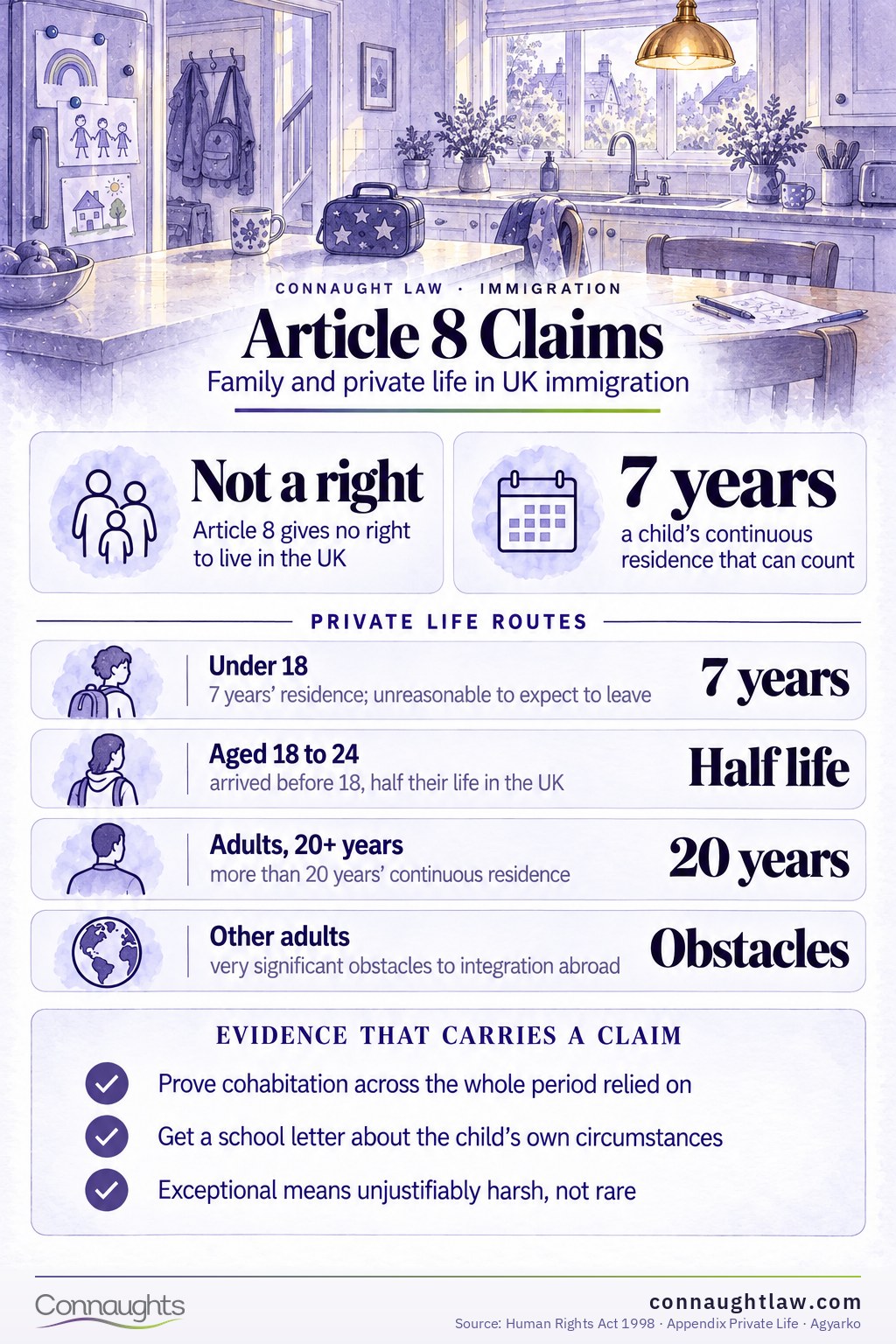
Article 8 gives everyone a right to respect for private and family life. It does not give anyone a right to live in the UK. What decides an immigration case is how that right is weighed against immigration control — a balance currently set by Appendix FM, Appendix Private Life and Part 5A of the 2002 Act, and one that Parliament is now being asked to redraw.
On This Page

The Test That Decides a Human Rights Claim
Article 8 protects private and family life, but it is a qualified right: the state may interfere where the law allows and the interference is proportionate. In an immigration case that means two questions. Do you meet a rule written to reflect Article 8 — Appendix FM or Appendix Private Life? If not, is refusal nonetheless unjustifiably harsh? Almost every claim is won or lost on the second.
Article 8(2) allows interference where it is in accordance with the law and necessary in a democratic society for one of six aims: national security, public safety, the economic well-being of the country, the prevention of disorder or crime, the protection of health or morals, and the protection of the rights and freedoms of others. Immigration control is not on that list. It enters through the economic well-being limb and the rights of others, and no court has doubted that it is a legitimate aim.
The order of questions comes from R (Razgar) v Secretary of State for the Home Department [2004] UKHL 27. Lord Bingham asked whether removal interferes with private or family life; whether the interference is grave enough to engage Article 8; whether it is in accordance with the law; whether it pursues an Article 8(2) aim; and whether it is proportionate. In practice the first four are conceded. The fifth is the case.
Proportionality is not at large. Part 5A of the Nationality, Immigration and Asylum Act 2002, in force since 28 July 2014, tells a court what weight to attach to the public interest, to English language and financial independence, to a private life built while immigration status was precarious, and to the deportation of foreign criminals. A tribunal must have regard to those considerations. It cannot replace them with a list of its own.
- Inside the Rules. Appendix FM for partners, parents and children; Appendix Private Life for length of residence and obstacles to integration.
- Inside the safety valve. GEN.3.1 and GEN.3.2 of Appendix FM, and PL 8.1 of Appendix Private Life, both of which ask whether refusal would be unjustifiably harsh.
- Outside the Rules altogether. A freestanding Article 8 claim, decided on Part 5A and the case law, usually on appeal to the First-tier Tribunal.
Convention, Rules and Statute
The Human Rights Act 1998 makes Article 8 enforceable in UK courts and requires public authorities, the Home Office included, to act compatibly with it. Leaving the EU changed nothing here: the Convention is a Council of Europe instrument and the UK remains a party to it. What Brexit did change is that EU free movement rights, which once did much of the work for family members, no longer exist.
Appendix FM and Appendix Private Life are the Home Office’s own statement of when family or private life ordinarily outweighs immigration control. Meeting one of them is the direct route: the claim succeeds under the Rules and no separate human rights argument is needed. Since 11 November 2025 both appendices are policed by Part Suitability rather than the old Part 9, following Statement of Changes HC 1333.
Stage one asks whether the application meets a rule. Stage two, reached only if it does not, asks whether refusal would breach Article 8 anyway. Confusing the two is the commonest drafting error in refused applications: an applicant who cannot meet the financial requirement argues that the requirement is unfair, when the argument that works is that refusal would produce unjustifiably harsh consequences for a named person.
Family Life: Partners, Parents and Children
Family life for Article 8 purposes is not a matter of formal status. Between partners, and between parents and their minor children, it is usually assumed. Beyond that — adult children, siblings, grandparents — it has to be proved, and the courts require more than affection: what the case law calls further elements of dependency going beyond normal emotional ties.
A durable unmarried partnership counts, and so does a genuine and subsisting parental relationship with a child the applicant does not live with. Marriage alone does not: a relationship the Home Office finds is not genuine and subsisting fails at the first hurdle, whatever the certificate says. Evidence of the relationship over time, rather than at the date of application, is what settles the point.
Where a partner application fails on immigration status or on the financial requirement, EX.1(b) of Appendix FM can still carry it, provided the partner is British, settled, or here with protection or stateless status, and there are “insurmountable obstacles to family life with that partner continuing outside the UK”. EX.2 defines those as very significant difficulties that could not be overcome or would entail very serious hardship.
EX.1(a) covers the parent of a child who is British or has lived here for seven years, where it would not be reasonable to expect the child to leave. Section 117B(6) of the 2002 Act carries the same test into freestanding claims for anyone not liable to deportation: where it is met, the statute says the public interest does not require removal. Family reunion sits on a separate footing.
Private Life After Paragraph 276ADE
Paragraph 276ADE(1) no longer exists. Statement of Changes HC 1118 deleted paragraphs 276ADE(1) to 276DH with effect from 20 June 2022 and replaced them with Appendix Private Life. Applications made before that date are still decided under the Rules in force on 19 June 2022, but for anyone applying now the old paragraph numbers are simply gone, and a submission that cites them signals drafting that has not been updated.
The Four Qualifying Routes
| Rule | Who it covers | What must be shown |
|---|---|---|
| PL 3.1 | Aged under 18 at the date of application | At least 7 years’ continuous residence, and that it would not be reasonable to expect the applicant to leave the UK |
| PL 4.1 | Aged 18 to 24, arrived before turning 18 | At least half their life continuously resident in the UK |
| PL 5.1(a) | Aged 18 or over | More than 20 years’ continuous residence in the UK |
| PL 5.1(b) | Aged 18 or over, under 20 years’ residence | Very significant obstacles to integration into the country they would have to live in |
Two tests do most of the work. Whether it is reasonable to expect a child to leave is judged from the child’s position, with their best interests a primary consideration; KO (Nigeria) held that where the parents will have to go, it will normally be reasonable for the child to go with them. Very significant obstacles asks whether the applicant could establish a private life of substance in the destination country — not whether life there would be harder.
A successful applicant is granted 30 months, or 60 months where that was applied for by a child or by a young adult meeting the half-life test (PL 10.1 to PL 10.3). Settlement takes five years on those two routes and ten years otherwise (PL 14.1 and PL 14.2). Permission normally carries a no recourse to public funds condition. Those already in the UK without status should read the regularisation options first.
Exceptional Circumstances Outside the Rules
Where the Rules are not met, Appendix FM carries its own valve. GEN.3.2 requires the decision-maker to consider whether there are exceptional circumstances that would make refusal a breach of Article 8, because refusal “would result in unjustifiably harsh consequences” for the applicant, their partner, a relevant child or another family member whose rights would be affected. Appendix Private Life does the same job through PL 8.1.
Agyarko settled the meaning. Exceptional does not mean statistically rare; it means the consequences of refusal are unjustifiably harsh. The Supreme Court also held that insurmountable obstacles must be applied in a practical way rather than as a test of literal impossibility, and that family life formed while status was precarious will normally be outweighed unless the circumstances are exceptional.
Section 117B(4) and (5) require little weight to be given to a private life or partner relationship formed while a person is here unlawfully, and to a private life built while immigration status was precarious. Rhuppiah held that everyone with limited leave has a precarious status, so the provision catches almost every applicant — but that little weight retains enough flexibility for a strong case to succeed. Discretionary leave is what a successful claim outside the Rules usually produces.
From White Paper to Bill: Article 8 Reform
The May 2025 immigration white paper promised legislation to clarify how Article 8 interacts with the Rules. That legislation now exists in draft. The Immigration and Asylum Bill was introduced on 30 June 2026 and its Part 2 is headed “Article 8 of the European Convention on Human Rights”. It is not law: at the time of writing it sits in committee in the Commons.
Clause 18 would insert a new section 117AA providing that a person’s family life is normally limited to their core cohabiting family — spouse, civil partner or partner, children under 18, and, where the applicant is a child, their parents. Anyone outside that would have to show additional elements of dependency beyond normal emotional ties, and the clause lists factors that on their own would not qualify, financial dependence and emotional support among them.
Clause 20 would replace section 117C entirely and extend it from foreign criminals to everyone liable to deportation. The four-year sentence threshold would go, replaced by a rule that deportation is required unless its effect would be disproportionate — and disproportionate only where one of three specified sets of exceptional circumstances applies. None of this is in force, and the Bill may change in committee.
Evidence That Carries an Article 8 Claim
Article 8 claims fail on evidence far more often than on law. The decision-maker is assessing a relationship and the consequences of ending it, and assertion establishes neither. What is needed is documentary proof of the relationship across the whole period relied on, independent evidence of the effect removal would have on a specific person, and, where a child is involved, material about that child rather than about the parent. The standard is the same on appeal, so the file is worth building once and building properly for the whole immigration case.
Cohabitation shown across the whole period rather than a bundle from one month. A school letter that addresses the child’s own circumstances, not the family’s. Country evidence about the specific place this family would go to, not the country in general. And a medical or social work report where vulnerability is relied on, because GEN.3.2 asks about consequences for a named person.
What the Courts Have Settled
Four Supreme Court decisions define the current law. Agyarko, on insurmountable obstacles and precariousness. Rhuppiah, on the meaning of precarious. KO (Nigeria), on reasonableness and on “unduly harsh”. And HA (Iraq) [2022] UKSC 22, which corrected the reading of KO (Nigeria) that had taken hold: there is no notional comparator, no baseline of ordinary hardship against which a particular child is measured.
The Court of Appeal has kept policing the edges. In 2026 it held that the Home Office cannot raise a relocation scenario for the first time on appeal where it was never put to the First-tier Tribunal (Hirtie [2026] EWCA Civ 1000), and that a wish to establish future contact with a child, without a genuine and subsisting relationship, cannot amount to very compelling circumstances under section 117C(6) (Lewis [2026] EWCA Civ 879).
One statutory change did land. From 22 March 2026, section 45(2) of the Sentencing Act 2026 removed the suspended-sentence carve-out from the definition of a period of imprisonment in section 117D(4), so a suspended sentence now counts towards deportation. The commencement regulations limit that to offences for which the person was convicted on or after 22 March 2026.
Frequently askedQuestions about Article 8 family and private life claims
Does Article 8 give a right to live in the UK?
No. Article 8 protects respect for private and family life; it does not confer a right to choose the country in which to enjoy it. It bites only where refusal or removal would be a disproportionate interference, which is why almost every claim turns on proportionality rather than on whether family life exists.
Is paragraph 276ADE still in force?
No. Paragraphs 276ADE(1) to 276DH were deleted on 20 June 2022 and replaced by Appendix Private Life. Applications made before that date are still decided under the earlier Rules, but a current application has to be framed under Appendix PL.
What are insurmountable obstacles?
Very significant difficulties the couple would face in continuing family life outside the UK, which could not be overcome or would entail very serious hardship. That is the EX.2 definition in Appendix FM, and Agyarko held it must be applied practically rather than as a test of impossibility.
How long must a child have lived in the UK?
Seven years’ continuous residence — under PL 3.1 for a private life application, and under EX.1(a) and section 117B(6) where a parent relies on the child. In each case the further question is whether it would be reasonable to expect the child to leave.
Has the law on Article 8 changed in 2026?
Not the framework. The Immigration and Asylum Bill would rewrite Part 5A but was still in Commons committee in August 2026. One change is in force: from 22 March 2026 suspended sentences count towards deportation, for convictions on or after that date.
Can I appeal a refusal of an Article 8 claim?
Usually yes. Refusal of a human rights claim carries a right of appeal to the First-tier Tribunal, where Part 5A applies directly. Certification restricts that in some cases, and section 94B certification can require the appeal to be brought after removal.
Tell us who your family in the UK are, how long you have lived here and what the last decision said. We’ll tell you whether the claim sits inside the rules or has to be argued outside them.
Get Expert Advice