Discretionary leave is granted outside the Immigration Rules, under Home Office policy rather than any rule you can point to. It is far narrower than it was: it must not be given to anyone who qualifies for asylum, humanitarian protection, or leave on family or private life grounds. What survives is a short list of categories, a normal grant of 30 months, and two settlement routes that depend entirely on when the first grant was made.
On This Page

Leave Granted Outside the Rules
The current policy is the Discretionary Leave caseworker guidance, version 12.0, published for Home Office staff on 21 July 2026. It opens by narrowing itself: discretionary leave “must not be granted where an individual qualifies for asylum or humanitarian protection”, or for family or private life reasons. It is what is left when nothing in the Rules fits and removal would still be unlawful or inappropriate.
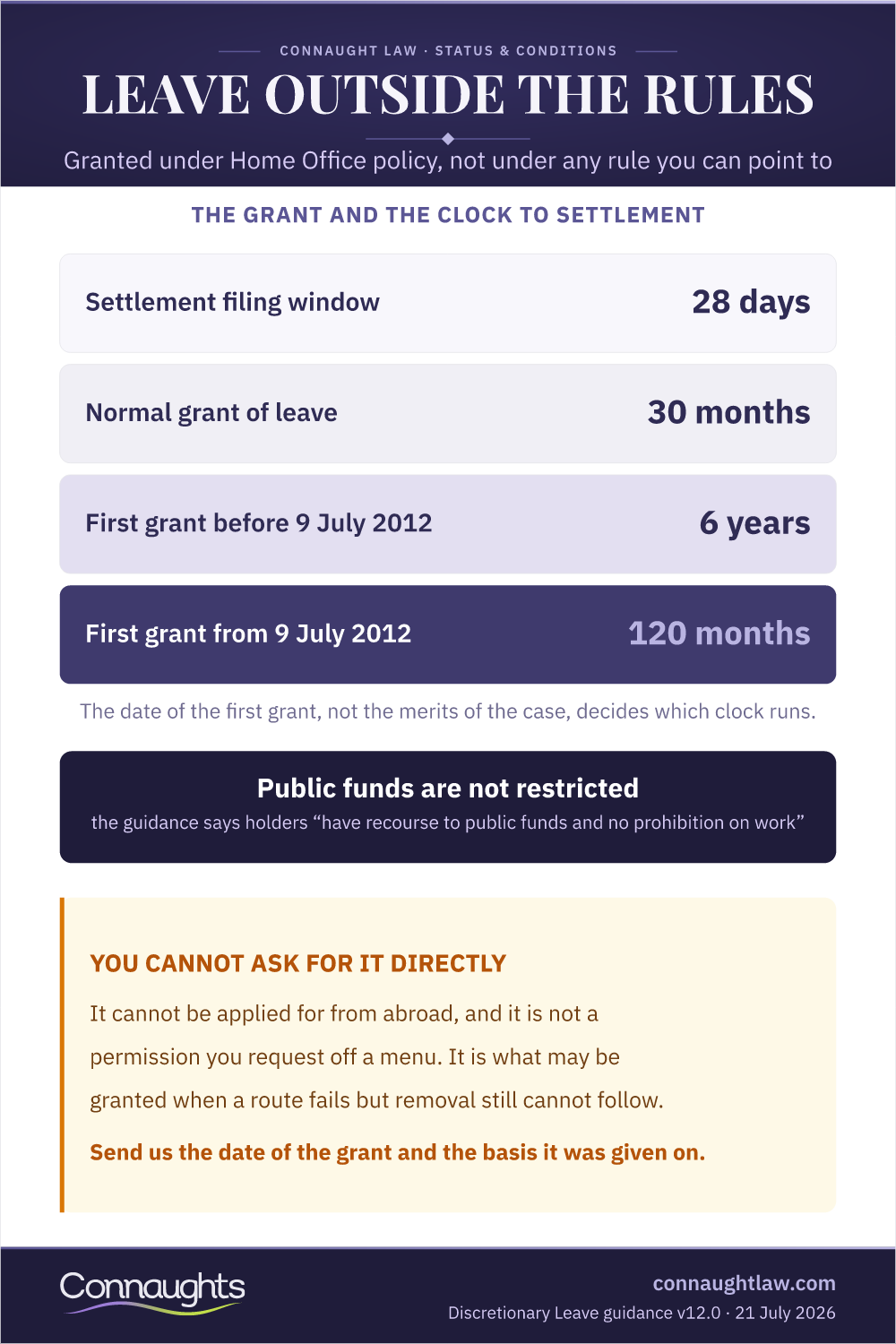
Two practical points follow immediately. It cannot be applied for from abroad — it is a grant made on a case already in the UK. And it is not a permission you request off a menu: it is the residual exercise of the Secretary of State’s discretion, which is why the guidance, not the Rules, is the document that decides your case.
- Normally 30 months. The guidance says leave “should not normally be granted for more than 30 months (2 and a half years) at a time”.
- Recourse to public funds. The guidance is explicit: those granted discretionary leave “have recourse to public funds and no prohibition on work”.
- Work permitted. No employment restriction attaches. Study is permitted but remains subject to ATAS where the subject requires it.
- No automatic settlement. Ten years of continuous leave for anyone first granted on or after 9 July 2012; six years under the transitional arrangements for those granted before it.
What Discretionary Leave Is
Discretionary leave is limited leave granted under policy where the Immigration Rules do not provide a route but the Home Office accepts that the person cannot be required to leave. It is a creature of the Secretary of State’s general power to grant leave, and it carries no statutory qualifying criteria — which is both its flexibility and the reason it is so hard to argue for. The guidance sets the boundaries, and the guidance changes.
Exceptional Leave and Leave Outside the Rules
Exceptional leave to enter or remain was the predecessor. From 1 April 2003 discretionary leave and humanitarian protection replaced it, and applications falling outside the Rules were considered within the discretionary leave criteria until 9 July 2012. Someone still holding a grant made under the old label will normally be dealt with under the transitional arrangements described below, so the label on the original decision letter matters.
Leave outside the Rules on compelling compassionate grounds is a different thing again, and it has its own guidance, version 6.0 of 24 November 2025. It covers cases where refusal would produce unjustifiably harsh consequences without breaching Article 8 or Article 3. The guidance says such a grant “should be rare”, is normally a maximum of 30 months in country or 33 months for entry clearance, and “is not intended to be a route to remain in the UK”. Article 8 cases go to the family and private life guidance instead; Article 3 medical cases come back to discretionary leave.
Two neighbours complete the picture. Restricted leave is for people excluded from protection under Article 1F of the Refugee Convention whose removal would still breach the ECHR: the starting point is six months, renewable without limit, with tight conditions. Section 67 of the Immigration Act 2016 leave — the Dubs scheme — is granted for five years with recourse to public funds, and settlement follows under paragraphs 352ZL to 352ZN.
When It Is Still Granted
Version 12.0 works through a closed list of categories. Most of the volume that once sat here has moved elsewhere, so the honest answer to “can I apply for discretionary leave” is usually that the case belongs in a different box — and identifying which box is the whole of the work.
The Current Categories
| Category | What it covers | Normal grant |
|---|---|---|
| Medical cases | Where removal would breach Article 3 on medical grounds | 30 months |
| Other ECHR cases | Where return would breach the Convention and no Rule applies | 30 months |
| Paragraph 353B | Exceptional circumstances making removal no longer appropriate after appeal rights are exhausted. Does not apply where the person is liable to deportation | 30 months |
| Modern slavery | Only the pre-30 January 2023 cohort with a positive conclusive grounds decision and an undetermined re-trafficking claim | 30 months |
| Exclusion and criminality | Cases where exclusion or criminality bars a grant under the Rules | Case by case |
Trafficking victims are no longer given discretionary leave. Since 30 January 2023, section 65 of the Nationality and Borders Act 2022 and Appendix Temporary Permission to Stay for Victims of Human Trafficking or Slavery govern instead. VTS 5.1 gives up to 30 months where permission is needed for recovery or to co-operate with an investigation, and up to 12 months where it is needed to seek compensation. The Appendix states in terms that this “is not a route to settlement”.
Unaccompanied children are also outside the discretionary leave policy. Since 6 April 2013 their leave sits in the Rules at paragraphs 352ZC to 352ZF, and paragraph 352ZE sets the period at “30 months or until the child is 17 ½ years of age whichever is shorter”. Paragraph 352ZC(b) was substituted on 9 December 2025, so a decision letter written before then may describe the requirements differently from the current rule.
Private Life Took Most of It Over
The reason discretionary leave is now rare is that family and private life cases were pulled into the Rules on 9 July 2012 and have stayed there. A claim based on length of residence or obstacles to integration belongs in Appendix Private Life; a claim based on a partner or child belongs in Appendix FM. Only where neither fits, and removal would still be unlawful, does discretionary leave come back into view.
Appendix Private Life sets the periods at PL 10.1 to PL 10.3 — 30 months as standard, 60 months for a qualifying child or a young adult meeting the half-life test — and the settlement routes at PL 14.1 and PL 14.2, five years for those two groups and ten for everyone else. On the family side, D-LTRP.1.2 grants 30 months at a time on the ten-year route. Our guide to Article 8 family and private life works through which of those applies.
Settlement: Six Years or Ten
The date of the first grant decides everything. For anyone first granted on or after 9 July 2012, the guidance requires “a continuous period of at least 120 months’ limited leave” — ten years, normally four separate grants of 30 months — before settlement can be applied for. Under the transitional arrangements, someone first granted before that date is normally given further leave in three-year blocks and becomes eligible for settlement after six years.
Version 12.0 carries a warning that settlement applications are on hold for people granted discretionary leave under the transitional arrangements who committed an offence before their first grant and were sentenced to 12 months or more. The pause follows Jimoh [2026] EWCA Civ 643, in which the Court of Appeal held on 22 May 2026 that the Home Office cannot rely on a conviction it already knew about when it granted the earlier leave to withhold settlement. If you are in that cohort, your application is not refused — it is waiting.
Time spent on leave outside the Rules can help. The discretionary leave guidance accepts that a person who accrued leave under the LOTR policy and was later granted discretionary leave may have all of those periods counted towards the qualifying period. Whether such time counts towards the separate ten-year route under Appendix Long Residence is a different question, and one the Rules do not answer directly, so it should not be assumed. Breaks in lawful leave are counted under their own regime.
Applying: Form, Fee and Evidence
Further discretionary leave is applied for on form FLR(DL). The guidance has required that form since 6 April 2015, and it is not the same as FLR(HRO), which is the form for a standalone human rights claim. Using the wrong one is a validity problem rather than a merits problem, and it is the most common avoidable error on these applications.
The fee is the “leave to remain — other” rate, £1,407 since 8 April 2026, payable for each applicant. The Immigration Health Surcharge is charged separately at £1,035 a year for an adult and £776 a year for anyone under 18, so a 30-month grant carries £2,587.50 of surcharge for an adult. A fee waiver must be applied for and decided before the main application is submitted.
Settlement applications have their own timing rule: the guidance requires them to be made “no more than 28 days before existing leave expires”. Filing earlier than that does not accelerate anything and can invalidate the application.
On evidence, the two decisions worth knowing are recent. In R (CPH) v SSHD [2025] EWHC 848 (Admin), decided on 9 April 2025, the Administrative Court held that part of the Family Policy dealing with longer or shorter periods of leave was unlawful because it allowed decisions inconsistent with the section 55 duty to safeguard children. That case concerned the Family Policy, not the discretionary leave policy.
In SSHD v S and VLT [2025] EWCA Civ 188, decided on 28 February 2025, the Court of Appeal upheld the exclusion of trafficking victims subject to deportation from the transitional concession. That litigation is over, and the guidance section it had frozen has been reinstated — anything describing the judgment as awaited is out of date. Where a decision goes the wrong way, the route is a challenge to the refusal rather than a fresh application.
Frequently askedQuestions about discretionary leave to remain
Can I apply for discretionary leave to remain?
Not directly, and not from outside the UK. It is granted where the Home Office decides that removal would be unlawful or inappropriate and no route in the Rules fits. In practice a claim is made on the applicable route, and discretionary leave is what may be granted if that route fails but removal still cannot follow.
How long does a grant last?
Normally 30 months. The guidance says leave should not normally be granted for more than 30 months at a time, though the period is set on the facts of the individual case and can be shorter.
Can I work on discretionary leave?
Yes. The guidance states that those granted discretionary leave have recourse to public funds and no prohibition on work. Study is permitted, subject to ATAS clearance where the course requires it.
How long until settlement?
Ten years of continuous limited leave if you were first granted on or after 9 July 2012 — normally four grants of 30 months. Six years under the transitional arrangements if your first grant was before that date, with further leave usually given in three-year blocks.
Which form do I use?
FLR(DL) for further discretionary leave, not FLR(HRO). The fee is £1,407 for each applicant at the leave to remain — other rate, with the Immigration Health Surcharge charged on top.
Is discretionary leave the same as exceptional leave to remain?
No. Exceptional leave was the earlier scheme, replaced on 1 April 2003 by discretionary leave and humanitarian protection. If you hold a grant made under the old label, the transitional settlement arrangements are likely to be the ones that apply to you.
Do trafficking victims still get discretionary leave?
Only those in the pre-30 January 2023 cohort. Since that date the grant is temporary permission to stay under section 65 of the Nationality and Borders Act 2022, up to 30 months for recovery or co-operation and up to 12 months to seek compensation. That route is not a route to settlement.
Tell us the date of the grant, how long the leave runs and the basis it was given on. We will tell you which settlement route that period counts towards, and when you can apply.
Get Expert Advice