
A Home Office fee waiver removes the application fee and health surcharge for people whose human rights applications would otherwise be priced out of reach — assessed on affordability, not destitution, since the courts rewrote the test. The waiver is won or lost on financial disclosure, and its token deadline catches the unwary. This guide covers who qualifies, the affordability test, the evidence, the process end to end, and what to do when a waiver is refused.
On This Page

Rights Applications Should Not Be Priced Out
Immigration fees assume ability to pay; human rights law does not. The fee waiver system, run under the Home Office's published policy and guidance, resolves that tension for applications engaging family and private life: where the applicant cannot afford the fee, the fee — and the health surcharge with it — is waived, because a right that depends on £1,407 the family does not have is no right at all.
Eligibility
What the Waiver Covers
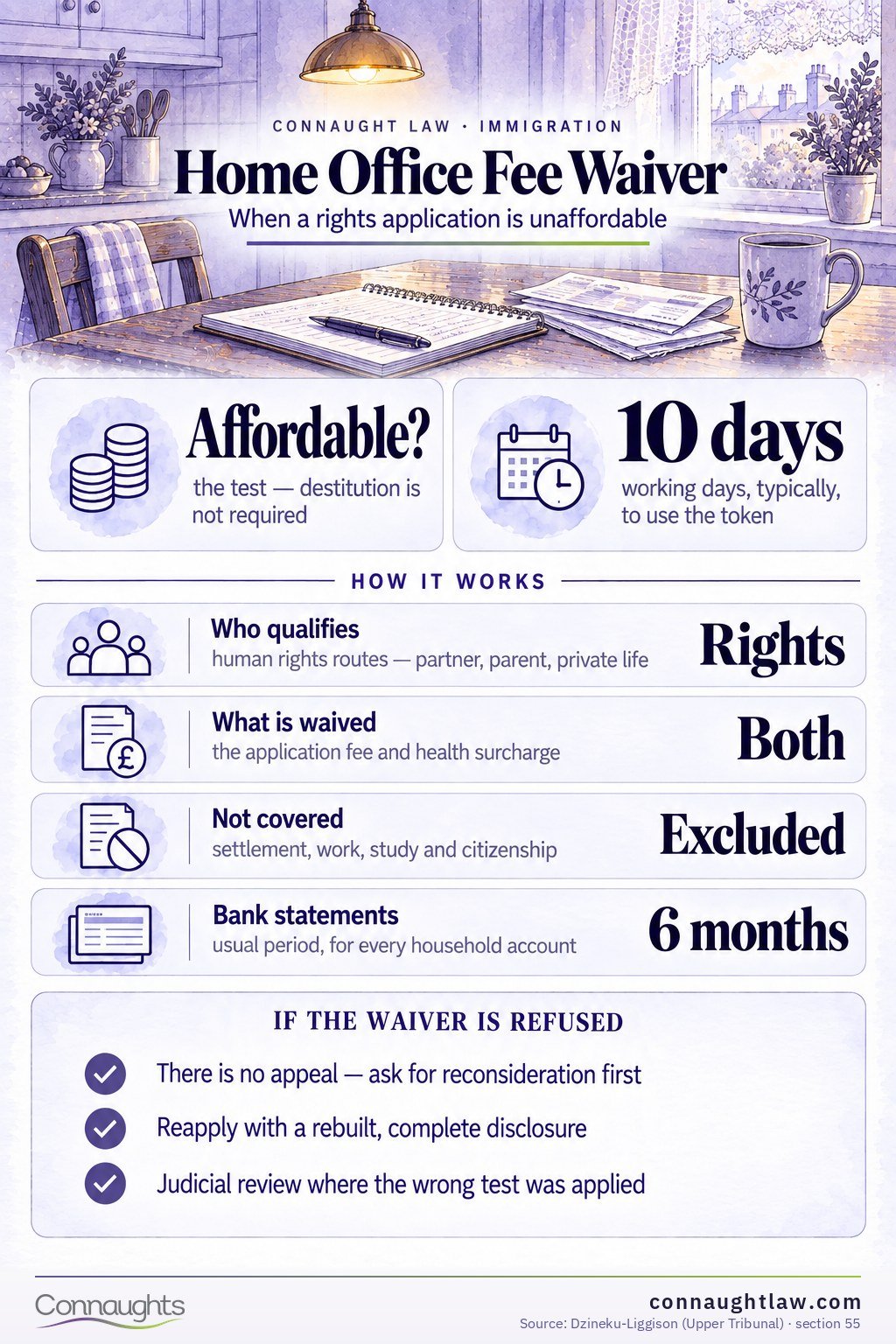
Waivers attach to human rights-based in-country applications — partner and parent routes on the ten-year track, private life applications, and further leave in those categories — covering the application fee and the immigration health surcharge together. Outside the scope sit settlement, work and study routes, and citizenship, which runs its own scheme for children in our child citizenship fees guide.
Exemptions and Special Circumstances
Alongside the waiver sit categorical exemptions — victims of trafficking, certain protection cohorts, looked-after children — and entry clearance concessions for defined Article 8 cases applying from abroad. Anyone in an excluded category with a genuine affordability crisis should still take advice: the categories move, and the concessions are policy rather than rule.
The Affordability Test
Essential Living Costs
The test asks whether the applicant can pay the fee and still meet essential living needs — housing, utilities, food, children's costs, existing debt. It expressly does not require destitution: a working household whose honest budget leaves nothing over qualifies, and the guidance directs caseworkers to assess the household as it actually lives, not as a spreadsheet says it might.
Child Welfare
Where children are in the household, section 55 puts their welfare into the assessment as a primary consideration — money that would come from children's essential needs cannot be treated as available for fees. Waiver applications should present the children's position explicitly rather than leaving it inside the totals.
Application Process
The Evidence File
- Bank statements for every household account, usually six months, gaps explained.
- Income: payslips, benefit award letters, self-employment records, support from family or friends.
- Outgoings: rent or mortgage, utilities, debts, children's costs — evidenced, not asserted.
- A reconciliation schedule doing the arithmetic: income, essential costs, what remains.
- Any third-party support explained — who helps, how much, and why it cannot stretch to fees.
Tokens and Submission Deadlines
A granted waiver issues a code — the token — unlocking fee-free submission of the substantive application within a short window, typically ten working days. The token deadline is the process's sharpest edge: the substantive application must be ready before the waiver decision arrives, because preparing it from scratch inside the window loses cases that the waiver was granted to save.
Common Errors
The recurring failures: accounts omitted from disclosure, unexplained deposits read as hidden income, expenditure claimed without evidence, and inconsistency between the waiver's poverty picture and the substantive application's account of the household. One financial story, fully evidenced, across both applications — that is the whole discipline.
Case Law
The Cases That Shaped the Policy
The Upper Tribunal's decision in Dzineku-Liggison in 2020 replaced the old destitution-only approach with the affordability test the guidance now states, and subsequent litigation extended waiver thinking into the health surcharge and entry clearance concessions. The direction has been one-way: where a fee blocks a rights application, the policy has had to give.
Entry Clearance Concessions
From Destitution to Affordability
The same evolution reached applications from abroad: defined family reunion and Article 8 entry clearance cases can now access fee relief under concessionary arrangements — narrower than the in-country waiver, but real, and worth checking before a family abandons an application for cost. The wider routes for families out of status sit in our regularisation guide.
Processing Times
Timelines in Practice
What to Expect
Fee waiver decisions carry no published service standard — no official statistics on timescales or grant rates are released — and in practice they add weeks to months in front of the substantive application, whose own clock starts only at submission. Build the waiver stage into any deadline planning: for a family facing leave expiry, the waiver application should go in well before the expiry date, with section 3C protection then covering the substantive application filed on the token.
Decision Consistency
Waiver decisions on similar facts vary — the familiar weakness of volume discretionary caseworking — and refusals frequently misapply the affordability test as if destitution were still required. That specific error is worth naming in any challenge, because it is the one the case law most clearly forbids.
After Refusal
Reconsideration
There is no appeal against a waiver refusal; the first route is a reconsideration request confronting the stated reasons — usually evidential gaps — with the missing documents. Reconsideration works where the refusal identified something fixable; it wastes time where the caseworker applied the wrong test.
Fresh Applications
A fresh waiver application with a rebuilt evidence file is often faster than arguing about the old one — circumstances move, and a complete disclosure answering the previous refusal's doubts frequently succeeds where correspondence would not.
Judicial Review
Where the refusal misapplies the test or ignores evidence — and a rights application is stalled behind it — judicial review is the remedy, and pre-action correspondence citing the guidance and the case law resolves many cases without proceedings. Timing pressure from expiring leave strengthens rather than weakens the challenge; our family visa team, human rights team and wider immigration practice run waiver challenges alongside the substantive applications they unlock, with settlement-stage planning through our settlement team.
Frequently askedQuestions about fee waivers
Who qualifies for a Home Office fee waiver?
Applicants on human rights routes — ten-year partner and parent tracks, private life — who cannot pay the fee and health surcharge while meeting essential living needs. The test is affordability, not destitution, and benefits receipt is strong supporting evidence.
Does the waiver cover the health surcharge?
Yes — a granted waiver removes both the application fee and the IHS for that application, which for a family on a 30-month grant is the larger of the two amounts.
How long does a fee waiver decision take?
There is no published standard — expect weeks to months, in front of the substantive application's own processing time. Apply well before any leave expiry and have the main application drafted and waiting for the token.
What is the fee waiver token?
The code a granted waiver issues, unlocking fee-free submission of your substantive application within a short window — typically ten working days. Missing the window forfeits the waiver, so the main application must be ready in advance.
Can I get a fee waiver for ILR or citizenship?
Not through this scheme — settlement and adult citizenship fees carry no waiver. Children's citizenship registration has its own affordability waiver, and bereaved partner settlement carries specific fee relief.
What if my fee waiver is refused?
Request reconsideration with the missing evidence, reapply with a rebuilt disclosure, or — where the affordability test was misapplied — challenge by judicial review. Refusals demanding destitution apply the wrong law and say so on their face.
Send us the household's income and outgoings. We'll build the disclosure to the affordability test, draft the substantive application in parallel, and file both on the token's clock.
Get Expert Advice