
Registering a child as a British citizen got cheaper in April 2026: the MN1 and under-18 Form T fee fell to £1,000, the first cut in the fee's contentious history — and the fee waiver introduced after the PRCBC litigation means a family who cannot afford even that may pay nothing. This guide covers the current fees, the affordability waiver and its evidence, the local authority exemption for children in care, and the case law that forced the changes.
On This Page

A Fee With a Litigation History
No fee in the immigration system has been fought over like the child registration fee — challenged through the courts as pricing children out of an entitlement Parliament gave them, answered first with a waiver and now with an actual cut. The framework sits in the citizenship fees table: registration for children at £1,000 since 8 April 2026, waivable to zero where unaffordable, and free entirely for children looked after by a local authority.
Current Fees
Fee Breakdown
Costs and Waiver Availability
| Application | Fee | Relief available |
|---|---|---|
| Child registration — MN1 (discretion and entitlement routes) | £1,000 | Fee waiver on affordability |
| Child registration — Form T (born in UK, 10 years' residence), applicant under 18 | £1,000 | Fee waiver on affordability |
| Form T where the applicant is 18 or over | £1,540 | Fee waiver on affordability |
| Citizenship ceremony (if 18 by decision) | £130 | — |
| Child looked after by a local authority | £0 | Automatic exception |
| Adult naturalisation (for comparison) | £1,839 incl. ceremony | No waiver |
How the Fee Got Here
The fee climbed for a decade to £1,214 — far above the Home Office's own processing cost, the surplus openly cross-subsidising the wider system — before litigation, parliamentary pressure and the waiver's introduction reversed the direction. The April 2026 cut to £1,000 is the first reduction; the waiver, not the cut, remains the bigger money for the families the fee actually excludes.
£1,000 to register a child (MN1 or Form T), £0 with a granted fee waiver or where the child is in local authority care, and £130 extra only if the child turns 18 before the decision. Adults naturalising pay £1,839 with no waiver — one more reason to register entitled children while they are children.
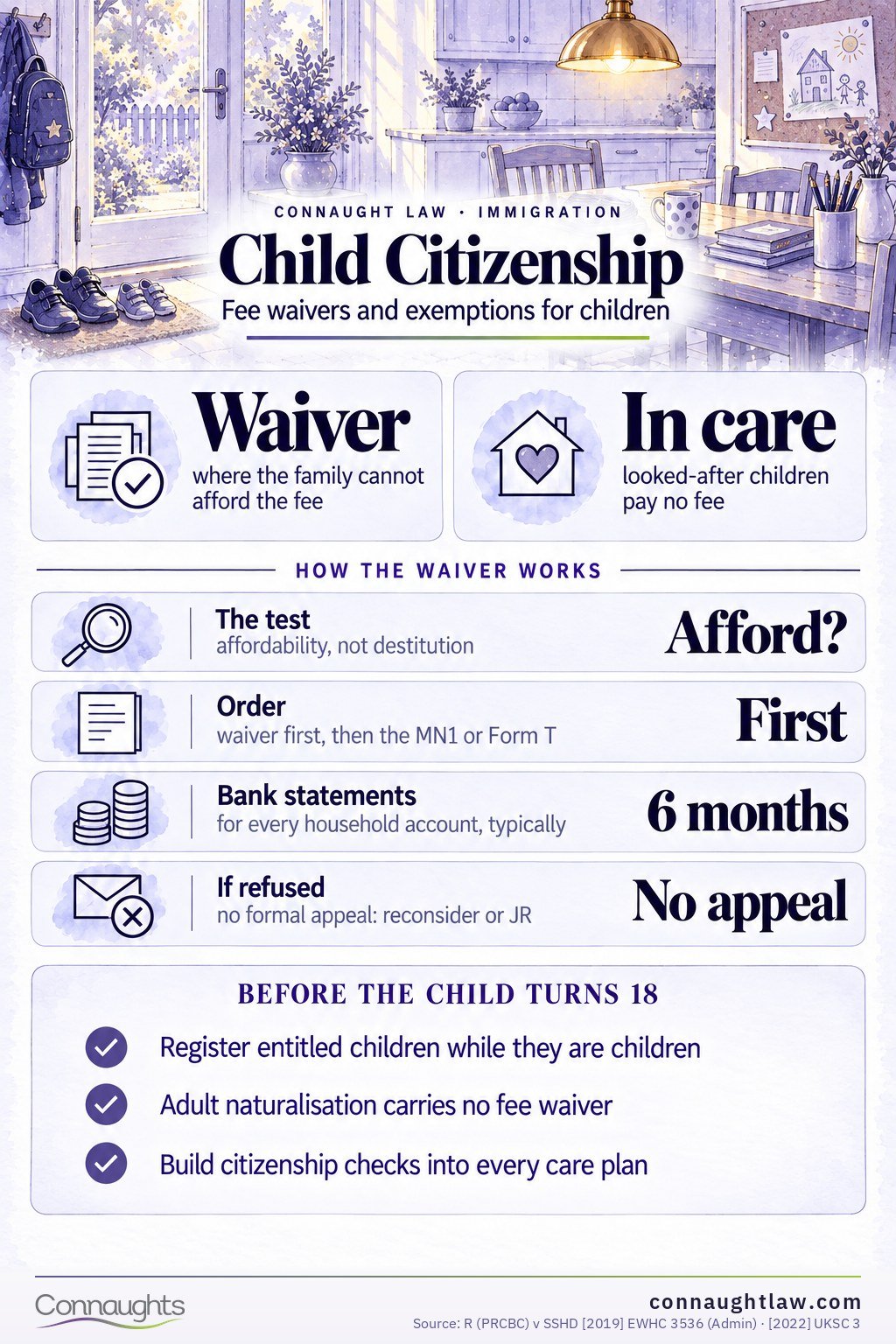
Waiver Eligibility
The Affordability Test
The child citizenship fee waiver, applied for through the gov.uk process under the caseworker guidance, asks one question: can the family afford the fee and still meet the child's and household's essential living needs? It is affordability, not destitution — a working family whose budget genuinely cannot absorb £1,000 qualifies, and receipt of income-related benefits is strong evidence in itself.
Vulnerable Applicants
The guidance directs particular care toward vulnerable children — those affected by disability, family breakdown, or a parent's inability to manage the process — and the child's welfare frames the assessment throughout. Waiver refusals in these cohorts are worth challenging rather than accepting.
Applying for a Waiver
Submission Sequence
The sequence matters: the waiver application goes first, online, with the financial evidence; a grant produces a code that unlocks the fee-free MN1 or Form T submission, filed within the code's validity window. Filing the citizenship application first and requesting a waiver after does not work — the fee falls due with the application.
Outcomes and Challenges
A refused waiver can be reapplied for with better evidence or challenged where the guidance was misapplied — there is no formal appeal, so the routes are reconsideration and judicial review. The same affordability logic runs through the wider immigration fee waiver system, and evidence built for one application serves the other.
The PRCBC Case
What the Litigation Decided
In R (PRCBC) v SSHD [2019] EWHC 3536 (Admin) the High Court found the Home Office had set the child registration fee without regard to children's best interests — the finding that ultimately produced the waiver. The Supreme Court in PRCBC [2022] UKSC 3 upheld Parliament's power to set fees above cost, closing the direct attack on the fee's level while leaving the best-interests duty standing.
The Fee-Setting Settlement
The litigation's net result defines today's landscape: the fee is lawful, the process must weigh children's interests, and the waiver is the mechanism that reconciles the two. For families the practical lesson is to use it — the waiver exists because the courts said cost must not extinguish a child's statutory entitlement.
Financial Evidence
Income Documentation
Waiver applications stand on full disclosure: bank statements for every household account (typically six months), payslips or self-employment records, benefit award letters, and an honest account of who supports the household. Gaps and unexplained deposits sink waiver applications exactly as they sink visa applications.
Expenditure Analysis
The other half is outgoings: rent, utilities, food, debt obligations, children's costs — evidenced, and reconciled against the income so the disposable-income arithmetic makes the case itself. A short covering schedule doing the caseworker's sums is the cheapest advocacy a waiver application can carry.
Children in Care
Qualifying Care Arrangements
Children looked after by a local authority pay no registration fee at all — an exception, not a waiver, requiring only evidence of the care arrangement. Social workers and personal advisers should build citizenship checks into care planning for every eligible child; the entitlement is too often discovered at 18, when the cheaper and stronger child routes have closed and the options narrow to those in our ten-year child citizenship guide.
Kinship and Informal Care
Children in kinship or informal arrangements outside formal local authority care do not take the exception — they route through the affordability waiver, with the carer's finances assessed. Where the child's underlying status also needs resolving, our child settlement guide and settlement and citizenship team sequence the applications.
Frequently askedQuestions about child citizenship fees
How much is the MN1 application fee in 2026?
£1,000 since 8 April 2026 — cut from £1,214 — with a £130 ceremony fee added only if the child turns 18 before the decision. Form T registrations for UK-born children with ten years’ residence carry the same £1,000 fee while the applicant is under 18; at 18 or over the adult registration fee of £1,540 applies.
Can the child citizenship fee be waived?
Yes — where paying it would leave the family unable to meet essential living needs. Apply for the waiver first; a grant unlocks fee-free submission of the MN1 or Form T. Children looked after by a local authority pay nothing automatically.
What evidence does the fee waiver need?
Full household financial disclosure: six months of bank statements, income evidence, benefit letters and essential outgoings, reconciled so the affordability arithmetic is visible. Benefits receipt is strong evidence but not a precondition.
What did the PRCBC case change?
The High Court found the fee was set without regard to children's best interests, which produced the waiver; the Supreme Court later confirmed Parliament may set fees above cost. Together they created today's fee-plus-waiver settlement.
Is there a waiver for adult naturalisation?
No — the £1,839 adult fee carries no waiver, which makes registering entitled children before 18 the family's cheaper and safer sequence. Adults' full fee picture is in our Home Office fees guide.
My child is in foster care — who pays for citizenship?
No one — children looked after by a local authority are exempt from the registration fee entirely. The care arrangement is evidenced with the application, and citizenship checks belong in every eligible child's care plan.
Send us the household's income picture and the child's history. We'll run the waiver first, the registration second, and neither at a fee the family cannot bear.
Get Expert Advice