
Children reach UK settlement by several doors — joining settled parents under paragraph 297, SET(F) applications from inside the UK, the seven-year private life rule, and the EU Settlement Scheme — and choosing the right one decides both the evidence and the timeline. The tests that matter are parental: sole responsibility, and the child's best interests. This guide maps each route, the stepchild rules, and how child and parent applications interact.
On This Page

Four Doors to a Child's Settled Status
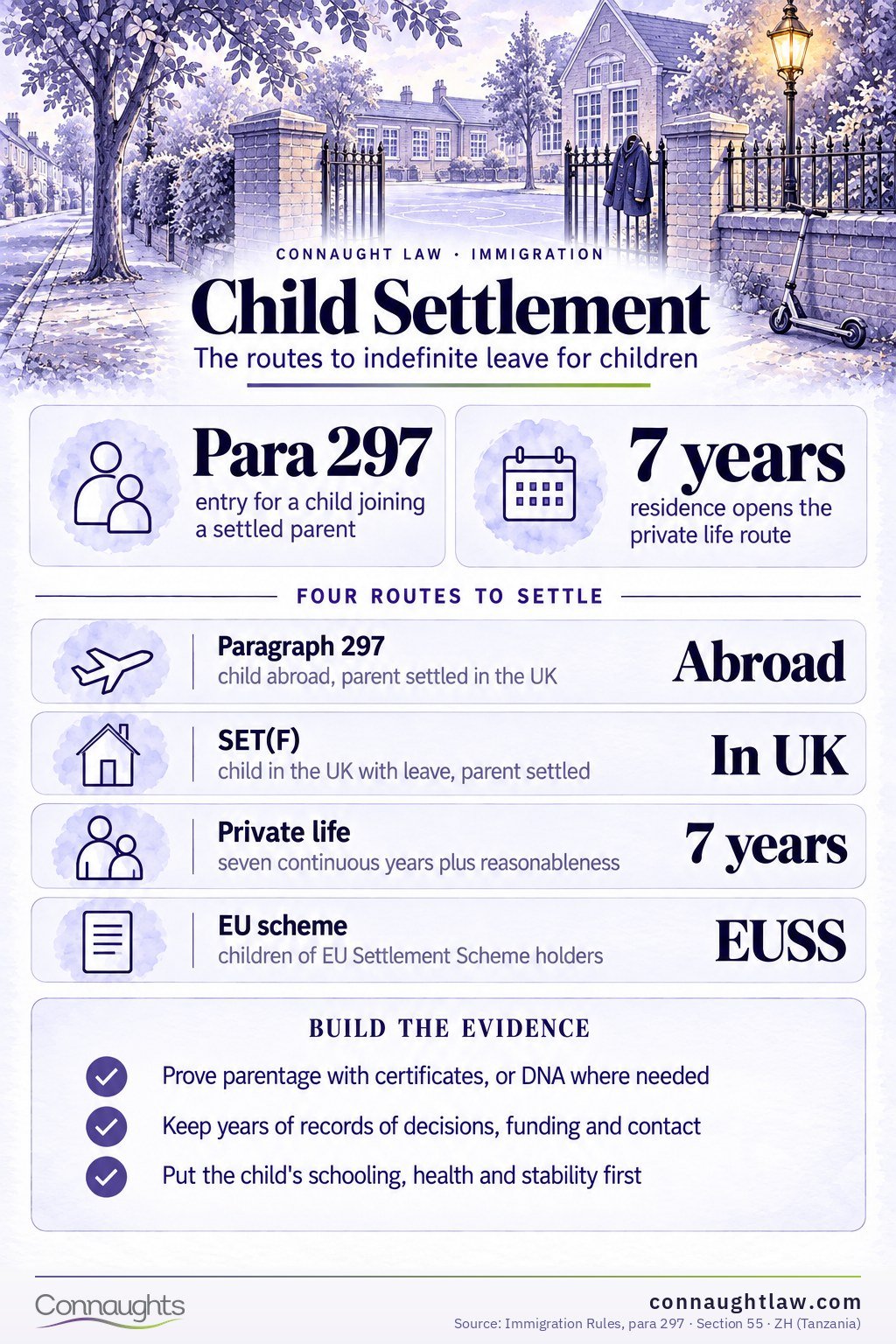
More than one route leads a child to indefinite leave, and the right one is dictated by where the child lives, each parent's status and who directs the upbringing. Paragraph 297 governs entry clearance from abroad, SET(F) the in-country equivalent, with the private life rule and the EU Settlement Scheme serving children who qualify on their own residence or a parent's status. Sole responsibility and the child's best interests decide most contested cases.
Rules Framework
Paragraph 297 and Sole Responsibility
Paragraph 297 of the Immigration Rules admits a child for settlement where both parents are settled or being admitted for settlement — or where one settled parent has had sole responsibility for the child's upbringing, or serious and compelling circumstances make exclusion undesirable. Sole responsibility is the litigated heart: not sole custody, but the continuing direction of the child's life — schooling, health, religion, discipline — evidenced across years of decisions, remittances and involvement despite the distance.
Stepchildren
Stepchildren qualify through the rules' definition of parent, which embraces step-parents where the birth parent is dead, and adoptive relationships through recognised adoptions. Living arrangements and the other birth parent's position need honest treatment — a surviving birth parent abroad pushes the case into sole responsibility or serious circumstances territory, with the evidence burden that carries.
Children of Settled Parents
SET(F) Applications
Children already in the UK with limited leave apply for settlement through SET(F) at £3,226 when a parent is settled — the in-country mirror of paragraph 297, testing the same parentage, responsibility and accommodation requirements per the gov.uk child settlement guidance. Children born in the UK to parents who later settle sit alongside a further option entirely: registration as British citizens, often the better prize for the same evidence.
EU Settlement Scheme Children
Children of EUSS status holders take the scheme's own free route: settled status immediately where the parent holds it, pre-settled otherwise, with the family link the operative evidence. Mixed families — one parent on EUSS, one on the points-based system — should map which scheme serves each child before any application is filed.
Best Interests
The Section 55 Standard
Section 55 makes the child's welfare a primary consideration in every immigration decision, and the case law — ZH (Tanzania) and its successors — requires decision-makers to engage with it substantively. For applications this is architecture, not decoration: the child's schooling, health, relationships and stability belong at the file's centre, framed as the decision's primary question rather than background.
Choosing the Route
Child Applications Against Parent Routes
Which Route Applies
- Parent settled, child abroad: paragraph 297 entry clearance, on sole responsibility or both-parents evidence.
- Child in the UK with leave, parent settled: SET(F) settlement at £3,226.
- Child with 7 years' UK residence: the private life route — direct ILR for UK-born children — in our 7-year rule guide.
- Parent on EUSS: the scheme's free child provisions.
- Child born in the UK, parent later settled: often citizenship registration rather than ILR at all.
Evidence Compilation
Whatever the door, the evidence triangle is constant: parentage (certificates, DNA where documents fail), responsibility (decisions, funding, contact records across years), and welfare (schooling, health, the life awaiting the child). Families assembling sole responsibility cases should start the file long before the application — the test rewards longitudinal records and punishes reconstruction.
Policy Direction
Framework Evolution
Children's settlement has moved consistently toward faster security — the private life reforms' five-year child tracks and direct ILR for UK-born children being the clearest examples — even as adult settlement tightens under the earned settlement agenda. Families planning around the published statistics and policy noise should anchor on current law and file when eligible; the broader family settlement architecture sits in our family settlement guide, with schooling-driven arrivals covered by the parent route for child students, complex protection cases by our human rights team, and the applications themselves by our family visa team.
Frequently askedQuestions about child settlement
What is sole responsibility in child settlement cases?
Continuing direction of the child's upbringing — schooling, health, major decisions — by the UK parent, evidenced over years. It is not custody paperwork: caseworkers look for the lived record of who actually parents the child.
How much does a child ILR application cost?
SET(F) settlement costs £3,226. EUSS children apply free, and UK-born children of settled parents may register as British citizens instead — a different fee and a better outcome where it applies.
Can my stepchild get ILR?
Yes, where the rules' parent definition is met — most cleanly where the other birth parent is deceased, or through adoption. Otherwise the case runs on sole responsibility or serious circumstances, with the evidence those tests demand.
Does my child qualify after 7 years in the UK?
Seven continuous years plus the reasonableness test opens the private life route — and UK-born children can apply directly for ILR. It runs on the child's own residence, independent of the parents' status.
Are best interests really considered, or just recited?
The law requires substantive engagement — section 55 and the case law make welfare a primary consideration. Applications that document the child's actual life give that duty something to bite on; thin files let it be recited and passed over.
Should my UK-born child apply for ILR or citizenship?
Where a parent has settled, registration as British is usually the stronger application — permanent, unlosable by absence, and carrying a passport. ILR suits children who do not yet qualify to register. Take advice before paying either fee.
Tell us where the child is, each parent's status and who makes the decisions. We'll pick the strongest door — settlement, private life or citizenship — and build the file to its test.
Get Expert Advice