
Mental health conditions intersect settlement applications at two points: exemptions from the English language and Life in the UK requirements for those whose conditions prevent them, and the medical evidence standards that make or break those exemption requests. The rules are humane on paper and demanding in practice — the report's author, content and currency decide most cases. This guide covers the framework, the exemption categories, the evidence standards, and realistic strategy.
On This Page

Where Health Meets the Settlement Rules
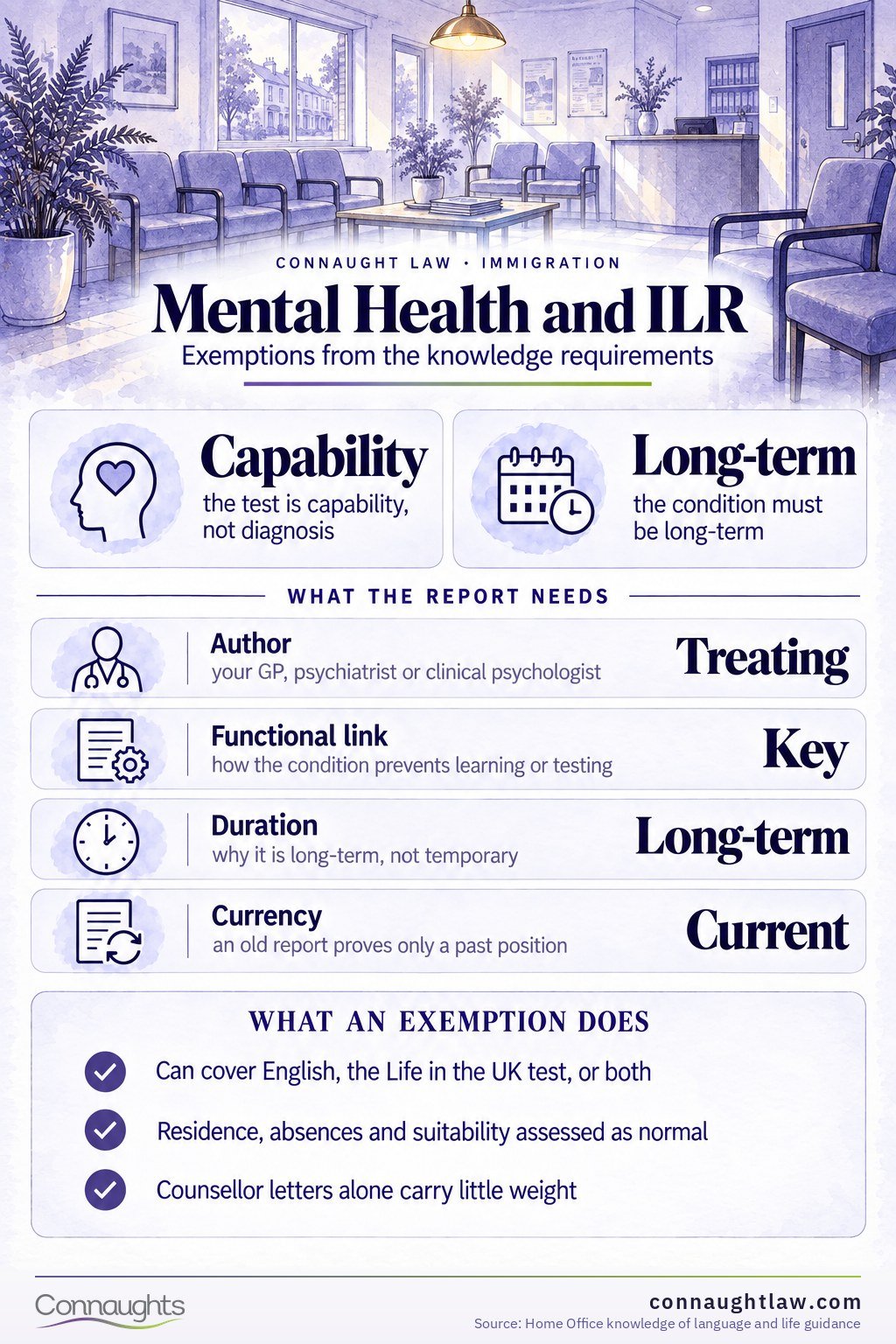
A long-term physical or mental health condition can exempt a settlement applicant from the English language and Life in the UK requirements, from both or from whichever it actually prevents. Capability is the test, not diagnosis. That puts the medical evidence at the centre: who writes the report, whether it explains the functional link, and how current it is. Everything else — residence, absences, suitability — is assessed as normal.
Legal Framework
How the Framework Developed
The knowledge requirements — English at B1 and the Life in the UK test — carry a statutory exemption for applicants with long-term physical or mental conditions that prevent them meeting the requirement, applied through the knowledge of language and life guidance. The framework has evolved through litigation and guidance revision toward a clearer principle: the question is capability, not diagnosis — what the condition actually prevents, evidenced by someone qualified to say so.
The Case Law's Contribution
Background and History
Judicial review challenges — the Gayle litigation prominent among them — pushed decision-making from box-ticking toward substantive assessment: caseworkers must engage with the medical evidence presented rather than demanding a particular form of words, and refusals that ignore a qualified opinion without reasons are vulnerable.
Implications for Current Applications
The practical inheritance is a fairness baseline: an exemption request supported by a proper clinical opinion cannot be dismissed with a template sentence. That protects applicants with genuine evidence — and does nothing for requests supported by brief GP letters that assert without explaining.
Exemptions
Exemption Categories
How Conditions Are Assessed
Long-term conditions supporting exemption span serious mental illness, cognitive impairment, learning disability, and physical conditions preventing study or test attendance — assessed individually, not from a qualifying list. The exemption covers what the condition prevents: some applicants are exempted from both requirements, others from the test but not spoken English, per the wider framework in our exemptions guide and the test detail in our Life in the UK guide.
Implementation Inconsistencies
Outcomes on similar evidence genuinely vary between caseworkers — the known weakness of a discretion exercised at volume. Applications should therefore be built for the strictest plausible reader, and inconsistency itself becomes a review ground where a refusal departs from the guidance without explanation.
Evidence Standards
Who Can Write the Report
The opinion must come from a medical practitioner qualified to give it — for mental health conditions, ordinarily a GP with full knowledge of the history or a psychiatrist or clinical psychologist involved in care. Letters from counsellors alone, or from clinicians instructed the week before filing with no treating relationship, carry predictably little weight.
What the Report Must Contain
- The diagnosis, its duration and its treatment history.
- The functional link: precisely how the condition prevents learning English or sitting the test.
- Why the position is long-term rather than temporary.
- The clinician's role, qualifications and length of involvement.
- Currency — a report from years ago proves a past position, not the present one.
Decision-Making
Common Errors
The refusal patterns worth challenging: demanding a specific form no rule requires, treating treatability as disproof of the exemption, dismissing a psychiatric opinion on a caseworker's own lay assessment, and ignoring the functional evidence entirely. Each is a reasons-based error the review routes exist for.
Impact on Vulnerable Applicants
The stakes concentrate on the most vulnerable — long-resident applicants whose settlement is otherwise unarguable, blocked at the knowledge requirements their conditions make impossible. For them the exemption is the application, which is why the medical evidence deserves the same investment other applicants give financial documents.
Practical Strategy
Preparing the Application
Start with the treating clinicians months ahead: brief them on the legal test (capability, long-term, functional), obtain the report against the checklist, and file it with the supporting treatment records rather than alone. Where capability is partial, consider attempts honestly — a documented failed attempt at the test sometimes evidences the exemption better than any letter.
Managing Expectations
Not every condition supports exemption, and refusal of the exemption is not refusal of the person — settlement simply waits until the requirement is met or the evidence matures. The honest pre-application assessment, and the choice between exemption request, deferral and supported test preparation, is exactly what our settlement team and wider immigration practice advise on — with the settlement guidance as the caseworker's script to prepare against.
This guide covers mental health as settlement evidence. If you are struggling yourself, help exists beyond the application: your GP, NHS 111, or Samaritans on 116 123 are places to start.
Questions about mental health and ILR
Can I be exempt from the Life in the UK test on mental health grounds?
Yes — a long-term physical or mental condition that prevents you meeting the requirement supports exemption, evidenced by a qualified clinician explaining the functional link, not just the diagnosis.
Who must write the medical report?
A practitioner qualified for the condition and familiar with your care — typically your GP, psychiatrist or clinical psychologist. Reports from clinicians with no treating relationship, obtained days before filing, carry little weight.
Does depression or anxiety qualify for exemption?
It can, where severe, long-term and functionally preventing study or testing — assessed individually. Mild or well-managed conditions rarely meet the threshold, and the report must explain prevention, not just symptoms.
What if my exemption request is refused?
Review routes catch reasons-based errors — evidence ignored, wrong tests applied. Otherwise the options are stronger evidence, a documented attempt at the requirement, or deferring settlement while the clinical picture is better established.
Does an exemption affect the rest of my ILR application?
No — it removes the knowledge requirements only. Residence, absences and suitability are assessed as normal, and the exemption carries forward to a later citizenship application's equivalent requirements where granted on the same basis.
Is a psychiatric report worth the cost?
Where the exemption decides the application, yes — a thorough report from the treating service answers the legal test in one document. Spend on the clinician who knows the history rather than the letterhead.
Tell us the condition, the treatment history and who provides your care. We'll brief the clinician on the legal test and build the exemption evidence properly — once.
Get Expert Advice