
Not everyone has to sit an English test for settlement or citizenship. Nationals of majority English-speaking countries, holders of degrees taught in English, applicants aged 65 or over, people with long-term medical conditions and several whole settlement routes are exempt — each on different evidence. This guide maps every exemption from the B1 English requirement and the Life in the UK test, the differences between the ILR and citizenship stages, and how to claim one properly.
On This Page
Who Never Has to Sit the Test
The English language requirement for settlement and citizenship sits at B1, proved by an approved secure English language test — unless an exemption applies. Exemptions come in four families: who you are (nationality), what you hold (a degree taught in English), your age or health, and which route you are settling on. Claiming the right one, with the right evidence, saves a test fee and — claimed wrongly — costs an application.
ILR Exemptions
Qualification-Based Exemptions
Degrees Taught in English
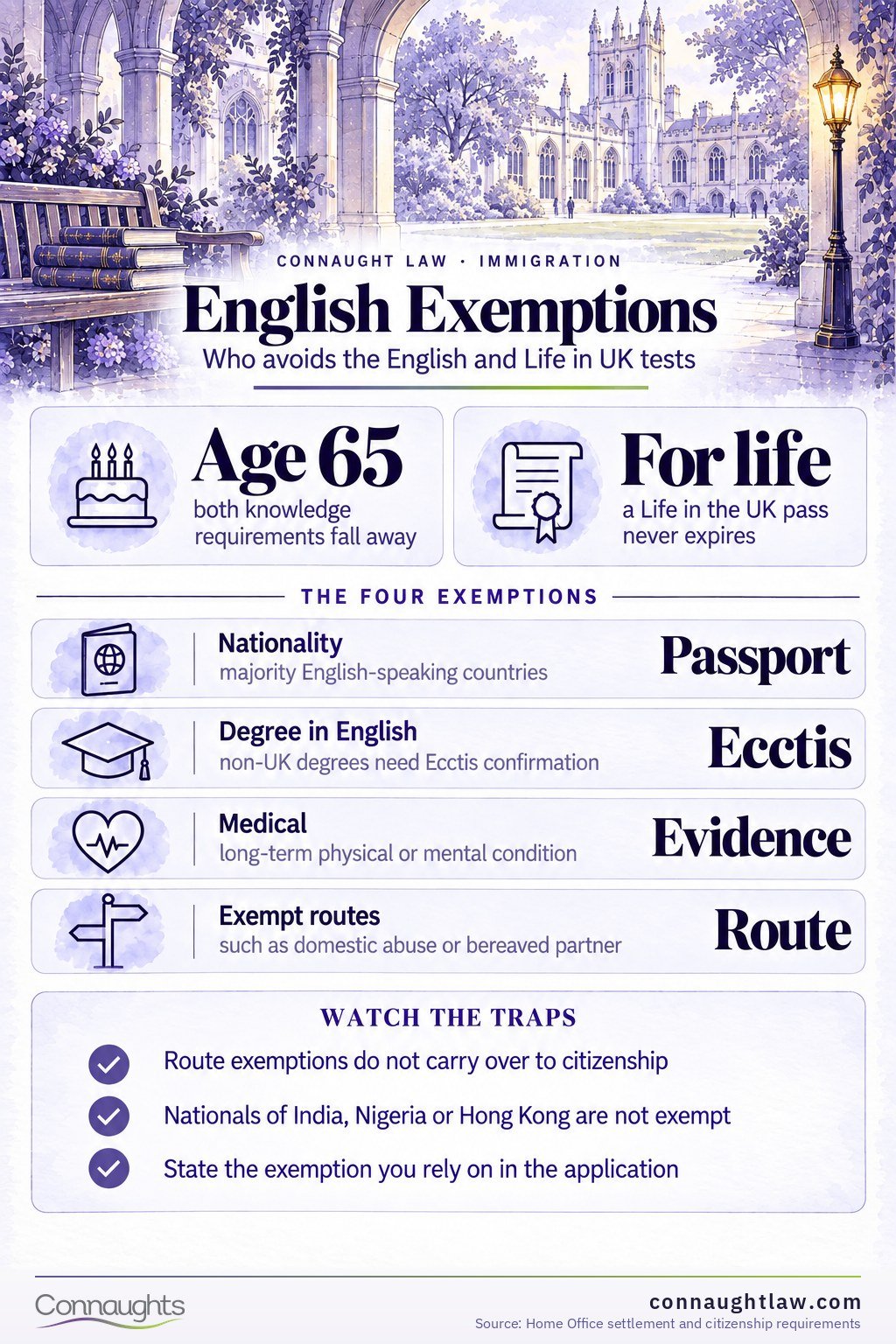
A degree taught or researched in English meets the requirement without a test: a UK degree proves itself with the certificate, while a degree from elsewhere needs Ecctis confirmation that the qualification meets UK degree standard and was taught in English. Order the Ecctis statements before applying — they are the piece applicants most often discover missing at the deadline, a pattern familiar to the American graduates in our US-to-UK guide.
Routes with No Requirement
Some ILR routes carry no knowledge requirements at all: settlement as a victim of domestic abuse, as a bereaved partner, as an adult dependent relative, on the protection route, and applications by children. The exemption belongs to the route, not the person — someone refused on an exempt route who reapplies on a standard one meets the full requirement, a trap worth mapping with our settlement and citizenship team before switching.
Life in the UK Exemptions
Age and the Test
The Life in the UK test follows its own exemption logic: under-18s and over-65s never sit it, and a pass, once achieved, lasts for life — it carries from ILR to citizenship without retaking. The English requirement and the test are separate hurdles with separate exemptions; qualifying out of one does not qualify you out of the other.
Medical Exemptions
What the Evidence Must Show
A long-term physical or mental condition exempts an applicant from the English requirement, the Life in the UK test, or both — but the exemption is only as strong as its evidence: a medical professional's confirmation of the condition, its long-term nature, and specifically why it prevents test preparation or sitting. Generic letters fail; the standard the Home Office actually applies is dissected in our medical evidence guide.
Age Exemptions
Approaching 65
At 65 both knowledge requirements fall away entirely, for ILR and citizenship alike. Below 65 there is no general age concession — an applicant of 65 on the date of application is exempt, and timing an application around the birthday is legitimate planning rather than evasion. What does not work is assuming a decade of residence or a long working life in English substitutes for the test: without an exemption, the requirement stands.
Citizenship Against ILR
The stages differ in ways that catch people. English proved at B1 for ILR does not need proving again at naturalisation, and a Life in the UK pass carries over — but a route exemption does not: someone who settled on the domestic abuse or adult dependent relative route sat no test at ILR, yet faces both requirements at citizenship unless a personal exemption (age, medical, nationality, degree) applies. Plan the citizenship application at the ILR stage, not after it.
Nationality Exemptions
The Exempt Country List
- Antigua and Barbuda, the Bahamas, Barbados, Belize, Dominica, Grenada, Guyana, Jamaica, St Kitts and Nevis, St Lucia, St Vincent and the Grenadines, Trinidad and Tobago.
- Australia, Canada, New Zealand and the United States.
- Malta.
Citizens of these countries meet the English requirement by nationality alone — passport in, test out. The list is about nationality, not language: fluent English speakers from Hong Kong, India, Nigeria, Singapore or South Africa are not on it and must prove English by test or degree, which is why BNO route applicants, whatever their English, still plan for B1.
Claiming an Exemption
Documentation Checklist
An exemption is claimed inside the application, evidenced like any other requirement: the passport for nationality, degree certificate with Ecctis statements for qualifications, the medical form or letter for health, and the route itself where the rules exempt it. State the exemption relied on explicitly — applications that leave the caseworker to infer one invite a refusal that reconsideration then has to unpick.
Frequently askedQuestions about test exemptions
Who is exempt from the English test for ILR?
Nationals of majority English-speaking countries, holders of degrees taught in English, applicants aged 65 or over, people with qualifying long-term medical conditions, and applicants on routes with no knowledge requirement — domestic abuse, bereaved partner, adult dependent relative, protection and children.
Is there an ILR English test exemption for age?
Yes — at 65, both the English requirement and the Life in the UK test fall away, for settlement and citizenship. There is no general concession below 65; applying after the 65th birthday is the clean way to use the exemption.
Do BNO visa holders need the English test?
At settlement, yes — Hong Kong is not on the exempt nationality list, so BNO applicants prove B1 by test or an English-taught degree unless an age or medical exemption applies. The Life in the UK test applies equally.
Can a medical condition exempt me from both tests?
Yes — a long-term physical or mental condition can exempt you from the English requirement, the Life in the UK test, or both, if a medical professional confirms the condition and explains specifically why it prevents the test. The specificity is what decides these claims.
Does my B1 test expire before citizenship?
No — English proved at B1 or above for ILR carries to naturalisation without retesting, and a Life in the UK pass never expires. Route-based exemptions are the exception: they do not carry, so check what citizenship will require before relying on one.
Does a degree from my home country count?
It can — if Ecctis confirms it meets UK degree standard and was taught or researched in English. Both confirmations are needed, they take time to obtain, and applications filed without them are refused on paper, not on merit.
Send us your nationality, qualifications, age and route. We'll identify the exemption the rules actually give you — and the evidence that makes the caseworker accept it.
Get Expert Advice