
A record 8,790 US nationals applied for British citizenship in 2025 — up 42% on 2024, with the final quarter alone setting a quarterly record. Behind that headline sits a practical question the statistics cannot answer: how does an American actually move to the UK, and what does the road from visa to passport involve? This guide gives the sourced numbers, the routes that genuinely work, and the tax realities that follow the move.
On This Page

Why Americans Are Looking at Britain
Every US election cycle produces a spike of interest in moving abroad; what distinguishes the current wave is that it shows up in hard Home Office data rather than search trends alone. Citizenship applications from US nationals are at their highest recorded level, and the queries behind them — which visa, how long, what tax — all have concrete answers. The move is entirely achievable; it is also slower, more route-dependent and more tax-entangled than most first-time enquirers expect.
What the Numbers Actually Show
US nationals made 8,790 applications for British citizenship in 2025 — a record, and 42% up on 2024 — with 2,490 in the final quarter of the year, itself a quarterly record. The figures come from the Home Office's Immigration system statistics, year ending December 2025, published 26 February 2026.
The wider context makes the American figure more striking, not less: total grants of British citizenship across all nationalities fell 13% in the same period, to 235,782. Applications from US nationals rose against a falling tide — evidence of a genuine cohort decision rather than a system-wide swell carrying Americans along with it.
Who Is Moving
The honest answer is that the Home Office does not publish a demographic profile of American applicants, and neither will we invent one. What the casework shows is breadth: dual-career couples with a British partner, technology and finance professionals with London offers, academics, and families relocating around education. For the population already here, the official count lives in the ONS Census 2021 country-of-birth data — the citizenship series above is the better measure of the current wave.
Routes an American Can Actually Use
Spouse and Partner Visas
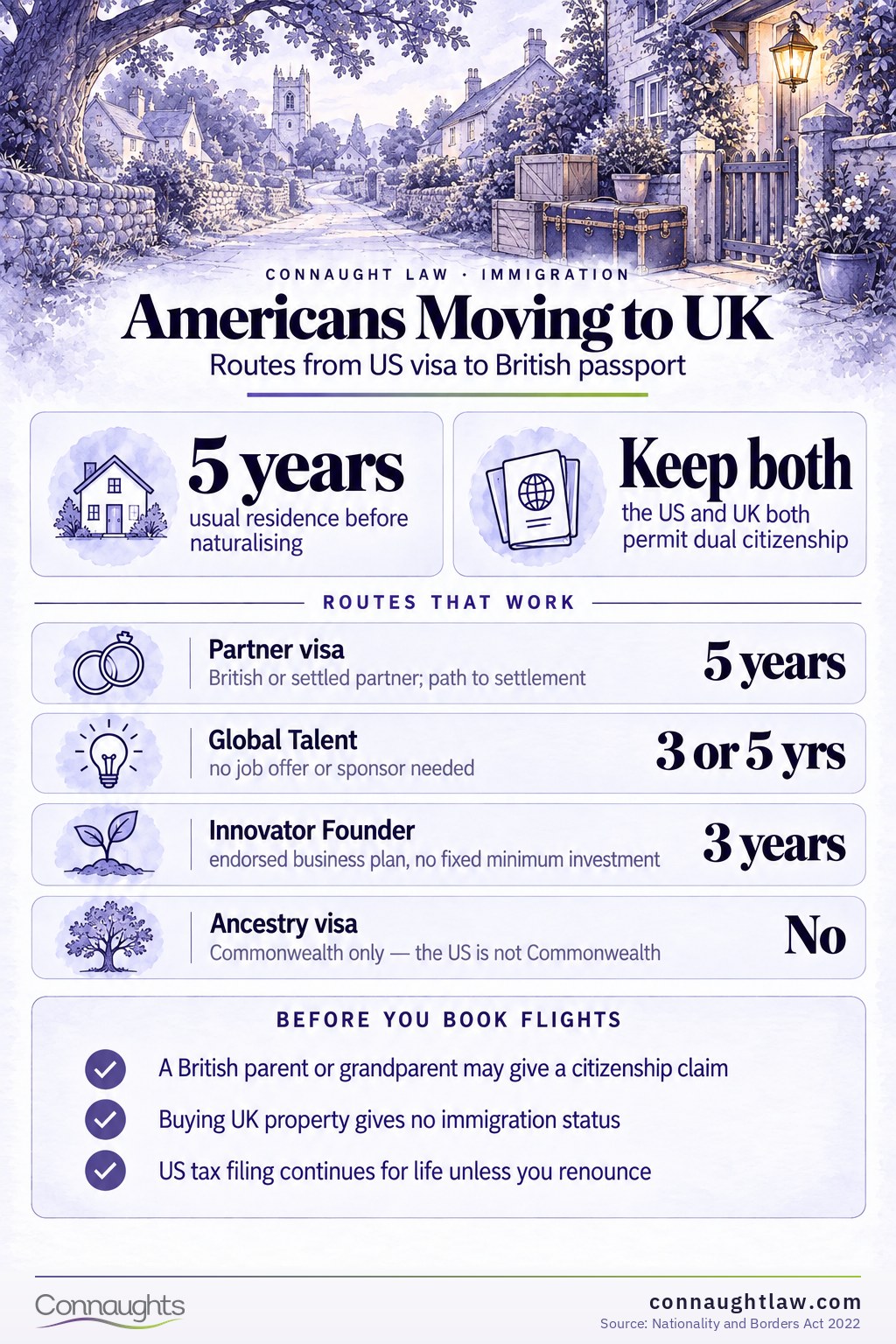
The most travelled route by far. A British or settled partner, a genuine relationship, and the £29,000 minimum income requirement open a five-year path to settlement and then citizenship — with the costs mapped in our spouse visa fees guide. Americans married to British citizens are the single largest group in our transatlantic casework, and the route's evidential demands reward preparation over improvisation.
The Ancestry Visa Trap
A correction worth making plainly: the UK Ancestry visa is for Commonwealth citizens with a UK-born grandparent — and the United States is not a Commonwealth country. An American qualifies only through a second citizenship of a Commonwealth state, Canada being the common example. A British grandparent alone gives a US citizen no ancestry route; what it may give is a claim to British citizenship by descent, which is a nationality question worth checking before any visa is considered.
Global Talent for Americans
For leaders and potential leaders in science, digital technology and the arts, the Global Talent route needs no job offer and no sponsor — an endorsement or qualifying prize carries the application, and the route leads to settlement in three or five years depending on the category. American academics and senior engineers are frequently better served here than by employer sponsorship, and often do not know it.
Business and Investment Routes
Founders can use the Innovator Founder route — endorsed business plan, no fixed minimum investment, settlement possible at three years. There is currently no open investor visa: the Tier 1 (Investor) route closed in 2022, and the trailed replacement remains a proposal, tracked in our investor route status guide. Buying UK property, at any price, confers no immigration status at all.
Nationality Law Since 2022
The Nationality and Borders Act 2022 widened registration — the citizenship route for people with existing claims through birth, descent or historical unfairness — including a discretionary adult registration power for cases the old rules missed. For Americans with a British parent or grandparent, this is why the file review comes first: some discover they need registration rather than naturalisation, and some that they are already British.
Registration vs Naturalisation
Naturalisation is the standard earned route: five years' residence (three with a British spouse), twelve months holding settlement unless married to a British citizen, B1 English, the Life in the UK test, and the £1,709 fee plus £130 ceremony cost. Registration recognises an existing claim and follows different, often simpler requirements. Which applies is a question of nationality law, not preference — and getting it wrong wastes a four-figure fee.
Tax for Americans in the UK
The United States taxes its citizens wherever they live, so an American in Britain files in both systems for life unless they renounce. The UK side changed in April 2025: the remittance basis gave way to the four-year foreign income and gains regime for new arrivals. The treaty prevents most double taxation but none of the double filing — FATCA and FBAR obligations follow the passport, and UK pension and investment wrappers do not always translate cleanly into US tax treatment.
Estates and Inheritance Tax
Long-term UK residence brings worldwide assets within UK inheritance tax under the residence-based rules that replaced domicile in April 2025, while US estate tax follows citizenship. The two systems' exemptions differ by an order of magnitude, which makes the estate plan a transatlantic document: wills, trusts and lifetime gifts that work in one system can misfire expensively in the other. Take coordinated advice before settling permanently, not after.
Property and Where People Land
American buyers are a visible presence in London and the university cities, and our foreign investor guide covers the purchase mechanics. The immigration point bears repeating because it catches people every year: property ownership plays no part in any visa or settlement application. Buy because the family will live there — and let the immigration status stand on its own route. A visitor visa covers the house-hunting trips, but permits neither work nor residence.
The Hurdles Between Visa and Passport
- Continuous residence: absence limits apply throughout the qualifying period, and heavy transatlantic travel is the classic way Americans break them.
- Settlement first: citizenship needs indefinite leave to remain, with its £3,226 per-person fee — our ILR analysis covers the long-residence alternative.
- Tests: B1 English (a formality for Americans, but still a required certificate) and the Life in the UK test.
- The cost stack: visa fees, the health surcharge and settlement fees accumulate per person across the family — budget the whole road, not the first application.
None of these is a reason not to move; all of them are reasons to plan the route before booking the flights. Our settlement and citizenship team maps the full journey — visa, settlement, naturalisation — as one piece of work.
Frequently askedQuestions about Americans moving to the UK
How big is the surge in UK citizenship applications from Americans?
Home Office data for the year ending December 2025 records 8,790 British citizenship applications from US nationals — a record high, up 42% on 2024 — with 2,490 in the final quarter alone. Total citizenship grants across all nationalities fell 13% in the same period.
Can I move to the UK without a job offer?
Yes, through the right route: Global Talent for endorsed leaders in science, technology and the arts, Innovator Founder for endorsed business founders, or a partner visa if your spouse is British or settled. There is currently no investor visa, and buying property gives no immigration status.
How long does it take an American to become a British citizen?
Typically six years: five years to settlement on most work routes (three on Global Talent's accelerated path), then twelve months holding settlement before naturalising — waived for spouses of British citizens. Time on visitor visas never counts.
Can I keep my US citizenship?
Yes. Both countries permit dual citizenship, and most Americans naturalising in Britain keep their US passport. The lasting consequence is fiscal, not legal: US tax filing obligations continue for life unless citizenship is formally renounced.
How many Americans live in the UK?
The official count is the ONS census country-of-birth data, and the citizenship series shows the direction: record application numbers from US nationals in 2025. No reliable single "Americans in the UK" total exists beyond those official datasets, and figures quoted without them deserve scepticism.
Does a British grandparent help me?
Not through the Ancestry visa unless you also hold Commonwealth citizenship — the route excludes US-only citizens. But a British parent or grandparent can ground a claim to British citizenship by descent or registration, so have the family history checked before applying for any visa.
Tell us your situation — partner, profession, business or family history — and we'll tell you which route fits, what it costs end to end, and how long the road to a British passport actually runs.
Get Expert Advice