
The Innovator Founder visa is decided twice: first by an endorsing body that tests whether your business idea is new, innovative, viable and scalable, and only then by the Home Office. The application fee is £1,357 from outside the UK, endorsement costs £1,000, and the route can lead to settlement after just three years — if the business hits two of seven defined achievements. This guide covers the requirements, the business plan and the money, at the rates in force from 8 April 2026.
On This Page

Endorsement First, Everything Else Second
Since April 2023 this has been the UK's main route for entrepreneurs building a business here, replacing both the Innovator and Start-up visas. Its defining feature is sequencing: the Home Office will not look at your application until an approved endorsing body has assessed the business idea and said yes. Applicants who treat the visa forms as the hard part have the project backwards — the endorsement is the contest, and the business plan is the weapon.
The Requirements and the Points
Essential Eligibility Criteria
- Endorsement of a new, innovative, viable and scalable business by an approved body — 50 points, and the whole route in practice.
- English at CEFR B2 — a higher bar than the work routes' B1 — via an approved test or exemption: 10 points.
- £1,270 in personal funds held for 28 consecutive days before applying: 10 points.
- Applicants must be 18 or over and clear the ordinary suitability rules; there is no qualification or minimum-investment requirement in the rules themselves.
The Business Plan — Where the Route Is Won
What the Plan Must Prove
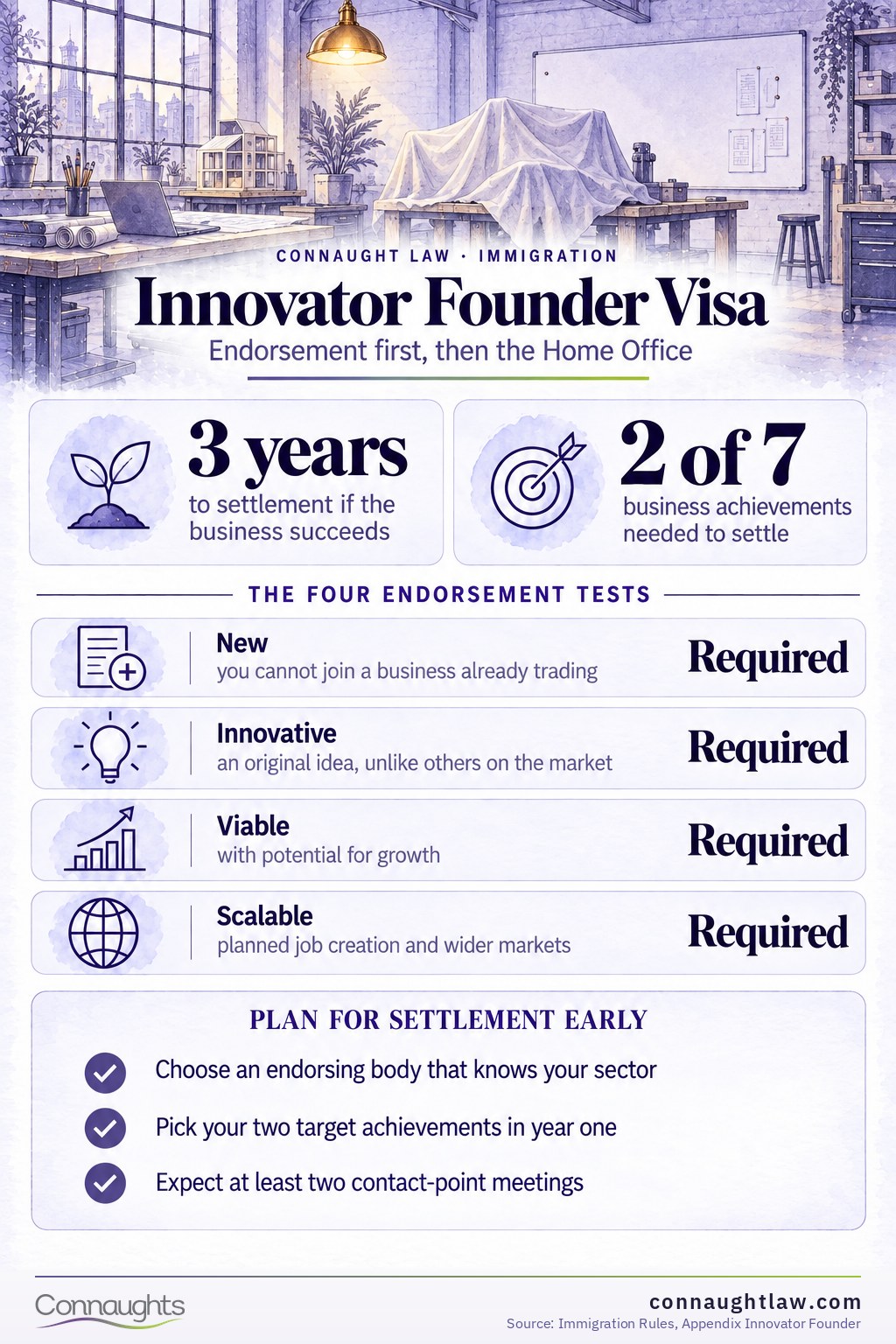
The gov.uk criteria, checked on the day of writing, are exact: the business must be new — you cannot join one already trading — innovative, meaning an original idea different from anything else on the market; viable, with potential for growth; and scalable, with evidence of planning for job creation and growth into national and international markets. Every section of the plan should be traceable to one of those tests, because the endorsing body's assessment will be.
Building a Plan That Survives Scrutiny
Endorsing bodies read plans professionally and reject politely. What survives: innovation described specifically enough to be checked, market analysis built on identifiable sources, financial projections whose assumptions are stated and conservative, and a scaling story with dates and hires rather than adjectives. What fails: template plans, revenue curves without mechanics, and "no competitors" claims — which read as no research. The plan is also the document your first contact-point meetings will be measured against, so write commitments you can keep.
Endorsement and the Approved Bodies
The Endorsing Bodies
Endorsement costs £1,000, paid to the body, not the Home Office. The route launched with four appointed bodies — Envestors, Innovator International, UK Endorsement Services and the Global Entrepreneurs Programme — and the authoritative current list, with each body's sector focus, is maintained on gov.uk. Choosing the body whose expertise matches your sector is a genuine strategic decision — an assessor who understands the market reads innovation claims very differently from one who does not.
How Assessment Works
Expect staged scrutiny: plan review, due diligence on you and the venture, and usually an interview testing whether the founder can defend the plan unprompted. Endorsement does not end the relationship — the body monitors progress at contact-point meetings, at least twice during your stay at £500 per meeting, and can withdraw endorsement if the business has abandoned its plan. Our endorsement requirements guide covers the assessment in more depth.
What It Costs
Comprehensive Fee Breakdown
| Item | Amount | When |
|---|---|---|
| Application fee — outside the UK | £1,357 per person | With the visa application |
| Application fee — extend or switch in the UK | £1,693 per person | At extension or switching |
| Immigration health surcharge | £1,035 per year — £3,105 for the 3-year grant | With the application |
| Endorsement | £1,000 | To the endorsing body, before applying |
| Contact-point meetings | £500 each, minimum two | During the stay |
| Settlement (indefinite leave to remain) | £3,226 per person | At the three-year point |
Funding the Business Itself
There is no minimum investment requirement — the old £50,000 rule died with the Innovator visa. The £50,000 figure survives in one place only: investing and spending that amount on the business is one of the seven settlement achievements. So capital planning is really settlement planning: fund the business at whatever level the plan honestly needs, and keep the records that will later prove what went in and where it was spent.
Timing and the Success-Rate Question
What the Numbers Do and Do Not Show
Visa decisions usually arrive within 3 weeks from outside the UK and 8 weeks inside, per gov.uk on the day of writing; the endorsement stage runs on the body's own timetable and should be measured in weeks, not days. On success rates, be blunt: the Home Office publishes no approval rate for this route, so any article quoting a percentage is quoting an invention. What can honestly be said is structural — endorsement is the filter, and applications that reach the Home Office with a genuine endorsement fail mainly on suitability, evidence or funds errors, all of which are avoidable.
The Three-Year Settlement Path
The route's quiet superpower is the clock: settlement after three years rather than five, at the standard £3,226 fee, with the Life in the UK test and the 180-days-per-year absence limit applying as usual. The price of the shorter clock is proof of achievement — a fresh endorsement confirming the business has grown, measured against the criteria below.
Settlement Achievement Criteria
| Achievement | What must be shown |
|---|---|
| Investment | At least £50,000 invested into the business and actively spent furthering it |
| Customer growth | Customers at least doubled in 3 years and above the mean for comparable UK businesses |
| Research and development | Significant R&D activity with a UK intellectual property application |
| Revenue | Gross revenue of at least £1 million in the last full accounting year |
| Revenue with exports | At least £500,000 gross revenue, including £100,000 from exporting |
| Job creation — volume | The equivalent of at least 10 full-time jobs for settled workers |
| Job creation — value | At least 5 full-time jobs for settled workers at a mean salary of £25,000 or more |
The same criterion cannot be counted twice, and every achievement is evidence-defined — accounts, payroll, Companies House filings, IP applications. The founders who settle comfortably are the ones who chose their two target criteria in year one and built the record as they went; the official settlement guide and our settlement team cover the application itself.
Strategy Before Submission
Where Advice Earns Its Fee
Three decisions repay professional input: matching the plan to the endorsement tests before the £1,000 is spent, choosing the endorsing body, and structuring the venture so the settlement evidence accumulates by design. Founders coming from the closed routes have their own transition questions — covered in our guide for former Innovator visa holders — and a refused application is challengeable but rarely quickly, which makes the first attempt worth building properly. Our business immigration team works both stages; where a refusal has already landed, our visa refusal team and, where grounds exist, immigration appeals pick it up. Broader options across the immigration practice sit alongside.
Frequently askedQuestions about the Innovator Founder visa
What are the main requirements?
Endorsement of a new, innovative, viable and scalable business by an approved body (50 points), English at B2 (10 points) and £1,270 held for 28 days (10 points) — 70 points in all, plus age 18+ and suitability. There is no minimum investment requirement.
How much does the innovator founder visa cost?
£1,357 from outside the UK or £1,693 to extend or switch inside it, plus £3,105 health surcharge for the three-year grant, £1,000 endorsement and at least two £500 contact-point meetings — around £6,500 per founder before any business capital, at the rates from 8 April 2026.
What must the business plan contain?
Evidence against the four tests: a genuinely new business, an original idea different from anything on the market, viability with growth potential, and scalability with planned job creation and national or international expansion. Specific, checkable claims outperform length — and the plan becomes your monitoring baseline.
What is the success rate?
No official success rate is published for this route, and quoted percentages in articles are not sourced from Home Office data. The practical filter is endorsement: ventures that clear a genuine endorsing-body assessment rarely fail at the visa stage except on avoidable evidence and suitability errors.
Do I need £50,000 to apply?
No — the £50,000 minimum belonged to the closed Innovator visa. On this route no investment figure is required at application. The £50,000 returns only as one of the seven settlement achievements, where investing and spending that amount is one way of proving the business grew.
Can I really settle after three years?
Yes. Settlement requires three years' residence within the absence limits, the Life in the UK test, and a new endorsement confirming at least two of the seven business achievements — from £50,000 invested to the job-creation and revenue thresholds. The ILR fee is £3,226.
Tell us what the business does, how far it has got and which endorsing body you have approached. We'll tell you what the plan has to establish and how the two stages fit together.
Get Expert Advice