
The May 2025 White Paper stopped being a prediction long ago — for employers it is now a delivery schedule, arriving measure by measure. Degree-level sponsorship and the £41,700 threshold took effect in July 2025, the higher Immigration Skills Charge in December 2025, B2 English in January 2026 — while the ten-year settlement proposal remains exactly that, a proposal. This guide keeps the employer's status map straight: what binds you today, what is dated, and what is still politics.
On This Page

A Delivery Schedule, Not a Debate
The "Restoring control" White Paper is being implemented in stages, and the practical skill for employers is telling the stages apart. Some measures bind you today with penalties attached; some are in the Rules with future commencement dates; some remain consultation-stage politics that may never arrive in their trailed form. This post is maintained as that status map, checked against the sources on the day of writing; the system-wide picture beyond employer duties sits in our White Paper overview.
Degree-Level Sponsorship — in Force
What Changed on 22 July 2025
Since 22 July 2025, new Skilled Worker sponsorship generally requires the role to sit at degree level (RQF6), with the general salary threshold at £41,700 — up from £38,700 — per the HC 997 statement of changes, which removed around 180 occupations from eligibility. Sub-degree roles survive only through the interim Temporary Shortage List and the Immigration Salary List, and the TSL is currently due to run to the end of 2026 with a MAC review of what follows.
Living With the Narrower List
The adjustment is occupational maths: workforce plans built on RQF3–5 sponsorship needed re-basing on the current Skilled Worker rules, transitional protections for pre-July-2025 sponsored workers need tracking to their expiry, and every job description now earns closer scrutiny against its occupation code than the old regime ever gave it.
The Duties That Frame All of It
Core Legal Obligations
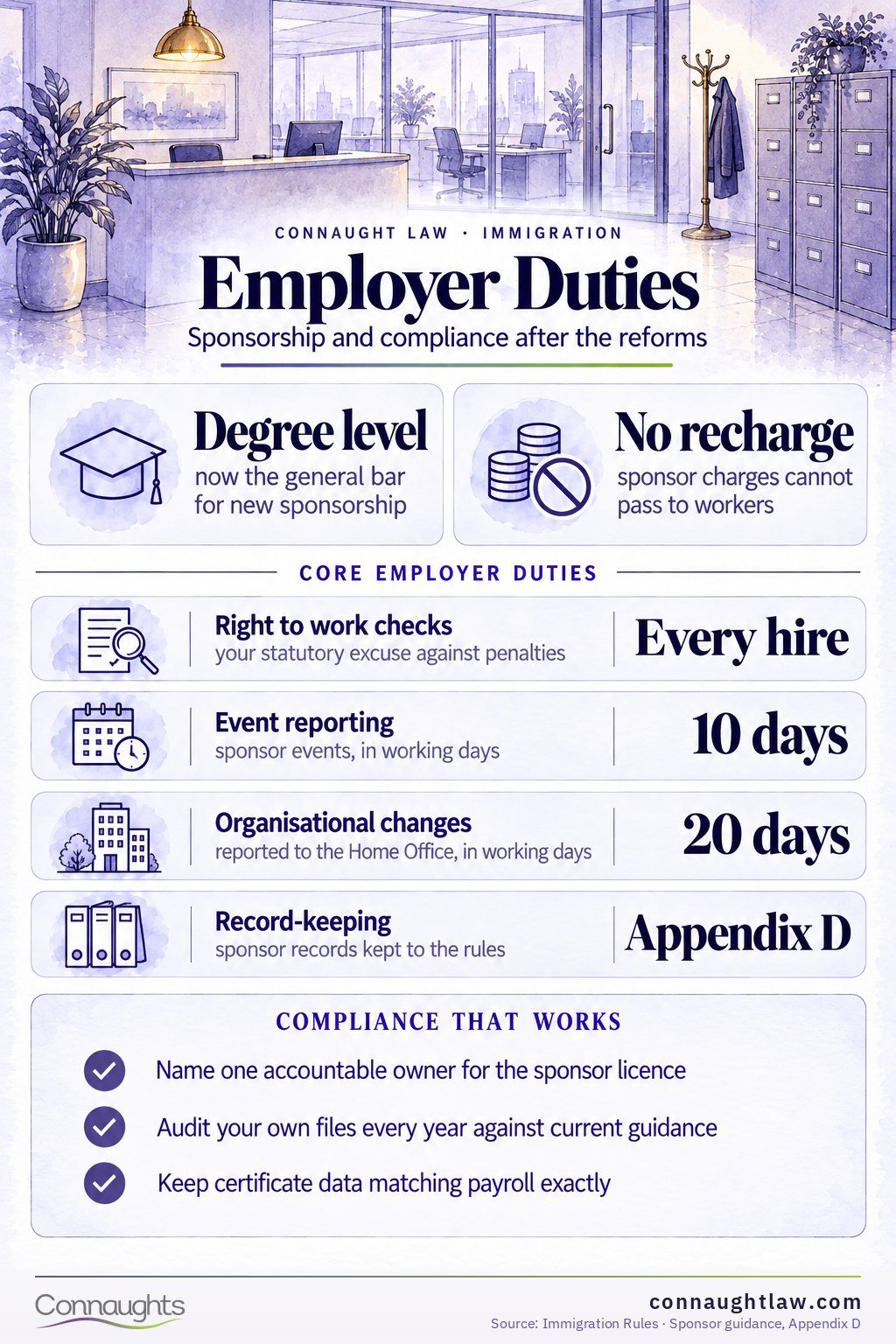
Nothing in the White Paper displaced the fundamentals: right to work checks with their statutory excuse, sponsor record-keeping to Appendix D, event reporting within 10 working days and organisational reporting within 20, and civil penalties of up to £60,000 per illegal worker. The White Paper's effect is intensity, not novelty — the same duties, policed harder, with our compliance crackdown analysis tracking the enforcement data behind that claim.
Sponsorship Reforms in Practice
What Sponsors Actually Face
Ignore the "real-time automated penalty" rhetoric that circulates in commentary: what sponsors face is the sponsor guidance, reissued several times a year (current edition 20 May 2026), applied through visits and data cross-checks that have grown sharper each cycle. The reforms that bit hardest are the quiet ones — fee recovery prohibitions that make recharging licence and certificate costs a revocation trigger, and compliance findings converting to suspensions faster than the old warning culture did.
The Cost Changes — in Force
A Skills Charge Rise, Dated Correctly
The Immigration Skills Charge rose on 16 December 2025 — not July, as some guides state — to £480 for the first year and £240 per further six months for small or charitable sponsors, and £1,320 plus £660 for medium and large ones, per the gov.uk ISC page. Over a five-year sponsorship that means £2,400 and £6,600 respectively — £580 and £1,600 more per worker than the old maxima, paid up front at certificate assignment.
Skills Charge Cost Comparison
| Sponsor size | Old structure | Current structure | Five-year maximum now |
|---|---|---|---|
| Small or charitable | £364 + £182 per 6 months | £480 + £240 per 6 months | £2,400 (+£580) |
| Medium or large | £1,000 + £500 per 6 months | £1,320 + £660 per 6 months | £6,600 (+£1,600) |
The Care Closure — in Force
Three Years to Rebuild a Model
Care worker sponsorship closed to new overseas recruitment on 22 July 2025, with in-country switching transition arrangements running to 2028. For providers the maths is unforgiving: a recruitment pipeline built on international hiring has a dated end, domestic recruitment in a sector with chronic vacancy pressure is the replacement, and the transition window is the whole planning horizon. Compliance around existing sponsored care staff matters more than ever — losing a licence now cannot be cured by recruiting replacements abroad.
Settlement — Still a Proposal
Planning Around an Unmade Decision
The proposal to move settlement from five years towards an earned ten-year baseline was consulted on into February 2026, drawing an enormous response and sustained parliamentary pressure, with implementation signalled for later in 2026 — but as of the day of writing nothing has been laid in the Rules. Employers should not re-plan retention around it yet: track it through the Commons Library briefing and our ten-year ILR analysis, and treat any article stating a ten-year rule as current law as wrong.
Compliance Expectations Now
What "Enhanced" Really Means
Enforcement visits, suspensions and revocations all rose sharply through 2024–25, and illegal-working activity hit record published levels in 2025. The operational translation: audit your own files annually against the current guidance edition, keep certificate data matching payroll to the pound, and treat every reporting deadline as hard. Employers running that discipline describe the new environment as demanding; employers without it meet it as enforcement.
The Employer Response That Works
Workforce Planning
Re-base plans on RQF6 reality: map which roles still qualify, which transitional workers carry old thresholds and until when, and where the salary and shortage lists genuinely help. The employers coping best treat sponsorship as a planned channel with a budget, not an emergency lever.
Budget Reallocation
Price the full stack at current rates — licence, certificates, the risen Skills Charge, salaries at threshold — and remember none of the sponsorship charges can lawfully be recovered from workers. The arithmetic per hire is in our sponsor licence fees guide; what belongs in this post is the planning point that the December 2025 rise made per-worker budgeting obligatory rather than prudent.
Compliance Systems Worth the Name
One accountable owner for the licence, an audit rhythm tied to guidance reissues, and training that reaches the managers who change salaries and locations without telling HR. That is the whole prescription — the rest is doing it before a visit rather than after.
Sector Impacts at a Glance
Technology and Professional Services
Largely intact: graduate-level occupations dominate, thresholds bite less at sector salaries, and the routes still serve expansion — including founders through the Innovator Founder route. The cost rises are absorbable; the compliance expectations are not optional.
Healthcare Beyond Care
Clinical roles remain sponsorable and in demand; the closure is specific to care workers. Health employers hold a split estate — protected clinical sponsorship next to a closed care route — and need their compliance and planning to respect the line between the two.
Construction and Manufacturing
The RQF6 change lands hardest here: many trades sit below degree level and now depend on the temporary lists while they last. With the TSL's currently published end-date at December 2026, these sectors have the shortest runway and the strongest case for domestic pipeline investment running alongside any remaining sponsorship.
Hospitality and Services
Squeezed twice: most roles fall below the new skill line, and the sector tops the illegal-working enforcement tables. The practical agenda is right to work discipline first, selective sponsorship of genuinely qualifying roles second, and no reliance on workarounds that enforcement data shows are being found.
Frequently askedQuestions about the changes for employers
Which White Paper changes are actually in force?
The RQF6 skill requirement and £41,700 threshold (22 July 2025), the care-route closure to new overseas recruitment (22 July 2025), the higher Immigration Skills Charge (16 December 2025) and B2 English for new Skilled Worker applicants (8 January 2026). Everything else is dated ahead or still proposed.
Is the ten-year settlement rule in effect?
No. Earned settlement remains a consultation-stage proposal — consulted on into February 2026, signalled for later implementation, but not in the Immigration Rules. Current sponsored workers settle under today's five-year framework unless and until a change is actually laid, with notice.
How much did the Skills Charge rise?
From 16 December 2025: £480 plus £240 per further six months for small and charitable sponsors, £1,320 plus £660 for medium and large — five-year maxima of £2,400 and £6,600, up £580 and £1,600. It is paid in full at certificate assignment and cannot be recharged to the worker.
Can we still sponsor roles below degree level?
Only where the occupation sits on the Immigration Salary List or the interim Temporary Shortage List, which currently runs to the end of 2026 pending the MAC's review. Roles outside those lists need to meet RQF6 — or need a domestic recruitment answer instead.
What should care providers do with the 2028 window?
Protect existing sponsored staff with rigorous compliance, use the in-country switching transition deliberately, and build the domestic pipeline now — the closure to new overseas recruitment is in force and the transition window is the entire planning horizon.
Where should we track what changes next?
Statements of changes to the Immigration Rules for what is real, the Commons Library's running briefing for status, and the sponsor guidance's edition dates for operational duties. Commentary predicting dates has been reliably wrong; commencement provisions have not.
Tell us the roles, the salaries and your sponsor status. We'll tell you which hires still qualify under the reformed rules, what they now cost, and which of the coming changes actually affect your plans.
Get Expert Advice