
A sponsor licence costs £611 for small or charitable sponsors and £1,682 for medium or large ones under the Home Office fee table in force from 8 April 2026 — and the application fee is the smallest part of the bill. Each Skilled Worker certificate adds £525, the Immigration Skills Charge adds up to £6,600 per worker, and almost none of it can lawfully be recovered from the person you sponsor. Here is the full arithmetic.
On This Page

Where the Money Goes
The Home Office charges sponsors at three points: once when you apply for the licence, once each time you assign a Certificate of Sponsorship, and again for every period of sponsorship through the Immigration Skills Charge. Employers who budget from the application fee alone routinely underestimate the real commitment — for a single Skilled Worker over five years, the mandatory charges come to more than five times the licence fee itself.
The licence application fee is £611 for small or charitable sponsors and £1,682 for medium or large ones. Most applications are decided in under eight weeks; £750 buys a ten-working-day decision where slots are available. Each Skilled Worker certificate then costs £525, and the Immigration Skills Charge runs from £480 to £1,320 for the first year alone.
This guide prices the whole system and shows where the figures come from. The application process itself — eligibility, key personnel and the documents the Home Office expects — is covered in our sponsor licence application guide.
Sponsor Licence Fees from 8 April 2026
The figures below come from the Home Office immigration and nationality fees table effective 8 April 2026, checked on 1 August 2026. April is the usual fee cycle, so any figure you find elsewhere dated 2025 or earlier should be treated as expired.
You pay the small-sponsor rate if you meet at least two of the Companies Act criteria: annual turnover of £15 million or less, total assets of £7.5 million or less, or 50 employees or fewer. Registered charities qualify for the lower rate regardless of size. The difference is £1,071 on the licence fee alone, and it also fixes your Immigration Skills Charge rate.
Application and Certificate Fees
The licence fee depends on your size and the routes you apply for. Certificates are charged per worker at assignment, and the optional priority service — capped at a small daily allocation, first come, first served — buys a decision within ten working days instead of the standard eight weeks.
Mandatory Fees by Sponsor Size
| Fee | Small or charitable sponsor | Medium or large sponsor |
|---|---|---|
| Sponsor licence — Worker routes | £611 | £1,682 |
| Sponsor licence — Temporary Worker only | £611 | £611 |
| Certificate of Sponsorship — Worker routes | £525 | £525 |
| Certificate of Sponsorship — Temporary Worker | £55 | £55 |
| Priority service (optional) | £750 | £750 |
The Immigration Skills Charge
The Skills Charge rose sharply on 16 December 2025, and guides that predate the change understate it by around a third. The current rates are £480 for the first twelve months and £240 for each further six months for small or charitable sponsors, and £1,320 plus £660 for medium or large ones — capped over five years at £2,400 and £6,600 respectively.
The charge is paid in full when you assign the certificate, not annually. A three-year certificate therefore costs a small sponsor £480 + (4 × £240) = £1,440 up front, and a medium or large sponsor £1,320 + (4 × £660) = £3,960. Some assignments are exempt — check the gov.uk Immigration Skills Charge page before you budget it in.
Costs You Must Not Pass to the Worker
The sponsor guidance (version 05/26, 20 May 2026) is explicit that the Home Office will normally revoke a licence where a sponsor recoups prohibited fees from a sponsored worker. The prohibitions arrived in two waves and now cover the whole system.
- The sponsor licence fee and associated administrative costs — for Skilled Worker sponsors from 31 December 2024, and for every other route from 9 April 2025.
- The Certificate of Sponsorship fee — for Skilled Worker certificates assigned on or after 31 December 2024, extended from 9 April 2025 to Global Business Mobility, Minister of Religion, International Sportsperson, Scale-up and Seasonal Worker assignments.
- The Immigration Skills Charge — never recoverable, in any route, at any time.
The worker's own visa application fee and the £1,035-a-year immigration health surcharge sit outside these prohibitions, so repayment clauses covering them remain possible — but they need careful drafting, and deductions can affect whether a salary still meets the sponsorship threshold. The detail is in part 1 of the sponsor guidance.
Compliance Costs After Approval
Once the licence is granted, the recurring cost is mostly time rather than fees. The sponsor guidance imposes duties that somebody in your organisation has to own: keeping prescribed records, reporting events on deadline, and tracking each sponsored worker's role, salary and location against what the certificate says.
Record-Keeping and Right to Work Evidence
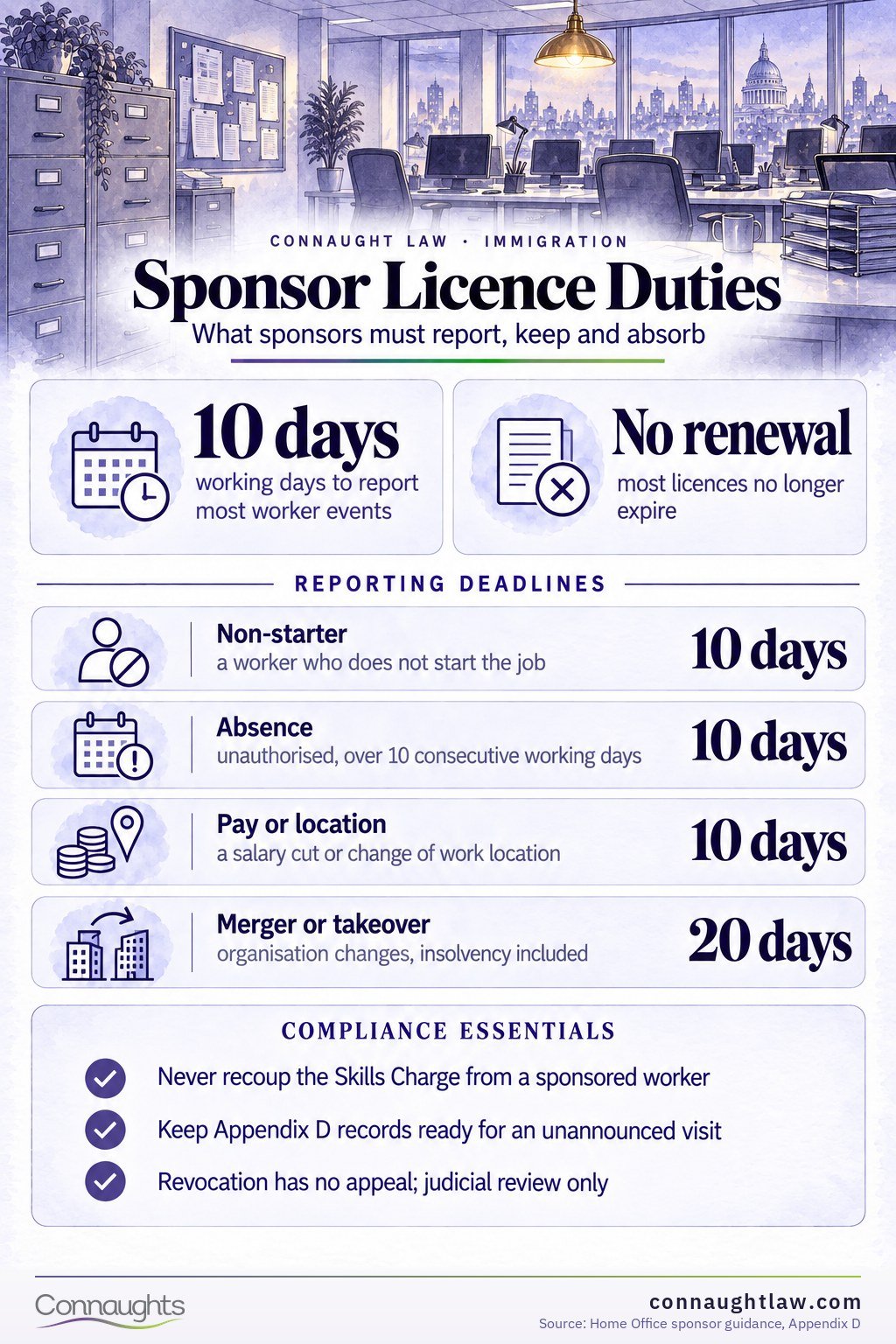
Appendix D of the sponsor guidance prescribes the documents you must hold for every sponsored worker — right to work checks, contact details, absence records, salary evidence and recruitment records among them. These must be produceable at a compliance visit, announced or not, and gaps found at a visit are treated as breaches rather than oversights.
Reporting Deadlines That Carry Risk
Worker events — a non-starter, an unauthorised absence of more than ten consecutive working days, a salary reduction, a change of work location, an early end to employment — must be reported within ten working days. Changes to your organisation, including mergers, takeovers and insolvency, get twenty working days. Everything goes through the sponsor management system, and late reporting is one of the most common findings at compliance visits.
Systems, Training and Staff Time
The sponsor management system itself is free to use. What costs money is the internal machinery around it: named key personnel with time to do the job, HR records that can answer an Appendix D request quickly, and refresher training whenever the guidance changes — which is several times a year, with the current edition issued on 20 May 2026. Budget people, not software.
Professional Support
Legal support earns its cost at three points: preparing a first application so it is granted rather than refused, auditing compliance before the Home Office does, and responding when enforcement action starts. We do not publish hourly rates on this page — legal fees vary with the work, and the courts' guideline hourly rates exist only for costs assessment in litigation. Our business immigration team scopes fees per instruction.
Budgeting the Full Cost of a Licence
The honest way to budget sponsorship is per worker, over the life of the sponsorship, using only the charges that are fixed and published. Everything else — internal time, systems, advice — varies too much between organisations for any published range to be worth relying on.
A Five-Year Worked Example
Take one Skilled Worker sponsored for five years on a single certificate. A small sponsor pays the £611 licence fee, £525 for the certificate and the capped £2,400 Skills Charge: £3,536 in total. A medium or large sponsor pays £1,682 + £525 + £6,600 = £8,807. The worker's own visa fee (£819 to £1,865 depending on length and where they apply) and health surcharge sit outside the sponsor's mandatory bill.
Five-Year Cost per Worker
| Charge | Small or charitable sponsor | Medium or large sponsor |
|---|---|---|
| Licence application | £611 | £1,682 |
| Certificate of Sponsorship | £525 | £525 |
| Immigration Skills Charge (five-year cap) | £2,400 | £6,600 |
| Total | £3,536 | £8,807 |
Change of Circumstances
Since 6 April 2024 sponsor licences no longer expire, so there is no renewal fee to budget — the old four-year renewal cycle is gone, except on the UK Expansion Worker and Scale-up routes, where licences still run for a maximum of four years. Routine changes are mostly free to report; the cost arrives when a corporate transaction means the licence cannot transfer and a fresh application is needed.
Common Changes and Their Fees
| Change | What you must do | Home Office fee |
|---|---|---|
| Replacing key personnel | Update the sponsor management system | No fee |
| Change of address | Report within 20 working days | No fee |
| Merger, takeover or ownership change | Report within 20 working days; a new licence application may be required | £611 or £1,682 where a fresh application is needed |
| Adding Worker routes to a Temporary Worker licence | Apply to add the route | No fee for small sponsors; £1,071 for medium or large |
Where Budgets Go Wrong
- The Immigration Skills Charge is paid in full at assignment, so a three-year hire lands £1,440 or £3,960 on the day the certificate is issued, not spread across payroll years.
- Sponsor size is checked, not taken on trust — apply the two-of-three test before you declare, because the difference cascades through every later charge.
- Renewal fees no longer exist; a budget line carried over from pre-2024 planning is money that should be spent on compliance instead.
- Clawback clauses written before 31 December 2024 may now describe recoveries that would cost you the licence — have them reviewed, not reused.
What Enforcement Costs
Non-compliance converts a modest, predictable budget into an open-ended one. The direct fees are small; the losses come from frozen recruitment, curtailed workers and, in illegal working cases, civil penalties that dwarf every figure above. What refusal and revocation mean in practice — including the cooling-off period — is covered in our refusal and revocation guide.
Action Plans, Suspension and Revocation
A sponsor downgraded to a B-rating must pay £1,579 for a time-limited action plan and complete it to return to an A-rating; new sponsorship is on hold until it does. Suspension freezes the licence while the Home Office investigates. Revocation ends it — sponsored workers' permission is usually cut to 60 days, and there is no right of appeal; challenge is by judicial review only. If any of these letters has arrived, our sponsor licence revocation team can act quickly.
Enforcement Steps and Direct Costs
| Step | Home Office fee | Practical effect |
|---|---|---|
| B-rating with action plan | £1,579 | No new certificates until the plan is completed and the rating restored |
| Suspension | No fee | Licence frozen during investigation; existing workers continue, no new assignments |
| Revocation | No fee — reapplication at full cost after a cooling-off period | Workers' permission usually curtailed to 60 days; judicial review the only challenge |
Civil Penalties and the Wider Bill
Illegal working carries a civil penalty of up to £60,000 per worker, with £45,000 the starting point for a first breach — levels in force since 13 February 2024. Enforcement visits and penalty volumes rose sharply through 2025; our sponsor compliance crackdown analysis tracks the published data and what it means for sponsors.
In Akbars Restaurant (Middlesbrough) Ltd v SSHD [2026] UKSC 26 the Supreme Court held that a civil penalty notice must state which statutory limb it relies on — reciting the grounds in the alternative is not enough. If you have received a penalty notice, our guide to challenging an illegal working civil penalty explains the objection and appeal routes.
Controlling the Spend
The savings that exist are unglamorous. Confirm your size classification before applying rather than after. Plan certificate use so you assign the right type at the right time — our Certificate of Sponsorship guide explains how defined and undefined allocations work. Pay for priority only when a start date demands it. Above all, audit your own records before the Home Office does: every figure in the enforcement section is avoidable, and none of the fees in the tables above is.
Sector Pressures on the Budget
Fee arithmetic is uniform, but sectors do not face equal conditions. Sponsorship-dependent industries carry more enforcement attention, and rule changes have redrawn what some sectors can recruit for at all.
Where Sectors Differ
| Sector | What changes the numbers |
|---|---|
| Care | Closed to new overseas recruitment since 22 July 2025; sponsorship largely limited to in-country switching during the transition |
| Hospitality | Consistently the most-visited sector for illegal working enforcement, so compliance readiness carries real weight |
| Charities | Registered charities pay the £611 licence fee and £480 Skills Charge rate regardless of size |
| Regulated professions | Registration and qualification evidence extends the record-keeping load per worker |
Questions about sponsor licence costs
How much does a sponsor licence cost in 2026?
The application fee is £611 for small or charitable sponsors and £1,682 for medium or large ones, under the fee table in force from 8 April 2026. The optional priority service adds £750. Per-worker charges — the Certificate of Sponsorship and the Immigration Skills Charge — then apply on top.
What does sponsoring one worker cost over five years?
Counting only mandatory Home Office charges: £3,536 for a small sponsor (£611 licence + £525 certificate + £2,400 capped Skills Charge) and £8,807 for a medium or large sponsor (£1,682 + £525 + £6,600). Internal compliance time and any professional support come on top.
Can we recover sponsorship costs from the worker?
Mostly no. The licence fee and associated administrative costs, the Skilled Worker certificate fee (assigned on or after 31 December 2024, extended to other routes from 9 April 2025) and the Immigration Skills Charge must not be recouped — the Home Office will normally revoke the licence. Clauses covering the worker's own visa fee need specialist drafting.
How much is the Immigration Skills Charge now?
Since 16 December 2025: £480 for the first year and £240 per further six months for small or charitable sponsors, and £1,320 plus £660 for medium or large ones. It is paid in full when the certificate is assigned, capped at £2,400 and £6,600 over five years.
How much does a certificate of sponsorship cost?
£525 per certificate on the Worker routes, including Skilled Worker, and £55 on the Temporary Worker routes. The fee is paid when the certificate is assigned and is one of the charges that cannot be passed on to the sponsored worker.
Is there a fee to renew a sponsor licence?
No. The four-year renewal requirement — and its fee — was abolished on 6 April 2024, and most licences now continue indefinitely. The exceptions are the UK Expansion Worker and Scale-up routes, where a licence still runs for a maximum of four years.
Tell us your headcount, whether you meet the small-sponsor test and the routes you plan to use. We will price the application, the per-worker charges and the compliance arrangements you actually need.
Get Expert Advice