
A refused sponsor licence application and a revoked licence are different events with different consequences — but neither carries a right of appeal. Refusal usually means a six-month wait before reapplying; revocation curtails every sponsored worker's permission on 60 days' notice and blocks a new application for at least twelve months. This guide separates refusal, suspension, downgrading and revocation, and sets out what can realistically be done about each.
On This Page
When the Home Office Says No
Sponsorship runs on trust: the Home Office licenses an employer to carry out immigration functions and withdraws that trust when it concludes the employer cannot be relied on. Because the licence is a privilege administered under guidance rather than a statutory right, the usual machinery of immigration appeals does not exist here — which makes understanding the process, and acting early inside it, most of the game.
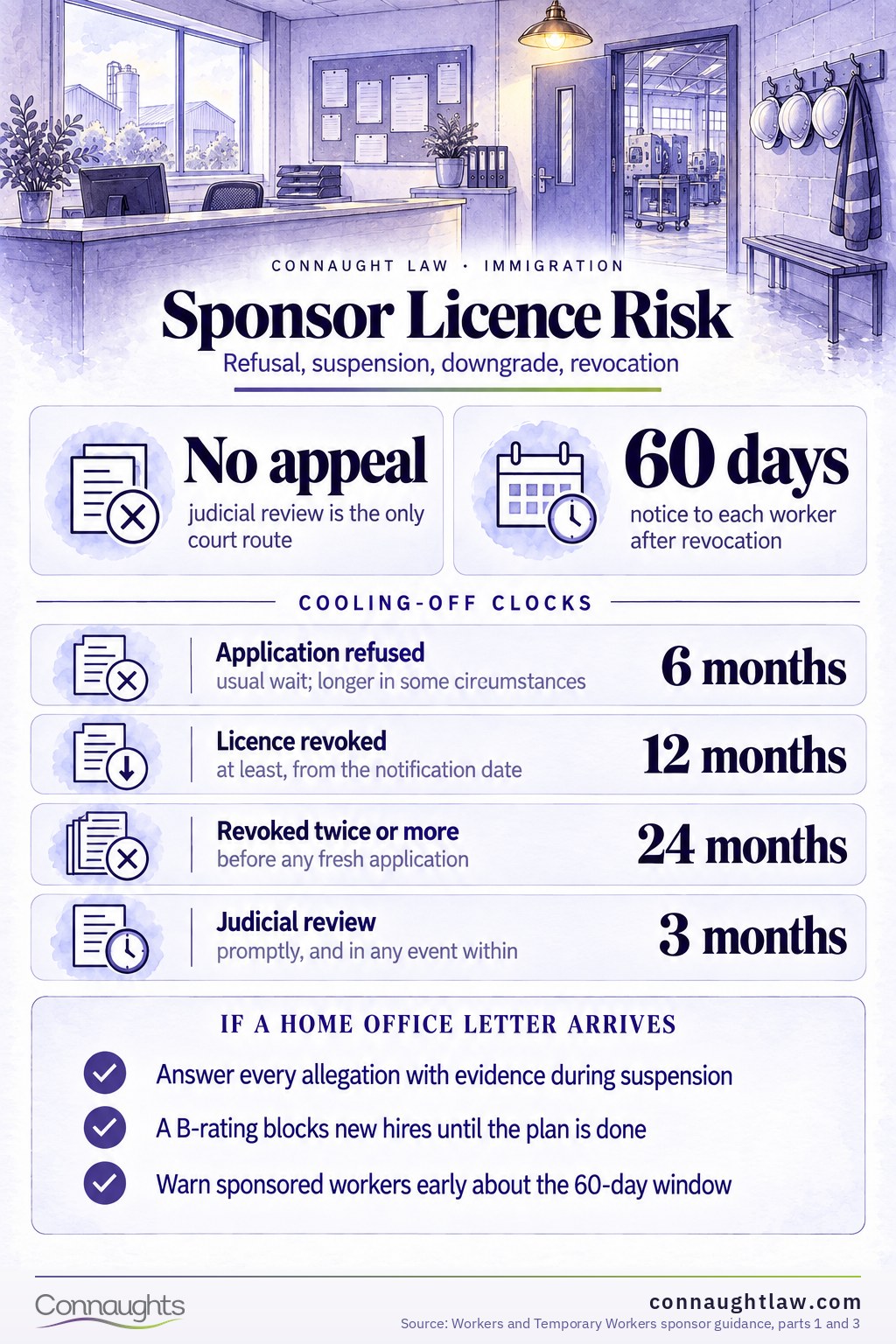
Refusal means the application failed: no licence, and usually a six-month wait before trying again. Revocation means an existing licence is cancelled: sponsorship ends, every sponsored worker's permission is curtailed on 60 days' notice, and no fresh application is possible for at least twelve months. Neither decision carries a right of appeal — judicial review is the only court route.
Refusal, Suspension and Revocation Told Apart
Four outcomes sit on the enforcement ladder. An application can be refused. A licence-holder can be downgraded to a B-rating. A licence can be suspended while the Home Office investigates. And a licence can be revoked — the terminal step. Each has its own trigger, its own consequences and its own way back.
Where the Powers Come From
The rules live in the Workers and Temporary Workers sponsor guidance — part 1 for applications and refusal, part 3 for compliance and revocation, both reissued on 20 May 2026. Part 3 organises revocation into three annexes: circumstances where the Home Office will revoke, where it will normally revoke, and where it may revoke. The first category leaves no room for argument on outcome — only on whether the facts are made out.
Downgrading to a B-Rating
Where failings are considered fixable, the Home Office can downgrade the licence to a B-rating instead of revoking. The sponsor must pay £1,579 for a time-limited action plan and complete it to regain an A-rating; until then it cannot sponsor any new workers, though it can extend sponsorship for existing ones. Failing the action plan converts a warning into revocation — the plan is a final chance, and it deserves to be treated as one. The fee sits alongside the others in our sponsor licence fees guide.
Why Licences Are Refused or Revoked
The Home Office does not publish a breakdown of refusal and revocation reasons, so treat any percentage you read with suspicion. What the guidance and reported cases show clearly is the pattern: decisions turn on evidence the sponsor could not produce, reports the sponsor did not make, and roles that did not match what was sponsored.
Refusal Grounds at Application
Applications fail when the specified documents are missing or inconsistent, when the Home Office doubts the business genuinely needs the roles it wants to sponsor, when key personnel fail suitability checks, or when a pre-licence visit contradicts the paperwork. A refusal letter states its reasons — brief ones — and those reasons set both the reapplication task and any waiting period. The groundwork that avoids all of this is covered in our sponsor licence application guide.
Common Grounds and Their Outcomes
| Ground | Where it surfaces | Likely outcome |
|---|---|---|
| False or misleading information | Application or any later check | Refusal, or revocation under the mandatory annex |
| Record-keeping and reporting failures | Compliance visit | Downgrade, suspension or revocation by severity |
| Genuine-vacancy doubts | Application or visit | Refusal, or revocation where roles do not match certificates |
| Unsuitable key personnel | Application and monitoring | Refusal, or a demand to replace the appointee |
Revocation Triggers After Grant
- Employing illegal workers, losing a required regulatory registration, or supplying false information sit in the will-revoke category — the decision follows once the facts are established.
- Systemic record-keeping or reporting failures normally bring revocation unless strong mitigation exists.
- Lesser failings fall to discretion, which is where early, well-evidenced representations do their work.
- Suspension usually comes first — it is an investigation, not a verdict, and the response window is the best chance of saving the licence.
What Happens After Revocation
The Business Consequences
Revocation removes the organisation from the register of licensed sponsors and ends its ability to employ sponsored staff — current workers wind down on curtailed permission and no replacement can be sponsored for at least a year. For businesses built around sponsored roles the practical effect is a forced restructure: recruitment plans, client commitments and in some sectors regulatory staffing minimums all inherit the problem at once.
What Happens to Sponsored Workers
Part 3 of the guidance is blunt: on revocation the Home Office curtails the permission of all sponsored workers, writing to each with 60 days' notice. Inside that window a worker can apply to switch to a new sponsor or another route; those who cannot must leave. Employers who see trouble coming owe their workers early warning — the window is survivable with preparation and very tight without it.
How Decisions Can Be Challenged
There is no appeal against refusal or revocation, and no tribunal to hear one. What exists is narrower: persuading the Home Office it has made an error on its own terms, and public law challenge where the decision is unlawful, irrational or procedurally unfair.
Representations and Pre-Action Steps
During suspension, the sponsor is invited to respond to the allegations — this is the stage where licences are actually saved, with evidence assembled against each allegation rather than a general plea. After a final decision, a pre-action protocol letter can put specific errors to the Home Office before litigation; decisions are sometimes withdrawn and retaken where the letter exposes a factual mistake the original decision relied on.
Judicial Review in Practice
Judicial review — brought promptly, and in any event within three months of the decision — asks the Administrative Court to test lawfulness, not to remark the homework. The court will not substitute its own view of your HR systems; it will intervene where the Home Office ignored its own guidance, got a material fact wrong or decided unfairly. That makes strong grounds rarer than strong grievances, and early advice on which you hold is worth more than optimism.
Cooling-Off Periods and Applying Again
How Long You Must Wait
The waiting periods are set by the guidance, not negotiation. After refusal, part 1 states you may be ineligible to reapply for six months, with longer periods in certain circumstances. After revocation, no new application is allowed until at least twelve months from the notification date — 24 months where a licence has been revoked more than once. The clocks run from the decision, so time spent disputing it does not extend them.
Cooling-Off Clocks by Outcome
| Outcome | Waiting period | Source |
|---|---|---|
| Application refused | Usually 6 months; longer in certain circumstances | Sponsor guidance part 1 |
| Licence revoked | At least 12 months from notification | Sponsor guidance part 3 |
| Revoked more than once | 24 months | Sponsor guidance part 3 |
What a Reapplication Must Show
A reapplication is judged with the history on the table, so it must demonstrate change, not assert it: the failure that ended the last licence identified precisely, the system that prevents it rebuilt and evidenced, and key personnel who can explain both at a visit. Applications that merely restate the original case invite the original outcome — with the record now against them.
Where Enforcement Is Heading
The Current Climate
Compliance activity has intensified across visits, suspensions and illegal working penalties, and sponsor-heavy sectors feel it first. We track the published enforcement data — and what it means for how sponsors should run their licences — in our sponsor compliance crackdown analysis, which pairs with this guide: that post covers the duties and the trends, this one covers what happens when the Home Office acts.
What Sponsors Should Do Now
Treat a suspension letter as litigation: preserve documents, respond to every allegation with evidence, and take advice before replying rather than after. Audit the licence annually against the current guidance, because editions change several times a year. And if the decision has already arrived, move quickly — the response deadlines, the judicial review clock and the 60-day worker window all run whether or not the business has caught up. Our sponsor licence revocation team acts at every stage from suspension response to judicial review.
Frequently askedQuestions about refusal and revocation
Can you appeal a sponsor licence revocation?
No — the guidance states there is no right of appeal. The routes that exist are representations during suspension, a pre-action letter identifying specific errors, and judicial review brought promptly and within three months. Judicial review tests lawfulness only, so grounds need careful assessment before committing to it.
How long is the cooling-off period?
After a refusal, usually six months — longer in certain circumstances. After a revocation, at least twelve months from the notification date, rising to 24 months where a licence has been revoked more than once. The periods come from the sponsor guidance and run from the decision itself.
What happens to our sponsored workers if the licence is revoked?
The Home Office curtails every sponsored worker's permission, writing to each with 60 days' notice. Within that window workers can apply to a new sponsor or switch route; otherwise they must leave the UK. Suspension alone does not affect them — only revocation triggers curtailment.
What is the difference between suspension and revocation?
Suspension is investigative: the licence is frozen, the sponsor comes off the public register and no certificates can be assigned, but existing workers are unaffected and the licence can be reinstated. Revocation is final — sponsorship ends, workers are curtailed and the cooling-off period begins.
Can we surrender the licence instead?
Only if no sponsored workers still work for you, and no fee is refunded. Surrender does not clean the record — the compliance history remains and will be considered on any future application. Where enforcement is already underway, surrendering rarely improves the position; take advice first.
Can a B-rated sponsor still assign certificates?
Not for new workers — sponsorship of new hires is blocked until the A-rating is regained by completing the £1,579 action plan. A B-rated sponsor can still assign certificates to extend existing sponsored workers. Failing or refusing the action plan leads to revocation.
Send us the Home Office letter and the date it arrived. We will tell you which deadlines are running, what the realistic routes back are, and what your sponsored workers need to know now.
Get Expert Advice