
The UK Expansion Worker visa lets an overseas business that is not yet trading in the UK send senior staff to build its first UK presence. The employer takes a £611 provisional sponsor licence, each certificate costs £55, the visa fee is £340, and workers must earn at least £52,500. The route is deliberately temporary — two years maximum, no settlement — and it rewards businesses that sequence the two stages properly.
On This Page

A Licence Before You Exist Here
Every other sponsor route assumes a UK business that already trades. The UK Expansion Worker route inverts that: it licenses an overseas company precisely because it has no active UK operation yet, so that the people who will build one can arrive lawfully. That inversion explains everything unusual about the route — the provisional rating, the worker cap, the hard time limit and the absence of any settlement path.
The sponsor licence costs £611 at the Temporary Worker rate, each Certificate of Sponsorship £55, and the visa application £340 per worker, under the fees in force from 8 April 2026. Workers must be paid at least £52,500 or the going rate for the occupation, whichever is higher, and can stay for a maximum of two years.
How the Route Is Built
The route replaced the Sole Representative visa in April 2022, swapping the old single-representative model for sponsored teams under Global Business Mobility. The trade-off is control: the overseas business gets more people in, but only inside the sponsorship system, with duties and monitoring from day one. The official overview sits on gov.uk; the sponsor-side rules are in the Global Business Mobility sponsor guidance, version 04/26.
Key Characteristics
- The licence starts with a provisional rating where the Authorising Officer is still overseas, with an allocation of just one certificate — for the Authorising Officer themselves.
- You may sponsor only the workers genuinely needed to establish the UK business, capped at 10 at any one time.
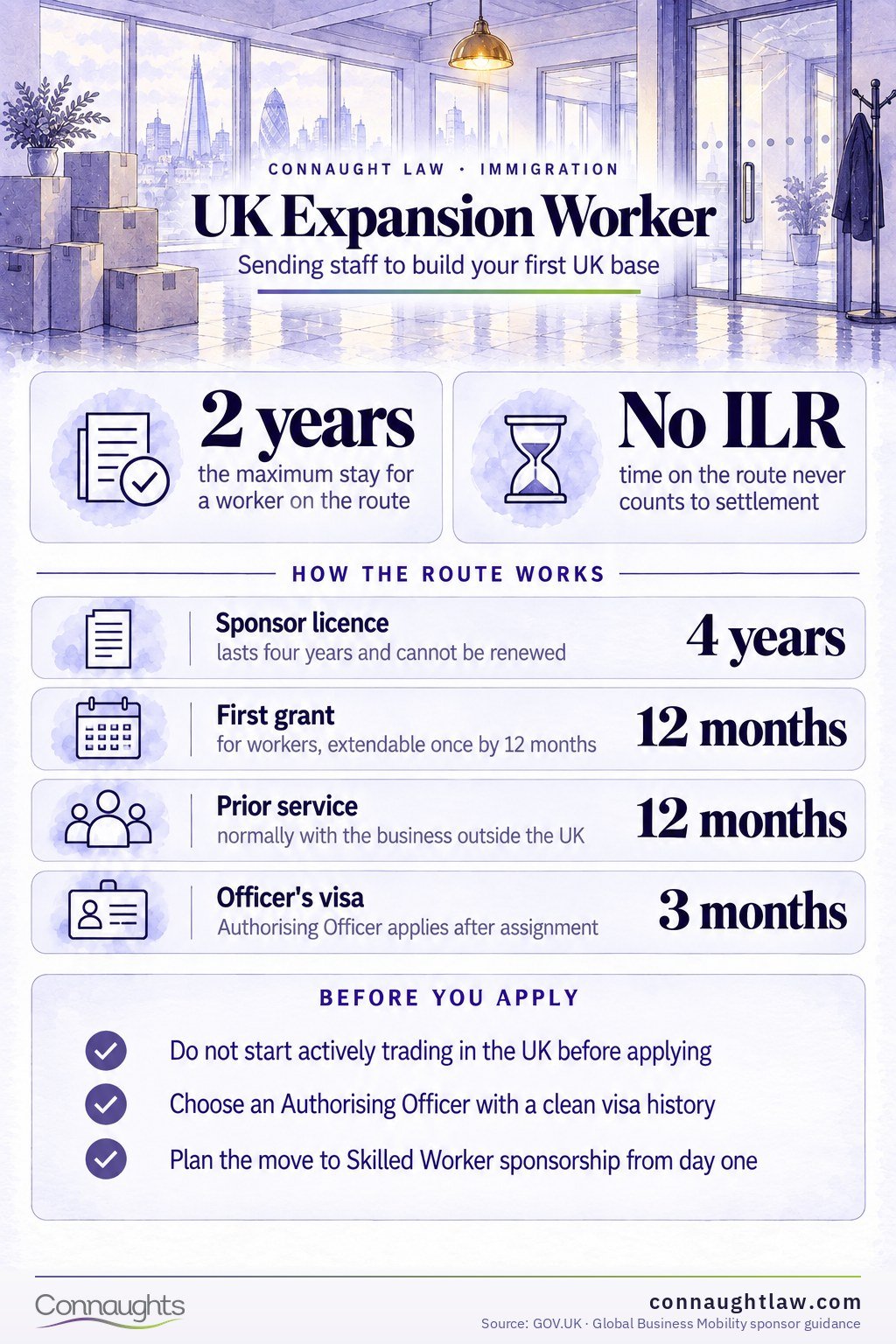
- The licence lasts four years and cannot be renewed — expansion is expected to finish inside it.
- Workers get 12 months, extendable once to a two-year maximum, with no route to settlement from this visa.
Who Qualifies on Each Side
The Overseas Business
The applicant is the overseas company, and it must show three things: an established, actively trading business abroad; a credible plan for a genuine UK expansion; and a UK footprint in the making — premises secured or registration in progress — without having crossed into active UK trading.
The guidance is explicit that an applicant on this route must not already be actively trading in the UK. A business that has begun UK trading needs an ordinary Worker sponsor licence instead; a business with nothing at all — no premises, no registration steps — is usually not ready to apply. The route lives in the narrow band between the two.
Who You Can Send
Workers must normally have worked for the business outside the UK for at least 12 months — the main exception is high earners paid over £73,900 — and must be coming to do a senior or specialist job on the eligible occupations list, paid at least £52,500 or the occupation's going rate if higher. Each also needs £1,270 in personal savings held for 28 consecutive days before applying.
Business and Worker Criteria
| Requirement | What must be shown |
|---|---|
| Overseas trading | An active, established business abroad with accounts and activity that support expansion |
| UK footprint | Concrete steps towards a UK base — premises or registration — without active UK trading |
| Worker service | 12 months' employment with the business, unless paid over £73,900 |
| Role and salary | A senior or specialist occupation on the eligible list, at £52,500 or the going rate if higher |
| Worker's own funds | £1,270 held for 28 consecutive days before the application |
What Expansion Costs
Fees, Line by Line
The route is cheap by sponsorship standards, and notably there is no Immigration Skills Charge — that levy applies to Skilled Worker and Senior or Specialist Worker sponsorship, not this route. The licence-fee and certificate-fee recovery prohibitions still apply: none of the employer-side fees below can be recouped from the workers. The wider sponsorship cost system is set out in our sponsor licence fees guide.
What the Route Costs
| Item | Amount | Paid by |
|---|---|---|
| Sponsor licence (Temporary Worker rate, all sizes) | £611 | Employer |
| Certificate of Sponsorship | £55 per worker | Employer |
| Visa application | £340 per worker | Worker or employer |
| Immigration health surcharge | £1,035 per year per person | Worker or employer |
| Maintenance funds | £1,270 held 28 days | Worker's own savings |
The Two-Stage Application
Stage One — the Provisional Licence
The overseas business applies for a UK Expansion Worker sponsor licence, evidencing overseas trading and the UK footprint. Where the Authorising Officer is still abroad — the usual case — the licence arrives provisional, with a single certificate allocation reserved for that officer. Most licence applications are decided in under eight weeks, with the £750 priority service available for ten-working-day decisions; the mechanics mirror the standard process in our sponsor licence application guide.
Stage Two — Certificates and Visas
The Authorising Officer is assigned the first certificate — how assignment works is covered in our Certificate of Sponsorship guide — and must apply for their visa within three months. Once the officer has entry clearance and the licence moves to a full A-rating, the allocation can be increased through the sponsor management system and the rest of the team applies, always within the 10-worker ceiling.
Switching Into and Out of the Route
Who Can Switch In
Workers already in the UK on many routes can switch into UK Expansion Worker where the sponsor and role tests are met — though in practice most expansion teams apply from overseas, because the route exists precisely for businesses without a UK operation to transfer people into. What does not work is the reverse manoeuvre: a business already actively trading here cannot take this licence to bring staff in more cheaply.
The Exit, Planned at Entry
The route ends, so the plan must include what happens next. Once the UK entity is genuinely trading, it can apply for its own Worker licence, and staff can move into Skilled Worker or Senior or Specialist Worker sponsorship — routes with longer permissions, and in Skilled Worker's case a settlement path. Time on the expansion visa does not build towards indefinite leave to remain, which makes an early move onto the right long-term route a financial as well as legal decision.
Planning the Expansion Properly
Sequencing Entity, Licence and People
The expansion timetable has three interlocking clocks: corporate steps (registration, premises, banking), the licence stages, and each worker's certificate and visa windows. Run them in the wrong order and the business either trips the no-trading rule too early or leaves its Authorising Officer waiting on a licence that cannot progress. We plan these timelines with clients through our business immigration team, alongside the other specialised sponsorship routes where they fit better.
What Can Go Wrong
- The Authorising Officer's own visa refusal stalls the entire expansion — choose an officer whose immigration history is clean.
- Trading too early in the UK undermines the licence application itself.
- The two-year worker limit and four-year non-renewable licence are hard stops, not targets to drift towards.
- Fees and thresholds move — the salary floor and fee table should be re-checked at each stage, not assumed from the plan.
Questions about the UK Expansion Worker visa
What is the UK Expansion Worker visa?
A Global Business Mobility route letting an overseas business that is not yet trading in the UK sponsor senior or specialist staff to establish its first UK presence. It replaced the Sole Representative visa in April 2022 and runs on a provisional sponsor licence held by the overseas company.
How many workers can be sponsored?
Only as many as the expansion genuinely needs, capped at 10 at any one time under the current guidance. While the licence is provisional — the Authorising Officer still overseas — the allocation is a single certificate for that officer; the rest follow once the licence gains its A-rating.
What does it cost?
The licence is £611, each certificate £55 and the visa application £340, plus the £1,035-a-year health surcharge and the worker's £1,270 maintenance funds. There is no Immigration Skills Charge on this route, which materially lowers the per-worker cost against Skilled Worker sponsorship.
How long can workers stay?
Twelve months from the job's start date (or the certificate period plus 14 days if shorter), extendable by a further 12 months to a maximum of two years on the route. The sponsor licence itself lasts four years and cannot be renewed.
Does the route lead to settlement?
No — the visa cannot lead to indefinite leave to remain, and time spent on it does not count towards settlement. The long-term plan is usually to move staff into Skilled Worker or Senior or Specialist Worker sponsorship once the UK entity is trading and licensed.
How is this different from the old Sole Representative visa?
The Sole Representative route allowed one senior employee, unsponsored, with a settlement path. Expansion Worker allows a team under sponsorship, with duties and monitoring, but no settlement and a two-year ceiling. The old route closed to new applicants in April 2022.
Tell us what the overseas business does, how long it has traded and who you plan to send. We'll tell you what the sponsor licence application has to evidence and how the two stages fit together.
Get Expert Advice