
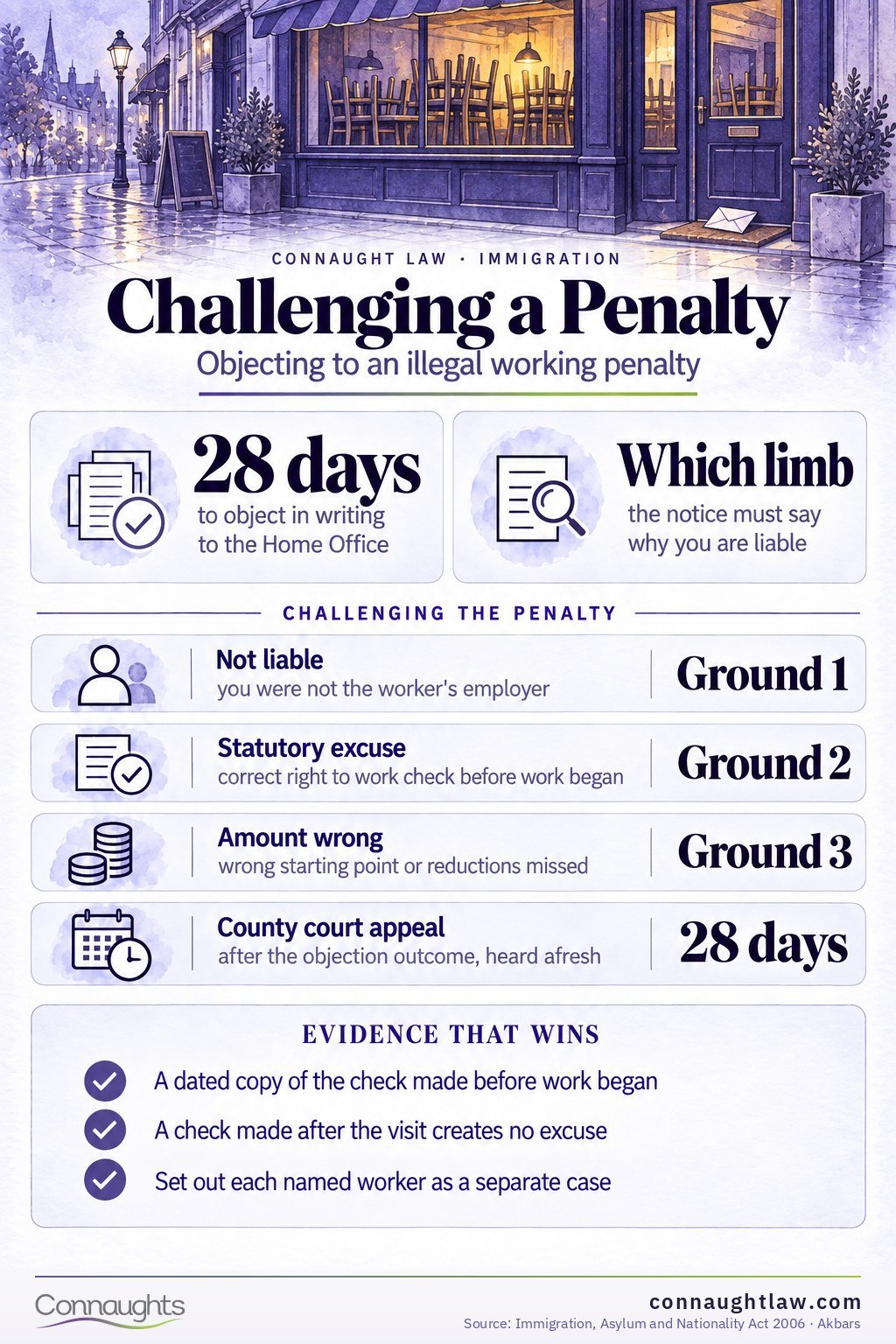
A civil penalty notice for illegal working starts at £45,000 for each worker named, and you have 28 days to object. On 27 July 2026 the Supreme Court held that a notice which does not say why you are liable is not a valid notice. That single point has made the wording of the document in your hand the first thing to check, before the arguments about your paperwork, your workers or your checks.
On This Page

Not a Conviction, and Not Final
A civil penalty is not a criminal conviction and it is not a court judgment. It is an administrative decision taken by a Home Office official, and like any administrative decision it can be wrong. It can be issued to the wrong company. It can ignore checks that were in fact carried out. It can be calculated on the wrong starting point or without the reductions the employer has earned. The scheme builds in two stages of challenge — a written objection to the Home Office, then an appeal to the county court — and both run on short, fixed deadlines.
Read the notice for a single sentence that tells you which route to liability the Home Office says applies: that the worker had no permission to be in the UK at all, or that they had permission which did not allow the work they were doing. If the notice recites both possibilities without choosing between them, the Supreme Court's decision in Akbars is directly relevant to you.
What a Civil Penalty Notice Has to Tell You
The scheme sits in the Immigration, Asylum and Nationality Act 2006. Section 15(1) makes an employer liable to a penalty where it employs a person who is subject to immigration control and who falls into one of two situations. The first is that the person has no leave to enter or remain in the United Kingdom at all. The second is that the person does have leave, but that leave is invalid, has ceased to have effect, or carries a condition which prevents them from taking the employment in question.
Those are two materially different allegations. The first says the worker should not have been in the country. The second says the worker was lawfully here but was not permitted to do this job — a description that covers an expired visa, a curtailed visa, a student working beyond permitted hours, and a dependant whose conditions restrict employment. An employer defending the first allegation is looking at completely different documents from one defending the second.
Section 15(6)(a) requires the penalty notice to state why the Secretary of State thinks the employer is liable to the penalty. Until this year, notices were routinely issued which set out the statutory grounds in the alternative, leaving the employer to work out for itself which one was actually being alleged. That practice is what the Supreme Court has now held to be insufficient.
The Supreme Court's Decision in Akbars
In Akbars Restaurant (Middlesbrough) Limited v Secretary of State for the Home Department [2026] UKSC 26, handed down on 27 July 2026, the Court allowed the employer's appeal unanimously. Lord Sales gave the leading judgment, with which Lord Leggatt, Lady Rose, Lord Richards and Lady Simler agreed. The appeal came from the Court of Appeal, which had decided the point the other way in [2024] EWCA Civ 1387.
The Court held that section 15(6)(a) obliges the Secretary of State to explain which limb of section 15(1) she considers applies. Reciting the grounds in the alternative does not discharge the duty. In Lord Sales's words, an employer who receives a penalty notice "is entitled to know from the notice which limb of section 15(1) is being invoked to justify imposing the penalty".
The reasoning turns on a point of ordinary fairness rather than technicality. A person facing a substantial financial penalty imposed by the state should be able to understand the case against them from the document that imposes it. The Court put the objection to the previous practice directly: an employer "should not have to appeal in order to find out which limb of section 15(1) is in fact being relied on by the Secretary of State, which is what happened here".
What the Judgment Does Not Decide
It is worth being precise about the limits, because the decision has been reported in broad terms. The Court did not hold that every civil penalty issued to date is invalid. It did not create a route to reopen penalties where the objection and appeal deadlines have long expired, and it did not address what happens to sums already paid. It decided what a valid notice must contain.
The practical consequence is therefore narrower than the headlines suggest, and it is also time-limited. The Home Office can be expected to amend its notice template so that future notices identify the limb relied on. The employers for whom this matters most are those holding a notice now, or who are inside the objection or appeal window, or whose penalty is still being enforced.
Objecting to the Penalty: The 28 Days and the Three Grounds
An objection is made in writing to the Home Office and must be submitted within 28 days of the due date given on the notice. It is not a formality and it is not a request for time to pay. It is the statutory mechanism for putting the employer's case, and in practice it is where most penalties that are reduced or cancelled are reduced or cancelled.
- You are not liable. You are not the employer of the person named — for example the individual was an agency worker, a genuinely self-employed contractor, or an employee of a separate legal entity.
- You have a statutory excuse. You carried out the prescribed right to work check correctly before employment began, and repeated it where the person had time-limited permission.
- The amount is wrong. The penalty has been calculated on the wrong starting point, or mitigating factors that should have reduced it have been left out of account.
Following an objection the Home Office reviews the decision and issues an objection outcome notice. It may cancel the penalty, reduce it, or maintain it. A cancellation is not unusual where the employer produces a compliant check that was simply not before the officer who made the original decision, which is a common outcome where records are held on site rather than centrally.
Twenty-eight days is not long to locate personnel files, obtain copies of documents from a payroll provider, and take advice. Gathering the evidence and drafting the objection should run in parallel, not in sequence. If material is genuinely outstanding, say so in the objection rather than missing the deadline while waiting for it.
The Evidence That Actually Changes the Outcome
Objections succeed on documents, not on assertions. The single most valuable item is a clear, dated copy of the right to work check as it was carried out before the employment began — the document that was seen, the record of the person conducting the check, and the date. A check carried out after the Home Office visit does not create a statutory excuse, although it may be relevant to mitigation.
Where the allegation is that the worker's conditions did not permit the employment, the useful material is different. It is the evidence of what the employer was told and shown about those conditions: the share code and the response it generated, the sponsor's records where the person was sponsored, and any correspondence about hours or restrictions. Where the allegation concerns hours worked by a student, rotas and timesheets often matter more than immigration documents — and the worker's own legal position, covered in our guide to the employment rights of illegal workers, is a separate question from the employer's liability.
Structure matters as much as content. An objection which sets out, worker by worker, what was checked, when, by whom and on what evidence is far easier for a reviewing officer to act on than a narrative account of the business. Where more than one worker is named, treat each as a separate case: it is common for a penalty covering several individuals to be cancelled for some and maintained for others.
Appealing to the County Court
If the objection does not produce an acceptable result, the employer may appeal to the county court. The appeal is on the same three grounds and must be brought within 28 days of the objection outcome. The court considers the matter afresh rather than reviewing the Home Office decision on public law principles, so evidence which was not before the Home Office can be put in.
An appeal carries costs risk and takes time, and for many employers the commercial judgment is finely balanced against the discount available for early payment. That calculation changes where the sum is large, where several workers are named, or where the penalty carries consequences beyond the money — most obviously for a business that holds or intends to apply for a sponsor licence, where a civil penalty is a matter the Home Office will take into account.
How the Penalty Amount Is Calculated
The figures were raised substantially on 13 February 2024 and are set out in the Home Office code of practice on preventing illegal working. The starting point is per worker, not per notice, which is why penalties naming several individuals reach six figures quickly.
Starting Points per Worker
| Circumstance | Starting point per worker |
|---|---|
| First breach | £45,000 |
| Repeat breach within three years | £60,000 |
Reductions are then applied for specified mitigating factors, which include reporting suspected illegal working, actively co-operating with the Home Office investigation, and having effective document checking practices in place even though the check on this occasion was defective. A first-time employer who meets the mitigating criteria may also receive a warning notice rather than a financial penalty, though that is not available where there has been a previous breach.
Where the calculation is the battleground, the objection needs to identify precisely which mitigating factor was overlooked and evidence it. "We co-operated" is weaker than a chronology showing what was provided, to whom and when.
Why More Notices Are Arriving
The increase in penalties is not an impression; it is visible in the Home Office's own published data. Enforcement visits and arrests both rose sharply in 2025, and the number of civil penalties issued to employers rose with them.
Enforcement Activity Year on Year
| Measure | 2024 | 2025 |
|---|---|---|
| Enforcement visits | 8,122 | 12,831 |
| Arrests | 5,647 | 9,008 |
| Civil penalties issued to employers | — | 2,438 |
| Total value of penalties issued | — | Over £130 million |
The activity is concentrated by sector. Restaurants, takeaways and cafés accounted for 3,559 visits in 2025, more than any other category, followed by food, drink and tobacco retail and then the beauty industry. Employers in those sectors are materially more likely to receive a visit, and should treat their right to work records as a live compliance risk rather than a filing exercise. The published enforcement data is broken down by sector and region.
Getting the Statutory Excuse Right for Next Time
The statutory excuse is the protection an employer acquires by carrying out the prescribed right to work check correctly before employment begins, and repeating it before permission expires where the person's leave is time-limited. It does not prevent a Home Office visit, but it defeats liability for a penalty in respect of that worker.
The excuse is procedural and unforgiving. It depends on the right check having been done, in the right way, at the right time, and on a legible dated record having been kept. A check that was carried out but not recorded is worth very little at the objection stage, because the employer cannot prove it. This is the single most common reason a penalty that could have been defeated is not.
The mechanics of manual checks, digital checks through the online service, and Identity Service Provider checks are covered in our guide to right to work checks for employers, together with the follow-up checks required for time-limited permission. Businesses that hold a sponsor licence carry additional duties — and their compliance costs — and a civil penalty is capable of affecting the licence itself as well as the balance sheet: the position on sponsor licence compliance and enforcement is dealt with separately.
For employers who have already received a notice, the two exercises run together. The objection deals with the penalty in front of you. The audit that follows deals with the next visit, which in the sectors currently being targeted is a realistic prospect rather than a remote one. General guidance on penalties for employing illegal workers is published on GOV.UK.
Frequently askedQuestions about civil penalties for illegal working
How long do I have to object to a civil penalty notice?
Twenty-eight days from the due date stated on the notice. The objection must be in writing and must be made on one or more of the three statutory grounds. Missing the deadline is difficult to recover from, so the date on the notice should be diarised the day it arrives.
Does the Akbars decision mean my penalty is cancelled?
No. The Supreme Court decided what a valid notice must contain, not that existing penalties are automatically void. If your notice does not identify which limb of section 15(1) is relied on, that is an argument to raise in an objection or appeal. It does not cancel the penalty by itself.
Can I reopen a penalty I paid last year?
The judgment does not address penalties where the objection and appeal deadlines have passed, and there is no established route to reopen them. Anyone in that position should take advice on their specific facts rather than assume the decision applies retrospectively.
How much is a civil penalty for employing an illegal worker?
The starting point is £45,000 for each worker on a first breach and £60,000 for each worker where there has been a breach within the previous three years, before any reductions. Because the figure is per worker, a notice naming several people reaches six figures quickly.
What is a statutory excuse and how do I prove I have one?
It is the protection gained by carrying out the prescribed right to work check correctly before employment starts, and repeating it where permission is time-limited. You prove it with a clear, dated record of the check made at the time. A check carried out after an enforcement visit does not create the excuse.
Can I appeal if the Home Office rejects my objection?
Yes. An appeal lies to the county court within 28 days of the objection outcome, on the same three grounds. The court hears the matter afresh, so evidence not previously provided can be introduced, but an appeal carries costs risk and should be weighed against the discount for early payment.
Will a civil penalty affect my sponsor licence?
It can. A civil penalty is a matter the Home Office takes into account when assessing whether a sponsor is suitable, and it may be relevant to a licence application, a renewal or compliance action against an existing licence. Sponsors should treat a penalty as a licensing issue as well as a financial one.
Does using an agency or a contractor remove my liability?
Not automatically, and it is fact-sensitive. Liability attaches to the employer, so the question is who actually employed the individual. Where labour is supplied through an agency or a genuinely self-employed contractor the answer may be that you are not liable, and that is the first of the three grounds of objection.
Tell us the date on the notice, how many workers it names and what right to work records you hold. We will tell you whether the notice says what the law now requires, whether an objection is worth making, and what evidence it needs to carry.
Get Expert Advice