A person working without permission to be in the UK still holds most of the employment rights everyone else holds. The contract is not automatically void, unpaid wages remain recoverable, and protection against discrimination does not depend on immigration status at all. What changes is which claims are open, how they are proved, and how quickly they must be brought — and the deadline for bringing them doubles this October.
On This Page

What You Can Still Claim
Employers sometimes assume that a worker without permission has no standing to complain about anything — no wages claim, no dismissal claim, no discrimination claim. That assumption has been wrong since 2019, and acting on it is how employers end up paying more than they would have paid by simply meeting their obligations.
The starting point is that an employment contract is not made void merely because the worker lacks immigration permission. Parliament created criminal and civil consequences for the employer; it did not, in doing so, strip the worker of contractual and statutory rights. Some claims do become harder, and one of them turns on how long the person has worked. But the door is not closed.
Quick answer — the contract usually stands
Unpaid wages, holiday pay, discrimination and harassment claims are available regardless of immigration status. Unfair dismissal depends on length of service, not status. The employer's own immigration breach does not become a defence to the worker's claim, and where the employer caused the immigration problem it will not be a defence at all.
The Two Cases That Decide This
Two decisions govern the area. One settles whether the statute itself kills the contract; the other settles when a court will refuse a claim on public policy grounds. Together they explain why an employer facing a wages claim from a worker without status is usually in a weaker position than it expects.
Okedina v Chikale and the £72,271 Award
Ms Chikale was brought from Malawi as a live-in domestic worker. Her visa expired; her employer kept her passport, told her an extension was in hand, and submitted an application that was refused. She went on working, unaware she had no leave, until she was dismissed after asking for more money. The tribunal ordered payment of £72,271.20, of which roughly £64,000 was unlawfully deducted wages.
The Court of Appeal upheld it. Giving the leading judgment, Underhill LJ held that sections 15 and 21 of the Immigration, Asylum and Nationality Act 2006 do not impliedly prohibit the contract: legislation creating an offence for the employer says nothing about whether the contract that employer entered into is valid. The common law illegality defence also failed, because Ms Chikale did not know of the illegality and had not knowingly taken part in it.
Okedina — why the employer's defence failed
The case is often read as being about sympathy. It is not. It turns on two separate findings: that the 2006 Act does not make the contract unlawful, and that the worker's own knowledge is what matters to the common law defence. An employer who conceals the position from the worker removes the only ground on which it could have resisted the claim. See Okedina v Chikale [2019] EWCA Civ 1393.
Patel v Mirza and the Range of Factors
Where illegality is raised at common law, the court no longer applies a mechanical rule. In Patel v Mirza [2016] UKSC 42 the Supreme Court replaced the old approach with an assessment of the underlying purpose of the prohibition, any other relevant public policy, and whether refusing the claim would be a proportionate response.
Applied here, the purpose of the illegal working provisions is to deter employers from engaging people without permission. Allowing an employer to keep wages it never paid would reward the very conduct the provisions target. That is why the defence rarely succeeds against a worker who did not know, and why it is weakest of all where the employer created the problem.
Where EU Workers Stand Now
EU citizens who did not obtain status under the EU Settlement Scheme, or whose status has lapsed, are in the same position as any other person without permission: the employment rights described below still apply. The immigration question and the employment question are decided separately, and a gap in status does not retrospectively unmake the work that was done.
Enforcement and the Fair Work Agency
Labour market enforcement was reorganised on 7 April 2026, when Part 5 of the Employment Rights Act 2025 came into force and the Fair Work Agency began operating. It brings the existing enforcement bodies together and takes on enforcement of rights such as holiday pay and statutory sick pay. For a worker owed wages, it is a route that does not depend on bringing a tribunal claim personally.
Which Rights Survive
Not every right behaves the same way. Some attach from the first day and take no account of status; one turns on length of service; one is capped and one is not. The distinctions matter more than the general principle, because they decide what a claim is actually worth.
Minimum Wage and Unpaid Wages
Entitlement to the national minimum wage arises from doing the work, not from holding permission to do it. Unpaid or underpaid wages are recoverable as an unlawful deduction, and this is where the largest sums usually sit — as Okedina shows, years of underpayment accumulate into a figure far larger than any single dismissal award. Current rates are published on gov.uk.
Unfair Dismissal and the Qualifying Period
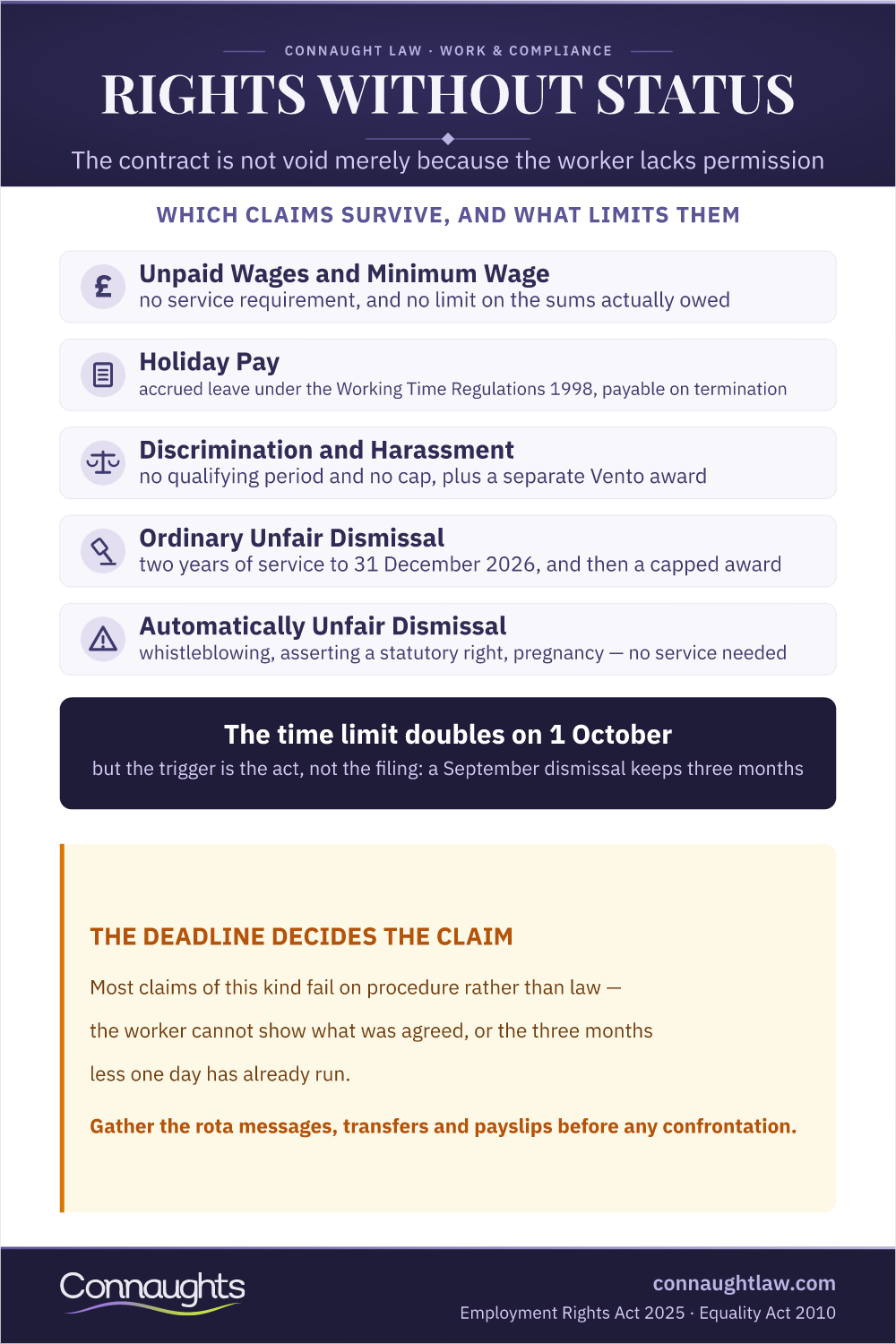
Unfair dismissal is the one claim that turns on service rather than status. Two years' continuous service is required, and that remains the position through 2026; the Employment Rights Act 2025 reduces it to six months for dismissals from 1 January 2027. Some dismissals — for whistleblowing, for asserting a statutory right, for pregnancy — are automatically unfair and need no qualifying period at all.
Awards are capped. From 6 April 2026 a week's pay is capped at £751 and the compensatory award at £123,543 or a year's pay, whichever is lower. The basic award is calculated from the capped week, so its ceiling is 30 × £751 = £22,530.
Discrimination and Injury to Feelings
Discrimination and harassment claims under the Equality Act 2010 need no qualifying period and carry no cap. On top of financial loss, tribunals award a separate sum for injury to feelings, set by the Vento bands. For claims presented on or after 6 April 2026 the bands run £1,300 to £12,600, £12,600 to £37,700, and £37,700 to £62,900, with the most exceptional cases capable of exceeding the top figure.
Rights that hold — whatever the status
- Wages actually earned, including the national minimum wage, recoverable as an unlawful deduction.
- Holiday pay and rest entitlements under the Working Time Regulations 1998.
- Discrimination and harassment protection under the Equality Act 2010 — no service requirement, no cap.
- Automatically unfair dismissal grounds, which need no qualifying service.
- Personal injury claims and the employer's health and safety duties, which are not employment-status dependent.
Rights That Survive Status
| Claim | Service needed | Limit on award |
|---|---|---|
| Unpaid wages and minimum wage | None | None — the sums actually owed |
| Holiday pay | None | None |
| Discrimination and harassment | None | Uncapped, plus a Vento award |
| Ordinary unfair dismissal | Two years, to 31 December 2026 | £123,543 or a year's pay |
| Automatically unfair dismissal | None | £123,543 or a year's pay |
Working Time and Holiday Pay
The Working Time Regulations 1998 give paid annual leave, rest breaks and limits on weekly hours. They apply to workers, a category wider than employees, and nothing in them turns on immigration permission. Accrued but untaken leave is payable on termination, and long periods of unpaid leave entitlement are a common second head of claim alongside unpaid wages.
What This Means for Employers
An employer facing both problems at once — a Home Office penalty and a tribunal claim from the same worker — is dealing with two systems that do not offset each other. Paying the penalty does not extinguish the wages claim, and settling the wages claim does not reduce the penalty.
Two separate duties — checks and contracts
The right to work check protects you against a civil penalty. It does nothing about your obligations under the contract you have made. Our guide to right to work checks covers the first duty; this post covers the second. From 1 October 2026 the checking duty reaches limb (b) workers, individual sub-contractors and online matching services under section 48 of the Border Security, Asylum and Immigration Act 2025 — the same people who already hold most of the rights set out above.
Right to Work Checks Are a Separate Duty
A compliant check gives a statutory excuse against the penalty. It is not a defence to a claim for wages, holiday pay or discrimination, and the absence of a check is not evidence that the worker has no rights. The two questions are decided by different bodies applying different tests, and an employer that conflates them tends to answer both badly.
Civil Penalties and Criminal Liability
The civil penalty maximum is £60,000 per worker, with published starting points of £45,000 for a first breach and £60,000 for a repeat breach within three years. Separately, section 21 of the 2006 Act creates a criminal offence where the employer knew, or had reasonable cause to believe, that the person was disqualified, carrying up to five years' imprisonment on indictment. If a notice has landed, our guide to challenging an illegal working civil penalty sets out the route.
When the Illegality Defence Fails
The defence is at its weakest where the employer controlled the immigration position — held the passport, undertook to make the application, or told the worker that permission was in place. It also fails where the worker simply did not know. It is at its strongest, and can still succeed, where the worker knowingly participated in a scheme to conceal the position from the outset.
Bringing a Claim
Most claims of this kind fail for procedural reasons rather than legal ones: the worker cannot show what was agreed, or misses the deadline. Both are fixable, and the deadline is about to become more forgiving.
Evidence of the Working Relationship
There is rarely a written contract. What usually proves the case is the ordinary residue of working life — rota photographs, messages arranging shifts, bank transfers or cash records, uniforms and name badges, a payslip however irregular, and the names of colleagues who can say what hours were worked. Contemporaneous material carries far more weight than a later account, so it should be gathered before any confrontation with the employer.
Settlement or Tribunal
Employers in this position often prefer to settle, because a tribunal hearing puts their own compliance failures on a public record. That gives a claimant real leverage, but it also means the first offer is usually low. A settlement agreement compromising statutory claims requires independent legal advice to be binding, which is a protection for the worker rather than an obstacle.
Time Limits and ACAS Early Conciliation
Most tribunal claims must currently be brought within three months less one day of the act complained of, with ACAS early conciliation notified first — that step pauses the clock. Deadlines here are strict and are the most common reason a good claim is lost.
From 1 October — the limit doubles
The Employment Rights Act 2025 extends the time limit for bringing most employment tribunal claims from three months to six, where the act complained of occurs on or after 1 October 2026, as Acas records. It does not revive a claim that is already out of time, so anyone approaching the current three-month deadline before that date should still treat it as the deadline that applies to them.
Funding a Claim
There is no fee to bring an employment tribunal claim. Legal aid is not generally available for employment claims, but conditional fee and damages-based agreements are common, and specialist advice charities take cases of this kind. Where the facts suggest labour exploitation or trafficking, separate support and immigration routes may be engaged, and those should be considered before any tribunal step is taken.
Frequently askedQuestions about work rights without status
Can I claim unpaid wages if I had no right to work?
Yes in most cases. The contract is not void simply because you lacked permission, and unpaid wages are recoverable as an unlawful deduction. The defence of illegality generally fails where you did not know, and fails almost always where the employer caused the problem.
Will bringing a claim expose me to the Home Office?
A tribunal is a public forum and the risk cannot be ruled out. It should be weighed against the value of the claim, and against any immigration route you may have. Take immigration and employment advice together, before a claim is issued rather than after.
Can I be dismissed just for not having status?
An employer who continues to employ you commits an offence, so dismissal is often lawful in substance. That does not remove wages already earned, holiday pay accrued, or any discrimination claim, and the manner of the dismissal can still be unlawful.
How long do I have to bring a claim?
Three months less one day for most claims, with ACAS early conciliation notified first. The Employment Rights Act 2025 doubles that to six months, and the trigger is the act complained of rather than the date you file: the six-month limit applies where the act or failure occurs on or after 1 October 2026, so a September dismissal keeps the three-month limit however late the claim is brought. In Scotland, breach of contract claims move on 9 November 2026. The extension does not rescue a claim that has already expired.
Does a discrimination claim have a limit on compensation?
No. Discrimination awards are uncapped and need no qualifying service. Tribunals also make a separate injury to feelings award under the Vento bands, which for claims presented on or after 6 April 2026 start at £1,300 and reach £62,900 in the most serious cases.
What if I was paid in cash with no payslip?
Cash payment does not defeat a claim. Messages arranging shifts, bank deposits, rota photographs and colleague evidence are all routinely accepted. The absence of paperwork is often the employer's failure, and tribunals are alive to that.
Tell us what work you did, how you were paid and what your immigration position is. We'll tell you what you can claim and what the risks of claiming are.
Get Expert Advice