
Immigration detention discrimination claims turn on a distinction the Immigration Rules never spell out: the Equality Act’s immigration exceptions apply to decisions about leave, not to decisions to detain. Two Court of Appeal judgments have already held the Home Office in breach inside detention. This guide sets out which duties survive, what the statutory limits on detention actually are, and the deadline that ends most claims before they start.
On This Page

What the Equality Act Reaches Inside Detention
People often assume the Equality Act stops at the border, and that anything the Home Office does under the Immigration Acts is beyond its reach. That is not the position. The Act carries two carve-outs for immigration functions, both narrow and both drafted around decisions on entry clearance and leave. Neither of them touches a decision to detain, to keep someone detained, or to hold them apart from other detainees. That is why two claims of this kind have already succeeded in the Court of Appeal.
- Which characteristic. Disability, sex, pregnancy and maternity, gender reassignment and sexual orientation are untouched by the immigration exceptions. Age, religion or belief, and race in the sense of nationality or ethnic origins are partly clipped.
- Which duty. The duty not to discriminate and the duty to make reasonable adjustments apply in full. Only one limb of the public sector equality duty is disapplied.
- Which decision. The exceptions bite on refusing, cancelling or varying leave. Detention, segregation and the conditions inside are outside them.
- Which forum. A damages claim goes to the county court under section 114; an ongoing detention is challenged by judicial review or a bail application.
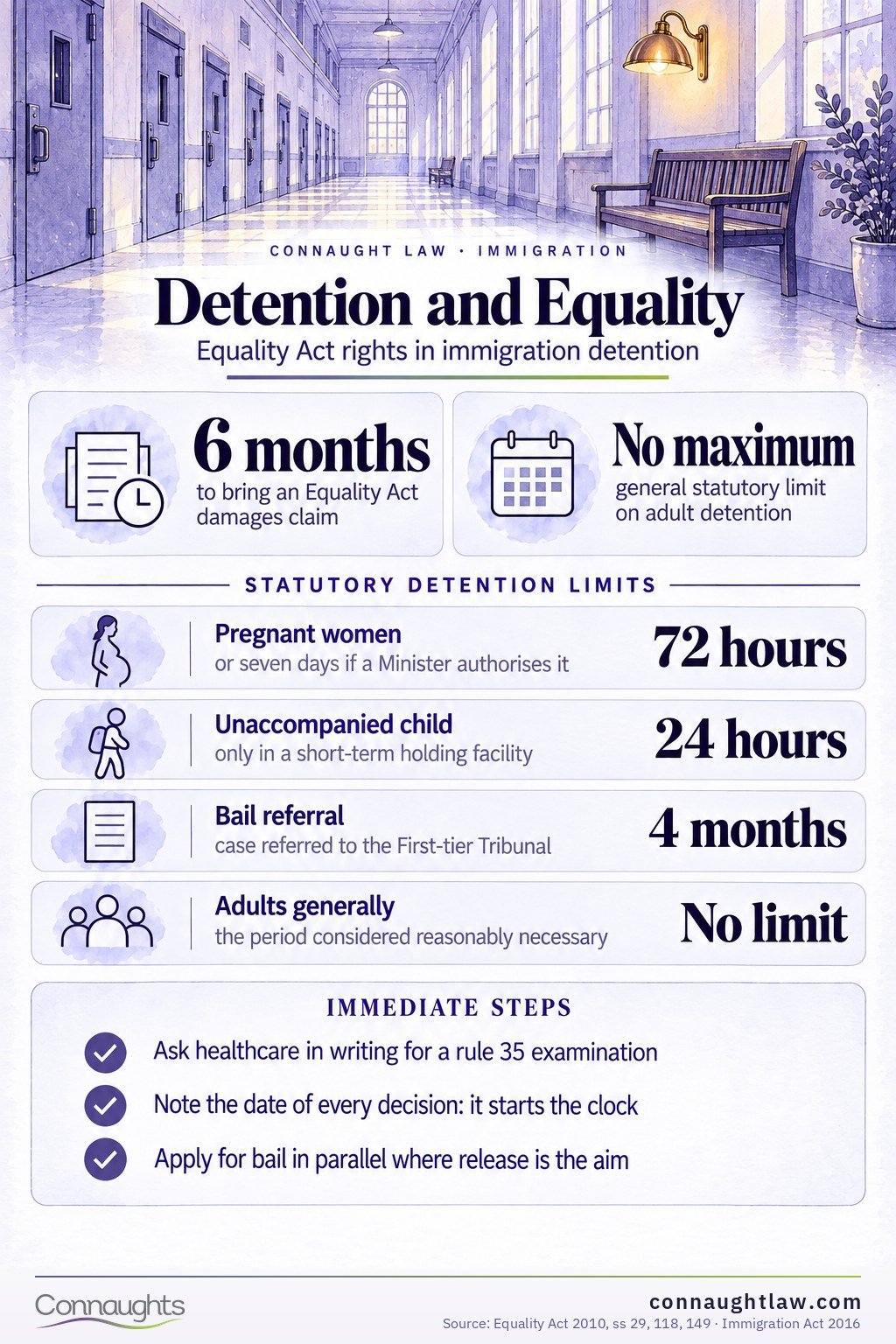
- Which deadline. Six months from the act complained of, running from the date of the act itself.
Sections 29 and 149 Applied to Detention
Section 29(6) of the Equality Act provides that a person exercising a public function that is not the provision of a service must not do anything that constitutes discrimination, harassment or victimisation. Section 29(7)(b) attaches the duty to make reasonable adjustments to that same function. Detaining someone under Schedule 2 to the Immigration Act 1971, or under section 62 of the 2002 Act, is the exercise of a public function, so both duties run throughout a period of detention.
Section 149 adds the public sector equality duty: a public authority must have due regard to the need to eliminate discrimination, to advance equality of opportunity, and to foster good relations. Subsection (4) spells out that meeting the different needs of disabled people includes taking account of their disabilities. The duty is owed in the exercise of functions, so it is engaged by every detention review, every segregation decision and every removal direction.
These are two different claims and they fail for different reasons. A challenge to the decision to detain, or to maintain detention, is a public-law challenge and belongs in judicial review, with the Equality Act duties running alongside. A complaint about treatment inside — healthcare, religious observance, segregation, access to an interpreter — engages the Detention Centre Rules 2001 as well, and is usually a damages claim. Confusing the two is the most common reason a detention discrimination case reaches the wrong forum.
Where Schedule 18 Bites, and Where It Does Not
Paragraph 2 of Schedule 18 provides that, in relation to immigration and nationality functions, section 149 has effect as if subsection (1)(b) did not apply to age, race or religion or belief — and for that purpose race means only nationality or ethnic or national origins. Read precisely, that removes one limb of one duty for three characteristics. The duty to eliminate discrimination and the duty to foster good relations survive for every characteristic, and nothing at all is removed for disability, sex, pregnancy, gender reassignment or sexual orientation.
Disability, Leave and the Second Carve-Out
The second carve-out sits in Part 4 of Schedule 3. Its disability provision, paragraph 16, disapplies section 29 for decisions to refuse entry clearance, or to refuse, cancel or vary leave, taken on the ground that doing so is necessary for the public good, and for guidance connected with such decisions. Every paragraph in that Part is keyed to entry clearance or leave. None of them mentions detention, which is precisely why the reasonable-adjustments claims described below were available at all.
How Long Detention Can Last
There is no general statutory maximum on immigration detention in the United Kingdom. Section 12 of the Illegal Migration Act 2023, in force since 28 September 2023, inserted a provision into Schedule 2 to the Immigration Act 1971 making the permissible period one that, in the opinion of the Secretary of State, is reasonably necessary. That opinion is reviewable, but it is the starting point, and it is the single most important fact about this subject that most published guidance omits.
The common-law limits still apply. The Hardial Singh principles, restated by the Supreme Court in R (Lumba) v SSHD [2011] UKSC 12, require the power to be used only for the purpose of removal, for a period that is reasonable in all the circumstances, with detention ending once it becomes apparent that removal will not be achieved within a reasonable period, and with reasonable diligence throughout. They set no number of days. Fixed limits exist only for two groups.
Detention Limits in Statute
| Who | What the limit is | Where it comes from |
|---|---|---|
| Adults generally | No maximum; the period is what the Secretary of State considers reasonably necessary | Illegal Migration Act 2023 s.12, in force 28 September 2023 |
| Pregnant women | 72 hours, or seven days if authorised personally by a Minister of the Crown | Immigration Act 2016 s.60 |
| Unaccompanied children | 24 hours, and only in a short-term holding facility | Immigration Act 1971, Sch 2 para 18B |
| Anyone held four months under Sch 2 or s.62 of the 2002 Act | The Secretary of State must refer the case to the First-tier Tribunal to decide bail | Immigration Act 2016, Sch 10 para 11 |
The Two Judgments That Decide These Claims
In R (VC) v SSHD [2018] EWCA Civ 57 the Court of Appeal granted a declaration that the Secretary of State had discriminated against a detainee with bipolar affective disorder by failing to make reasonable adjustments to her decision-making processes, in breach of sections 20 and 29. The reasoning is the part worth carrying: because an independent review of immigration detention depends on the detainee applying for bail, a detainee too unwell to start that process is at a substantial disadvantage compared with one who is not.
The court held the duty to be anticipatory as well as individual, so it is owed to mentally ill detainees as a class and not only once a particular person has asked for help. It also placed the burden on the Secretary of State under section 136 to show she had complied, and held that she had not. No further appeal is recorded.
R (ASK) v Secretary of State for the Home Department [2019] EWCA Civ 1239
ASK was decided on 16 July 2019 and is the authority most often cited without being read. The Court of Appeal held that because his illness left him unable at times to engage with decisions about his continued detention, segregation and transfer to hospital, he was treated differently from detainees who were not disabled; that the Secretary of State had breached the public sector equality duty by failing to have due regard to the need to eliminate discrimination; and that obvious adjustments, such as advocate representation, could have been made and were not.
Two features of the disposal matter more than the finding. The equality ground succeeded and every other ground failed, including article 3, article 8 and Hardial Singh. And the damages claim was remitted to the county court, which is where a section 114 claim belongs. Note also which limb of the public sector equality duty was breached: the duty to eliminate discrimination, the limb Schedule 18 leaves intact. A claim framed on advancing equality of opportunity for age, religion or race would have met the exception.
Adults at Risk and the Rule 35 Chain
Section 59 of the Immigration Act 2016 requires the Secretary of State to publish guidance on detaining people who would be particularly vulnerable to harm in detention. The current version came into force on 21 May 2024. It grades evidence into three levels: a self-declaration carries limited weight at level 1; professional or official evidence that someone is at risk sits at level 2; and professional evidence that detention would be likely to cause harm sits at level 3. Pregnant women are automatically treated as meeting level 3.
The indicators include mental health conditions, torture, sexual and gender-based violence, trafficking and modern slavery, post-traumatic stress disorder, serious physical disability, age of 70 or over, and being transgender or intersex. The list is expressly not exhaustive. What the guidance does not do is exempt anyone. It states that no group of vulnerable people within it is exempt from the possibility of detention, and that a vulnerable person may be detained where the immigration factors outweigh the risk factors.
The evidence usually arrives through rule 35 of the Detention Centre Rules 2001. The medical practitioner must report on any detainee whose health is likely to be injuriously affected by continued detention, on any detainee suspected of suicidal intentions, and on any detainee who may have been a victim of torture. Torture has carried a statutory definition since 2 July 2018: severe pain or suffering intentionally inflicted where the perpetrator has control over a victim who is powerless to resist.
The report goes to the centre manager, who must send a copy to the Secretary of State without delay. It then feeds the balancing exercise; it does not decide it. The Independent Chief Inspector of Borders and Immigration found in his third annual inspection of the adults-at-risk policy, published in January 2023, that in 15 of 50 sampled cases the report had not been uploaded to the case record at all. Assume the report will need chasing, and that a bail application will be doing the real work.
Brook House, the Time Limit and the Government’s Answer
The Brook House Inquiry reported on 19 September 2023, chaired by Kate Eves. Across a relevant period of five months it identified nineteen incidents in which there was credible evidence of acts or omissions capable of amounting to mistreatment contrary to article 3 of the European Convention, and made thirty-three recommendations. Two of them go directly to the safeguards described above: mandatory annual training on rules 34 and 35, and a review of whether all three limbs of rule 35 are operating effectively and are adequately resourced.
Recommendation 7 asked for a statutory maximum of twenty-eight days. The Government refused it in its response of March 2024, on the ground that a time limit would impair the ability to remove people who have refused to leave voluntarily, and pointed to the Illegal Migration Act formulation instead. That refusal is why the table above has no general maximum in it, and it is the honest answer to the question most readers arrive with.
The Border Security, Asylum and Immigration Act 2025 received Royal Assent on 2 December 2025. Section 44 permits detention while the Secretary of State merely considers whether to make a deportation order, subject to written notice, which is a real expansion. It contains no offshore detention power, no time limit, and no amendment to the Detention Centre Rules or the Equality Act. Section 41 repealed most of the Illegal Migration Act 2023 but not section 12, so the reasonable-period rule survives.
HM Inspectorate of Prisons Detention Estate Reports
Inspection reports are the most usable contemporaneous evidence in a detention case, because they are Crown-copyright, dated, and specific to a centre. The February 2024 inspection of Harmondsworth, published on 9 July 2024, recorded the worst conditions inspectors had seen in immigration detention. The independent review of progress in February 2025, published on 8 April 2025, found good progress against eleven of fourteen concerns, but recorded that protections for vulnerable detainees were still improving too slowly, particularly through the rule 35 process, and that mental health services remained inadequate.
The most current inspectorate work on this subject is the thematic report on women’s experience of immigration detention, published on 14 July 2026. It found that women with histories of self-harm, gender-based violence, trafficking or pregnancy were often nonetheless assessed as fit to be detained, that assessment and communication about vulnerability were poor, and that gaps in staff knowledge meant vulnerable women did not always get the support they needed. In a claim under sections 20 and 29, findings of that kind are what establish the substantial disadvantage.
Remedies, Forums and the Six-Month Trap
Four routes exist and they do different jobs. The internal complaints system under rule 38 of the Detention Centre Rules deals with treatment and produces a paper trail; complaints escalate to the Independent Examiner of Complaints and then to the Prisons and Probation Ombudsman, whose jurisdiction covers treatment in removal centres but expressly excludes immigration status, the reasons for detention and its length. Use it for evidence, not for release.
For release, the routes are a bail application to the First-tier Tribunal and, where the detention is unlawful in public law terms, judicial review. Where deportation is the underlying decision, the equality points will usually be run alongside the deportation appeal rather than separately. Damages for a breach of sections 20, 29 or 149 go to the county court under section 114 of the Equality Act, which is exactly where the Court of Appeal remitted the claims in both VC and ASK.
Section 118 of the Equality Act gives a claimant six months starting with the date of the act complained of, so the claim must be issued the day before the six-month anniversary. Conduct extending over a period is treated as done at the end of that period, and a failure to act is treated as occurring when the decision not to act was taken. The court has a discretion to allow a longer period where it is just and equitable, but that is a concession to be argued for, not a limitation period to be relied on.
Immediate Steps for Detainees and Representatives
Ask the healthcare team in writing for a rule 35 examination and keep the request. Obtain the monthly written reasons for detention, which rule 9 requires the Secretary of State to provide. Where a period of removal from association is imposed, ask for the written reasons the rules require within two hours. Request the full detention review record and the adults-at-risk assessment, and note the date of every decision, because that date starts the six-month clock. Where the object is release rather than compensation, apply for immigration bail in parallel; our immigration team runs the two together as a matter of course.
Frequently askedQuestions about discrimination in immigration detention
Is there a 28-day limit on immigration detention in the UK?
No. The Brook House Inquiry recommended one and the Government rejected the recommendation in March 2024. Section 12 of the Illegal Migration Act 2023 makes the permissible period one that the Secretary of State considers reasonably necessary. Fixed limits exist only for pregnant women and unaccompanied children.
Does the Equality Act apply to people in immigration detention?
Yes. The immigration exceptions in Schedule 3 are confined to decisions on entry clearance and leave, and Schedule 18 removes only one limb of the public sector equality duty, for three characteristics. Nothing is removed for disability, sex, pregnancy, gender reassignment or sexual orientation.
What is a rule 35 report and what does it achieve?
It is a report by the centre’s medical practitioner where a detainee’s health is likely to be injuriously affected by detention, where suicidal intentions are suspected, or where they may have been a victim of torture. It must reach the Secretary of State without delay and feeds the adults-at-risk assessment, but it does not require release.
How long do I have to bring a discrimination claim?
Six months from the date of the act, under section 118 of the Equality Act, with a discretion to extend where it is just and equitable. Judicial review of an ongoing detention should be brought far sooner. Do not rely on any longer period; the six-year figure sometimes quoted is wrong for these claims.
Can the Ombudsman order my release?
No. The Prisons and Probation Ombudsman can examine the management, supervision, care and treatment of people held under immigration powers, but its terms of reference exclude immigration status, the reasons for detention and its length. Release comes from bail, judicial review or a Home Office decision.
Will the Home Office review my detention automatically?
Written reasons must be given monthly. After four months of detention under Schedule 2 to the 1971 Act or section 62 of the 2002 Act, the Secretary of State must refer the case to the First-tier Tribunal to decide bail. That duty does not reach detention pending deportation, and the clock restarts each time the Tribunal considers bail.
Tell us the date detention began, the power it was authorised under, and whether a rule 35 report has been made. We’ll tell you what can be challenged now and what has a deadline running against it.
Get Expert Advice