
Derivative rights of residence come from EU case law rather than from any treaty right of the person claiming them: Zambrano for the carer of a British child, Chen for the carer of a self-sufficient EU child, and Ibrahim and Teixeira for the carer of a child in education. Under the EU Settlement Scheme they have diverged sharply. One of the three closed to new applicants in August 2023; the other two did not.
On This Page

Where Derivative Rights Stand Now
The operative source is Appendix EU, not the Immigration (European Economic Area) Regulations 2016, which were revoked at the end of the transition period on 31 December 2020. Regulation 16 still appears in a great deal of published commentary and it is no longer the rule anyone is decided under.
Appendix EU carries the derivative categories forward through the Annex 1 definitions of a person with a Zambrano right to reside and a person with a derivative right to reside. Those definitions, and the required date attached to each, are what decide whether an application can still be made.
The single most important thing on this page is that the three categories no longer share a deadline. Treating them as one body of law — as most guidance still does — produces the wrong answer for two of the three.
The Three Categories
Zambrano covers the primary carer of a British citizen child or dependent adult who would in practice be compelled to leave the UK, and with it the EU, if the carer were removed. Chen covers the primary carer of a self-sufficient EEA citizen child exercising free movement rights. Ibrahim and Teixeira cover the primary carer of the child of an EEA worker where that child is in education in the UK.
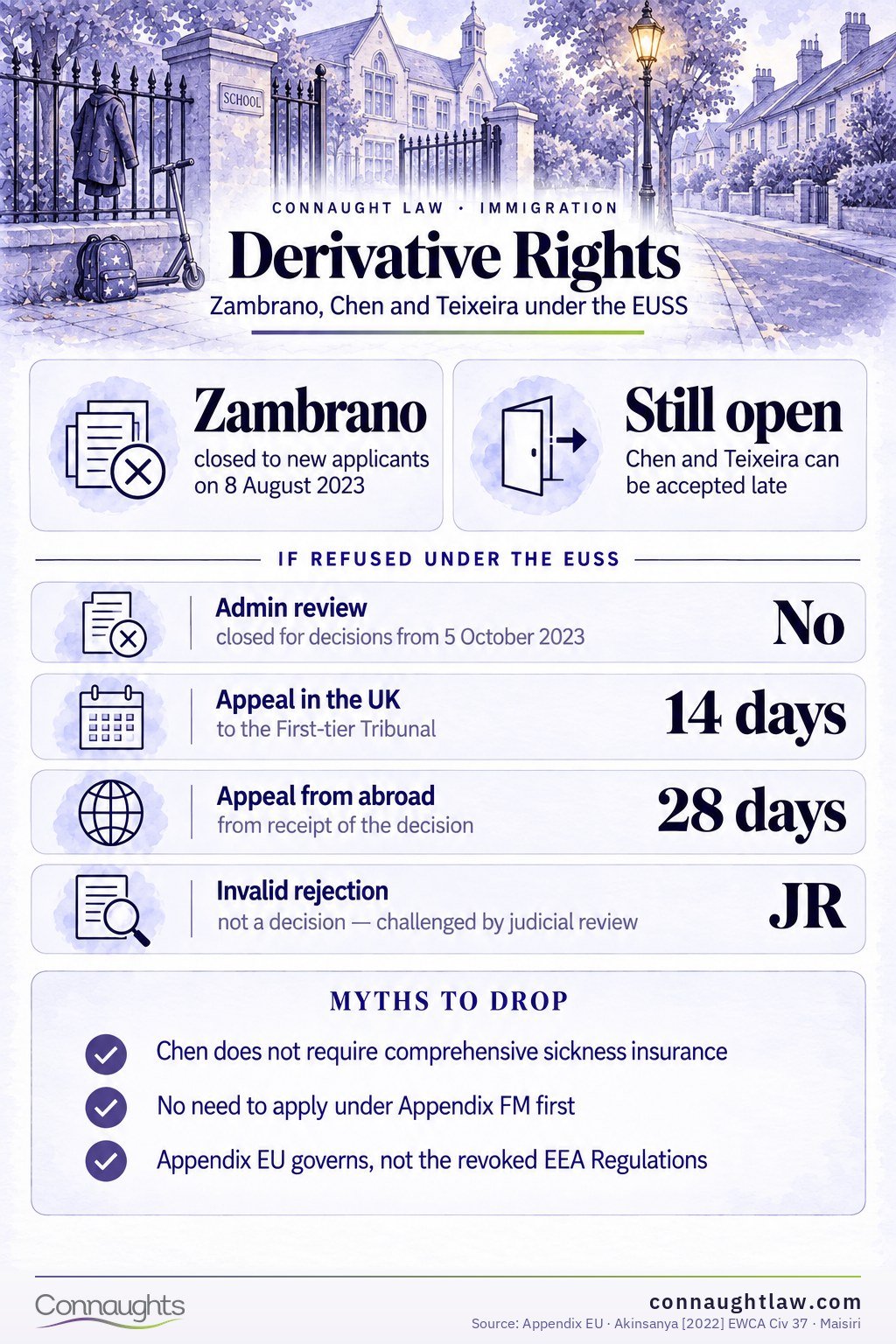
One correction worth making at the outset, because it appears widely: a Chen case does not require comprehensive sickness insurance. Annex 1 defines a self-sufficient person as someone with sufficient resources not to become a burden on the social assistance system “regardless of whether they hold comprehensive sickness insurance cover in the UK”. Applications have been abandoned over a requirement that does not exist.
Zambrano: Closed to New Applicants
The Zambrano route closed on 8 August 2023. Annex 1’s definition of the required date, at paragraph (a)(vi), fixes that date for a person relying on a Zambrano right, and EU9(e) makes an application outside it invalid. There is no reasonable grounds escape. Unlike a late application in most other EUSS categories, lateness here is not something the Home Office can excuse.
- A person who already holds pre-settled status granted on a Zambrano basis, applying for settled status.
- A person who holds an EU Settlement Scheme family permit issued on that basis.
- Nobody else. A carer who has never applied cannot start now, however strong the facts and however plainly a British child would be compelled to leave.
That is a hard result and it is the current law. Where the Zambrano route is shut, the remaining options are the family and private life routes under Appendix FM and Appendix Private Life, decided on Article 8 rather than on EU derivative principles.
What Akinsanya Actually Decided
This is the point most often reported backwards. In R (Akinsanya) v SSHD [2022] EWCA Civ 37, decided on 25 January 2022, the Court of Appeal ruled against the Secretary of State. Underhill LJ held that “the natural meaning of regulation 16 is indeed that a person with limited leave to remain is entitled to a derivative right to reside”, and the court declared that the Secretary of State had erred in law in her understanding of that regulation.
So holding limited leave did not, at that time, defeat a Zambrano claim. The reason the current rules nonetheless exclude a person who holds other leave is not that Akinsanya endorsed the position — it is that the Rules were changed afterwards. Statement of Changes HC 719, laid on 18 October 2022 and in force from 9 November 2022, put the condition into Appendix EU directly.
A second correction follows from Maisiri [2024] UKUT 235 (IAC), decided on 21 June 2024. The Upper Tribunal held that a decision maker is not required to assess whether a Zambrano applicant has a realistic prospect of leave under another provision, including Appendix FM — and said in terms that Home Office guidance “has been wrong in suggesting otherwise from 14 December 2022 to date”. There is no requirement to apply under Appendix FM first.
Chen and Teixeira: Still Open
Chen and Ibrahim/Teixeira carers sit under a different limb of the required date definition, at paragraph (a)(i)(bb), and a late application in those categories can still be accepted on reasonable grounds. That is the live route, and it is the practical reason for separating the categories rather than describing derivative rights as a single closed door.
A Chen application turns on the child’s self-sufficiency and the carer’s role; a Teixeira application turns on the child’s continuing education and the former worker status of the EEA parent. Both need documentary evidence covering the whole period relied on, and both are decided under Appendix EU rather than under the old Regulations.
Applying, Evidence and Refusals
Applications are made through the EU Settlement Scheme, and the evidence has to establish the relationship, the primary carer role and — for Zambrano — the compulsion to leave the UK if the carer went. That last element is where most cases are decided, and it is a factual question about the child’s actual circumstances rather than a legal formula.
Administrative review closed for EU Settlement Scheme decisions made on or after 5 October 2023, under AR(EU)1.4. The remedy is a statutory appeal to the First-tier Tribunal under the Immigration (Citizens’ Rights Appeals) (EU Exit) Regulations 2020, with 14 days to appeal in country and 28 days from receipt outside the UK. A rejection as invalid, by contrast, is not a decision at all and has to be challenged by judicial review — which is the position a late Zambrano application will be in. Our litigation team handles both.
Where the application is a derivative one made alongside a family member’s, the two are decided separately and on different definitions — our guide to the EU Settlement Scheme family permit covers that side, and extended family member appeal rights covers the appeal case law in more detail.
Frequently askedQuestions about derivative rights of residence
Can I still make a Zambrano application?
Only if you already hold pre-settled status granted on a Zambrano basis, or an EU Settlement Scheme family permit issued on that basis. The route closed to new applicants on 8 August 2023 and there is no reasonable grounds exception.
What did Akinsanya decide?
The Court of Appeal decided against the Secretary of State in January 2022, holding that a person with limited leave to remain could be entitled to a derivative right to reside. The current exclusion comes from HC 719, which changed the Rules in November 2022.
Do I have to apply under Appendix FM first?
No. In Maisiri the Upper Tribunal held that no realistic-prospect assessment under another route is required, and that Home Office guidance had been wrong to suggest otherwise since December 2022.
Does a Chen case need comprehensive sickness insurance?
No. Annex 1 defines self-sufficiency "regardless of whether they hold comprehensive sickness insurance cover in the UK". The requirement is often asserted and it is not in the rules.
Can Chen or Teixeira applications still be made late?
Yes. They fall under a different limb of the required date definition and can be accepted late on reasonable grounds, unlike Zambrano.
Can I ask for an administrative review if refused?
No. Administrative review closed for EUSS decisions made on or after 5 October 2023. The remedy is an appeal to the First-tier Tribunal — 14 days in country, 28 days from receipt abroad.
Are the EEA Regulations still relevant?
No. The Immigration (European Economic Area) Regulations 2016 were revoked on 31 December 2020. Anything decided today is decided under Appendix EU, whatever regulation 16 used to say.
Tell us the child's nationality, your immigration status and whether you have ever applied to the settlement scheme. We'll tell you which derivative category applies and whether it is still open to you.
Get Expert Advice