Grounds of Divorce on 5 Years Separation 2026: Expert Legal Guide

Grounds of divorce on 5 years separation no longer exist: the five-year separation ground was abolished on 6 April 2022, when the Divorce, Dissolution and Separation Act 2020 introduced no-fault divorce in England and Wales. If you have been separated for five years - or five months - you now divorce the same way as everyone else: a statement that the marriage has broken down irretrievably, which your spouse cannot contest, with no separation period required at all. This guide explains how the old five-year route worked, what replaced it, and the issues that genuinely matter for long-separated couples divorcing in 2026 - especially the financial claims that never expired.

Understanding Grounds of Divorce on 5 Years Separation - Then and Now

For half a century, five years’ separation was the divorce of last resort: the only route that needed neither the other spouse’s consent nor allegations of fault. Spouses trapped in long-dead marriages - often because the other refused to engage - waited out the five years and divorced unilaterally.

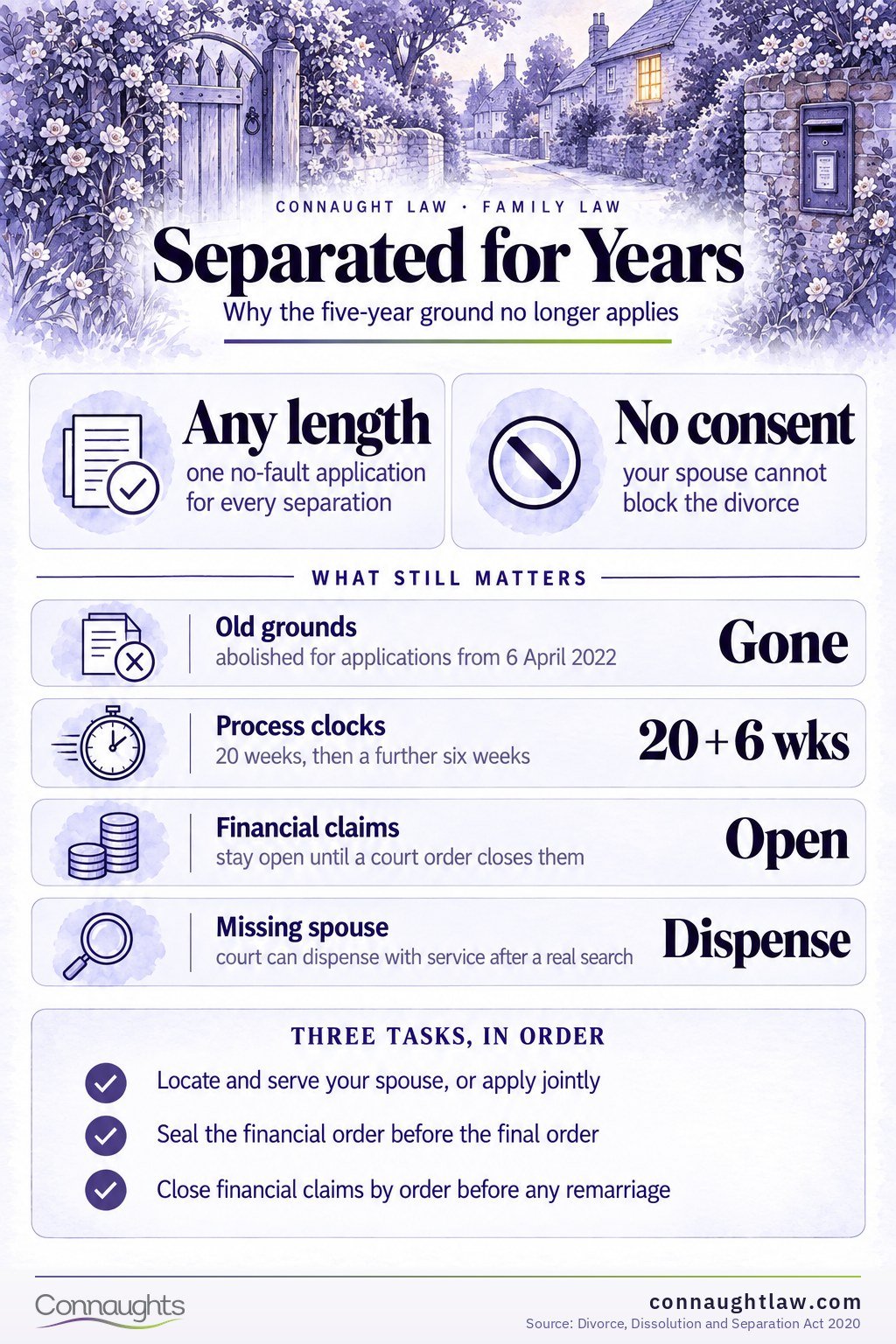
That world ended on 6 April 2022. The Divorce, Dissolution and Separation Act 2020 abolished all five facts, including five-year separation, for every application made from that date. Anyone still searching for the five-year rule is looking at the old law - and following it would mean waiting years for a divorce available today.

This page therefore does two jobs. It preserves an accurate account of how the five-year ground operated, because the old terminology - petitioner, decree nisi, decree absolute - still appears in older orders, articles and search results. And it maps every question the old ground used to answer onto the current law, so long-separated spouses can act now rather than wait needlessly.

One group genuinely still touched by separation periods: couples who signed separation agreements years ago. Those agreements remain relevant evidence of intended finality and asset division, and a court will weigh them under the ordinary fairness principles - especially where both had advice and honoured the terms since. Bring them to the first appointment.

Children arrangements are rarely live issues after five or more years apart - patterns have settled - but child maintenance can still be recalculated at any time while children qualify, and the CMS applies current income, not the position at separation. Where adult children remain financially dependent through university, provision is negotiated rather than statutory.

Five-Year Separation Divorce Uk Infographic — How Separation Grounds Worked Before The 2022 Reforms And How No-Fault Divorce Now Removes The Need To Wait Or Prove Separation

Under section 1(2)(e) of the Matrimonial Causes Act 1973, a petitioner could rely on five years of continuous separation without the respondent’s consent - unlike the two-year route, which required agreement. The respondent’s only shield was section 5: a defence that dissolution would cause grave financial or other hardship, deployed rarely and successfully almost never.

The ground’s abolition followed directly from Owens v Owens, where the Supreme Court reluctantly upheld the refusal of a divorce to a wife whose behaviour petition failed - leaving her to wait out five years of separation. The public reaction to that result drove the 2020 Act through Parliament.

The two-year separation ground with consent, desertion, adultery and behaviour disappeared at the same time. With them went the vocabulary: the petitioner became the applicant, the decree nisi the conditional order, the decree absolute the final order. Documents from older proceedings keep their original names - a decree absolute from 2015 remains exactly that, and remains fully valid.

Search behaviour reflects the confusion: thousands still look for the five-year rule every month, and some older websites present it as current law. Treat any page describing separation grounds, consent requirements or the hardship defence as live law with caution - it describes proceedings that ceased to exist in April 2022.

If you hold an old decree nisi but never obtained the decree absolute, the marriage never ended - a situation discovered surprisingly often when someone plans to remarry. The remedy is an application within the original proceedings for the final order, with an explanation for the delay; long gaps attract judicial scrutiny of any financial prejudice but are routinely resolved.

What Replaced the Grounds of Divorce on 5 Years Separation

The single modern route: an application - sole or joint - stating irretrievable breakdown, followed by a 20-week reflection period, a conditional order, and a final order 6 weeks and 1 day later. No separation period, no consent requirement, no hardship defence, no fault. The full procedure is covered in our no-fault divorce guide.

The Position in 2026: Separation length is legally irrelevant to obtaining a divorce. Whether you separated last month or in 2010, the process, timeline and fee are identical. Where long separation still matters is money: financial claims survive until dismissed by a court order, and how assets built up during the separation are treated can dominate the settlement.

The old ground demanded proof: the date the couple began living apart, continuity of separation for five years, and - where they shared a roof - evidence of separate households, separate finances and separate lives. Disputes over the separation date could add hearings and cost.

Today the divorce needs no evidence beyond the marriage certificate and the breakdown statement. But do not discard the old records: the separation date remains important for financial purposes. It anchors capital gains tax treatment of transfers between separating spouses, frames arguments about which assets are matrimonial, and explains the shape of each party’s finances to a court assessing needs.

Separation Date and Capital Gains Tax

Since April 2023, separating spouses have three tax years from the end of the tax year of separation to transfer assets between themselves on a no-gain, no-loss basis - and unlimited time where the transfer happens under a formal divorce agreement or court order. For couples separated many years, that window has usually closed, so transfers need structuring through the financial order to avoid unnecessary CGT.

Serving Proceedings on Cooperative and Uncooperative Respondents

Five-year cases were classically brought against spouses who would not engage - and the modern process handles them better. The court serves the application, usually by email with postal notice; the respondent has 14 days to acknowledge. Cooperation speeds things up but is not required, and there is no longer anything to defend.

Where a respondent sits silent, deemed service, bailiff or process-server service, and service by alternative methods keep the case moving - the escalation ladder is set out in our guide to a spouse who does not respond to divorce papers. Silence delays a divorce by weeks, not years.

Respondents living abroad follow the international service routes - permitted postal service, the Hague Service Convention, or court-approved alternatives - with extra time allowed for acknowledgment. Long-separated spouses are disproportionately likely to be overseas, so build service method and timing into the plan at the start rather than discovering the issue mid-case.

Long separation often means a spouse whose whereabouts are unknown. The court expects genuine efforts first: last known addresses, relatives and mutual contacts, social media, and where proportionate a tracing agent. Government records can be reached through specific court orders where justified.

If searches fail, the court can permit service by an alternative method - email, a relative, even social media - or, as a last resort, dispense with service entirely and let the divorce proceed unserved. Judges grant dispensation cautiously, so documenting every search attempt is what wins the application.

Costs in missing-spouse cases stay manageable when the searches are organised once, comprehensively, rather than piecemeal across months. A single instruction to a tracing agent with a documented report typically satisfies the court, where scattered informal attempts invite requisitions and repeat hearings.

Where the missing spouse is later found - it happens more often than expected once proceedings concentrate minds - the case simply reverts to the ordinary track: service is effected, the acknowledgment window runs, and the timetable continues. Nothing done in the search phase is wasted, and the financial proceedings gain a respondent who can give disclosure.

A different situation is the spouse believed to have died. Where death is likely but unproven, a presumption of death application - available after seven years’ absence, or earlier with strong evidence - may be more appropriate than divorce, since it ends the marriage and resolves inheritance questions at once. Advice on which route fits usually takes one conversation.

Whichever route applies, keep the evidence trail: search reports, returned correspondence, statements from relatives. The same bundle that persuades a judge to dispense with service also supports later financial applications where the missing spouse’s non-engagement must be explained.

Cost Analysis and Financial Planning in 2026

The court fee is £628 from 13 July 2026, whatever the history of the marriage, with Help with Fees remission for those on low incomes. Tracing agents, process servers and dispensation applications add modest amounts in missing-spouse cases - the D11 application fee is £195.

The real financial planning issue for long-separated couples is the settlement, not the divorce. A financial consent order (£62 to lodge) or contested financial remedy application (Form A, £321) resolves claims that otherwise stay open indefinitely. Where hourly-rate work is quoted, the solicitors’ guideline hourly rates published on gov.uk give the benchmark ranges.

Legal aid remains unavailable for the divorce itself absent domestic abuse evidence, but the cost of a straightforward no-fault application is modest and predictable. Where finances are the battleground after long separation, mediation with the £500 voucher for cases involving children, or solicitor-led negotiation towards a consent order, keeps total spend proportionate.

Budget realistically for disclosure difficulty rather than court fees. After many years apart, statements, valuations and pension information take longer to assemble, and estates may have changed shape entirely - businesses sold, homes remortgaged, inheritances received. The cost driver is reconstruction of the financial picture, not the divorce paperwork.

Interest and occupation issues accumulate too: one spouse may have paid the mortgage alone for a decade, or lived rent-free in the jointly owned home. Courts can reflect both through equitable accounting or in the overall division - another reason contemporaneous records of who paid what during separation are worth keeping.

Why Long Separation Changes the Financial Case

Financial claims between spouses do not lapse with time. In Wyatt v Vince the Supreme Court allowed a wife to pursue claims nearly two decades after separation - the husband’s post-separation fortune was exposed to a needs-based award. Until a court dismisses claims, every year of separation adds assets to argue about.

Courts do distinguish matrimonial property from wealth built up after separation, particularly after Standish v Standish confirmed that the sharing principle applies to matrimonial property only. Long separation strengthens arguments that post-separation accrual should stay with its maker - but needs can still reach it, and pensions accrued during separation remain in the pot for consideration.

Pensions deserve particular attention after long separations because they compound silently: a pension modest at separation can be the largest asset a decade later. Pension sharing orders operate on values at the time of the order, not separation, so delay literally changes the numbers - another reason long-separated couples should resolve finances promptly once the divorce begins.

Timing the Final Order in Long-Separation Divorces

The sequencing rule from ordinary divorces applies with more force here: do not take the final order until the financial order is approved, because ending the marriage extinguishes widow and widower pension rights that may have quietly accrued through decades of separation. For older couples those survivor benefits can be the most valuable asset in the case.

The Remarriage Trap After Long Separation

One deadline is absolute: a spouse who remarries before applying for financial orders loses the right to make most claims. People divorcing after years apart are precisely those likely to have new partners - so financial claims should be raised, or deliberately dismissed by consent order, before anyone remarries.

The Right Approach After Years of Separation

The modern playbook is short. Apply under the no-fault process now - there is nothing to wait for. Deal with service early if your spouse is uncooperative or missing. Above all, treat the financial order as the main event: disclosure may be complicated by years of separate lives, and a clean break is usually the priority on both sides.

Where the marriage was long and the separation longer, expect the settlement discussion to focus on needs, pensions and the treatment of post-separation assets rather than equal sharing of everything. Free guidance on the divorce mechanics is available from Citizens Advice; the strategy belongs with a specialist.

Finally, resist the instinct that a long separation makes formality unnecessary. The couples most exposed are those who drifted apart amicably, never divorced, and never dismissed each other’s claims - leaving pensions, inheritances and business growth open to claims that mature silently. A no-fault divorce plus a consent order converts a stable informal arrangement into a legally closed chapter, usually in under a year.

Frequently Asked Questions

Do I still need to be separated for 5 years to divorce without consent?

No. The five-year separation ground was abolished on 6 April 2022. You can divorce immediately under the no-fault process whatever your separation length, and your spouse cannot contest the divorce - only jurisdiction or the validity of the marriage can be challenged.

Can my spouse refuse the divorce like they could under the old law?

No. The hardship defence and the ability to defend a petition went with the old grounds. A spouse who refuses to engage is dealt with through service procedures - deemed, alternative or dispensed service - not by the divorce failing.

We separated over 10 years ago. Can my ex still claim money from me?

Potentially yes. Financial claims survive until a court dismisses them, as Wyatt v Vince showed after nearly 20 years. Post-separation wealth attracts arguments against sharing, but needs-based claims can still reach it. A consent order with a clean break is the only way to close the risk.

Does our separation date still matter for anything?

Yes - for money, not the divorce. It anchors the capital gains tax treatment of transfers between you, frames which assets are argued to be matrimonial, and explains each party’s financial position. Keep evidence of when you separated even though the court no longer requires it for the divorce itself.

What if I cannot find my spouse at all?

Document genuine search efforts - addresses, family, employers, social media, a tracing agent where proportionate. The court can then allow alternative service or dispense with service altogether, letting the divorce proceed. Missing spouses delay the process; they do not block it.

How much does it cost to divorce after a long separation?

The same as any divorce: £628 court fee from 13 July 2026, plus £195 for procedural applications such as alternative service if needed. The financial order is the meaningful extra - £62 by consent, £321 contested - and is where legal spend actually protects you.

What happened to divorces started under the old five-year ground?

Petitions issued before 6 April 2022 continued under the old law, but virtually all have long concluded. Any new application today proceeds under the no-fault framework - there is no option, and no need, to rely on separation grounds.

Is judicial separation still available instead of divorce?

Yes. Judicial separation continues on a no-fault basis for couples who need formal separation without ending the marriage - typically for religious reasons or to preserve pension survivor benefits. It provides most financial orders but not pension sharing or the ability to remarry.

Expert Legal Support
Divorce After Long Separation

No-fault applications run efficiently, including missing and unresponsive spouses.

Financial Clean Breaks

Consent orders that close decades-old claims before they resurface.

Post-Separation Assets

Clear advice on what long separation means for sharing, needs and pensions.

If you have been separated for years and want matters resolved properly, contact the family law team at Connaught Law for a confidential consultation.

Contact Our Family Team

Disclaimer:

The information in this blog is for general information purposes only and does not purport to be comprehensive or to provide legal advice. Whilst every effort is made to ensure the information and law is current as of the date of publication it should be stressed that, due to the passage of time, this does not necessarily reflect the present legal position. Connaught Law and authors accept no responsibility for loss that may arise from accessing or reliance on information contained in this blog. For formal advice on the current law please don't hesitate to contact Connaught Law. Legal advice is only provided pursuant to a written agreement, identified as such, and signed by the client and by or on behalf of Connaught Law.