
Immigration bail is not release. It is a status: you are liable to detention, you are not currently detained, and you are subject to conditions that can be varied or enforced at any time. It can be granted by the Home Office or by the First-tier Tribunal, there is no fee for applying to the Tribunal, and it can continue even after the power to detain you has gone.
On This Page

What Immigration Bail Is
The whole regime sits in Schedule 10 to the Immigration Act 2016, and reading it is more use than reading most descriptions of it. Two people can grant bail. The Secretary of State may grant it to someone being detained under the listed powers, and — this surprises people — may also grant it to someone merely liable to detention who is not detained at all. The First-tier Tribunal may grant it on an application.
Bail does not end because detention becomes impossible. Paragraph 1(5) says a person may be granted and remain on immigration bail even where they can no longer be detained, provided they remain liable to detention or the Secretary of State is considering whether to make a deportation order. That is why people find themselves on bail for years without any prospect of removal.
Quick answer — what bail does and does not give you
It gets you out of detention, or keeps you out of it. It does not give you permission to stay, it does not give you the right to work, and it does not stop you being detained again — paragraph 1(6) says so expressly. It is a set of conditions attached to a person the Home Office could otherwise detain.
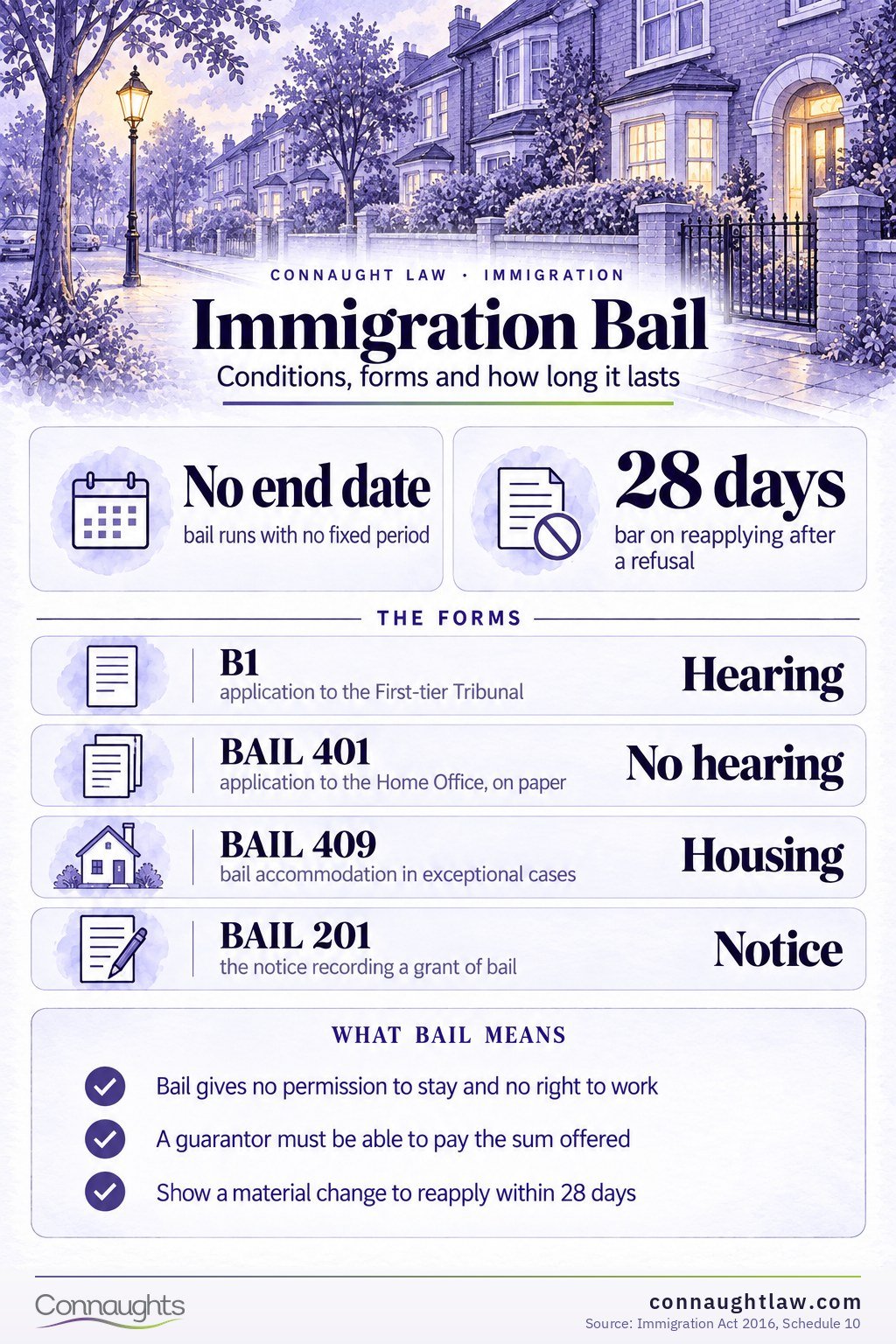
The Meaning, and What It Is Not
The word borrows from criminal procedure and misleads because of it. There is no charge, no trial and no presumption in your favour. Nobody is deciding whether you did something. The question is whether you should be held while an immigration decision is made or carried out, and the conditions exist to manage the risk that you will not be available when it is.
It is also not the same as temporary admission or asylum support, which people often search for together. Support under sections 95 or 98 of the Immigration and Asylum Act 1999 is a separate regime with its own application. Bail may require you to live at a particular address; whether you are supported at that address is a different question, dealt with below.
Work and study are controlled by condition rather than by bail itself. Where a person has no permission to stay, Home Office guidance says a condition restricting work will be appropriate in most cases. Study is treated more lightly: a study condition is not required, guidance says none should be applied where there is doubt, and anyone who has claimed asylum should not have one.
Applying to the Home Office or the Tribunal
There are two routes and they are not alternatives you should pick between casually. An application to the Secretary of State is made on form BAIL 401, and is decided internally without a hearing. An application to the First-tier Tribunal is made on form B1, currently the November 2025 edition, and gets you before a judge.
There is no fee for a Tribunal bail application. The First-tier Tribunal fees order imposes fees only in respect of an appeal, and contains no bail provision at all. Anyone telling you a payment is required to apply for bail is describing something that does not exist.
Four forms — and which goes where
- B1 — application to the First-tier Tribunal for release on bail. This is the one that produces a hearing.
- BAIL 401 — application to the Secretary of State. Note the published version dates from November 2020 and has not been revised since.
- BAIL 409 — application for bail accommodation on exceptional circumstances or Article 3 grounds, where a residence condition is imposed and you could not otherwise support yourself there.
- BAIL 201 — not an application at all. It is the notice recording a grant or variation of bail, which is what you will be handed rather than something you complete.
On timing, the rules say less than most sources claim. Rule 39(1) requires the Tribunal to hold a hearing "as soon as reasonably practicable" where the application is for release. There is no three-day rule in the procedure rules. The Presidential Guidance Note of 2023 says such applications are listed "normally within 3-6 days", which is guidance to judges rather than an entitlement.
Conditions and Electronic Monitoring
Bail must carry at least one condition. Until January 2026 the list ran from appearance and reporting through residence and electronic monitoring to a catch-all allowing any other condition thought fit. Three further conditions were added on 5 January 2026 by section 46 of the Border Security, Asylum and Immigration Act 2025, and they matter because they are now conditions in their own right rather than add-ons to a tag.
What Schedule 10 Allows
| Condition | What it requires |
|---|---|
| Appearance | To appear before the Secretary of State or the Tribunal at a specified time and place |
| Work, occupation or studies | A restriction on working, on occupation, or on studying in the UK |
| Residence | A requirement about where the person lives |
| Reporting | To report to the Secretary of State or another specified person |
| Electronic monitoring | Monitoring under paragraph 4; cannot be imposed on anyone under 18 |
| Being at a place between particular times (new, January 2026) | To be at a particular place between particular times, on particular days or any day |
| Remaining within an area (new, January 2026) | To remain within a particular area |
| Staying out of an area (new, January 2026) | Not to be in a particular area |
| Any other condition | Such other conditions as the person granting bail thinks fit |
Electronic monitoring is discretionary for most people and mandatory for some. Where the person is detained or liable to detention pending deportation, bail must be granted subject to an electronic monitoring condition unless the Secretary of State considers it would be impractical or contrary to the person's Convention rights. Whether it is impractical may be judged partly by the resources available, which is a statutory permission to ration tagging. Our guide to deportation appeals covers who falls into that group.
Guidance dated June 2025 — and what it cannot reflect
The Home Office immigration bail guidance is still version 22.0 of 12 June 2025. It deals with curfews and area restrictions, but as supplementary conditions hanging off the catch-all power. It predates their becoming freestanding statutory conditions in January 2026, so it is not a safe guide to the current condition set.
Financial Conditions and Guarantors
A financial condition can be attached to bail, under which a person agrees to pay a specified sum if a bail condition is broken. The person who gives that promise is commonly called a guarantor or surety. It is a real liability, not a formality, and it is the point on which family members most often agree to something they have not understood.
What a guarantor is actually offering is a sum they can pay. The Tribunal will want to know who they are, their relationship to the applicant, their immigration status, and that the money is genuinely available. A promise of a figure the guarantor could not meet weakens the application rather than strengthening it, because the point of the condition is that non-compliance costs someone something real.
The application form requires the details of anyone offering a financial condition, and they should expect to attend the hearing and answer questions. A guarantor is not required in every case: bail is frequently granted with reporting and residence conditions and no money at all. Offering one is a way of addressing a specific concern about compliance, not a fee for admission.
How Long Bail Lasts and When It Ends
There is no fixed period. Schedule 10 says bail runs from when the grant commences until it ends, and it ends in one of four ways: the person is granted leave to enter or remain; the person is detained again; the person leaves or is removed from the United Kingdom; or, where bail was continuing only because the person remained liable to detention or a deportation decision was under consideration, that ceases to be so.
Conditions can be changed while it runs. The power to amend, remove or add conditions belongs to whoever granted the bail, though the Tribunal can direct that the Secretary of State exercise it, and the Tribunal cannot amend an electronic monitoring condition. Whoever exercises or refuses to exercise that power must give notice of the decision.
One provision is worth knowing if you are still detained. Where a person has been detained for four months under the examination or removal powers, the Secretary of State must arrange a reference to the First-tier Tribunal for it to decide whether to grant bail — automatically, without an application. A person can opt out of that in writing, and there are exceptions, but it is not something you have to trigger.
Twenty-eight days — the bar on reapplying
Where the Tribunal has refused bail after a hearing, a further application made within twenty-eight days must be dismissed without a hearing unless you demonstrate a material change in your circumstances. A second application that simply restates the first will not be heard, so the change has to be identified and evidenced.
Breach, Arrest and What Follows
An immigration officer or constable may arrest without warrant a person on bail where there are reasonable grounds for believing they are likely to fail to comply with a condition, or for suspecting they are failing or have failed to comply. Belief about the future is enough; an actual breach is not required. A warrant may also be issued authorising entry to named premises, by reasonable force if necessary.
What happens next is structured. The arrested person must be brought before the relevant authority as soon as practicable, and may be detained in the meantime. That authority — the Secretary of State or the Tribunal, depending on who granted bail — must decide whether conditions have been broken or are likely to be. If it decides they have, it must either direct detention or grant bail again on the same or different conditions.
If it decides they have not, it must grant bail on the same conditions. That matters: an arrest on suspicion does not by itself end bail, and the decision that follows is a decision the person is entitled to have made. Where the underlying detention is the real issue, our guide to immigration detention deals with challenging it.
Frequently askedQuestions about immigration bail and its conditions
Is there a fee to apply for bail?
No. The First-tier Tribunal fees order imposes fees only in respect of appeals and makes no provision for bail applications. An application to the Secretary of State on form BAIL 401 is also free.
How long does immigration bail last?
There is no fixed period. It continues until you are granted leave, detained again, or leave the UK, or until you stop being liable to detention with no deportation decision under consideration. People remain on bail for years where removal is not possible.
Can I work while on immigration bail?
Usually not. Where you have no permission to stay, guidance says a condition restricting work will be appropriate in most cases. A separate application for permission to work exists for asylum seekers whose claim has been outstanding over twelve months through no fault of their own.
Who can be a guarantor and what do they risk?
Anyone who can genuinely pay the sum offered. They agree to pay it if a bail condition is broken, and should expect to give their details on the form and answer questions at the hearing. It is a real financial liability.
How soon will my bail hearing be listed?
The rules require a hearing as soon as reasonably practicable and set no deadline. Judicial guidance indicates release applications are normally listed within three to six days, but that is guidance to judges rather than a right.
Can I reapply if bail is refused?
Yes, but within twenty-eight days of a refusal after a hearing the Tribunal must dismiss a further application without a hearing unless you show a material change in circumstances. After that period a fresh application can be made normally.
Send us the detention paperwork and any bail refusal. We will tell you which route to use, what conditions are realistic, and whether a financial condition would help your application.
Get Expert Advice