Administrative review is a paper reconsideration by the Home Office, not an appeal to anyone independent. It costs £80, it currently takes twelve months or more, and it can only succeed if the original caseworker made a specific kind of mistake. Knowing that before you file is what separates a review worth making from £80 and a year spent confirming a refusal you could have cured with a fresh application.
On This Page

The Answer in Short
If your refusal letter offers administrative review, three numbers decide whether to use it. The fee is £80. The wait is twelve months or more, on the Home Office's own published estimate. And the test is narrow: the reviewer is looking only for a caseworking error, not taking a fresh view of your case.
Quick answer — cost, wait and odds
£80, refunded only if the review succeeds. Twelve months or more for a result. It succeeds only where the original decision maker failed to apply, or wrongly applied, the Immigration Rules or published guidance — so a review that simply disagrees with the outcome, or that relies on evidence you did not send the first time, will not work. There is no published success rate.
That combination is why the honest advice in many cases is not to review at all. Where the refusal turned on a document you did not supply, a fresh application usually reaches a decision faster than a review will, and it lets you fix the problem rather than argue that it was not one.
Administrative Review, Defined
Administrative review is an internal reconsideration conducted by a different Home Office decision maker. It replaced the right of appeal for most points-based and visit categories, and it is governed by Appendix AR of the Immigration Rules. Nothing about it involves a judge.
How It Differs from an Appeal
An appeal goes to the First-tier Tribunal, is heard by an independent judge, and in human rights cases the tribunal considers the position as at the date of hearing — so new evidence is generally admissible. A review stays inside the department, is decided on the papers by a caseworker, and is confined to the material that was before the original decision maker. The difference in what you can put forward is the difference that decides most cases.
Who Can Ask for One
Your decision letter tells you. If it offers administrative review, you have it; if it offers an appeal, you have that instead; if it offers neither, your options are a fresh application or judicial review. The two are never available at the same time for the same decision.
Which Decisions Qualify
Broadly, the routes that lost their appeal rights under the Immigration Act 2014: work and sponsored routes, study routes, visit visas, and most other points-based refusals, together with certain cancellation decisions. Refusals of a human rights or protection claim are not in Appendix AR at all — they carry an appeal, which our guide to UK visa appeal rights covers.
The Only Ground: Caseworking Error
AR 3.1 states the test: the review succeeds where the decision maker of the eligible decision failed to apply, or incorrectly applied, the relevant Immigration Rules or published guidance. That is the whole of it. A request that argues the decision was harsh, or that your circumstances deserve sympathy, is arguing something the reviewer has no power to consider.
Writing the request is therefore a matter of pointing, not persuading. Identify the rule or the guidance paragraph, quote what it requires, quote what the decision letter did instead, and name the document in the original bundle that proves it. Four patterns account for most successful requests.
Misapplying the Rules or Guidance
The decision applies the wrong provision, the wrong version of it, or a requirement that does not exist. Cite the rule by number and set the decision letter's wording against it. This is the strongest category because it is the one that maps directly onto AR 3.1's language.
Evidence Sent but Not Considered
The refusal says a document was not provided and it was. This is only a caseworking error if the document really was submitted with the original application — a document you have found since is not an error, it is a reason to apply again. Give the file name, the date of upload or the courier receipt, and the page of the bundle.
Arithmetic and Points Errors
Salary or maintenance calculated wrongly, points totalled wrongly, a period of absence counted wrongly. These are the clearest errors to demonstrate because they can be shown rather than argued: set out the figures, the arithmetic and the correct total in three lines.
Documents Read Wrongly
A bank statement read as showing the wrong balance, a letter read as saying something it does not, a qualification mapped to the wrong level. Quote the document and the decision letter side by side and let the discrepancy do the work.
Deadlines and How to Apply
The application is made online through the gov.uk service, and the deadline depends on where you are and what was refused. These are the dates that end cases, and they are counted in calendar days.
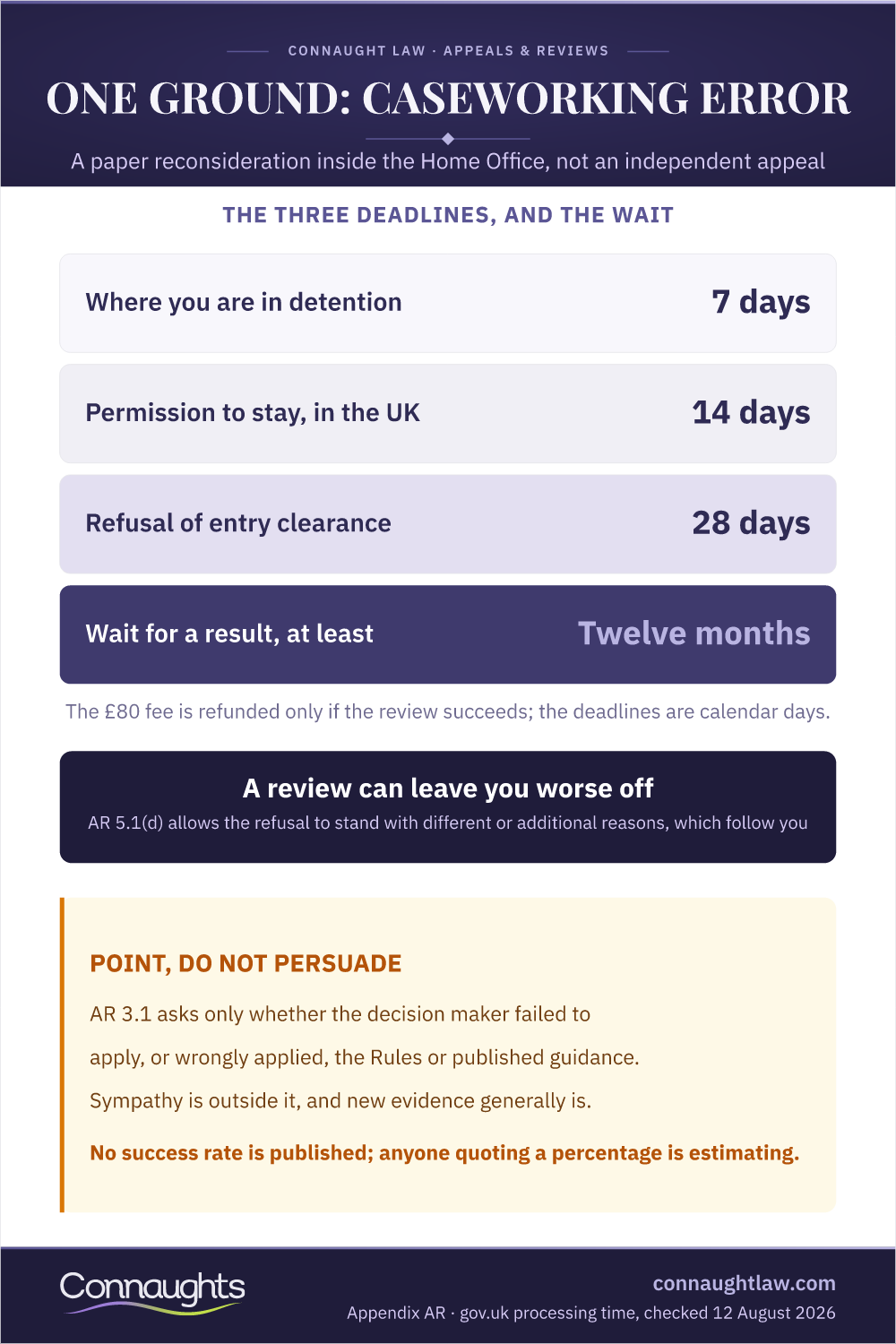
Three deadlines — and the one that catches people
- 28 calendar days — refusal of entry clearance, whether you are in the UK or outside it.
- 14 calendar days — refusal of permission to stay, and cancellation decisions, where you are in the UK.
- 7 calendar days — where you are in detention. This is the one people miss.
File through the online service rather than by email where the service is available to you, because the submission date is recorded and that date is the one that matters. Have the refusal letter, the original application reference and the list of documents you submitted to hand before you start, and draft the grounds before opening the form rather than in it — the form gives you a single free-text box and no opportunity to revise once it is sent. The caseworker guidance published for Home Office staff sets out how that box will be read.
£80 — and what it does not buy
The fee is refunded if the review succeeds and kept if it does not. It does not buy an independent look at your case, a hearing, or an opportunity to put in evidence you did not send before. Weigh it against the cost of a fresh application, which for most refused applicants is the faster route to actually holding a visa.
Seven, Fourteen and Twenty-Eight Days
The clock runs from when you receive notice of the decision, not from when you read it properly or when your representative sees it. There is no equivalent of the tribunal's power to extend time for a good reason, so a late request is generally simply invalid — and the £80 does not come back.
How Long It Takes Now
This is the single most important practical fact about administrative review in 2026, and it is the one the refusal letter does not tell you.
Twelve Months or More
Gov.uk states plainly that it can currently take twelve months or more to receive the result of an administrative review, and that the Home Office will contact you with an update if there is no decision within six months. There is no service standard shorter than that and no expedited route.
Twelve months — plan around the wait
A year is longer than most visas people are waiting on remain useful for. Where you are outside the UK and the trip, the course or the job has a date attached to it, a review will almost certainly not deliver in time. Where you are in the UK, check whether your existing permission continues while the review is pending, because that is often the only reason to use the route at all.
How Often It Works
There is no current published figure for how many administrative reviews succeed. The Home Office does not release outcome statistics for the process, and the most recent independent inspection of it does not give a rate either. Anyone quoting a percentage is estimating, and we are not going to add to that.
What can be said is structural, and it is more useful than a percentage would be. The test is confined to caseworking error; new evidence is generally excluded; and the reviewer works from the same file as the original decision maker. A request that identifies a rule misapplied on the papers already before the Home Office has a real prospect. A request that re-argues the merits has almost none.
Four Outcomes, One of Them Worse
AR 5.1 sets out what can happen. The review succeeds and the decision is withdrawn and reconsidered. It fails and the decision stands with all its original reasons. It fails but one or more of the reasons are withdrawn. Or it fails and the decision stands with different or additional reasons.
AR 5.1(d) — you can come out worse
That fourth outcome is the one to understand before filing. A review can leave you refused on grounds that were not in the original letter, and a new adverse finding — on credibility or deception, for instance — can follow you into later applications. It is a real reason to think hard about a weak review rather than filing one because the deadline is running.
Settlement Scheme Decisions Are Outside It
Appendix AR does not cover decisions under Appendix EU or Appendix EU (Family Permit), save in limited situations that do not include an ordinary refusal. EU Settlement Scheme refusals carry their own right of appeal instead, which is a better remedy than review in any event: it goes to an independent judge and admits evidence the Home Office has not seen.
If Review Is Not the Route
Three alternatives, and for most refused applicants the first is the right one.
Applying Again
Where the refusal turned on missing or inadequate evidence, a fresh application fixes the problem rather than arguing about it, and arrives far sooner than twelve months. Read the refusal as a checklist and answer every point. Our guide to the most common reasons for refusal covers what tends to go wrong, and the evidential flexibility provisions explain when the Home Office should have asked you for a document before refusing.
Appealing to the Tribunal
Where a human rights or protection claim was refused, you have an appeal rather than a review, and it is a materially better remedy. Visit visa refusals are a category of their own and usually call for a stronger second application rather than a challenge — see our guide to challenging a visit visa refusal.
Judicial Review
Where there is no appeal and either no review or a review that has failed, judicial review challenges the lawfulness of the decision rather than its merits. It is the remedy of last resort, has its own time limits and costs risk, and normally requires the earlier remedies to have been used first: our guide to immigration judicial review sets out how it works. How we cost this work is on our fees page.
Frequently askedQuestions about administrative review
How much does administrative review cost?
£80. It is refunded if the review succeeds and kept if it does not. There is no separate hearing fee, because there is no hearing — the review is decided on the papers by a Home Office caseworker.
How long does it take?
Gov.uk currently states twelve months or more, and says the Home Office will contact you with an update if there is no decision within six months. There is no faster or priority option.
What proportion of reviews succeed?
No figure is published. The Home Office does not release outcome statistics for administrative review and the most recent independent inspection does not give a rate. Treat any percentage you see quoted as an estimate rather than a published statistic.
Can I send new evidence with my request?
Generally no. The review looks at whether the original decision maker erred on the material they had. Evidence you have obtained since is a reason to make a fresh application, not a ground of review.
What is the deadline?
Twenty-eight calendar days for an entry clearance refusal, fourteen for a refusal of permission to stay or a cancellation while you are in the UK, and seven if you are in detention. The time runs from when you receive notice of the decision.
Can the decision get worse?
Yes. Under AR 5.1(d) the refusal can be maintained with different or additional reasons. A new adverse finding can affect later applications, so a weak review carries a cost beyond the £80 and the wait.
Send us the refusal letter and what you submitted with the application. We'll tell you whether there is a caseworking error worth reviewing, or whether applying again is the faster answer.
Get Expert Advice