
UK visa refusals rarely come from nowhere: most trace to a handful of causes — missing or inconsistent documents, funds evidence that fails the rules' technical tests, credibility doubts, unmet thresholds and suitability grounds like deception or criminal history. Each route fails in its own way. This guide maps the common refusal reasons across visitor, family, student and work applications, and what a refusal notice actually opens up: review, appeal or a stronger reapplication.
On This Page

Why UK Visas Get Refused
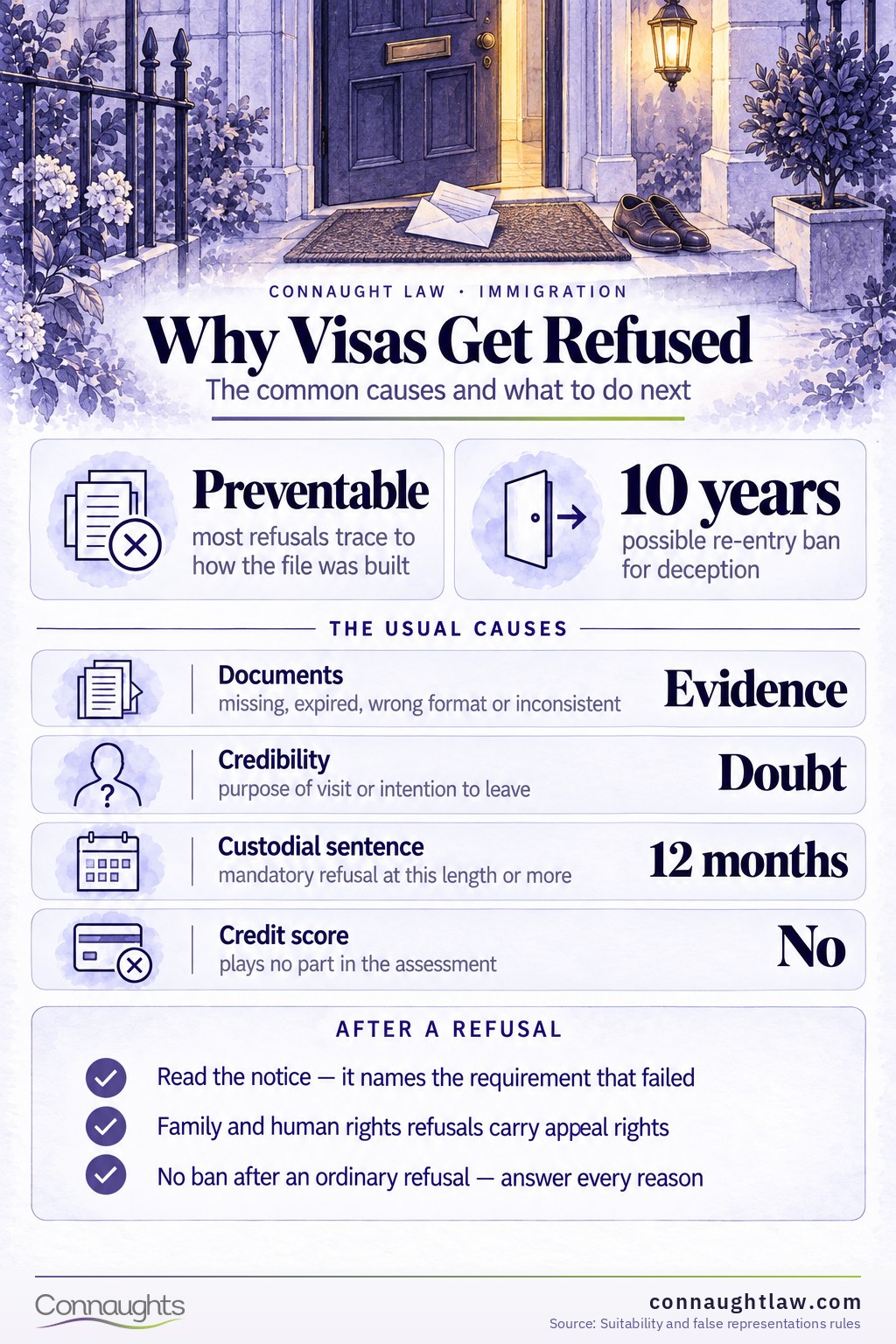
Most refusals trace to a small set of causes: documents that fail the rules' technical tests, funds evidence that breaks the qualifying period, credibility doubts, unmet thresholds, and suitability grounds such as deception or criminal history. Each route fails in its own characteristic way, so the ground stated in the refusal notice matters more than the outcome itself. It identifies which requirement failed, while the route decides whether review, appeal or a stronger reapplication is available.
Common Reasons
Refusal Patterns and Rates
Refusal rates differ sharply by route and by country of application — UK Visas and Immigration publishes the outcomes in its official immigration statistics rather than anyone's blog — but the reasons behind them are stable. A caseworker refuses when the rules' requirements are not evidenced, when the evidence contradicts itself, or when a suitability ground bites. The pattern worth knowing is that most refusals are preventable: they punish how the application was built, not who the applicant is.
- Documents missing, expired, in the wrong format, or contradicting each other across the application.
- Funds evidence failing technical rules — the 28-day requirements, unexplained deposits, the wrong account type.
- Credibility doubts: purpose of visit, intention to leave, or a story the paperwork does not support.
- Thresholds unmet — income, maintenance, salary or English — or a sponsor who fails their own checks.
- Suitability grounds: deception, previous breaches, criminal history.
Documentation Failures
The largest single family of refusals is evidential: the rules specify what must be shown, and applications fail by proving the right facts with the wrong documents — an employment letter without the required details, a sponsor's status unevidenced, translations missing, or dates that disagree between form and paperwork. Caseworkers refuse on what is in front of them; they are not obliged to ask for what is missing.
Financial Shortfalls
Money refusals are usually technical rather than about wealth: balances dipping below the required level during the qualifying period, funds parked too recently, large unexplained deposits, or statements from accounts the rules do not accept. Credit history, for the avoidance of doubt, is not part of the assessment — the Home Office tests the evidence of funds, not your credit score — so a "bad credit" worry matters only if it reflects an inability to show the required money properly.
Which Refusals Can Be Challenged
The remedy depends on the route: points-based and visitor refusals generally offer no appeal — administrative review or reapplication are the tools — while family and human-rights refusals carry appeal rights. Matching the refusal to its remedy is the first decision after the notice arrives, and it is time-limited.
Family and Spouse Refusals
Spouse Visa Refusal Causes
Spouse and partner refusals cluster around the financial requirement's exacting evidence rules, doubts that the relationship is genuine and subsisting, and inadequate accommodation evidence. The refusal letter will say which limb failed — read it precisely, because a genuineness refusal and a specified-evidence refusal lead to different responses, and the appeal route is usually open in family cases.
Nigerian Family Applications
Applications from Nigeria — one of the highest-volume family visa nationalities — fail most often on documentary verification: sponsor finances evidenced outside the specified rules, inconsistencies between the application and previous travel history, and third-party support the rules do not recognise. The answer is not more documents but the right ones, organised to the specified-evidence list, with every discrepancy in the history addressed head-on rather than left for the caseworker to find.
Student Visas
Academic and Financial Verification
Student refusals concentrate on maintenance funds failing the 28-day rule, CAS details that do not match the evidence, and qualification documents that cannot be verified. Applications for children carry their own consent and care requirements, covered in our child student visa guide — a parallel set of refusal traps.
Credibility and Progression
The genuine student assessment refuses applicants whose study plans do not add up: courses below existing qualifications without explanation, gaps the interview answers cannot fill, or an academic story that reads as an immigration route rather than an education. The credibility interview decides many of these — our credibility interview guide covers what is actually being tested on the student route.
Work Visas
Skilled Worker Refusals
On the Skilled Worker route, refusals track the sponsorship machinery: certificates of sponsorship with wrong occupation codes or salaries below the applicable threshold, genuineness doubts about the vacancy, and sponsors whose own compliance is in question — a sponsor-side failure the applicant inherits. What older guides call Tier 2 refusals are the same failures under the current names.
Business Visitor Issues
Business visitors are refused for crossing the line between permitted activities and work: evidence suggesting productive employment, payment from a UK source the rules do not allow, or visit patterns that look like de facto residence. The activity list is the test — map the trip to it before applying, not in the interview.
Medical Grounds
Health Requirements
Medical refusals are narrower than applicants fear: a missing or invalid TB test certificate where the route requires one, non-payment of the health surcharge, or — rarely — exclusion on public health grounds. A medical condition by itself is not a refusal reason on most routes; the failures are procedural, and they are the easiest category to fix on reapplication.
Deception and Misrepresentation
Consequences of False Documents
Deception is the most serious ground: a false document or false representation — even one the applicant did not know about — triggers refusal under the false representations rules and can carry a ten-year re-entry ban. Criminal history sits in the same suitability family: a custodial sentence of twelve months or more brings mandatory refusal, while shorter and older convictions are weighed case by case — the answer to "will a criminal record affect my application" is that it depends on the sentence, the recency and the route, and it must always be disclosed. Concealing a conviction is deception; disclosing it is a manageable fact.
Financial Rules Across Routes
Maintenance Calculations
The calculation itself is where most financial refusals are made. Funds must be held for the full qualifying period without dipping below the threshold on any single day, in an account the rules accept, with statements covering an unbroken run of dates. A balance that meets the figure on the closing date but fell short mid-period fails, and so does a correct total assembled from accounts the route does not recognise.
Thresholds by Visa Type
Every route prices itself differently — minimum income for partners, maintenance levels for students, salary thresholds for sponsored workers — and the figures move with the rules, so the calculation must be run against the current requirement on the day you apply, not a remembered number. The constants are the evidence disciplines: the money held for the required period, in an accepted account, documented in the specified format, with every large movement explained. Route-specific figures live in the current guidance and our individual route guides.
After a Refusal
Administrative Review and Appeals
The notice tells you the ground; the route tells you the remedy. Administrative review corrects caseworking errors on points-based refusals, statutory appeals run where human-rights claims were refused — our appeals team handles both — and judicial review reaches decisions with no other challenge route. Where nothing was legally wrong with the decision, challenge is the wrong tool and reapplication is the right one.
Reapplying Stronger
There is no ban after an ordinary refusal and no stamp in a modern passport — the refusal lives in your immigration history, and every future application asks about it. Chances on reapplication turn on one thing: whether the new application answers the refusal letter point by point, with the evidence the first one lacked. Repeating the same file invites the same result; a reapplication built on the refusal's own reasoning routinely succeeds where the original failed.
Deciding Your Next Step
Read the notice, identify the ground, match it to the remedy, and act inside the deadline — review and appeal windows are short. Where the refusal reads as wrong in law, challenge it; where it reads as right on the evidence you gave, rebuild the evidence. Our visa refusal team works both sides of that line, and for visit-specific refusals our visit visa refusal guide and prevention guide go deeper.
Frequently askedQuestions about visa refusals
Why do UK visas get rejected?
Overwhelmingly for evidential reasons: missing or inconsistent documents, funds that fail the technical rules, unmet income or maintenance thresholds, credibility doubts, and suitability grounds such as deception or criminal history. Most refusals are preventable application-building failures.
How do I find out why my visa was refused?
The refusal notice states the rules relied on and the reasons. Read it precisely — the paragraph numbers identify which requirement failed, which determines whether administrative review, appeal or reapplication is the right response.
Will a criminal record affect my UK visa application?
It can: a custodial sentence of twelve months or more brings mandatory refusal, and shorter or recent convictions are weighed under the suitability rules. Always disclose — concealment is deception, which is a far more serious ground than most convictions.
Does bad credit history affect a UK visa?
No — credit scores play no part in the assessment. The rules test evidence of funds: the required amount, held for the required period, in an acceptable account, properly documented. A poor credit record matters only if the money itself cannot be shown.
Is a visa refusal stamped in my passport?
Not in the current system — refusals are recorded in your immigration history, not your passport. Every future UK application asks about previous refusals, and honesty about them matters more than the refusal itself.
What are my chances of getting a UK visa after a refusal?
Good, if the new application answers the refusal letter's reasons with the evidence the first one lacked — there is no ban and no waiting period after an ordinary refusal. Chances collapse only when the same file is resubmitted unchanged.
Send it to us before the deadline passes. We'll identify the ground, the right remedy — review, appeal or rebuild — and the evidence that changes the outcome.
Get Expert Advice