
Where you apply from changes your UK visitor visa odds more than any single document: refusal concentrates by nationality and region, and the Home Office's own data shows the spread. This guide reads the refusal rate by country pattern, explains what drives it, and turns it into a prevention method — the evidence that answers the genuine visitor test, the mistakes that trigger refusals, and the realistic recovery routes when one lands.
On This Page

Prevention Starts with the Pattern
Two applicants with identical trips can face very different scrutiny because caseworkers price risk by country of application: verification difficulty, local document fraud rates and overstay history all feed the assessment. Knowing where your nationality sits in that pattern tells you how much evidence is enough — and building the file to that standard, rather than the global average, is what prevention actually means.
Reading the Refusal Statistics
The Home Office publishes entry clearance outcomes — applications, grants and refusals by nationality — in its quarterly immigration system data tables. Most visitor applications worldwide succeed, but the by-country sheets show refusal rates ranging from negligible to a substantial share of all applications. Check your own nationality's current figures there before applying: the table, not anecdote, should set how conservative your evidence needs to be.
Regional Refusal Patterns
Risk by Country Group
- Gulf and East Asian nationalities see near-routine approval where finances are orderly.
- Several African and South Asian countries face the highest refusal concentrations, driven by verification difficulty rather than individual merit.
- Recently visa-required nationalities — including Caribbean countries added in 2025 — face first-generation caseworking with little local precedent.
- Within every group, sponsored family visits are scrutinised harder than self-funded tourism.
Genuine Visitor Requirements
Evidence That Answers the Test
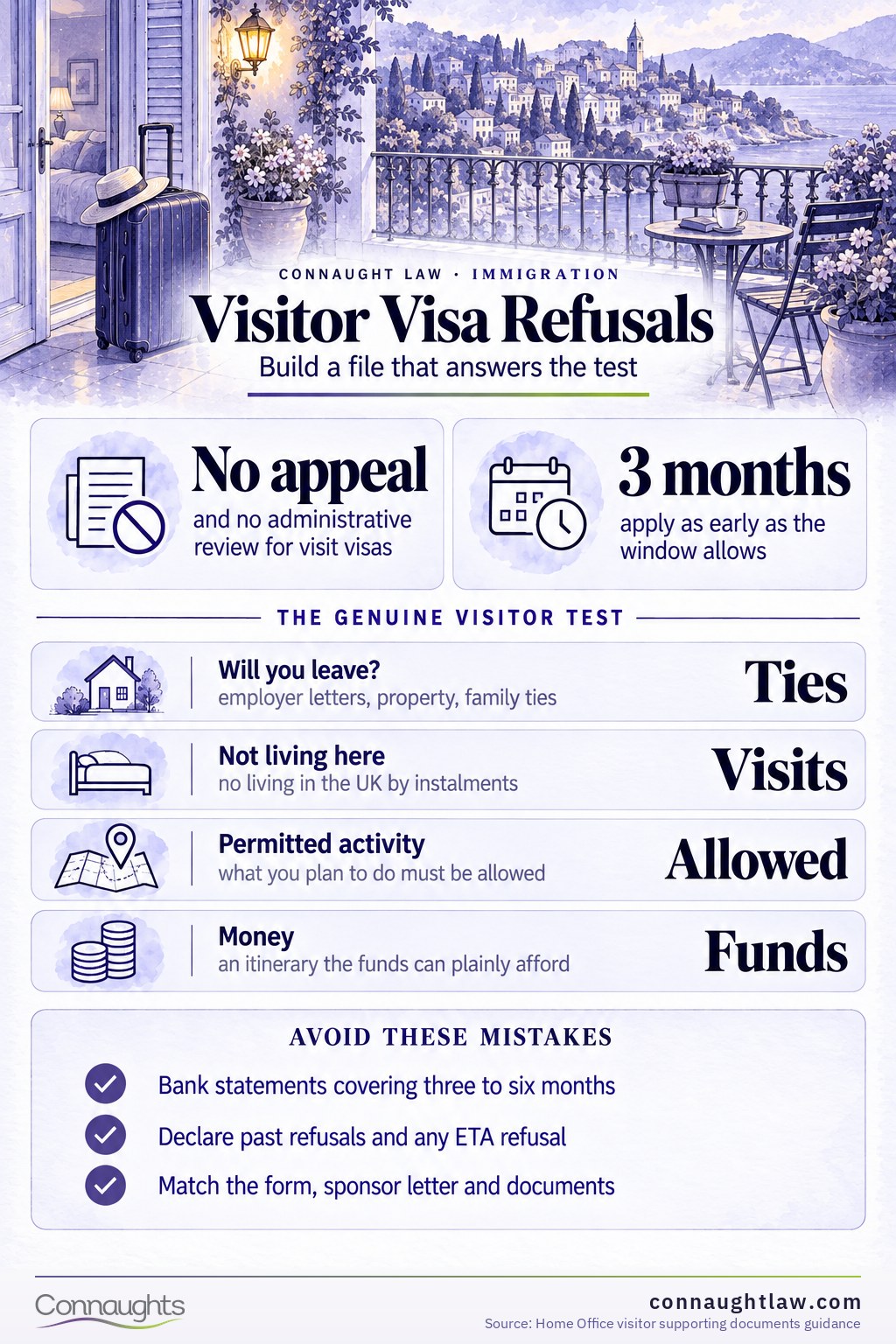
The genuine visitor test asks whether you will leave, whether you are living in the UK by instalments, whether your activities are permitted and whether the money works. High-refusal-country applicants should evidence each limb explicitly: employer letters with verifiable contacts, property or business documents, family obligations at home, and an itinerary whose cost sits comfortably inside the shown funds — the standard set in the supporting documents guidance.
Financial Evidence
Bank statements should cover three to six months and tell one story: regular income, ordinary spending, and a trip the account can plainly afford. The two classic failures are sufficiency — funds thinner than the itinerary — and provenance, the large deposit that arrives shortly before the application and cannot be explained. A supporting letter does not cure either; the numbers must reconcile.
Third-Party Sponsorship
Where a UK relative or friend funds the visit, their evidence joins the assessment: status, income, accommodation and the relationship itself. Sponsorship strengthens an application only when both sides align — the sponsor's letter, the applicant's form and the bank evidence must agree on who pays for what, because the mismatch is itself a refusal ground.
ETA and Digital Authorisation
When an ETA Is Refused
Non-visa nationals now travel on the £20 Electronic Travel Authorisation rather than a visa. An ETA refusal is not a visa refusal — it routes the traveller into the full visitor visa process, where the application is decided on complete evidence. Treat that as the system working: the visa route exists precisely to consider cases the automated checks cannot clear, and an ETA refusal declared and explained does not doom it.
Mistakes That Cause Refusals
The preventable failures repeat across nationalities: forms inconsistent with documents, itineraries that do not match stated leave from work, sponsor letters contradicting the application, translations without certification, and past refusals left undeclared. Each is caught by one discipline — reconciling every fact across every document before submission. The full refusal taxonomy is in our refusal reasons and rates guide and our general refusal analysis.
Timing the Application
Apply as early as the three-month window allows, especially from high-volume posts before summer and December peaks. Timing is also evidential: an application filed the week after a new job starts, or days after a large deposit, invites questions that the same application filed three months later would not face.
Recovering from a Refusal
Administrative Review and Its Limits
Visitor refusals sit outside the administrative review scheme — that remedy belongs to points-based and settlement decisions. For visitors the practical routes are a corrected fresh application or, where the decision is legally flawed, judicial review through the pre-action process covered in our challenge guide.
When Professional Help Pays
Straightforward first applications rarely need lawyers. The cases that do: a refusal already on the record, sponsorship with complex finances, nationality groups facing the highest refusal concentrations, and anything involving a deception allegation — where the next application's framing determines whether the problem compounds. Our visitor visa team works from the refusal notice backwards; where tribunal or court routes arise, our appeals team takes over.
Frequently askedQuestions about refusal rates and prevention
Which countries have the highest UK visa refusal rates?
Refusals concentrate among several African and South Asian nationalities, while Gulf and East Asian applicants see near-routine approval. The Home Office's quarterly data tables publish exact by-country figures — check your nationality's current sheet before applying.
Why does nationality affect my visitor visa chances?
Caseworkers weigh verification difficulty, document fraud patterns and overstay history in the country of application. It is risk pricing, not individual prejudgment — and it means evidence standards that clear easily from one country need reinforcement from another.
Can I prevent a refusal if I am from a high-refusal country?
Largely, yes. Evidence each limb of the genuine visitor test explicitly, reconcile every figure, make employer and sponsor contacts verifiable, and declare any history. Refusal in these cohorts overwhelmingly tracks evidence quality, which you control.
Is there administrative review for visitor refusals?
No — visit visa decisions carry no administrative review and no appeal. Your options are a fresh application that fixes the stated ground, or judicial review where the decision itself is legally defective.
Does an ETA refusal mean I cannot visit the UK?
No. An ETA refusal moves you to the standard visitor visa route, where a human caseworker decides on full evidence. Declare the ETA outcome, address whatever triggered it, and apply with a complete file.
How soon should I apply before my trip?
As close to the three-month mark as you can, particularly from busy posts before summer and winter peaks. Early filing absorbs processing delays and keeps your travel dates realistic if caseworkers raise questions.
Tell us your nationality, sponsor position and any history. We'll build the file to the evidence standard your cohort actually faces — not the global average.
Get Expert Advice