
Family visitor and tourist applications run on the same Standard Visitor visa — £135 for six months — but they are judged differently: a holiday-maker proves an itinerary and funds, while a family visitor must also evidence the relationship, the host and the reason the visit ends. This guide covers requirements for both, the documents each needs, invitation letters, fees and how long a visitor can actually stay.
On This Page

One Visa for Family Visits and Holidays
The UK has no separate "family visitor visa" or "tourist visa" — both are the Standard Visitor route under Appendix V. What changes is the evidence. A tourist's application is about the trip; a family visitor's application is about two households — the applicant's ties at home and the host's circumstances in the UK — and refusals concentrate where those two stories fail to line up.
Visitor Requirements
Eligibility Across Visit Types
Every applicant must satisfy the genuine visitor test: a real intention to leave, no plan to live in the UK through successive visits, activities within the permitted list, and funds for the whole trip without working or public funds. For family visits the test bites hardest on ties — employment, property, dependants and obligations at home are what convince a decision-maker that a visit to a settled relative is a visit, not a migration.
Permitted Activities and Restrictions
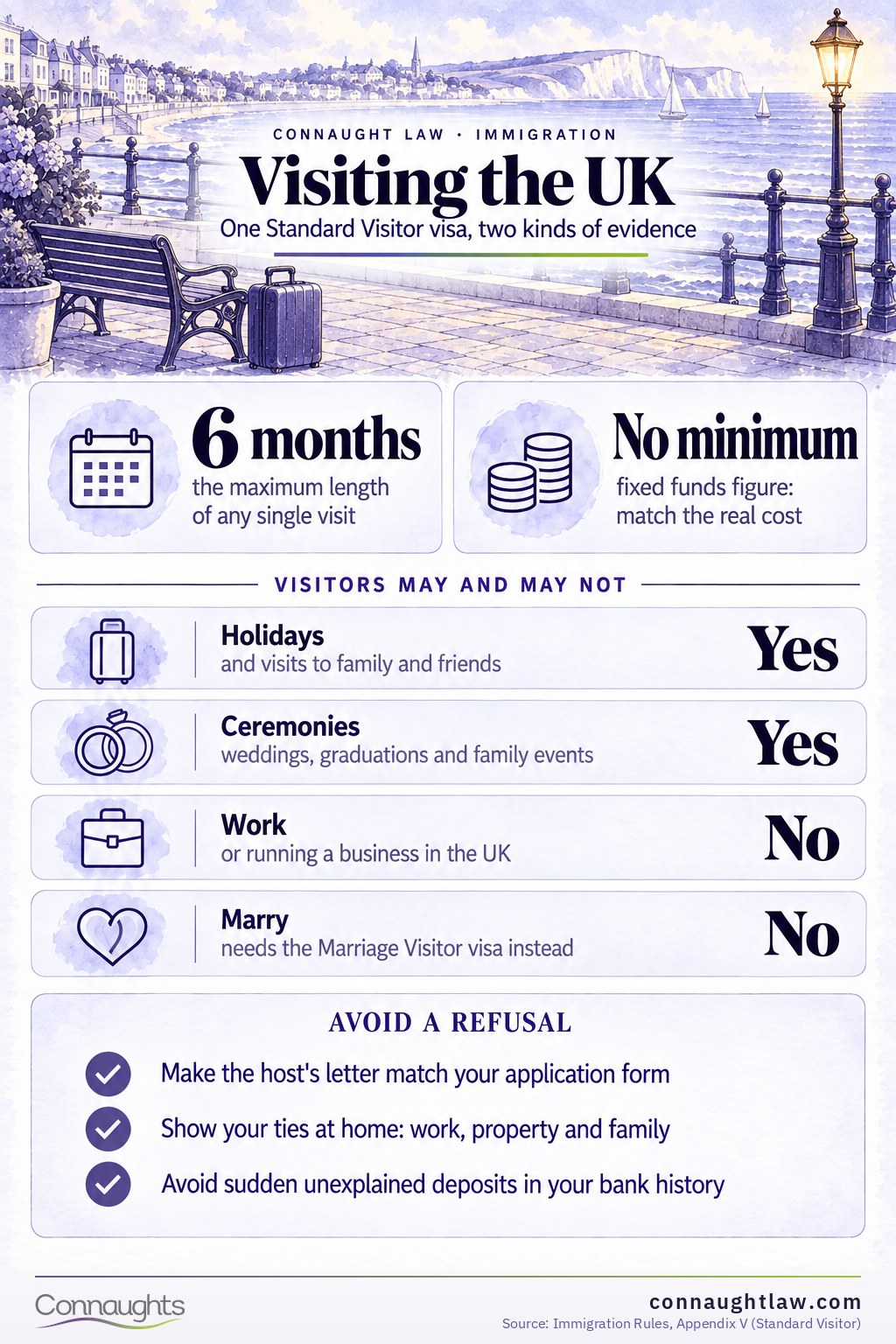
Visitors may holiday, visit family and friends, attend weddings and graduations, take a short course, attend business meetings and receive private medical treatment. They may not work, run a business in the UK, marry or give notice of marriage — that needs the Marriage Visitor visa — or make the UK their effective home. Border officers apply the same tests on entry, and a visa in the passport does not prevent refusal at the desk when the pattern of visits looks like residence.
Documents and Application Process
Application Steps
Apply online up to three months before travel on gov.uk, pay the £135 fee, enrol biometrics at a visa application centre, and upload the supporting file. The decision arrives within a three-week standard in most cases; nothing should be booked non-refundably until it does.
Documents for Tourists
An independent holiday application stands on four pillars: a passport, funds evidence covering the itinerary, proof of employment or income at home, and the outline plan — flights, accommodation and dates. The file should answer the affordability question at a glance: a trip whose cost is out of proportion to visible income triggers refusal more reliably than any missing certificate.
Extra Documents for Family Visits
Family applications add the relationship and the host: birth or marriage certificates linking applicant and host, the host's immigration status and address, who pays for what, and where the visitor sleeps. Where the host funds the trip, their bank evidence and accommodation documents join the file — the full sponsor-side picture is in our visitor sponsorship guide.
Financial Evidence
Evidence by Visitor Category
- Tourists: funds matching the itinerary's real cost, from an account whose history makes sense — no fixed minimum figure exists.
- Family visitors: their own funds, the host's support, or a combination — with the balance clearly explained.
- Sponsored visitors: the sponsor's statements, employment and accommodation evidence alongside the applicant's own ties.
- All categories: 3–6 months of bank history; sudden unexplained deposits do more damage than modest balances.
Invitation Letters for Family Visits
What the Letter Covers
An invitation letter is not mandatory, but a good one anchors a family application: who the host is and their status, the relationship, the visit's purpose and dates, where the visitor stays, and who bears which costs. It supplements the evidence rather than replacing it — a warm letter cannot carry an application whose bank statements and ties are thin. Structure, wording and a worked example are in our invitation letter guide.
Avoiding Refusal
Family visit refusals cluster around three findings: doubts that the visitor will leave, funds that do not add up, and inconsistencies between the applicant's form and the host's documents. Each is preventable at the evidence stage, and each is far harder to fix after a refusal is on the record. The refusal grounds in full — and current visitor approval patterns — are analysed in our visit visa refusal guide.
Fees, Timing and Visit Length
Visitor Fees and Visa Lengths
| Option | Fee | Best suited to |
|---|---|---|
| Single visa — up to 6 months | £135 | One-off holidays and visits |
| Long-term — 2 years | £506 | Annual family visitors |
| Long-term — 5 years | £903 | Parents visiting settled children |
| Long-term — 10 years | £1,128 | Established visiting patterns |
How Long a Visitor Can Stay
Every visit is capped at six months, whatever the visa's validity — a 10-year visa is a decade of permission to make six-month visits, not a decade of residence. There is no formal minimum gap between visits, but time in the UK that outweighs time at home invites the successive-visits finding, cancellation at the border, and difficulty on every later application.
Processing and Priority Options
The three-week standard governs most applications; the £500 priority service compresses it to five working days where the local application centre offers it. Legal help with a first-time family application is rarely necessary for straightforward cases — where it earns its keep is refusal history, complex finances or an unusual visit pattern, at rates we scope before starting; court-set benchmarks are on gov.uk.
Frequently askedQuestions about family and tourist visits
Is there a separate family visitor visa for the UK?
No — family visitors apply for the Standard Visitor visa like tourists. The difference is evidential: family applications add relationship proof, the host's status and accommodation, and a clear account of who funds the visit.
How long can a family visitor stay in the UK?
Up to six months per visit, on any visitor visa. Longer or repeated stays that make the UK the centre of someone's life breach the genuine visitor rules — parents spending most of each year with UK children are the classic borderline case.
Does my UK relative need to sponsor my application?
Not formally — there is no sponsorship certificate for visitors. But where your relative hosts or funds the visit, their documents effectively join your application, and inconsistencies between their letter and your form are a common refusal trigger.
How much does a UK tourist visa cost in 2026?
£135 for the standard six-month visa. Long-term visas cost £506 (2 years), £903 (5 years) and £1,128 (10 years), each allowing repeated visits of up to six months. The £20 ETA applies to non-visa nationals instead.
Can I attend a wedding or graduation on a visitor visa?
Yes — ceremonies, celebrations and family events are permitted visitor activities. Getting married yourself, or giving notice of marriage, is not: that requires the Marriage Visitor visa applied for before travel.
What is the biggest mistake in family visit applications?
Contradictions between applicant and host — different addresses, dates, or funding stories. Decision-makers read both sides of the file together, and a mismatch reads as unreliability even when it is only carelessness.
Tell us who is visiting, who is hosting and any refusal history. We'll align both sides of the evidence before anything is submitted.
Get Expert Advice