
If you were given a guarantor loan you could not afford — or agreed to be a guarantor without a proper affordability check — you may be entitled to compensation. This guide explains the mis-selling and irresponsible-lending grounds behind guarantor-loan claims, which lenders can still be pursued, and how to complain through the Financial Ombudsman Service.
On This Page

Guarantor loan mis-selling claims in 2026
Guarantor loans were sold to people with poor or thin credit histories, on the basis that a friend or family member would cover the repayments if the borrower fell behind. In practice, a large part of the sector lent irresponsibly — approving loans that neither the borrower nor the guarantor could realistically afford. When customers began to challenge those decisions, the resulting compensation liabilities pushed most of the major lenders into administration or wind-down.
The upshot is a genuine redress opportunity, but a nuanced one: whether you can recover anything, and how much, depends heavily on which lender you borrowed from and whether it is still solvent. This guide focuses on the claims that can realistically be brought, and how to bring them. Guarantor lending is only one part of a wider consumer-credit redress landscape; the largest current example is the FCA scheme covering mis-sold car finance claims, which turns on the same principles of affordability and undisclosed commission.
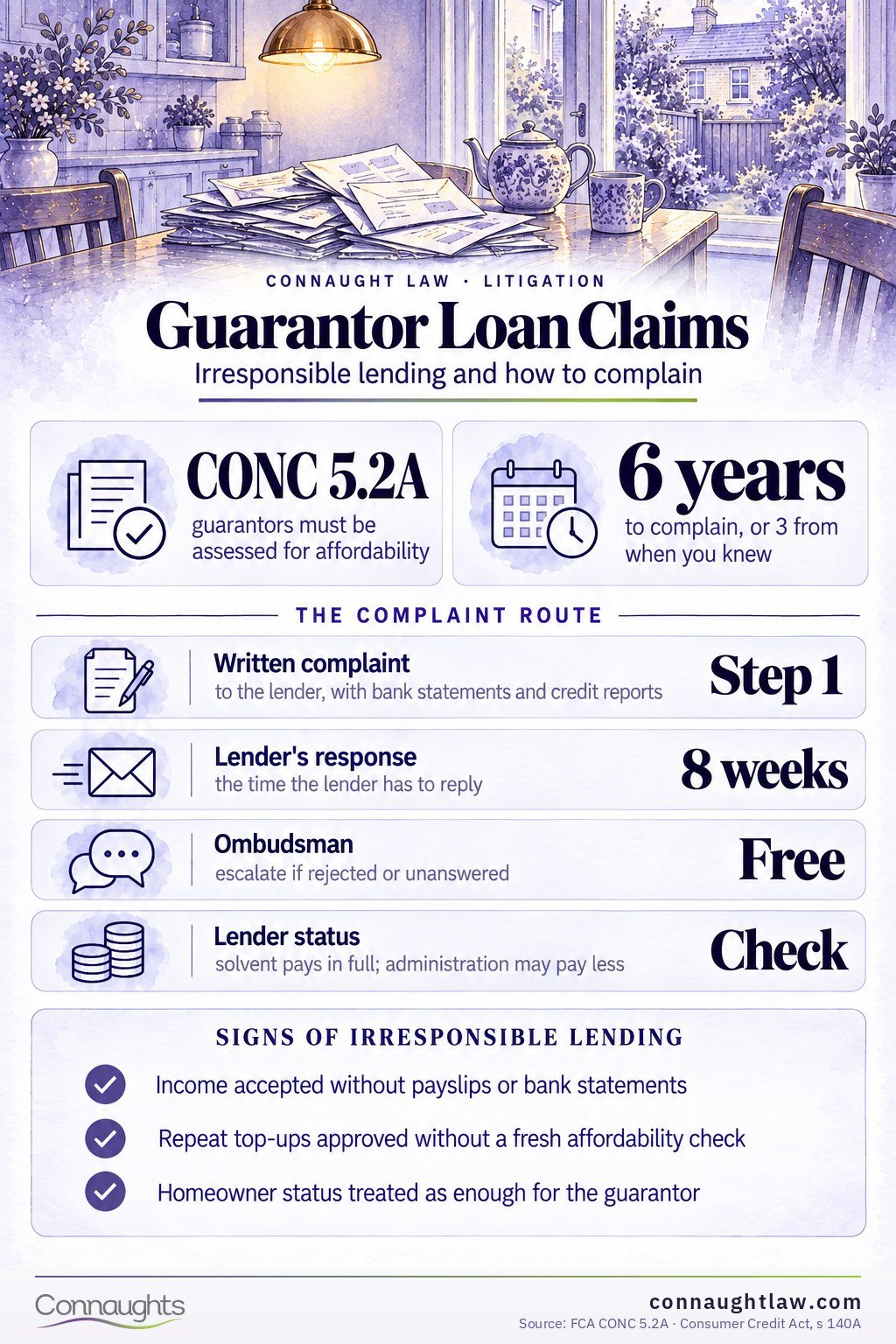
You may have a claim if the lender did not properly check that the loan was affordable — for the borrower or the guarantor — or did not clearly explain the guarantor's obligations. A successful complaint can mean a refund of interest and charges, a written-off balance, release of the guarantor, and removal of adverse credit markers. Claims run through the lender first, then the free Financial Ombudsman Service.
How guarantor loans work — and where they went wrong
A guarantor loan is a form of high-cost credit where a third party guarantees repayment if the borrower defaults. Loans typically ranged from around £500 to £15,000 over one to seven years, at representative rates commonly between 39.9% and 49.9% APR — meaning borrowers often repaid far more than they borrowed. The guarantor, usually a homeowner with a good credit record, took on full legal liability for the balance if the borrower stopped paying.
That structure placed real weight on the affordability check. Because the guarantor could be pursued for the whole debt — through the courts and, ultimately, against their assets — the lender was required to assess whether the guarantor could genuinely afford to step in, not merely whether they owned property. Widespread failure to do that is the root of most claims.
Why the guarantor-loan market collapsed
Between 2020 and 2025 the sector contracted sharply as mass complaints and regulatory action exposed systemic affordability failures. The pattern was consistent across lenders: superficial income checks, formulaic expenditure assumptions, and repeat top-up lending without fresh assessments.
Amigo, TFS and Buddy Loans
Amigo Loans — the UK's largest guarantor lender — saw complaints jump from 583 in 2019 to over 14,000 in 2020. The FCA restricted its lending in May 2020, and Amigo ultimately entered a court-approved Scheme of Arrangement that paid customers a total of 18.51 pence in the pound (a first payment of 12.5% followed by a final 6.01% in April 2025). That scheme is now complete and the company has moved into wind-down. TFS Loans entered administration in February 2022 and was fined £811,900 by the FCA for deficient affordability checks on 3,150 guarantors between November 2015 and April 2018. Buddy Loans went into administration in 2021, and other names — George Banco, Trust Two, UK Credit — stopped new lending.
The deadline to claim under the Amigo Scheme of Arrangement passed on 26 November 2022, and all scheme funds have now been distributed. New complaints against Amigo can no longer be made. If you borrowed from a lender that is still operating or accepting complaints, however, the position is very different — see below.
A pattern, not isolated cases
The scale of the problem showed in the outcomes: the Financial Ombudsman Service historically upheld guarantor-loan complaints at one of the highest rates of any financial product — evidence that lenders were routinely approving loans that should have been declined. Debt-charity data told the same story, with the number of people seeking help for guarantor debt rising sharply through the late 2010s.
Your protection: CONC 5.2A affordability rules
The legal foundation for a claim is the FCA's Consumer Credit Sourcebook. CONC 5.2A deals specifically with guarantor lending, requiring a firm to make a reasonable assessment — before entering the agreement — of whether the guarantor's commitment could have a significant adverse effect on the guarantor's own financial situation. It is not enough that the guarantor has assets; the lender must consider whether they could sustainably meet the payments if called upon.
The rules also require the lender to gather adequate information, from the guarantor or from credit-reference data, rather than relying on generic assumptions. The TFS Loans enforcement action turned on exactly this failure: the FCA found the firm had not collected sufficient information on guarantors' actual expenses — food, energy, childcare, medical costs — and instead applied a flawed formula. Where a lender breached these standards, the guarantor (and often the borrower) has grounds to complain.
Grounds for a mis-selling claim
Most successful claims come down to affordability. The Ombudsman asks whether the lender carried out reasonable and proportionate checks, and what those checks would have revealed had they been done properly. On the borrower side, common failures include accepting stated income without verification, ignoring bank statements or credit files showing existing payday loans, overdraft reliance, recent defaults or CCJs, and approving repeated top-ups without reassessing affordability.
On the guarantor side, the failures are often starker: minimal or no independent assessment, treating homeowner status as a proxy for affordability, and ignoring financial links between borrower and guarantor — shared households, for instance — that meant both would struggle at the same time.
- No real affordability check on the borrower or the guarantor.
- Stated income accepted without payslips, bank statements or verification.
- Obvious stress ignored — existing payday loans, persistent overdraft use, recent defaults or CCJs.
- Repeat top-ups approved without a fresh affordability review.
- Guarantor obligations not explained, or homeowner status treated as enough.
Which lenders can still be claimed against
This is the decisive question, and the answer depends on the lender's status. Against an operational lender still authorised by the FCA, you can complain in the normal way and, if upheld, recover full compensation. Against a lender in administration, complaints are handled by the administrators and any recovery depends on the assets available — often a reduced settlement rather than full redress. Against a fully liquidated lender whose scheme has closed, such as Amigo, no new claim is possible.
The difference between a full 100% Ombudsman award and pennies in the pound is often simply whether the lender is still trading when you complain. Amigo and TFS both moved from solvent to insolvent while customers delayed. If you think you have a claim against a lender that is still operating, it is worth acting promptly.
How to complain and what you can recover
A claim starts with a written complaint to the lender, setting out the loans concerned, your financial circumstances when they were approved, and why the lending was unaffordable. Useful evidence includes bank statements and credit reports from around the lending dates. The lender has eight weeks to respond. If it rejects the complaint or does not reply, you can escalate — free of charge as an individual — to the Financial Ombudsman Service.
Where a complaint succeeds, the remedy is designed to put you back in the position you should have been in. That typically means refunding all interest and charges paid, adding 8% statutory interest, reducing the outstanding balance to the original capital (which can eliminate the debt or leave you owed a refund if you have overpaid), releasing the guarantor from future liability, and correcting your credit file. You can complain even if the loan is fully repaid, provided you are within the Ombudsman's time limits.
For claims that are complex, high in value, or that must be pursued against a lender in administration, our financial services disputes team can help — including where an irresponsible-lending argument overlaps with wider Consumer Credit Act protections such as Section 140A unfair-relationship claims. Amigo borrowers can read our separate guide to the Amigo scheme and liquidation.
Frequently askedQuestions about guarantor loan mis-selling claims
Can I still claim compensation after a guarantor lender has collapsed?
It depends on the lender. Against operational lenders you can complain normally and, if upheld, recover full compensation. Against a lender in administration, claims go through the administrators and recovery may be reduced. Against Amigo, whose scheme closed to claims on 26 November 2022 and has now paid out in full, no new claim is possible. Acting while a lender is still solvent gives the best prospects.
What can a successful guarantor-loan claim recover?
Typically a refund of all interest and charges paid, plus 8% statutory interest, a recalculated balance (reduced to the original capital, which can wipe out the debt or leave you owed money), release of the guarantor from future liability, and removal of adverse markers from your credit file.
Do guarantors have their own right to claim?
Yes. CONC 5.2A requires lenders to assess the guarantor's affordability separately. A guarantor who was not properly assessed, was not told clearly what they were taking on, or whose financial link to the borrower was ignored, can complain in their own right and seek release from the guarantee, a refund of any payments made, and credit-file corrections.
How long do I have to complain?
The Financial Ombudsman Service generally requires a complaint within six years of the event, or three years from when you knew (or ought to have known) you had grounds to complain. Because a lender can become insolvent at any time, it is sensible not to wait.
Do I need a solicitor or claims company?
No — individuals can complain to the lender and escalate to the Financial Ombudsman Service for free. Legal help is most valuable for complex or high-value cases, disputes against lenders in administration, or where the claim overlaps with wider Consumer Credit Act arguments.
Can I complain if I have already repaid the loan in full?
Yes. A completed loan does not prevent a claim, provided you are within the Ombudsman's time limits. Because these were high-interest loans, a refund of interest and charges plus statutory interest can be substantial even years after the final payment.
Complaining to the lender, and then the Ombudsman, is free. Tell us who lent, when, and what checks were actually done — we’ll tell you whether the affordability grounds hold up and whether that lender is still worth pursuing.
Get Expert Advice