
The Consumer Credit Act 1974 still governs how personal loans, credit cards, hire purchase and motor finance are sold and enforced in the UK — but the framework is changing fast. This guide explains the protections that matter most in 2026: Section 75 credit-card liability, Section 140A unfair-relationship claims, the confirmed (and now partly paused) motor finance redress scheme, and what the government's CCA reform actually repeals.
On This Page

Consumer Credit Act protections and claims in 2026
Consumer credit touches almost every household. Most UK adults hold a credit card, loan, overdraft or hire-purchase agreement, and when one of those agreements goes wrong the Consumer Credit Act 1974 (CCA) is often what determines whether money can be recovered. Two provisions do most of the heavy lifting: Section 75, which makes a card issuer jointly liable for a supplier's breach of contract or misrepresentation, and Section 140A, which lets a court reopen an agreement it considers to have created an "unfair relationship" between lender and borrower.
Both provisions are now central to the biggest consumer-redress story in years — the motor finance commission scandal — and both survive the government's 2026 reform of the Act largely untouched. Understanding what is protected, what is being repealed, and where the deadlines fall is the difference between a valid claim and a missed one.
Yes. Section 75 (credit-card liability) and Section 140A (unfair relationships) remain in force, and the government has confirmed it is not changing them at this stage. What is being repealed is a separate set of technical information rules and the automatic "unenforceability" sanctions attached to them — not the core consumer claims most people rely on.
Consumer Credit Act reform: what is actually changing
On 18 May 2026 HM Treasury published its policy statement on reforming the Consumer Credit Act 1974 — the first significant modernisation of the Act since it was passed. Rather than a wholesale rewrite, the reform moves much of the CCA's detailed, prescriptive rulebook out of primary legislation and into the Financial Conduct Authority's (FCA) rules, so requirements can be updated more easily in future. The changes will be delivered through legislation, with commencement following once the FCA has consulted on and finalised the replacement rules.
The headline change for existing agreements concerns the Act's technical machinery. The government has confirmed it will repeal the majority of the CCA's information-disclosure requirements — recasting them, where appropriate, into FCA rules — and that the sanctions tied to those requirements will fall away with them. Those sanctions include unenforceability without a court order, unenforceability until a breach is remedied, and disentitlement to interest and default sums.
What the reform leaves alone
Crucially for consumers, the reform does not touch the two provisions that underpin most CCA claims. On Sections 75 and 75A (connected lender liability) the government has said it "does not intend to make changes at this stage," citing the complexity and wide-reaching implications of those rules. It has taken the same position on Sections 140A to 140C (unfair relationships), deferring any change for further policy work and consultation. In practice, that means the strongest routes to redress — a Section 75 claim against a card issuer, or a Section 140A unfair-relationship claim — remain fully available while the reform is implemented.
Because the "unenforceability" sanctions for technical non-compliance are being repealed, anyone relying on a documentation defect in an existing loan or hire-purchase agreement should have it assessed sooner rather than later. Transitional provisions will decide which agreements keep the old protections, so the timing of any claim matters.
Motor finance redress scheme: confirmed, then partly suspended
The motor finance commission scandal is the largest consumer-credit redress exercise the UK has seen in years, and it turns on the CCA's unfair-relationship provisions. It concerns commission that dealers and brokers earned on car-finance deals — in many cases without customers being told the commission existed or how it affected the interest they paid.
The scheme the FCA confirmed
On 30 March 2026 the FCA confirmed its Motor Finance Consumer Redress Scheme in Policy Statement PS26/3. The regulator estimates the total cost to firms at around £9.1 billion — roughly £7.5 billion in redress to consumers and £1.6 billion in administration and other non-redress costs — making it one of the largest redress programmes in UK financial-services history. The scheme covers motor finance agreements taken out between 6 April 2007 and 1 November 2024, split into two periods reflecting the different commission arrangements in use over that time.
Why the timetable is currently paused
The scheme has been challenged in the courts. After legal challenges were filed, the Upper Tribunal partially suspended parts of the scheme on 2 July 2026. During the suspension, firms are not required to calculate or pay redress, or to send compensation communications on the original timetable. They must still identify relevant agreements and complaints, gather the underlying commission and disclosure data, notify consumers who are not owed compensation, and cooperate with the Financial Ombudsman Service. The Tribunal is due to hear the substantive challenge in late 2026 or early 2027, with any payments following if the scheme is upheld.
The pause affects the payment mechanics, not the underlying right to complain. Consumers who are not contacted under the scheme can still bring a complaint, with a longstop of 31 August 2027. If you had car finance between 2007 and 2024, it is worth reviewing your paperwork now rather than waiting for the litigation to conclude.
Where Section 140A fits in
Underpinning the whole exercise is Section 140A. In its August 2025 motor finance judgment, the Supreme Court confirmed that an unfair relationship is assessed on a combination of factors — the size of the commission, how clearly it was disclosed, any representation that a broker was impartial, and the customer's own financial sophistication — rather than a single decisive test. That principles-based approach is why the redress scheme, and individual Section 140A claims outside it, can address commercial unfairness that stricter technical rules would miss. Our dedicated guide to mis-sold car finance claims explains who can claim and how.
Section 75: credit-card purchase protection
Section 75 is the CCA's best-known protection. It makes a credit-card issuer jointly and severally liable with the supplier for a breach of contract or misrepresentation, which means you can claim against the card company as an alternative to the trader — invaluable when a supplier has gone insolvent or simply refuses to put things right.
Where you buy goods or services on a credit card and the cash price is more than £100 and no more than £30,000, the card issuer is equally liable with the supplier for breach of contract or misrepresentation. It is the cash price of the item that matters — not the amount you put on the card — so Section 75 can apply even if you paid only part of the price by credit card.
The protection extends beyond a simple refund. Because the card issuer stands in the supplier's shoes, you can also claim consequential losses that would have been recoverable from the supplier — for example, the cost of replacement travel arrangements when a holiday company collapses, or additional expenses flowing from faulty goods. The courts have continued to test the boundaries of Section 75: in Bailey v Bijlani & MBNA Ltd [2025] EWHC 175 (KB) the High Court considered its application where private medical treatment paid for by credit card was alleged to be negligent, illustrating how the provision can reach situations well beyond ordinary retail purchases.
Section 140A: unfair relationship claims
Section 140A gives the courts a broad power to reopen a credit agreement where the relationship between lender and borrower is unfair to the borrower. Unlike the technical unenforceability rules, which focus narrowly on documentation, Section 140A takes a holistic view — the terms of the agreement, the lender's conduct throughout the relationship, and any other connected matter can all be weighed. It applies across regulated credit: personal loans, hire purchase, motor finance, credit cards, guarantor loans and more.
Where a court finds unfairness, the remedies are wide. It can reduce or extinguish sums the borrower owes, order a refund of amounts already paid, set aside part or all of the agreement's terms, or order compensation. That flexibility is what makes Section 140A the engine behind the motor finance redress scheme and a powerful tool in mis-selling and hidden-commission cases generally.
Unenforceable agreements and irresponsible lending
Two further routes remain important while the reform beds in. The first is technical unenforceability: personal loans and hire-purchase agreements must meet strict CCA requirements on prescribed terms, pre-contract information, signatures, copies and default notices. Historically, even modest defects could render an agreement unenforceable without a court order or strip out the lender's right to interest and charges — strong leverage in a dispute. As set out above, these sanctions are among those the government intends to repeal, which is precisely why existing agreements are worth reviewing now.
The second route is irresponsible lending. Under Section 140A and the FCA's CONC rules, lenders must carry out reasonable affordability and creditworthiness checks before advancing credit. A claim can arise where a lender failed to verify income and expenditure, lent to a clearly vulnerable borrower, or allowed repeat borrowing that created an unsustainable debt spiral. Successful complaints can lead to interest write-offs, balance reductions and compensation — the same principles that sit behind guarantor-loan mis-selling claims and the collapse of lenders such as Amigo Loans.
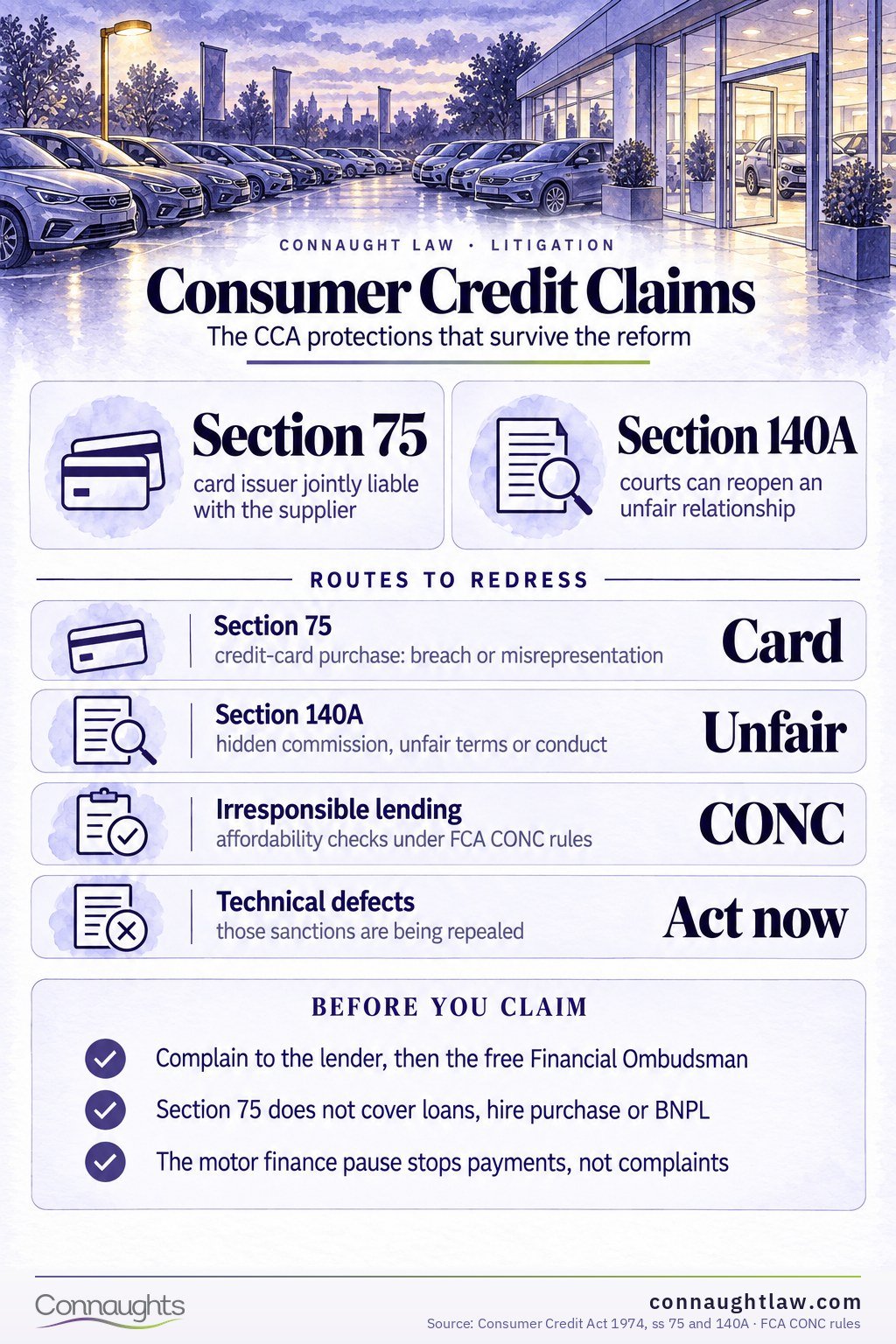
- Section 75 breach or misrepresentation — goods or services faulty, not delivered, or misdescribed, on a credit-card purchase between £100 and £30,000.
- Unfair relationship (s140A) — hidden commission, misleading impartiality claims, or exploitative terms.
- Irresponsible lending — inadequate affordability checks under FCA CONC rules.
- Technical unenforceability — missing prescribed terms or defective documentation (assess before repeal).
When to instruct a consumer credit solicitor
Many consumer-credit complaints can be resolved directly with the lender or through the Financial Ombudsman Service (FOS), which offers a free route for most disputes involving FCA-regulated firms. That is usually the sensible first step for a straightforward claim.
Legal advice becomes worthwhile where the issues are more complex or the sums larger: motor finance commission disputes turning on Section 140A, unenforceability challenges that need detailed CCA analysis, systematic mis-selling across a portfolio of agreements, or claims that exceed the Ombudsman's monetary limit and must be pursued in court. Our financial services disputes team handles these alongside hire purchase and car finance matters. The current maximum the FOS can require a firm to pay is £445,000 for complaints referred on or after 1 April 2025 (about acts or omissions on or after 1 April 2019); above that, a court claim under Section 140A may be the better route.
Buy-now-pay-later comes into scope
The credit landscape is also widening. New FCA rules bringing buy-now-pay-later (BNPL) "deferred payment credit" into regulation take effect on 15 July 2026, introducing affordability checks, clearer information and access to the Financial Ombudsman for these products. Importantly, Section 75 joint liability will not extend to BNPL agreements — that protection remains specific to credit cards — so it is worth understanding which safeguards apply to which product.
Frequently askedQuestions about Consumer Credit Act claims
Is the Consumer Credit Act being scrapped?
No. The 2026 reform modernises the Act by moving many technical information requirements into FCA rules and repealing the automatic unenforceability sanctions attached to them. The core consumer protections — Section 75 credit-card liability and Section 140A unfair relationships — are being retained, with the government confirming it will not change them at this stage.
What is the motor finance redress scheme and can I still claim?
It is an FCA scheme, confirmed in March 2026, to compensate customers who paid undisclosed or unfairly disclosed commission on car finance taken out between 6 April 2007 and 1 November 2024. Parts of the scheme were partially suspended by the Upper Tribunal on 2 July 2026 pending a legal challenge, so payment timetables are currently paused. You can still complain — the longstop for consumers not contacted under the scheme is 31 August 2027 — and reviewing your finance paperwork now is sensible.
How does Section 75 protect credit-card purchases?
Section 75 makes your card issuer jointly liable with the supplier for breach of contract or misrepresentation where the cash price is more than £100 and no more than £30,000. It applies even if you paid only part of the price on the card, and it can cover consequential losses — not just a refund — which is especially valuable when a supplier becomes insolvent.
Does Section 75 apply to personal loans, hire purchase or buy-now-pay-later?
No. Section 75 is specific to credit-card purchases within the £100–£30,000 range. Personal loans, hire purchase, motor finance and BNPL do not carry Section 75 protection, though they remain subject to other CCA safeguards including Section 140A unfair-relationship claims and, for now, technical unenforceability rules.
What is a Section 140A "unfair relationship" claim?
Section 140A lets a court reopen a credit agreement where the relationship between lender and borrower is unfair — looking at the terms, the lender's conduct and any connected matter. Remedies include reducing or refunding sums, setting aside terms, or ordering compensation. It underpins the motor finance redress exercise and hidden-commission and irresponsible-lending claims across all regulated credit.
Should I use the Financial Ombudsman or go to court?
The Financial Ombudsman Service is free and is the right first step for most straightforward complaints against FCA-regulated firms. Its maximum award is £445,000 (for complaints referred on or after 1 April 2025). Court proceedings — often under Section 140A — become appropriate where the claim exceeds that limit, involves complex legal argument, or spans multiple agreements.
Complaining to your lender, and then the Ombudsman, is free. Tell us the agreement, what went wrong and what you have been told so far — we’ll tell you whether Section 75, Section 140A or an affordability complaint is the route worth taking.
Get Expert Advice