
Hire purchase gives consumers more protection than almost any other way of buying a car, and in 2026 that protection is being tested at scale: the FCA has confirmed an industry-wide motor finance redress scheme expected to return around £7.5 billion for unfair commission arrangements on agreements made between 2007 and 2024 — though payments are currently paused by a legal challenge. This guide explains how hire purchase works, the statutory rights — voluntary termination, protected goods, quality claims — that survive regardless, where the Supreme Court’s August 2025 judgment left commission claims, and how the scheme works in practice.
On This Page

Understanding Hire Purchase Agreements UK 2026
Hire purchase is exactly what its name says: you hire the goods while paying, and you purchase them only at the end. The finance company owns the car until the final instalment and any option-to-purchase fee are paid, which is why HP cars cannot lawfully be sold mid-agreement, why repossession law centres on ownership, and why the statutory rights Parliament attached to HP in 1974 remain the consumer’s real leverage. Personal contract purchase is a variant with a deferred balloon; conditional sale is a sibling where ownership passes automatically at the end.
Two thousand and twenty-six is the year to dig out old agreements. The redress scheme covers motor finance commissions across seventeen years of agreements, participation is free, and the practical actions, checking paperwork, responding to lender letters, complaining where you were never contacted, cost nothing but attention. The rights below apply to live agreements; the scheme applies to the finance you may have long since paid off.
The consumer credit landscape around HP has also professionalised: affordability rules oblige lenders to check that repayments are sustainable, arrears handling is governed by conduct rules that require forbearance before enforcement, and complaints escalate free of charge to the Ombudsman. None of that machinery works for people who do not invoke it, which is this guide’s recurring theme.
What Hire Purchase Agreements Are
The structure is triangular even when it feels like a dealership transaction: the dealer sells the car to a finance company, the finance company hires it to you under the Consumer Credit Act 1974, and the dealer, for credit purposes, acts as the lender’s intermediary, which is precisely why what the dealer told you can bind the lender. Deposits reduce the financed balance; interest is fixed at the outset; and the total amount payable, not the monthly figure, is the number that describes the deal.
HP suits buyers who want eventual ownership without a balloon payment gamble, and its regulated status brings the machinery this guide covers: statutory termination rights, repossession protection, implied quality terms, and access to the Financial Ombudsman Service without court fees or costs risk. Business-use and high-value agreements can fall outside parts of the regime, one of several boundary questions worth advice rather than assumption.
HP versus PCP: The Balloon Payment Difference
PCP deserves its contrast because the scandal touched both: the discretionary commission problem lived in PCP and HP alike, so the redress scheme reads across, while the day-to-day rights differ, PCP’s guaranteed future value and mileage terms create end-of-term disputes HP never has, and HP’s half-paid voluntary termination has no true PCP twin until the balloon maths is done. Identify which agreement you actually signed before applying anyone’s advice, including this page’s.
Consumer Rights Under Hire Purchase
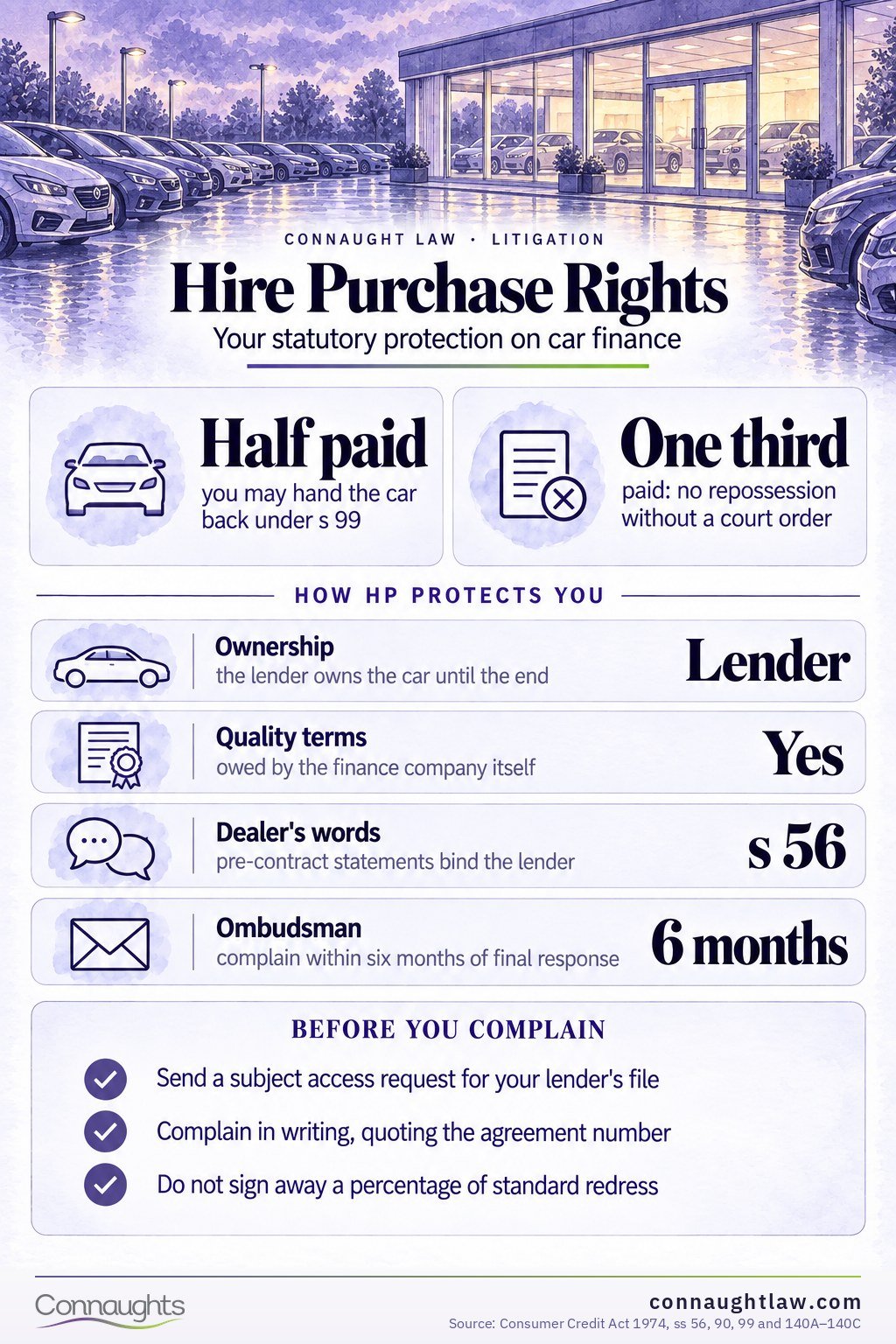
Voluntary termination is the right lenders least advertise: under section 99 of the Consumer Credit Act, you may end the agreement and return the car once at least half the total amount payable has been paid, or by paying up to that halfway line, with liability beyond it only for missed instalments and damage beyond reasonable wear. For buyers deep in negative equity, VT is frequently the cheapest lawful exit, and charges levied for ordinary mileage and condition at VT deserve scrutiny rather than payment by reflex.
Early settlement mechanics are governed arithmetic, not lender discretion: statutory rebate rules cap the charges recoverable when you settle ahead of schedule, and settlement figures should be checked against the formula rather than accepted. Where a settlement figure funds a part-exchange, the negative equity rolled into the next agreement deserves cold-eyed attention, because it is tomorrow’s dispute being financed today.
Affordability complaints have grown alongside the commission story: lending that ignored obvious signs the payments were unsustainable, income never verified, existing commitments overlooked, grounds complaints in its own right, with redress typically unwinding interest and charges. The same records that evidence commission complaints, the file the lender holds on you, evidence these too.
Protected Goods and the Third Rule
Protected goods status is the second shield: once a third of the total price has been paid, the lender cannot repossess without a court order under section 90, and goods seized in breach entitle the consumer to recover everything paid under the agreement. Alongside sit the implied terms of the Supply of Goods (Implied Terms) Act 1973, satisfactory quality, fitness and description owed by the finance company itself, and section 56, which makes the dealer’s pre-contract statements the lender’s problem, not just the showroom’s.
Insurance and add-on disputes ride alongside: GAP and warranty products sold with the finance are regulated sales with their own suitability and disclosure duties, refundable where mis-sold, and their commissions were part of what made dealer finance so profitable to arrange. Reviewing the whole file, finance, add-ons, disclosures, is how a single agreement sometimes yields several complaints.
Keep perspective on scale: for most customers the scheme will produce hundreds rather than thousands of pounds per agreement, real money worth claiming for free, not life-changing sums worth paying percentages on. The larger recoveries belong to multi-agreement histories, high-rate cases and litigation-track unfair relationship claims, exactly where advice, rather than automation, earns its keep.
Vulnerability Protections
Vulnerability protections thread through all of it: conduct rules oblige lenders to identify and accommodate vulnerable customers in arrears handling and communications, and failures there strengthen complaints independently. A household juggling default notices during illness or bereavement should say so to the lender in writing, both because it triggers duties and because it documents their breach.
Complaint drafting rewards specificity over volume: agreement number, dates, what was disclosed about commission and when, what rate you were given, and what outcome you seek. A three-paragraph complaint with the agreement attached outperforms ten pages of grievance, at the lender and at the Ombudsman alike, and it photographs well beside the lender’s own file when the two are compared.
Data rights back the whole exercise: a subject access request obliges the lender to hand over your file, agreement, commission records, affordability assessment, call notes, free and within a month. For pre-2014 agreements where your own paperwork is gone, it is frequently the difference between a speculative complaint and a documented one, and it costs a single email to send.
Sections 140A to 140C let courts reopen credit relationships that are unfair to the borrower, looking at the whole picture: undisclosed commissions, misleading sales framing, oppressive terms and conduct. This is the provision the Supreme Court used in August 2025 to uphold the lead commission claim, and it remains the litigation route where the redress scheme does not fit a case.
The Motor Finance Scandal and the 2026 Redress Scheme
The scandal’s core was discretionary commission arrangements: until the FCA banned them in January 2021, many dealers could set the customer’s interest rate within a lender-agreed range and be paid more commission for setting it higher, an incentive pointed directly at the customer’s pocket, usually without meaningful disclosure. Complaint volumes forced the FCA to pause normal complaint handling in 2024 while the courts worked through test cases.
The pause mattered practically: complaints lodged during it did not die, they queued, and time-bar rules were adjusted around the pause so that consumers were not prejudiced by the regulator’s own timetable. If you complained years ago and heard nothing, that complaint is likely part of the scheme’s workload now, and chasing its status in writing is a legitimate, useful step.
The Supreme Court Ruling and FCA Redress Scheme
On 1 August 2025 the Supreme Court reset the legal landscape: it rejected the broad fiduciary-duty and bribery analysis that had briefly made almost every commission claim look winnable, but upheld the claim in Johnson v FirstRand under the unfair relationship provisions, where a large undisclosed commission, around a quarter of the sum advanced, and misleading impressions about the dealer’s independence combined to make the relationship unfair, with the commission repaid with interest. Narrower than the Court of Appeal, but a clear route to redress for bad disclosure cases.
The FCA then moved from litigation to scheme: consultation from October 2025, and final rules on 30 March 2026 confirming an industry-wide consumer redress scheme covering unfair commission practices in motor finance agreements from 2007 to 2024, free for consumers and built for direct participation rather than claims-company involvement.
That launch timetable has since been overtaken. On 2 July 2026 the Upper Tribunal partially suspended the scheme while it hears legal challenges brought by several lenders and a consumer body, so firms are not currently required to calculate or pay redress, or to write to customers about compensation owed.
The groundwork continues in the meantime: lenders must still identify affected agreements, gather commission and disclosure data, and notify customers who are not owed redress by 18 November 2026 for agreements taken out from 1 April 2014, or 18 January 2027 for older ones. Substantive hearings are listed for December 2026 or early 2027, and any payments are unlikely before 2027. None of this closes the free route: you can still complain to your lender now and escalate to the Financial Ombudsman. Our dedicated guide to mis-sold car finance claims covers the scheme and the unfair-relationship route in full.
The FCA’s stated expectation is millions of claims settled during 2026 and the vast majority by the end of 2027, with total redress in the region of £7.5 billion; industry legal challenges to aspects of the scheme, announced in May 2026, are a live caveat on the edges rather than the core.
What consumers should actually do is short: locate agreements and any commission disclosures, respond promptly to lender letters, complain in writing if in scope and uncontacted, keep copies of everything, and treat the Ombudsman as the free escalation for disagreements over scheme outcomes. What consumers should not do is sign away a percentage of standardised redress, or assume that a scheme rejection ends the road when the unfair relationship route remains.
The scheme is designed for direct participation: lenders contact affected customers, complaining directly costs nothing, and a claims management cut taken from standardised redress buys little beyond a signature. Where paid help earns its place is the non-standard case, excluded agreements, disputed records, larger losses, unfair-relationship litigation, which is advice work, not form-filling.
Common Hire Purchase Disputes
Arrears and repossession disputes turn on process: default notices served correctly, protected-goods status respected, time orders available from the court where a realistic payment plan needs imposing. A car seized from a driveway without an order, a third of the price having been paid, is not a repossession, it is grounds to recover every pound paid, and lenders know it.
Quality disputes run against the finance company under the 1973 Act implied terms: rejection where faults surface early and go to the root, repair and price-reduction remedies beyond that, and the dealer’s glowing descriptions binding the lender through section 56. Settlement-figure and VT disputes, inflated early-settlement calculations, wear-and-tear charges priced like restorations, are answered from the agreement’s own arithmetic and CONC’s fairness rules, with the Ombudsman as the free tribunal of first resort.
Fraud and title problems close the dispute list: cars sold on with outstanding finance, innocent private purchasers protected by the Hire Purchase Act 1964’s good-faith provisions, and log-book loans masquerading as ordinary finance. Each is a title puzzle with statutory answers, and each moves faster with the agreement number and a subject access request in hand.
Commission disputes now route through the scheme first for in-scope agreements, with court litigation under the unfair relationship provisions holding the line for cases the scheme excludes or undervalues. Records are the recurring obstacle for pre-2014 agreements, which is why customers with old paperwork hold an advantage, and why a subject access request to the lender is often the first constructive step.
Guarantors occupy a difficult corner of consumer credit generally, and HP’s sibling products especially: liability follows the agreement’s enforceability, and the same disclosure and affordability failings that ground borrower complaints can ground guarantor ones. Where a household is pursued on a guarantee for a vehicle long gone, the paperwork deserves legal reading before any payment plan is agreed.
Court proceedings, where they come, are creditor-friendly on their face and consumer-friendly in their machinery: time orders can restructure payments, unfair relationship findings can rewrite or unwind obligations, and enforcement of improperly executed or improperly served agreements can be barred. Defended intelligently, an HP possession claim is a negotiation, not a formality, and judges expect lenders to have followed their own rulebook to the letter.
Evidence discipline is gentler here than in injury work but real: keep agreements, statements, settlement quotes and correspondence in one folder; put complaints and status-chasers in writing; and date everything. Consumer credit disputes are won from paper trails the consumer controls, which is a rare and useful inversion of the usual litigation imbalance.
The through-line for 2026: hire purchase rights did not change with the scandal, they were merely joined by a compensation programme for how agreements were sold. Use the statutory rights while agreements run, use the free scheme for the years it covers, and reserve paid help for the disputes that genuinely need a lawyer rather than a template. That allocation, more than any single right, is what this area of law now rewards.
Finally, the disputes this firm sees end the same way the statute suggests they should: consumers who invoked section 99 instead of defaulting, who demanded court orders instead of surrendering driveway keys, who put commission complaints in writing instead of waiting, recover more and stress less. The Consumer Credit Act is fifty years old and still the sharpest tool in the showroom; 2026’s scheme simply adds a second blade.
Frequently askedQuestions about hire purchase and motor finance redress
Am I owed money under the motor finance redress scheme?
Potentially, if you took motor finance between 2007 and 2024 and your agreement involved a discretionary or otherwise unfairly disclosed commission. The scheme was partially suspended on 2 July 2026, so lenders cannot currently calculate or pay redress; dig out agreements, respond to lender contact, and complain directly if you believe you are in scope and hear nothing.
How much compensation will motor finance customers get?
The FCA estimates around £7.5 billion across the scheme, with individual redress depending on the commission, the rate impact and interest. The Supreme Court’s lead case ordered repayment of the commission with commercial-rate interest, which frames the shape, though not the size, of scheme awards.
Can I end my hire purchase agreement early?
Yes, two ways: early settlement, paying the balance with a statutory rebate of charges, or voluntary termination under section 99 once half the total amount payable is covered, returning the car with liability only for arrears and abnormal damage.
Can the finance company take the car back without going to court?
Not once you have paid a third of the total price: the goods are protected under section 90, repossession requires a court order, and unlawful seizure entitles you to recover all sums paid under the agreement.
The car is faulty – do I claim against the dealer or the lender?
Against the finance company, which owes the implied quality terms in HP, with the dealer’s statements binding it through section 56. That routing is an advantage: regulated lenders answer complaints, and the Ombudsman sits behind them.
What did the Supreme Court actually decide in August 2025?
It rejected the fiduciary and bribery routes for typical commission claims, but upheld unfair relationship liability where a large commission went undisclosed amid misleading sales impressions, ordering the commission repaid with interest. That balance shaped the FCA scheme that followed.
Should I use a claims management company?
For standard scheme cases, no: participation is free and lender-driven, and a percentage fee buys nothing you cannot do with a letter. Take professional advice instead where your case is excluded, disputed or unusually large.
What are the time limits for hire purchase claims?
Scheme participation runs on the FCA’s 2026-27 timetable; Ombudsman complaints carry their own six-month-from-final-response rule; and court claims, including unfair relationship cases, run on Limitation Act periods that advice should confirm on your facts.
Complaining under the scheme is free and needs no solicitor. Tell us if your agreement falls outside it, the lender’s records are disputed, or the offer does not match what you lost — we’ll tell you whether an Ombudsman complaint or an unfair-relationship claim is the better route.
Get Expert Advice