
Millions of people who bought a car on finance between 2007 and 2024 may have been overcharged through commission they were never told about. The regulator has confirmed a redress scheme worth billions — though it is currently paused by a legal challenge. This guide explains who can claim, how the scheme works, and how to complain for free without a claims company.
On This Page

Mis-sold car finance claims in 2026
If you financed a car through a dealership — on hire purchase (HP) or a personal contract purchase (PCP) — the interest rate you paid was often influenced by commission the dealer earned from the lender. For years, that commission was rarely disclosed, and in many cases the dealer could increase your rate to earn more. When this went untested, borrowers paid more than they should have, without ever knowing why.
This is now the largest consumer-redress issue in the UK since PPI. A landmark Supreme Court decision, followed by a regulator-run compensation scheme, has opened the door to refunds for millions of agreements. But the position is nuanced: the scheme is confirmed yet temporarily suspended, and acting in the right way — and avoiding unnecessary fees — makes a real difference.
You may have a claim if you took out car finance between 6 April 2007 and 1 November 2024 and the dealer did not clearly tell you about the commission built into your deal. Complaining is free — you go to your lender first, then the Financial Ombudsman. The FCA's redress scheme is confirmed but currently paused by a legal challenge; the deadline to complain if your lender does not contact you is 31 August 2027.
What went wrong with car finance
Most car finance was arranged at the dealership rather than directly with a bank. The dealer acted as a credit broker, earning commission from the lender for setting up the loan — a normal arrangement in itself. The problem was how that commission worked and whether the customer knew about it.
A DCA allowed the dealer to set or adjust your interest rate, with their commission rising the higher the rate they charged. This gave the dealer a direct incentive to make your finance more expensive. The FCA banned DCAs from 28 January 2021, but agreements arranged before then are exactly the ones now under scrutiny.
Beyond DCAs, the concern extends to commission that was simply large and undisclosed, or arrangements where the dealer only ever offered one lender's finance without saying so. In each case the customer was not given the full picture needed to make an informed decision — the foundation of a mis-selling complaint.
The Supreme Court ruling that changed everything
The turning point came on 1 August 2025, when the Supreme Court handed down its judgment in Johnson, Wrench and Hopcraft [2025] UKSC 33. The court rejected the widest argument — that dealers owed customers a fiduciary duty — which had threatened to make almost every commission unlawful. To that extent, the ruling was narrower than campaigners had hoped.
But it kept the most important route open. In Mr Johnson's case, the court found the lender–borrower relationship was unfair under Section 140A of the Consumer Credit Act 1974, pointing to a commission worth 55% of the total charge for credit, the failure to disclose it, and the hidden commercial ties between lender and dealer. That unfair-relationship principle — not a blanket rule — is the legal engine behind the compensation that followed.
Section 75 of the Consumer Credit Act, which makes a credit-card issuer jointly liable for a purchase, does not cover car finance — this is a loan, not a credit-card purchase. Car finance claims run through the Section 140A unfair-relationship route and the FCA scheme, not Section 75. Our Consumer Credit Act guide explains both provisions in full.
The FCA redress scheme — and why it is paused
Following the ruling, the Financial Conduct Authority confirmed an industry-wide Motor Finance Consumer Redress Scheme in Policy Statement PS26/3 on 30 March 2026. The regulator estimates around £7.5 billion in redress to consumers, across roughly 12.1 million agreements, with an average payout of about £830 per agreement — one of the largest redress programmes in UK financial-services history.
The scheme is designed to be straightforward for consumers: rather than everyone having to fight individually, lenders are required to review their books and contact customers who are likely owed compensation. Those who have already complained are set to be paid sooner.
Why payments are currently paused
There is an important complication. After legal challenges were filed, the Upper Tribunal partially suspended the scheme on 2 July 2026. During the suspension, lenders are not required to calculate or pay redress on the original timetable, and any payouts are now expected to follow in 2027 if the scheme is upheld. Crucially, this does not close the door: you can still complain to your lender, and the Financial Ombudsman route remains open. The deadline to bring a complaint if your lender does not contact you is 31 August 2027.
Who can claim, and how much
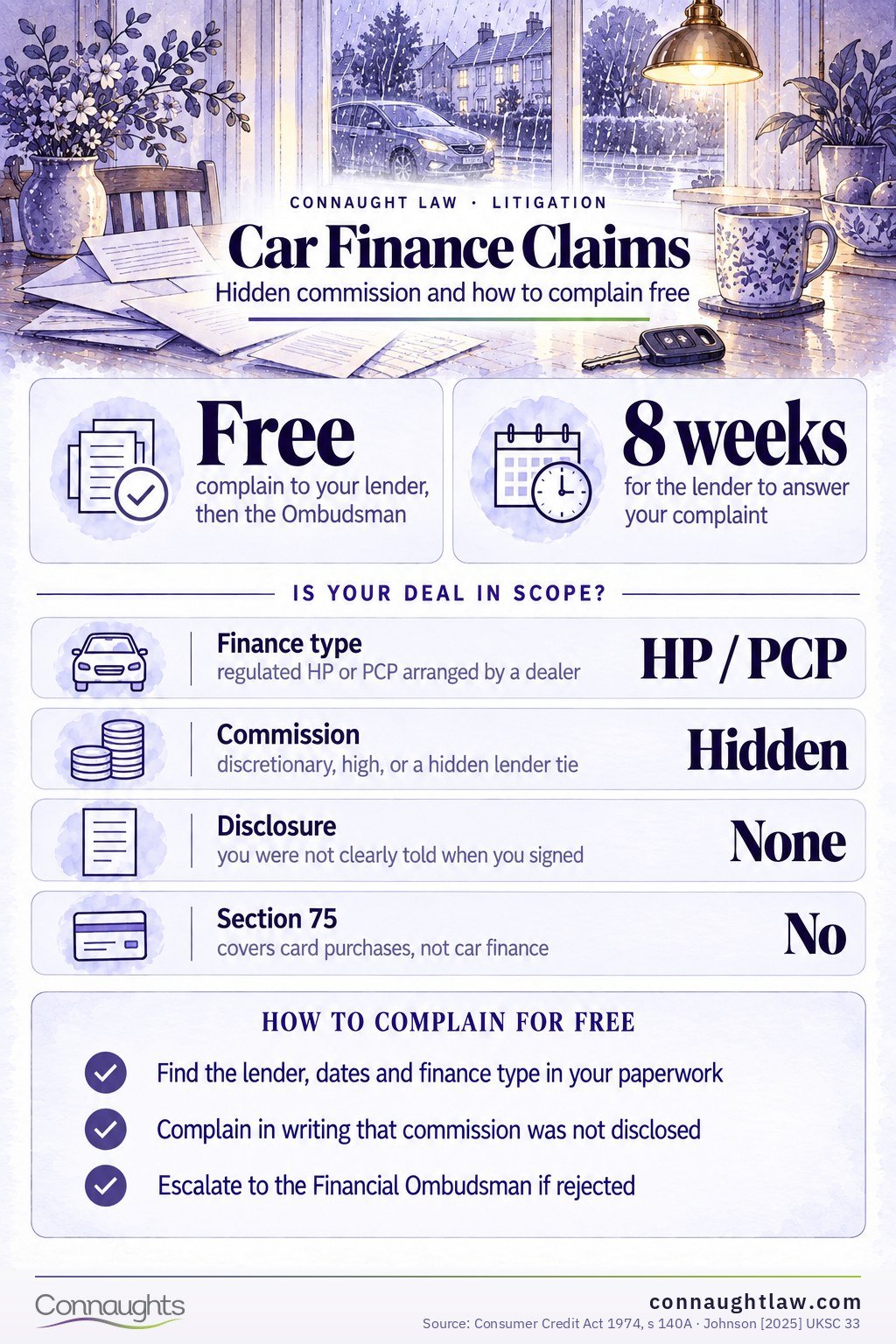
The scheme covers regulated motor finance agreements — HP, PCP and similar — taken out between 6 April 2007 and 1 November 2024. Broadly, an agreement is in scope where the commission was not properly disclosed and one of the following applied: the dealer used a discretionary commission arrangement; the commission was high relative to the cost of the credit; or the dealer was tied to a single lender without telling you.
Compensation is designed to put you back in the position you should have been in — typically by refunding the extra interest attributable to the undisclosed commission, with interest added on top. The FCA's headline average is around £830 per agreement, but individual amounts vary widely with the size of the loan, the rate, and how long you paid.
- Timing — car finance taken out between April 2007 and November 2024.
- Type — a regulated agreement such as HP or PCP arranged through a dealer or broker.
- Commission — a discretionary arrangement, an undisclosed high commission, or an undisclosed tie to one lender.
- Disclosure — you were not clearly told about the commission when you signed.
How to claim for free
The most important thing to know is that you do not need to pay anyone to claim. The process is free and designed for consumers to use directly. Start by identifying your agreement — the lender, the dates, and the type of finance — from your paperwork or credit file. Then complain in writing to the lender, stating that you believe commission was not properly disclosed and that the relationship was unfair.
The lender has eight weeks to respond. If it rejects your complaint or does not reply, you can escalate — free of charge — to the Financial Ombudsman Service. Because the redress scheme is currently paused, some complaints may be held pending the outcome of the legal challenge, but lodging your complaint protects your position and starts the clock. If your lender identifies you as owed compensation under the scheme, it should contact you directly once payments resume.
Hold on to your finance agreement, statements and any correspondence — they are the evidence a claim rests on. And note the longstop: if your lender does not contact you, you have until 31 August 2027 to complain. It is better to lodge a complaint now than to wait for the litigation to conclude.
Do you need a claims company?
Claims management companies and some law firms advertise heavily on car finance, and they take a percentage of any compensation — often a substantial one. For a straightforward complaint, that fee is avoidable: the Financial Ombudsman is free, and the FCA scheme is designed so that eligible customers are contacted without needing a representative at all. Paying a cut of your redress to a company for a claim you could make yourself rarely makes sense.
Specialist legal advice does earn its place in specific situations: high-value agreements, complex or commercial finance, cases that turn on detailed Section 140A arguments, or where a lender disputes the facts and the matter may head to court rather than the Ombudsman. Where a car finance issue overlaps with wider credit problems, our Consumer Credit Act and financial services disputes teams can advise, and if a lender is in financial difficulty our guidance on claims against insolvent lenders — as with guarantor loans — explains how redress works through administrators.
Questions about claiming and the redress scheme
Can I still make a car finance claim in 2026?
Yes. Although the FCA redress scheme was partially suspended on 2 July 2026 pending a legal challenge, you can still complain to your lender and escalate to the Financial Ombudsman. If your lender does not contact you under the scheme, the deadline to complain is 31 August 2027. Lodging a complaint now protects your position.
How much compensation could I get?
The FCA estimates an average of around £830 per agreement, but individual amounts vary with the loan size, the interest rate, and how long you paid. Redress broadly refunds the extra interest attributable to the undisclosed commission, with interest added on top.
What is a discretionary commission arrangement?
A DCA let the dealer set or increase your interest rate, earning more commission the higher the rate. It created a direct incentive to make your finance more expensive, usually without your knowledge. The FCA banned DCAs from 28 January 2021, so agreements before that date are central to the redress scheme.
Which agreements are eligible?
Regulated motor finance such as HP and PCP taken out between 6 April 2007 and 1 November 2024, where commission was not properly disclosed — through a discretionary arrangement, an undisclosed high commission, or an undisclosed tie to a single lender. Cash purchases and business contract hire fall outside the consumer scheme.
Do I need a claims company or solicitor?
No — you can complain to your lender and the Financial Ombudsman for free, and the scheme is designed to contact eligible customers directly. Claims companies take a percentage of your payout. Legal advice is worth it for high-value, complex, or disputed cases, or where a matter may go to court under Section 140A.
Does Section 75 cover car finance?
No. Section 75 applies to credit-card purchases, not loans. Car finance mis-selling is pursued under the Section 140A unfair-relationship provisions of the Consumer Credit Act and through the FCA redress scheme, not Section 75.
Most car finance complaints cost nothing and need no solicitor. If your lender has refused you, or your agreement falls outside the scheme, send us the dates and the lender — we’ll tell you where you stand.
Get Expert Advice