
A frozen bank account escalates fast: cards declined, standing orders bouncing, and a bank that will not explain itself. How long it lasts depends entirely on why it happened — from a few days for a routine compliance review to up to two years for a court-ordered freeze. This guide explains each route, your rights while frozen, and the steps that actually get accounts released.
On This Page
Bank account freezes in 2026: how long, and how to unfreeze
A frozen account is not a closed account, and it is not confiscation. Your money remains yours; access to it has been suspended while the bank, or an enforcement agency, examines something. That distinction matters, because each type of freeze has its own legal basis, its own timescale, and its own release route.
Banks rarely say which type applies. Anti-money-laundering law prohibits them from tipping off a customer about a suspicious activity report, so the branch genuinely cannot tell you what is happening. Reading the situation from its features, and responding with evidence rather than anger, is usually the fastest way out.
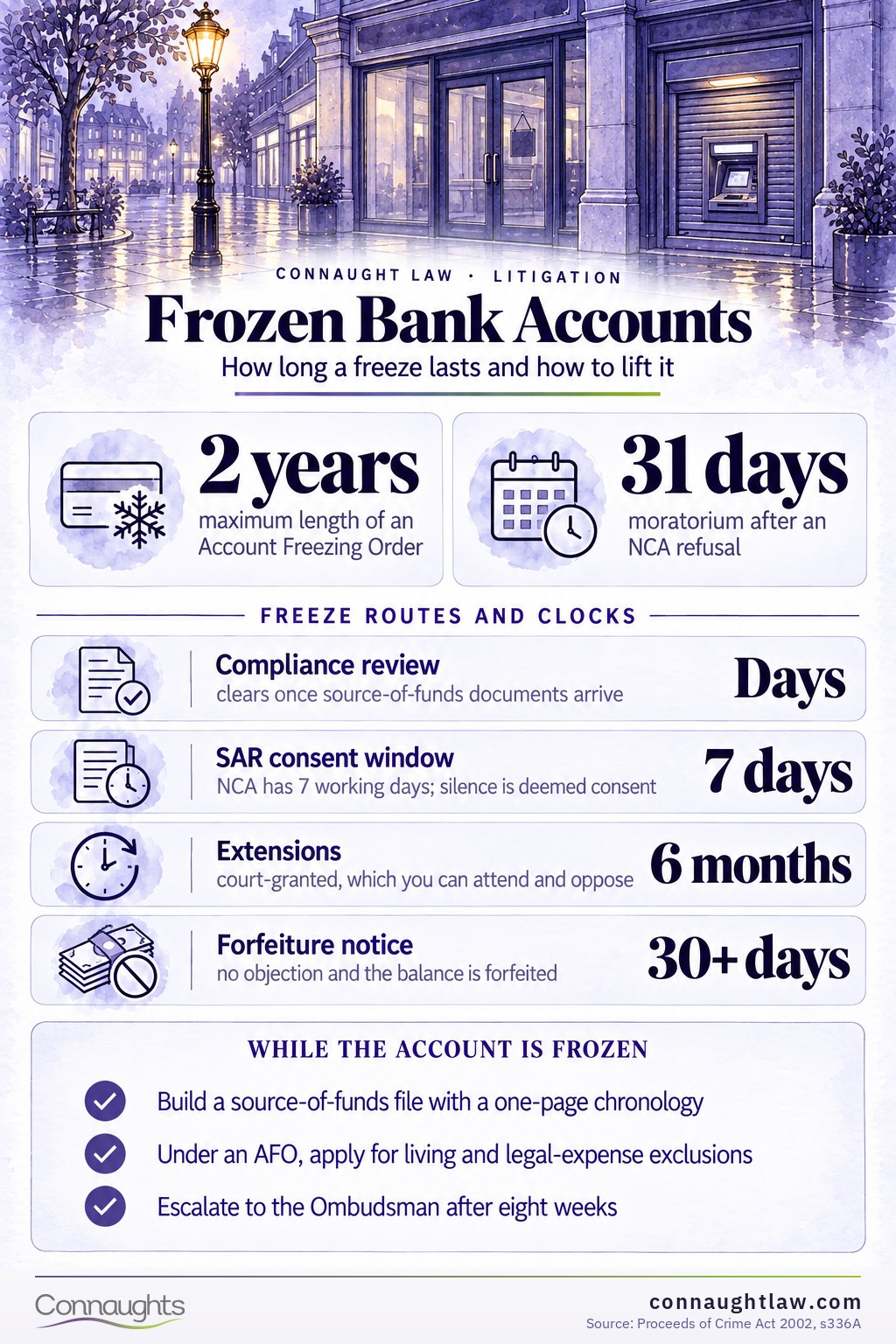
It depends on the reason. A routine compliance review often clears in days once documents are provided. A suspicious activity report can hold funds for 7 working days plus a 31-day moratorium — extendable by a court up to 6 months in total. An Account Freezing Order under the Proceeds of Crime Act 2002 can last up to 2 years. Knowing which regime you are in is the first step to getting released.
What a freeze is and how it happens
Three mechanisms account for almost every frozen account. First, the bank's own compliance review: know-your-customer and source-of-funds checks triggered by unusual activity, a large incoming payment, or a periodic file refresh. The bank can suspend the account under its terms and conditions while it completes these checks.
Second, a suspicious activity report. Where the bank suspects funds may be criminal property, it must report to the National Crime Agency and seek a defence against money laundering before processing transactions. The account is typically restricted while the NCA considers the request. Third, court-ordered freezes: an Account Freezing Order under the Proceeds of Crime Act 2002 lets enforcement agencies freeze accounts through the magistrates' court, and civil freezing injunctions can attach to accounts during litigation. These are the serious end of the scale, with the longest timescales and the most formal release procedures.
Freezes also vary in shape. Some accounts are blocked completely; others allow credits in but nothing out, or block online transfers while cards keep working. A partial restriction usually signals an internal review still in progress, while a total block with a formal letter points to a court order or an NCA moratorium. Note what still works — it is diagnostic.
The legal framework: SARs, moratoriums and freezing orders
The timescales that answer the question everyone asks — how long can a bank freeze your account — come from statute. They are best seen side by side.
Freeze Types and Duration
| Freeze type | Typical duration | How it lifts |
|---|---|---|
| Bank compliance review | Days to a few weeks | Provide source-of-funds documents to the bank |
| Suspicious activity report (SAR) | 7 working days, then a 31-day moratorium | NCA consent, or the moratorium expiring |
| Moratorium extensions (s336A POCA) | Up to 6 months in total | Court hearings, which you can attend and oppose |
| Account Freezing Order (POCA 2002) | Up to 2 years | Application to vary/discharge, or agreement with the agency |
| Civil freezing injunction | Duration of the litigation | Fighting or settling the underlying claim |
The suspicious activity report route runs on fixed clocks. When a bank seeks a defence against money laundering, the NCA has 7 working days to respond; silence amounts to deemed consent and the payment can proceed. A refusal starts the 31-day moratorium, during which investigators decide whether to seek freezing or forfeiture powers, and any extension beyond it must be granted by a court, with you entitled to appear and oppose.
Civil freezing injunctions are the separate, litigation-driven route. A claimant who shows a real risk that assets will be dissipated can obtain a High Court order freezing bank balances before judgment. Breaching one is contempt of court, and banks comply strictly, so these freezes are lifted by fighting or settling the underlying claim rather than by persuading the bank.
A freeze catches the entire balance, not just the suspected share. Spouses, business partners and anyone else with money in a frozen account can assert their interest through exclusion applications and forfeiture proceedings, and courts routinely carve out third-party funds that are properly evidenced.
An Account Freezing Order can lead to forfeiture. Agencies may serve an account forfeiture notice, and if no objection is lodged within the notice period — at least 30 days — the balance is forfeited without any court hearing. Objections push the question to the magistrates' court, where the agency must show the funds are recoverable property on the balance of probabilities. The regimes reach across the UK, with local variations: Account Freezing Orders are made by sheriff courts in Scotland and the magistrates' courts in Northern Ireland.
Common reasons accounts get frozen
Most freezes trace back to a familiar list: a large or unexpected credit, especially from overseas; cash-intensive trading that does not match the declared business profile; rapid in-and-out transfers that resemble layering; payments to or from high-risk jurisdictions; a mismatch between account activity and the customer information on file; or a report from another bank in the payment chain.
Perfectly innocent events sit behind many of these triggers. Property sale proceeds, inheritance, a business exit, cryptocurrency disposals and family gifts from abroad are regular culprits. The bank cannot see the story behind a transaction, only its shape, which is why the remedy is nearly always documentation rather than argument. Cryptocurrency deserves particular mention: transfers from crypto exchanges into bank accounts are among the most heavily flagged in UK banking, so keep the complete chain — exchange statements, wallet records, acquisition history and the relevant pages of your tax returns.
Your rights while the account is frozen
You keep important rights throughout. Under an Account Freezing Order you can apply for exclusions to cover reasonable living expenses and legal fees, and the order itself must be served on you with the right to apply to vary or discharge it. In moratorium cases, the extension hearings give you a voice before a judge.
Against the bank itself, the Financial Conduct Authority expects firms to treat customers fairly even during financial-crime checks. If the bank has been slow, uncommunicative, or has frozen more than the risk justifies, you can complain and — after eight weeks or a final response — escalate to the Financial Ombudsman Service, which can order compensation for losses caused by unfair treatment. Log consequential losses as they happen: bounced bills, damaged credit records, missed completions all belong in an Ombudsman complaint.
A freeze itself is not reported to credit agencies, but bounced direct debits and missed repayments are. Tell lenders and utility providers what has happened, pay critical bills from another source where possible, and once the freeze lifts, ask lenders to correct or annotate any markers caused by it.
How to unfreeze your account
Start by establishing which regime you are in. A letter or court order means an Account Freezing Order or injunction; silence plus a vague reference to checks usually means a compliance review or SAR. Then build the evidence file: contracts, completion statements, invoices, payslips, tax returns, gift letters, exchange records — whatever shows where each significant credit came from.
For compliance reviews, deliver the documents with a short covering explanation and ask for a decision date. For SAR-based freezes, the same evidence, sent to the bank's financial-crime team, often prompts consent before the moratorium expires. For Account Freezing Orders, apply promptly for living and legal-expense exclusions, then negotiate: well-evidenced funds are frequently released by agreement without a contested hearing. A strong source-of-funds bundle has a shape — a one-page chronology, each step cross-referenced to an exhibit, with the exhibits in order behind it. Compliance teams process files like that in days; loose screenshots sit in queues for weeks.
Run the freeze like a project while it lasts: diarise every deadline, ask the agency or bank directly for the moratorium or review end date, and request partial releases for critical payments such as payroll, rent and tax rather than waiting for full restoration. Where a freeze overlaps with regulated credit you are still repaying, our Consumer Credit Act guide explains the parallel protections there.
When to bring in specialist help
Self-help is realistic for straightforward compliance reviews. Specialist advice earns its fee the moment an Account Freezing Order is served, a moratorium extension is listed, a forfeiture notice arrives, or the sums frozen threaten a business's survival. Watch, too, for the point where a civil freeze develops a criminal edge — an invitation to a voluntary interview, an interview under caution, or a production order for records. From then on, anything you send the bank can reach investigators, and criminal-defence input belongs alongside the civil strategy.
The advice usually pays for itself in sequencing: what to disclose, in what order, and what to hold for a hearing. Our financial services disputes team handles frozen-account cases against banks, while our asset tracing and financial crime specialists deal with the Proceeds of Crime Act, freezing orders and forfeiture. Bring the freeze correspondence and any court order, six months of statements for the affected account, identification for every account holder, and the raw documents behind the flagged transactions, and a specialist can usually map the strategy — and a realistic timescale — in a single session. Our litigation team handles these disputes daily.
Frequently askedQuestions about frozen bank accounts
How long can a bank freeze your account for suspicious activity in the UK?
A compliance review usually resolves in days to a few weeks once documents are provided. Where a suspicious activity report is made, funds can be held for 7 working days, then a 31-day moratorium, which a court can extend in stages up to roughly six months. An Account Freezing Order can last up to two years.
Why did my bank freeze my account without warning?
Usually because it is legally required to. Tipping-off rules prohibit banks from revealing that a suspicious activity report has been made, so accounts are restricted without explanation. Unusual credits, overseas transfers and activity that does not match your profile are the common triggers.
Can I get living expenses from a frozen account?
Under an Account Freezing Order, yes — the court can grant exclusions for reasonable living expenses and legal fees. During bank-level freezes there is no formal right, but banks often release essential payments on request, and refusing unreasonably strengthens a later Ombudsman complaint.
What is an Account Freezing Order?
A magistrates' court order under the Proceeds of Crime Act 2002 freezing an account holding £1,000 or more where an enforcement agency reasonably suspects the funds are recoverable property. It can last up to two years and may be followed by forfeiture proceedings, which you can contest.
Will I get my money back after a freeze?
If the source of funds is legitimate and evidenced, normally yes. Money is only lost through forfeiture or confiscation, each of which involves notice, objection rights and a hearing where the agency must prove the funds are recoverable property.
Can the bank close my account after unfreezing it?
Yes. Banks may exit customers after a financial-crime review, normally with notice under the account terms, occasionally immediately where they consider the risk demands it. A closure decision can be challenged through the complaints process and the Financial Ombudsman if unfair.
Should I complain to the Financial Ombudsman about a freeze?
Complain to the bank first. If eight weeks pass or you receive a final response, the Ombudsman can review whether the bank acted fairly and order compensation for losses and distress. The Ombudsman cannot override NCA moratoriums or court orders — only the bank's own conduct.
Tell us which bank, when it happened and whether any court paperwork has arrived. We’ll tell you which freeze regime applies, what the deadline is, and what actually gets money released.
Get Expert Advice