Companies with more than one class of share can allocate voting power, dividends and capital returns in precise, bespoke ways. That flexibility, granted by the Companies Act 2006, is also the source of many shareholder disputes: when class rights are poorly drafted or overridden, holders of different classes fall out over money and control. This guide explains how share classes and class rights work, where share class disputes arise, and the statutory routes available to resolve them.
Understanding Share Class Disputes in UK Companies
A share class dispute turns on the rights attached to shares, not simply who owns them. Where a company has issued several classes, disagreements often follow a difficult transaction, an unequal dividend, or a decision that favours one group of shareholders over another. Resolving them requires reading the articles of association and any shareholders' agreement together, then applying the relevant provisions of the Companies Act 2006.
Share Classes and Class Rights Under the Companies Act 2006
Class rights are the rights attached to a particular class of share, typically covering voting, dividends and the return of capital on a winding up. A company may create as many classes as its constitution allows, provided the rights are properly recorded and any prescribed particulars are filed at Companies House.
Definition — class rights
The rights attaching to a class of shares — usually voting, dividend and capital entitlements — that distinguish one class from another. Shares carrying identical rights form a single class; a difference in any material right creates a separate class.
Common Types of Share Class
Most private companies work with a familiar set of classes, each carrying a different balance of income, capital and control. Understanding the intended function of each class is the starting point for identifying where rights may conflict.
Key points — the common share classes and what each carries
Ordinary shares: the default class, usually carrying one vote each, dividends and a share of surplus capital.
Preference shares: a prior, often fixed, dividend and priority on capital, frequently with limited or no voting rights.
Redeemable shares: issued on terms that they can be bought back by the company, permitted under section 684 provided some non-redeemable shares remain in issue.
Non-voting and deferred shares: used to separate economic value from control, for example in family or management structures.
Alphabet shares (A, B, C): separate classes allowing different dividends to be declared for different shareholders.
Redeemable shares are governed by sections 684 to 689 of the Companies Act 2006. A private company may issue them unless its articles restrict it, while a public company needs authorising provision in its articles; in every case the company must keep at least some non-redeemable shares in issue.
Where Class Rights Live: Articles and Shareholders' Agreements
Class rights are usually set out in the articles of association, which bind the company and every member and are a matter of public record. Many companies supplement the articles with a shareholders' agreement — a private contract that can address matters the articles do not, such as investment terms, board composition and exit. When the two documents conflict, or one is amended without the other, a dispute frequently follows.
The table below summarises how the two documents differ in practice.
Articles Versus Agreement
How the articles and a shareholders’ agreement differ in status, who they bind and how each is changed.
Feature
Articles of association
Shareholders' agreement
Status
Public; filed at Companies House
Private contract between the parties
Binds
Company and all members
Only the parties who sign
Amendment
Special resolution (75%)
Usually unanimous consent of parties
Typical content
Class rights, share capital, governance
Exit terms, drag/tag, deadlock, warranties
How Share Class Disputes Arise
Share class disputes tend to cluster around three moments: when the company tries to change the rights of a class, when it issues new shares, and when profits or a sale crystallise the differences between classes. Each engages distinct statutory rules.
Variation of Class Rights
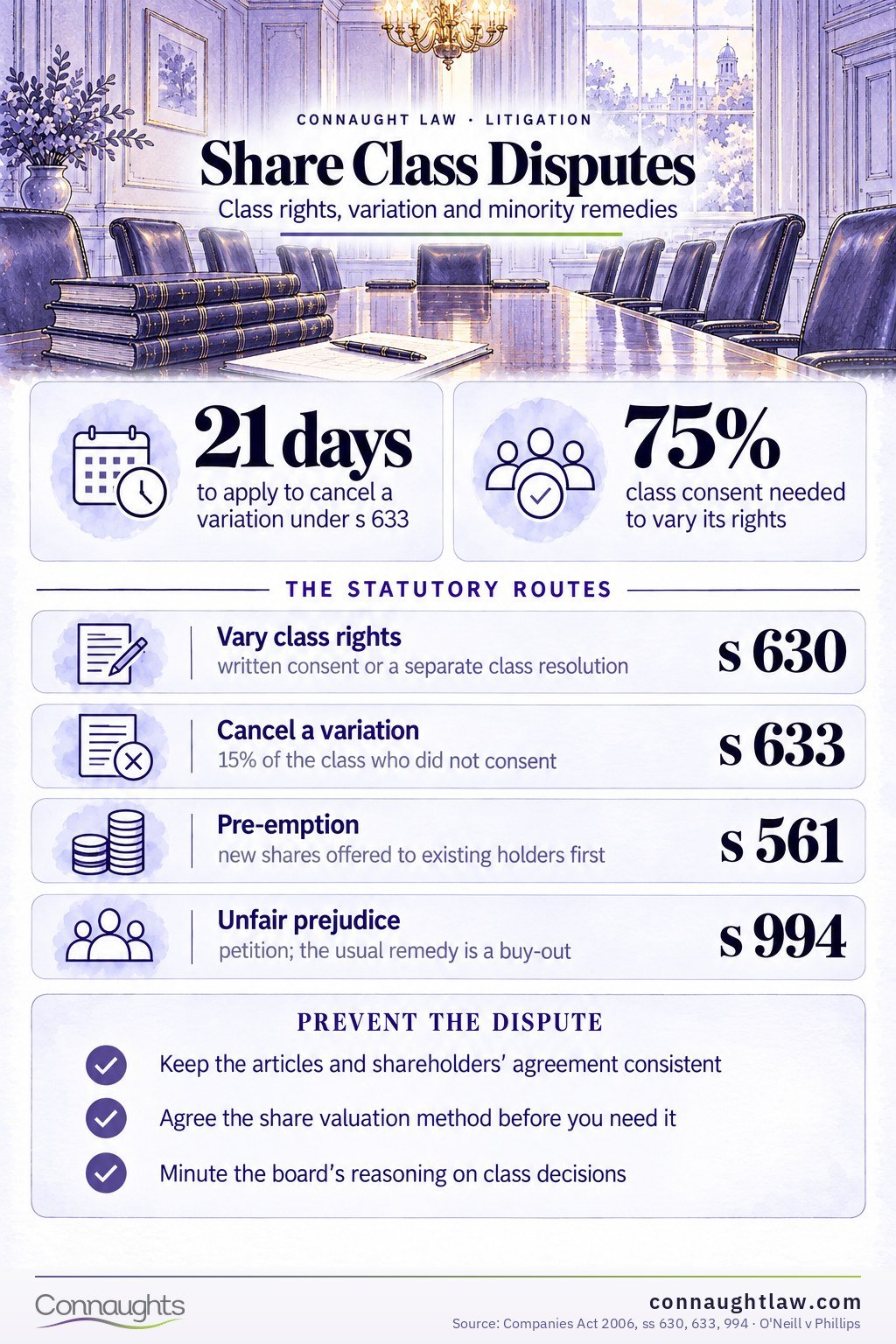
Rights attached to a class can only be varied in accordance with the company's articles, or — where the articles are silent — under section 630 of the Companies Act 2006. That section requires the written consent of the holders of at least three-quarters in nominal value of the issued shares of the class, or a special resolution passed at a separate meeting of the class. A variation pushed through without the correct consent is open to challenge.
Even where the threshold is met, a minority is not without protection. Under section 633, holders of not less than 15% of the issued shares of the class who did not consent may apply to the court to have the variation cancelled. The court will disallow the variation only if satisfied that it would unfairly prejudice the shareholders of that class.
Note — a section 633 application must be made within 21 days
An application under section 633 must be made within 21 days of the consent being given or the resolution passed. The window is short and strict, so dissenting shareholders must take advice quickly once a variation is proposed.
Allotment of Shares and Pre-emption Rights
Disputes also arise when a company issues new shares in a way that dilutes an existing class. Directors may only allot shares if authorised to do so under sections 549 to 551 — either by the articles or by an ordinary resolution of the members. Allotting shares without that authority is a breach of duty, even though the allotment itself remains valid.
Existing shareholders are further protected by statutory pre-emption rights. Under section 561, a company must generally offer new equity securities to existing ordinary shareholders first, in proportion to their holdings, before offering them elsewhere. These rights can be disapplied by the articles or by special resolution under sections 570 and 571, and a disputed or defective disapplication is a common flashpoint in investment rounds.
Dividend, Voting and Exit Conflicts
The sharpest disagreements often surface over money and control. Preference and alphabet structures allow the board to declare different dividends for different classes, and holders of an ordinary class may object when income is consistently steered away from them. Voting and veto arrangements can produce deadlock, where no class can carry a decision the others resist.
Exit mechanisms are a further source of conflict. Drag-along rights allow a majority to compel a minority to sell into an approved offer, while tag-along rights let a minority join a sale on the same terms. Where these clauses are ambiguous or their triggers disputed, the resulting litigation can sit alongside director disputes about how the sale process was run. In distressed cases, class priorities on a return of capital become critical and may intersect with corporate insolvency proceedings.
Directors' Duties in Multi-class Companies
Directors of a company with several classes owe their general duties under sections 171 to 177 of the Companies Act 2006 to the company, not to any one class. That distinction causes difficulty where the interests of the classes diverge. A board deciding whether to declare a dividend, issue new shares or approve a sale must act within its powers (section 171) and promote the success of the company as a whole (section 172), while balancing the competing expectations of each class.
The position is more acute where directors themselves hold shares. A director must avoid conflicts of interest (section 175) and declare any interest in a proposed transaction (section 177). When a director sits on one side of a class divide — for example holding preference shares while ordinary holders press for reinvestment — decisions attract close scrutiny and are a frequent trigger for shareholder complaint. Documenting the board's reasoning at the time is the most effective protection against later challenge.
Unfair Prejudice and Other Remedies
Where a shareholder cannot resolve matters through the company's constitution, statutory remedies exist. The most important for share class disputes is the unfair prejudice petition, but it is not the only route.
Bringing an Unfair Prejudice Petition
Under section 994 of the Companies Act 2006, a member may petition the court on the ground that the company's affairs are being, have been, or are proposed to be conducted in a manner unfairly prejudicial to the interests of members generally or of some part of them. Differential treatment of share classes — excluding a class from dividends, diluting it improperly, or overriding its rights — is a frequent basis for such petitions.
"Unfair prejudice" is judged against the terms on which the parties agreed to do business, including the articles and any shareholders' agreement, rather than by a general sense of unfairness. The leading authority remains the House of Lords decision in O'Neill v Phillips, which ties the concept to established equitable principles and the bargain between the members.
Remedies and Related Routes
Where unfair prejudice is established, section 996 gives the court a wide discretion to make such order as it thinks fit. In practice the most common remedy is an order that the wronged shareholder's shares be bought out, usually by the majority, at a value the court settles. The court may also regulate the company's future conduct, require or restrain particular acts, or authorise proceedings in the company's name.
Other routes may run in parallel. A derivative claim allows a member to sue in the company's name for a wrong done to the company, such as a breach of directors' duties. Winding up on the just and equitable ground is available in extreme cases, though the courts treat it as a last resort where a buy-out would suffice. Choosing the right remedy is a strategic question best taken with specialist commercial litigation advice at an early stage.
Preventing and Resolving Share Class Disputes
Most share class disputes are traceable to documents that did not anticipate the situation that later arose. Careful drafting at the outset, and a considered approach when conflict emerges, materially reduce both the risk and the cost of litigation.
Drafting Articles and Shareholders' Agreements
Well-drafted articles record each class's rights unambiguously and set out how those rights may be varied. A shareholders' agreement should address the scenarios the articles leave open: how shares are valued on an exit, how drag-along and tag-along operate, how deadlock is broken, and what information each class receives. Consistency between the two documents is essential — the amendment mechanics differ, and a change made to one but not the other is a recurring cause of dispute.
Note — agree the valuation method before you need it
Agreeing a valuation method in advance — for example independent expert determination on defined principles — removes one of the most contested issues in any exit or buy-out and narrows the scope for later litigation.
Alternative Dispute Resolution and Litigation
When a dispute does arise, litigation is rarely the first step. Many shareholders' agreements require the parties to attempt mediation or arbitration before issuing a claim, and the courts expect parties to consider such options. Mediation preserves commercial relationships and confidentiality; expert determination suits narrow valuation or accounting questions; arbitration offers a private, binding decision.
Where matters cannot be resolved and court proceedings become necessary, the value of an unfair prejudice petition or a shareholder claim usually justifies specialist representation. Early, realistic advice on the merits, the likely remedy and the costs involved is the most reliable way to keep options open and avoid escalating a recoverable position into an intractable one.
Frequently asked
Questions about share class rights and disputes
What is a share class dispute?
It is a disagreement over the rights attached to a class of shares — such as voting, dividends or capital on exit — rather than simply over ownership. They commonly arise when a company varies class rights, issues new shares, or distributes profits or sale proceeds unequally between classes.
How can a company change the rights attached to a class of shares?
Class rights are varied in accordance with the articles or, if they are silent, under section 630 of the Companies Act 2006. That requires the written consent of holders of at least three-quarters in nominal value of the class, or a special resolution at a separate class meeting.
Can a minority block a variation of class rights?
Holders of not less than 15% of the issued shares of the class who did not consent may apply to court under section 633 to cancel the variation. The application must be made within 21 days, and the court will cancel it only if satisfied it would unfairly prejudice that class.
What is an unfair prejudice petition?
Under section 994 of the Companies Act 2006, a member may ask the court to intervene where the company's affairs are being conducted in a way that is unfairly prejudicial to their interests. Unequal or improper treatment of a share class is a common ground for such petitions.
What can the court order if unfair prejudice is proved?
Section 996 gives the court a broad discretion. The usual remedy is an order that the majority buy out the wronged shareholder's shares at a court-assessed value, but the court may also regulate future conduct, require or prohibit particular acts, or authorise proceedings in the company's name.
Do I need pre-emption rights when the company issues new shares?
Section 561 generally requires new equity securities to be offered to existing ordinary shareholders first, in proportion to their holdings, before being offered elsewhere. These rights can be disapplied by the articles or a special resolution, and a defective disapplication often triggers a dispute.
How much does it cost to resolve a share class dispute?
Cost depends heavily on complexity, the remedy sought and whether the matter settles or goes to trial. Court issue fees are set by HM Courts and Tribunals Service and published on the gov.uk court fees page; mediation or expert determination is usually far cheaper than a contested petition.
Falling out over share rights?
Tell us what the articles and any shareholders’ agreement say, which class you hold and what has been done without your consent. We’ll tell you which remedy fits and how tight the deadline is.
The information in this blog is for general information purposes only and does not purport to be comprehensive or to provide legal advice. Whilst every effort is made to ensure the information and law is current as of the date of publication it should be stressed that, due to the passage of time, this does not necessarily reflect the present legal position. Connaught Law and authors accept no responsibility for loss that may arise from accessing or reliance on information contained in this blog. For formal advice on the current law please don't hesitate to contact Connaught Law. Legal advice is only provided pursuant to a written agreement, identified as such, and signed by the client and by or on behalf of Connaught Law.
UK Share Classes Disputes 2026: Legal Complexities and Litigation Prevention
Companies with more than one class of share can allocate voting power, dividends and capital returns in precise, bespoke ways. That flexibility, granted by the Companies Act 2006, is also the source of many shareholder disputes: when class rights are poorly drafted or overridden, holders of different classes fall out over money and control. This guide explains how share classes and class rights work, where share class disputes arise, and the statutory routes available to resolve them.
· Regulated by the Solicitors Regulation Authority · Legal 500 · Lexcel
On This Page
Understanding Share Class Disputes in UK Companies
A share class dispute turns on the rights attached to shares, not simply who owns them. Where a company has issued several classes, disagreements often follow a difficult transaction, an unequal dividend, or a decision that favours one group of shareholders over another. Resolving them requires reading the articles of association and any shareholders' agreement together, then applying the relevant provisions of the Companies Act 2006.
Share Classes and Class Rights Under the Companies Act 2006
Class rights are the rights attached to a particular class of share, typically covering voting, dividends and the return of capital on a winding up. A company may create as many classes as its constitution allows, provided the rights are properly recorded and any prescribed particulars are filed at Companies House.
The rights attaching to a class of shares — usually voting, dividend and capital entitlements — that distinguish one class from another. Shares carrying identical rights form a single class; a difference in any material right creates a separate class.
Common Types of Share Class
Most private companies work with a familiar set of classes, each carrying a different balance of income, capital and control. Understanding the intended function of each class is the starting point for identifying where rights may conflict.
Redeemable shares are governed by sections 684 to 689 of the Companies Act 2006. A private company may issue them unless its articles restrict it, while a public company needs authorising provision in its articles; in every case the company must keep at least some non-redeemable shares in issue.
Where Class Rights Live: Articles and Shareholders' Agreements
Class rights are usually set out in the articles of association, which bind the company and every member and are a matter of public record. Many companies supplement the articles with a shareholders' agreement — a private contract that can address matters the articles do not, such as investment terms, board composition and exit. When the two documents conflict, or one is amended without the other, a dispute frequently follows.
The table below summarises how the two documents differ in practice.
Articles Versus Agreement
How Share Class Disputes Arise
Share class disputes tend to cluster around three moments: when the company tries to change the rights of a class, when it issues new shares, and when profits or a sale crystallise the differences between classes. Each engages distinct statutory rules.
Variation of Class Rights
Rights attached to a class can only be varied in accordance with the company's articles, or — where the articles are silent — under section 630 of the Companies Act 2006. That section requires the written consent of the holders of at least three-quarters in nominal value of the issued shares of the class, or a special resolution passed at a separate meeting of the class. A variation pushed through without the correct consent is open to challenge.
Even where the threshold is met, a minority is not without protection. Under section 633, holders of not less than 15% of the issued shares of the class who did not consent may apply to the court to have the variation cancelled. The court will disallow the variation only if satisfied that it would unfairly prejudice the shareholders of that class.
An application under section 633 must be made within 21 days of the consent being given or the resolution passed. The window is short and strict, so dissenting shareholders must take advice quickly once a variation is proposed.
Allotment of Shares and Pre-emption Rights
Disputes also arise when a company issues new shares in a way that dilutes an existing class. Directors may only allot shares if authorised to do so under sections 549 to 551 — either by the articles or by an ordinary resolution of the members. Allotting shares without that authority is a breach of duty, even though the allotment itself remains valid.
Existing shareholders are further protected by statutory pre-emption rights. Under section 561, a company must generally offer new equity securities to existing ordinary shareholders first, in proportion to their holdings, before offering them elsewhere. These rights can be disapplied by the articles or by special resolution under sections 570 and 571, and a disputed or defective disapplication is a common flashpoint in investment rounds.
Dividend, Voting and Exit Conflicts
The sharpest disagreements often surface over money and control. Preference and alphabet structures allow the board to declare different dividends for different classes, and holders of an ordinary class may object when income is consistently steered away from them. Voting and veto arrangements can produce deadlock, where no class can carry a decision the others resist.
Exit mechanisms are a further source of conflict. Drag-along rights allow a majority to compel a minority to sell into an approved offer, while tag-along rights let a minority join a sale on the same terms. Where these clauses are ambiguous or their triggers disputed, the resulting litigation can sit alongside director disputes about how the sale process was run. In distressed cases, class priorities on a return of capital become critical and may intersect with corporate insolvency proceedings.
Directors' Duties in Multi-class Companies
Directors of a company with several classes owe their general duties under sections 171 to 177 of the Companies Act 2006 to the company, not to any one class. That distinction causes difficulty where the interests of the classes diverge. A board deciding whether to declare a dividend, issue new shares or approve a sale must act within its powers (section 171) and promote the success of the company as a whole (section 172), while balancing the competing expectations of each class.
The position is more acute where directors themselves hold shares. A director must avoid conflicts of interest (section 175) and declare any interest in a proposed transaction (section 177). When a director sits on one side of a class divide — for example holding preference shares while ordinary holders press for reinvestment — decisions attract close scrutiny and are a frequent trigger for shareholder complaint. Documenting the board's reasoning at the time is the most effective protection against later challenge.
Unfair Prejudice and Other Remedies
Where a shareholder cannot resolve matters through the company's constitution, statutory remedies exist. The most important for share class disputes is the unfair prejudice petition, but it is not the only route.
Bringing an Unfair Prejudice Petition
Under section 994 of the Companies Act 2006, a member may petition the court on the ground that the company's affairs are being, have been, or are proposed to be conducted in a manner unfairly prejudicial to the interests of members generally or of some part of them. Differential treatment of share classes — excluding a class from dividends, diluting it improperly, or overriding its rights — is a frequent basis for such petitions.
"Unfair prejudice" is judged against the terms on which the parties agreed to do business, including the articles and any shareholders' agreement, rather than by a general sense of unfairness. The leading authority remains the House of Lords decision in O'Neill v Phillips, which ties the concept to established equitable principles and the bargain between the members.
Remedies and Related Routes
Where unfair prejudice is established, section 996 gives the court a wide discretion to make such order as it thinks fit. In practice the most common remedy is an order that the wronged shareholder's shares be bought out, usually by the majority, at a value the court settles. The court may also regulate the company's future conduct, require or restrain particular acts, or authorise proceedings in the company's name.
Other routes may run in parallel. A derivative claim allows a member to sue in the company's name for a wrong done to the company, such as a breach of directors' duties. Winding up on the just and equitable ground is available in extreme cases, though the courts treat it as a last resort where a buy-out would suffice. Choosing the right remedy is a strategic question best taken with specialist commercial litigation advice at an early stage.
Preventing and Resolving Share Class Disputes
Most share class disputes are traceable to documents that did not anticipate the situation that later arose. Careful drafting at the outset, and a considered approach when conflict emerges, materially reduce both the risk and the cost of litigation.
Drafting Articles and Shareholders' Agreements
Well-drafted articles record each class's rights unambiguously and set out how those rights may be varied. A shareholders' agreement should address the scenarios the articles leave open: how shares are valued on an exit, how drag-along and tag-along operate, how deadlock is broken, and what information each class receives. Consistency between the two documents is essential — the amendment mechanics differ, and a change made to one but not the other is a recurring cause of dispute.
Agreeing a valuation method in advance — for example independent expert determination on defined principles — removes one of the most contested issues in any exit or buy-out and narrows the scope for later litigation.
Alternative Dispute Resolution and Litigation
When a dispute does arise, litigation is rarely the first step. Many shareholders' agreements require the parties to attempt mediation or arbitration before issuing a claim, and the courts expect parties to consider such options. Mediation preserves commercial relationships and confidentiality; expert determination suits narrow valuation or accounting questions; arbitration offers a private, binding decision.
Where matters cannot be resolved and court proceedings become necessary, the value of an unfair prejudice petition or a shareholder claim usually justifies specialist representation. Early, realistic advice on the merits, the likely remedy and the costs involved is the most reliable way to keep options open and avoid escalating a recoverable position into an intractable one.
Frequently askedQuestions about share class rights and disputes
Tell us what the articles and any shareholders’ agreement say, which class you hold and what has been done without your consent. We’ll tell you which remedy fits and how tight the deadline is.
Get Expert AdviceDisclaimer:
The information in this blog is for general information purposes only and does not purport to be comprehensive or to provide legal advice. Whilst every effort is made to ensure the information and law is current as of the date of publication it should be stressed that, due to the passage of time, this does not necessarily reflect the present legal position. Connaught Law and authors accept no responsibility for loss that may arise from accessing or reliance on information contained in this blog. For formal advice on the current law please don't hesitate to contact Connaught Law. Legal advice is only provided pursuant to a written agreement, identified as such, and signed by the client and by or on behalf of Connaught Law.