
A child's injury claim runs on rules of its own. A litigation friend — usually a parent — conducts the claim, a court must approve any settlement before it binds the child, and the three-year time limit does not start until the child turns 18. Whether the injury came from a playground fall, a school's failed supervision, a road collision or a dog bite attack, this guide explains how child injury compensation is valued under the Judicial College Guidelines (18th edition, April 2026), what court approval involves, and where the money is kept until adulthood.
On This Page
Understanding Child Injury Compensation Claims
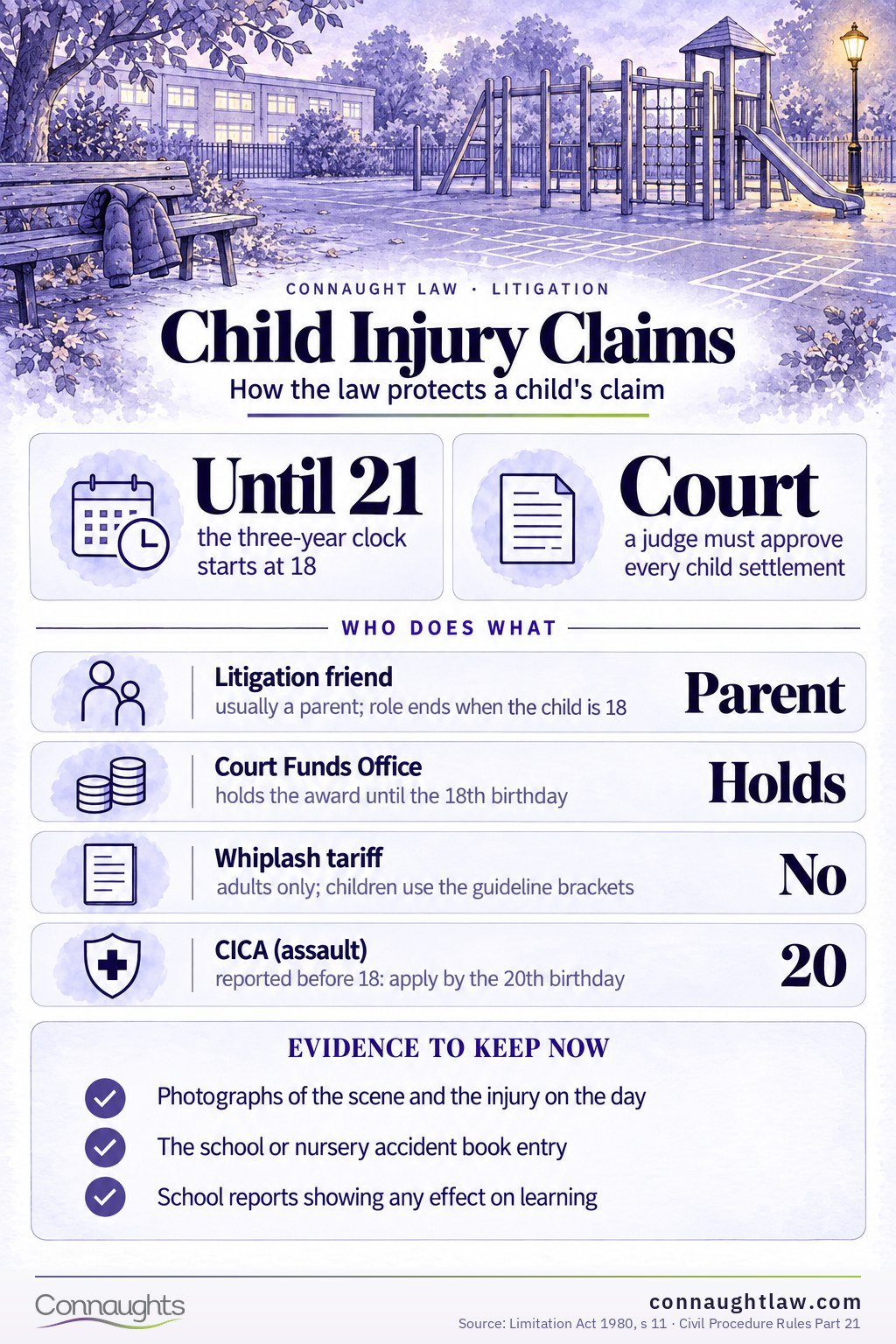
Children are injured in the same ways adults are — road collisions, defective premises, animal attacks, negligent medical care — but the law treats the resulting claims very differently. The child cannot bring proceedings personally, cannot settle them, and cannot receive the money. Each of those steps passes through an adult or an institution charged with protecting the child's interests: a litigation friend to run the claim, a judge to approve the outcome, and the Court Funds Office to hold the award until the child turns 18.
The claim itself follows the ordinary framework of a personal injury claim — proving that someone owed the child a duty of care, breached it, and caused the injury. What follows concentrates on the parts that are genuinely different for children: who conducts the claim, how long the family has, how children's injuries are valued, and what happens to the money. Claims arising from negligent maternity care follow the clinical negligence route explained in our birth injury compensation guide.
Litigation Friends and Time Limits in Child Injury Claims
A person under 18 lacks capacity to litigate, so Part 21 of the Civil Procedure Rules requires a litigation friend to conduct the claim — almost always a parent or guardian, though any suitable adult without a conflicting interest can act. The litigation friend instructs the solicitors, takes the procedural decisions and conducts settlement negotiations, under a duty to act fairly and competently in the child's interests rather than the family's convenience. Where a parent's own position conflicts — a parent who was driving in the accident, for instance — another relative or a professional acts instead.
The role carries responsibility rather than financial risk for most families: in a properly funded claim the litigation friend does not meet the defendant's costs personally, and the solicitors handle the formal steps. The appointment ends automatically when the child turns 18 and takes the claim over in their own name.
Limitation: The Clock Starts at 18
Under section 11 of the Limitation Act 1980, an adult must normally issue proceedings within three years of an accident or of first knowledge of the injury. For a child, time does not begin to run until the 18th birthday — so a child injured at any age can bring a claim up to their 21st birthday. The extension is legally generous but evidentially expensive: witnesses move, CCTV is overwritten and premises change. Families should take advice early even though the deadline is distant, and injuries that only reveal themselves during adolescence remain claimable when they do.
Funding and Evidence
Most child claims are funded by no win no fee agreements, sometimes supported by legal expenses cover on a household or motor policy, so pursuing the claim should not put the family at financial risk. The evidence that decides these claims is mundane and perishable: photographs of the scene and the injury taken on the day, names of witnesses, the accident book entry at school or nursery, and prompt GP or hospital attendance tying the injury to the incident.
School records deserve particular care. Educational impact — concentration, attendance, lost progress — is a genuine head of a child's claim, and contemporaneous school reports prove it far better than recollection years later. Keep everything: a claim issued at 17 may depend on paper created at 7.
Child Injury Compensation Amounts 2026
General damages — the award for pain, suffering and loss of amenity — are valued under the Judicial College Guidelines, whose 18th edition was published in April 2026 with an increase of roughly 8.26% over the 2024 edition to reflect inflation. There is no separate children's scale: the same brackets apply, selected by what the injury actually did, with the child's age influencing where within a bracket the award lands. The table below shows the 18th edition brackets that appear most often in children's claims.
Child Injury Brackets
| Injury Consequence | JCG 18th Edition Bracket |
|---|---|
| Facial scarring — trivial | £2,260 – £4,670 |
| Facial scarring — less significant | £5,220 – £18,150 |
| Psychiatric injury — moderate | £7,740 – £25,190 |
| Simple forearm fractures | £8,730 – £25,370 |
| Neck injury — minor | Up to £10,420 |
| Facial scarring — significant | £12,040 – £39,750 |
| Brain damage — less severe | £20,240 – £56,890 |
| Facial scarring — very severe | £39,340 – £128,590 |
| Brain damage — very severe | £372,570 – £533,720 |
Facial scarring dominates the table deliberately: children meet dogs, playground surfaces and car interiors at face height, and a scar carried from childhood is valued with decades of visibility in mind. Our scar compensation guide explains how visibility, maturation and camouflage prospects move an award within these brackets, and our broken arm compensation guide covers the fracture categories the same way.
Valuation in child cases waits for a stable prognosis. A fracture through a growth plate, a head injury before developmental milestones, a scar that has not matured — none can be fairly valued until doctors can say how the child will grow with it. Interim payments can fund treatment in the meantime, so waiting for the right medical moment costs the family nothing.
Why Child Injury Compensation Calculators Mislead
Online calculators match an injury description to a guideline bracket and return a number. For children they fail twice over. The inputs are wrong — no dropdown captures how a growth-plate fracture or an evolving brain injury will develop, and developmental and educational consequences are exactly what children's awards turn on. And the output is provisional anyway, because no child settlement is valid until a judge approves it. Treat any calculator figure as orientation at best; the brackets above are the honest starting point.
Court Approval of Child Settlements
No settlement of a child's claim binds the child until a court has approved it — a requirement under Part 21 of the Civil Procedure Rules that applies to every child settlement, whatever its size. The approval hearing — still commonly called an infant approval hearing — is short and unintimidating: a judge reads the medical evidence and a barrister's advice on valuation, asks the litigation friend any questions, then approves the figure or sends the parties back to negotiate. The child usually attends, briefly.
The rule protects everyone. It stops insurers extracting cheap early settlements from families under financial pressure, it protects litigation friends from later complaint that they settled too low, and it gives defendants finality — an approved settlement cannot be reopened when the child turns 18. Offers made directly to parents in the hope of bypassing this scrutiny are a warning sign, not a shortcut.
Court Funds Office: Where the Money Is Held Until 18
Approved compensation is not handed to the parents. The court normally directs payment into the Court Funds Office, the Ministry of Justice body that banks and invests money held for children, where it earns interest at a rate set by the Lord Chancellor until the child's 18th birthday. Larger awards with years to run may be invested more broadly under the court's direction. On turning 18 the young person claims the fund, with its accumulated interest, directly. For substantial awards — or where the child will lack capacity at 18 — a personal injury trust may be used instead.
Accessing Funds Before 18
The money is protected, not locked away. The litigation friend can apply for payments out before 18 where spending clearly benefits the child — therapy the NHS cannot provide promptly, educational support, adapted equipment, home modifications. Courts approve applications that serve the child's welfare and refuse those that look like general family spending; receipts and a clear child-focused justification decide most applications.
Deductions From a Child's Award
Deductions are policed with the same rigour. Under a no win no fee agreement, a success fee may be taken from a child's damages only once the court has approved its amount, and the litigation friend's expenses are checked the same way. Solicitors' charges are measured against the court's guideline hourly rates, so families should expect a clear breakdown at the approval stage of exactly what the child will keep.
General and Special Damages in Child Injury Claims
General damages under the guideline brackets are only half the claim. Special damages — the financial losses — often exceed them, and in serious cases dwarf them: multi-million child awards are built not from bigger brackets but from lifetime costs of care, therapy, education and lost earnings priced on expert evidence.
- Care provided by parents counts even though unpaid — gratuitous care is valued and recovered
- Travel to appointments, prescriptions, equipment and childcare for siblings during hospital stays are all claimable
- Educational support: tutoring, special needs provision and educational psychology where injury disrupts schooling
- Future loss of earnings where the injury will limit the adult the child becomes
- Keep receipts from day one — schedules are built from documents, not recollection
Government guidance on compensation after an accident outlines the same heads of loss; the difference in child cases is horizon. A seven-year-old with a permanent injury may need losses projected across seventy years, which is why care experts and actuaries, not calculators, set the figures.
Child Car Accident Settlements and the Whiplash Tariff
The most searched question in this field — the average settlement for a child in a car accident — has no official answer: no court or insurer publishes child settlement averages, and every child settlement is individually negotiated and court-approved rather than read off a table. What can be said is structural. The fixed whiplash tariff introduced in 2021 applies only to adults injured as motor-vehicle occupants, so it does not apply to children. A child's whiplash or soft-tissue injury is valued under the Judicial College brackets instead, on medical evidence — generally more generously than the adult tariff would allow.
No official average exists. Children are excluded from the fixed whiplash tariff, so even minor injuries are valued under the Judicial College Guidelines — minor neck injuries at up to £10,420 — and every settlement must be approved by a court before it binds the child.
Child passengers can claim whoever was driving — including a parent — because the claim is met by the driver's insurer, not the driver personally. Child pedestrians and cyclists are judged by age-appropriate standards: courts do not expect adult road sense from a seven-year-old, so contributory negligence arguments that would succeed against an adult often fail, or bite less, against a child. The mechanics of establishing fault and dealing with insurers are covered in our car accident compensation guide.
School, Playground and Holiday Accident Claims
Schools and local authorities owe children a duty of care often summarised as that of a reasonably prudent parent — supervision appropriate to age, safe premises, maintained equipment and risk-assessed activities. Claims succeed where injury flows from a breach: a climbing frame known to be broken, a science experiment run without protection, supervision absent where it was plainly needed. They fail where the injury is simply childhood — playgrounds are not required to be risk-free, and a trip during ordinary play, competently supervised, is usually no one's fault in law.
Playground claims against councils or equipment manufacturers turn on maintenance records, inspection regimes and safety standards for surfacing and equipment. Holiday accidents add a layer: injuries in UK hotels and attractions follow occupiers' liability principles, while package holiday injuries abroad can often be pursued against the UK tour operator under the package travel rules — a significant practical advantage over suing a foreign hotel. Time limits for accidents abroad can be far shorter than the domestic rule, so advice should be immediate.
Criminal Injuries: CICA Claims for Children
A child injured by a crime of violence — an assault, or a dog deliberately set on them — may claim through the Criminal Injuries Compensation Authority where no insured civil defendant exists. CICA awards follow a fixed government tariff and are generally lower than civil damages, so the civil route is preferred wherever a defendant can pay. The incident must have been reported to the police, and applications are decided on that report and the medical evidence.
Time limits differ from civil claims. Where the incident was reported before the child turned 18, the application must normally arrive by the 20th birthday; where it is first reported after 18, within two years of that report — with extensions only in exceptional circumstances. The official CICA guide sets out the tariff and the process.
Frequently askedQuestions about child injury claims
What is the average settlement for a child in a car accident in the UK?
There is no official average — every child settlement is individually valued and court-approved. Children are excluded from the fixed whiplash tariff, so injuries are valued under the Judicial College Guidelines, with minor neck injuries worth up to £10,420 and financial losses added on top.
How much compensation can a child claim for an injury?
The full guideline range applies: minor injuries resolve in the low thousands, significant facial scarring attracts £12,040–£39,750, and very severe brain damage £372,570–£533,720 — with special damages for care, education and future earnings often multiplying the total in serious cases.
Who can act as a litigation friend?
Usually a parent or guardian, but any suitable adult who can conduct the claim fairly and has no interest adverse to the child's — an aunt, grandparent or professional. Where a parent's position conflicts, for example as the driver, someone else acts.
Do all child injury settlements need court approval?
Yes. Under Part 21 of the Civil Procedure Rules no settlement binds a child until a judge approves it, whatever the amount. The infant approval hearing is short, and an approved settlement cannot be reopened when the child turns 18.
What happens to a child's compensation money?
It is normally held by the Court Funds Office, earning interest until the child's 18th birthday, or placed in a trust in appropriate cases. The litigation friend can apply for early payments that clearly benefit the child, such as therapy, equipment or educational support.
How long does my child have to claim injury compensation?
The three-year limitation clock does not start until the 18th birthday, so a claim can be brought up to the child's 21st birthday. Evidence decays much faster than the deadline, so families should still take advice as early as possible.
Can my child claim if the accident was partly their fault?
Usually yes. Courts judge children by age-appropriate standards rather than adult road sense or caution, so contributory negligence arguments bite less against a child. Shared fault reduces compensation proportionately rather than barring the claim.
Can we claim for a playground or school accident?
Yes, where the injury flows from a breach of duty — defective equipment, poor maintenance or inadequate supervision. Playgrounds are not required to be risk-free, so claims turn on inspection records, safety standards and what supervision the age group needed.
Can a child claim compensation after an assault?
Yes, through the Criminal Injuries Compensation Authority where no insured defendant exists, provided the incident was reported to the police. If reported before the child turned 18, the application must normally arrive by their 20th birthday.
Tell us what happened, what treatment your child has had and how they are now. We’ll explain the litigation friend role, how court approval works, and why waiting for a stable prognosis usually protects the award.
Get Expert Advice