
Birth injury compensation exists for one reason: when maternity care falls below a reasonable standard and a baby or mother is harmed, the law funds the needs that follow. The scale is substantial — NHS Resolution paid £3.1 billion in clinical negligence compensation in 2024/25, £1.3 billion of it on maternity claims, its largest single area of cost. This guide explains how birth injury compensation is valued in 2026: Judicial College 18th edition brackets, average settlements honestly examined, cerebral palsy, Erb’s palsy and stillbirth claims, time limits and legal aid.
On This Page

Understanding Birth Injury Compensation UK 2026
Most births in England end safely. When care goes wrong, the consequences sit at the most serious end of medical negligence claims: brain injury from oxygen deprivation during labour, nerve damage from a difficult delivery, or lasting physical and psychological injury to the mother. Maternity safety is under sustained national scrutiny in 2026 — but no reform programme changes a family’s existing legal rights.
Compensation is assessed around need: the cost of care, therapies, equipment, adapted housing and lost earnings, together with an award for the injury itself. Claims can be brought for the child, for the mother, or for both. Because the most serious birth injuries create lifelong needs, these are among the highest-value claims in English law.
Birth injury covers harm to either patient. For the baby: cerebral palsy and hypoxic brain injury, brachial plexus damage, fractures, and untreated jaundice or infection — failures that often begin as a missed diagnosis, the territory of misdiagnosis compensation claims. For the mother: severe perineal tears missed or badly repaired, mismanaged postpartum haemorrhage, retained swabs, anaesthetic errors and psychiatric injury after a traumatic delivery. The claim is concerned only with harm that competent care would have avoided.
Judicial College Guidelines and Birth Injury Compensation Brackets
Every birth injury award has two parts. General damages compensate the injury itself — pain, suffering and loss of amenity — and are set by the Judicial College Guidelines, now in their 18th edition, published in April 2026 with an uplift of roughly 8.26 per cent for inflation. Special damages then cover the financial consequences: care, treatment, equipment, accommodation and lost earnings, assessed item by item. The brackets most relevant to birth injury under the 18th edition are:
Birth Injury Brackets
| Injury | JCG 18th edition bracket |
|---|---|
| Very severe brain damage | £372,570 – £533,720 |
| Moderately severe brain damage | £289,420 – £372,570 |
| Less severe brain damage | £20,240 – £56,890 |
| Severe shoulder injury (including brachial plexus damage) | £25,370 – £63,450 |
| Severe arm injuries | £127,050 – £172,970 |
Position within a bracket turns on insight, life expectancy, physical limitation and dependence on others. Cerebral palsy with severe cognitive and physical disability typically sits in the very severe brain damage bracket. Severe psychiatric injury and post-traumatic stress disorder have their own chapters, with brackets rising steeply with severity; they matter for mothers, and sometimes fathers, left with a diagnosable psychiatric injury after a traumatic birth — a part of the claim routinely undervalued or overlooked.
Maternal Birth Injuries
Maternal physical injuries are valued from the same guidelines: severe third and fourth degree perineal tears with lasting bowel or bladder consequences, for example, are assessed within the digestive and bladder chapters rather than under a single “birth injury” heading. What matters is the evidenced consequence. Continence, pain, the effect on family life and on future obstetric choices all move an award within, or between, brackets.
Average Birth Injury Settlement UK: The Honest Answer
Families searching for an average birth injury settlement will find plenty of confident numbers online. None is reliable. No official body publishes an average, most settlements are confidential, and any figure that blends a resolved brachial plexus claim with a lifetime cerebral palsy award describes nothing real. Where a claim sits depends almost entirely on whether the injury is permanent and what it will cost to live with.
There is no meaningful average. Claims for permanent brain injury such as cerebral palsy commonly resolve as multi-million-pound lifetime packages, while injuries that recover well typically settle for five-figure or low six-figure sums.
The multi-million-pound settlements reported in the press are not awards for the injury itself. The injury element — general damages — is capped in practice by the brackets above, so even the most catastrophic brain injury attracts an injury award in the hundreds of thousands. Everything beyond that is the cost of the future: round-the-clock care priced over a lifetime, adapted housing, therapies, equipment and lost earnings. Future care is almost always the largest item, so awards grow with life expectancy rather than severity headlines.
Why a Birth Injury Compensation Calculator Cannot Work
Online calculators work by matching an injury to a Judicial College bracket. That is tolerable for a broken wrist; for birth injury it fails, because the bracket is the smallest part of the claim. No calculator can model a child’s life expectancy, the hours of care a family will need in twenty years, the cost of a purpose-built house, or how periodical payments should be structured. A properly costed schedule of loss, built from expert evidence, is the only reliable valuation.
Cerebral Palsy Compensation and Hypoxic Brain Injury Claims
The most serious claims involve hypoxic-ischaemic encephalopathy: brain injury caused by restricted oxygen supply around delivery. Many cases turn on a window of minutes. The central questions are usually whether the CTG trace showing fetal distress was interpreted correctly, whether concerns were escalated in time, and whether delivery, often by emergency caesarean, was achieved as quickly as a competent unit would have managed. Records of therapeutic cooling in the first days of life frequently become key evidence of timing and severity.
Cerebral palsy is often not diagnosed at birth. Many families receive the diagnosis months or years later, as milestones are missed, and only then ask questions about the delivery. A late diagnosis does not weaken a claim: the child’s limitation clock has not started, and the investigation reconstructs events from records rather than memory. Request the full maternity and neonatal records as soon as questions arise.
How Cerebral Palsy Awards Are Structured
Valuation in cerebral palsy claims is dominated by lifetime need rather than the injury bracket. A care regime running day and night, physiotherapy, speech and occupational therapy, specialist education support, adapted housing, equipment replaced throughout life, and the earnings the child will never make are each costed by expert evidence. Where parents have provided years of unpaid care, the claim includes that too.
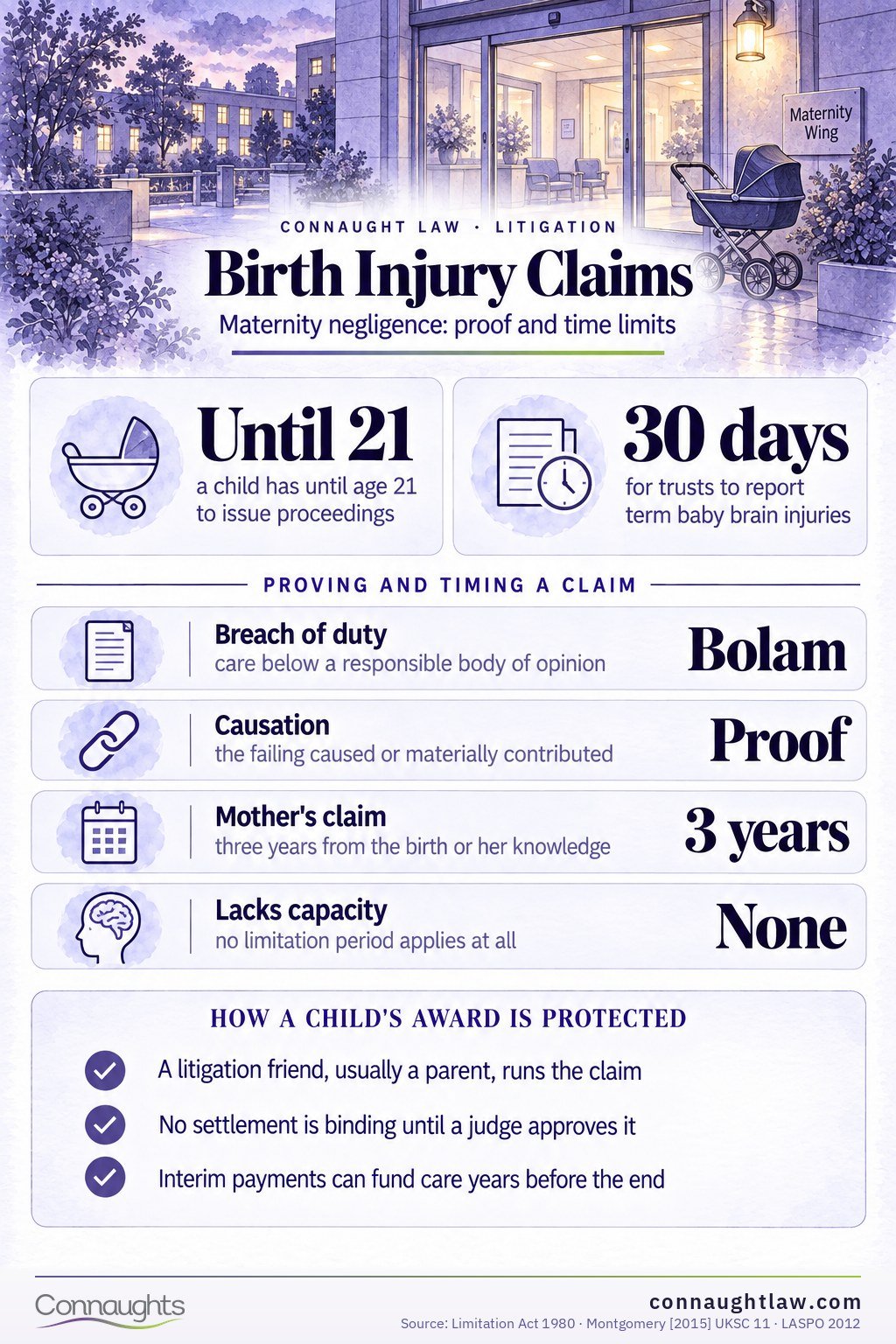
- The claim is conducted by a litigation friend, usually a parent.
- No settlement is binding until a judge approves it.
- The money is managed for the child, typically by a Court of Protection deputy.
- Substantial interim payments can fund care and housing years before the claim concludes.
- Final awards commonly combine a lump sum with index-linked periodical payments for life.
Erb’s Palsy and Brachial Plexus Birth Injury Compensation
Erb’s palsy is weakness or paralysis of the arm caused by damage to the brachial plexus nerves in the neck, most often when a baby’s shoulder becomes trapped behind the mother’s pubic bone during delivery — an emergency known as shoulder dystocia.
Shoulder Dystocia and Management Standards
Shoulder dystocia is a recognised emergency rather than proof of negligence, and some brachial plexus injuries occur despite proper care. The legal question is how the emergency was handled: whether recognised manoeuvres such as McRoberts positioning and suprapubic pressure were used, whether excessive traction was applied to the baby’s head, and whether risk factors — a suspected large baby or maternal diabetes — should have prompted an antenatal discussion about delivery options, including caesarean section.
Many children recover substantially with physiotherapy or nerve surgery, and Erb’s palsy claims are usually valued once recovery has plateaued, because prognosis drives the award. Where weakness is permanent, Erb’s palsy compensation is assessed in the severe shoulder bracket of £25,370 to £63,450 under the 18th edition, and the most serious arm injuries reach £127,050 to £172,970, with lifetime financial losses claimed on top where function and working capacity are limited.
Proving Negligence in Birth Injury Claims
A claim must clear two hurdles. The first is breach of duty: showing that care fell below the standard of a responsible body of obstetric or midwifery opinion — the Bolam test, as refined by Bolitho. Independent experts in the same disciplines as the treating clinicians examine the records and say what competent care would have looked like at each decision point. The same framework underpins medical negligence compensation claims generally.
Consent After Montgomery
Consent is judged differently. Since Montgomery v Lanarkshire Health Board [2015] UKSC 11, itself a shoulder dystocia case, clinicians must take reasonable care to ensure the mother is aware of material risks and of reasonable alternatives, including caesarean delivery. A unit that never gave a diabetic mother expecting a large baby the chance to choose a caesarean may be liable on consent grounds even if the delivery itself was competent.
The second hurdle is causation: proving the injury was caused, or materially contributed to, by the failing rather than by something no one could have prevented. In brain injury cases this is fought over timing, with cord blood gases, imaging, cooling records and neonatal notes used to reconstruct when the damage occurred and what an earlier delivery would have avoided.
Families do not investigate alone. Qualifying incidents — intrapartum stillbirths, early neonatal deaths and severe brain injuries in term babies — are independently investigated by the Maternity and Newborn Safety Investigations programme, and trusts run their own reviews, which the duty of candour requires to be shared honestly. These reports do not decide a claim, but they establish the chronology early, and any gap between what a family was told and what the records show is taken seriously by the court.
Stillbirth and Fatal Birth Injury Claims
Some families come to this subject after the worst outcome of all. Where a baby is stillborn because of negligent care, the law treats the loss as part of the mother’s own claim: the physical injury of the delivery, the psychiatric harm that follows, and losses including funeral costs. The reason is a legal technicality — a child who did not live independently cannot have a claim of their own.
Where a baby is born alive but dies as a result of negligence, the claim proceeds under the Fatal Accidents Act 1976. Parents can recover the statutory bereavement award, fixed at £15,120 in England and Wales, together with funeral expenses, and either parent may have a psychiatric injury claim of their own. No sum reflects the loss; the surrounding psychiatric and financial claims are where real needs are met.
Where a baby or mother dies unexpectedly, the coroner examines how the death came about, and the family’s legal team can test hospital evidence at the inquest. Findings frequently shape the civil claim. Bereaved families are entitled to representation, and the trust will almost always have lawyers present — reason enough for the family to have their own.
Time Limits for Birth Injury Compensation Claims
Time limits under the Limitation Act 1980 work differently for children. A child cannot issue their own claim, so the three-year clock does not start until their eighteenth birthday, giving until age 21 to issue proceedings. A person who lacks mental capacity to conduct a claim — which includes many people with severe birth brain injuries — faces no limitation period at all. The mother’s own claim must normally be issued within three years of the birth or of her knowledge that her injury may be linked to substandard care. The same principles govern child injury claims more widely.
Limitation is only part of the picture. Maternity records become harder to reconstruct, staff move on, and a family’s early needs cannot wait for a claim issued at 20. Early advice preserves the evidence and opens the door to interim payments long before final settlement.
NHS Early Notification Scheme, Legal Aid and Maternity Reform
Since April 2017, NHS trusts must report to NHS Resolution, within 30 days, babies born at term who suffer a potentially severe brain injury, including those diagnosed with grade three hypoxic-ischaemic encephalopathy or given therapeutic cooling. The Early Notification Scheme investigates liability from the outset, so that admissions, apologies and early financial support can follow years sooner than a traditional claim. NHS Resolution’s 2024/25 accounts record £3.1 billion paid across its clinical schemes, with 83 per cent of claims resolved without court proceedings — rising to a record 84 per cent in 2025/26.
Early notification does not replace independent advice. The scheme is run by the NHS’s own indemnifier, and any admission, interim offer or settlement proposal should be tested by the family’s own solicitors against a properly costed assessment of lifetime need.
Funding rarely blocks a serious birth injury claim. Legal aid remains available where clinical negligence during pregnancy, birth or the first eight weeks of life causes a neurological injury leaving a child severely disabled — one of the few areas of clinical negligence still within scope under LASPO 2012. Where legal aid does not apply, claims proceed under no-win-no-fee agreements, and our personal injury team will explain both routes at the outset.
The sequence is consistent whatever the funding route: records are obtained, independent experts report on breach and causation, a letter of claim is sent under the pre-action protocol, and the trust must investigate and respond. Strong cases settle; very few birth injury claims end in a courtroom.
Baroness Amos’s final report of 30 June 2026 found women unheard, units understaffed and inequalities unaddressed across the twelve trusts investigated. The government’s response so far includes a national maternity taskforce, the first Maternity and Neonatal Commissioner and the extension of Martha’s Rule to all maternity services. For families, the legal position is unchanged: where substandard care caused injury, compensation remains a right, not a concession.
Frequently askedQuestions about birth injury and maternity claims
How much compensation do you get for a birth injury in the UK?
General damages are set by Judicial College brackets — up to £533,720 for very severe brain damage under the 18th edition. Financial losses are then added: in severe cases, lifetime care, housing and lost earnings take totals far beyond the bracket.
What is the average birth injury settlement in the UK?
There is no reliable average. Permanent brain injury claims such as cerebral palsy resolve as lifetime packages, often paid partly as annual periodical payments, while injuries that recover settle for far smaller sums.
Is there a birth injury compensation calculator?
No calculator can value a birth injury claim. Calculators match injuries to guideline brackets, but most of a serious award is future care, housing and lost earnings, which depend on expert evidence about one child’s lifetime needs rather than a formula.
How long do I have to make a birth injury claim?
For the child, proceedings can be issued any time before their 21st birthday, and with no time limit at all if they lack capacity to litigate. A mother’s own claim must normally be issued within three years of the birth or of her date of knowledge.
What compensation is available after a stillbirth?
A stillbirth caused by negligence is claimed as part of the mother’s own case, covering her physical and psychiatric injuries and losses such as funeral costs. Where a baby born alive dies, the Fatal Accidents Act adds a £15,120 bereavement award.
How do you prove a birth injury was caused by negligence?
Independent experts must show care fell below a reasonable standard and that the failing caused the injury. Maternity records, CTG traces, cord gases and cooling records reconstruct events, and consent failures are judged under Montgomery.
What is the NHS Early Notification Scheme?
A scheme requiring trusts to report potentially severe brain injuries in babies born at term to NHS Resolution within 30 days. It investigates liability early and can deliver admissions and interim support quickly, but families should still take independent advice.
Is legal aid available for birth injury claims?
Yes, for children left severely disabled by a neurological injury caused by negligence during pregnancy, birth or the first eight weeks of life. Other birth injury claims usually proceed under no-win-no-fee agreements, so funding rarely prevents investigation.
Tell us what happened during labour and delivery, and what you have been told since. We will review the maternity records with obstetric and midwifery experts and tell you honestly whether the care fell below standard.
Get Expert Advice