
Nerve damage compensation in the UK is valued through the body region affected: the Judicial College Guidelines contain no single nerve-damage chapter, so a brachial plexus tear is priced with shoulder injuries, sciatic damage with the back and leg, and CRPS under chronic pain. Verified 18th edition (April 2026) brackets run from £20,680 for lasting elbow nerve symptoms to £428,850–£533,720 for tetraplegia, and most successful claims settle far below the headline figures. This guide covers the amounts, car accident claims, injury types, causes, legal tests and time limits for 2026.
On This Page

Understanding Nerve Damage Compensation UK 2026
Nerves carry movement, sensation, temperature control and the automatic functions nobody notices until they fail. Damage announces itself as numbness, pins and needles, burning pain, weakness or paralysis, and its legal value follows its permanence. Bruised nerves recover over weeks; crushed nerves recover slowly and incompletely; severed nerves, without successful surgery, do not recover at all. Valuation tracks that gradient, which is why prognosis evidence matters more here than in almost any other injury claim.
Because function decides value, two people with the same nerve injured can hold very different awards: a violinist and an office worker do not lose the same thing when an ulnar nerve fails. And because nerve damage arrives three ways — sudden trauma, gradual occupational exposure and clinical injury — liability is analysed three times while the money is analysed once, through the same regional framework this guide sets out first.
Nerve Damage Compensation Amounts 2026
There is no single nerve-damage figure: general damages follow the Judicial College bracket for the region affected. Verified 2026 brackets include £20,680–£42,290 for lasting elbow nerve injury, £25,370–£63,450 for severe shoulder damage including brachial plexus, £51,230–£92,130 for back injuries with nerve root damage, and £428,850–£533,720 for tetraplegia. Financial losses are added on top.
The Judicial College Guidelines, 18th edition (published April 2026, roughly 8% above the previous edition), value nerve injuries inside the chapter for the body part they disable. Brachial plexus damage sits in the shoulder chapter, sciatic and femoral nerve injuries in the back and leg chapters, hand nerve loss in the hand chapter, and complex regional pain syndrome in the chronic pain chapter. Finding your bracket therefore means asking two questions: which region, and how much function is gone.
The table shows verified 18th edition anchors for the regional brackets nerve claims most often fall into:
Nerve Injury Brackets
| Injury | JCG 18th Edition Bracket |
|---|---|
| Elbow nerve injury — less severe, lasting symptoms | £20,680 – £42,290 |
| Severe shoulder damage including brachial plexus | £25,370 – £63,450 |
| Serious hand injuries — median or ulnar nerve loss | £38,310 – £81,790 |
| Severe back injury — nerve root damage | £51,230 – £92,130 |
| Arm injuries — permanent and substantial disablement | £51,750 – £79,080 |
| Paraplegia — spinal cord | £289,420 – £375,540 |
| Tetraplegia — spinal cord | £428,850 – £533,720 |
Within brackets, awards move on pain levels, dominance of the affected limb, age and completeness of loss. Where nerve damage forms part of a wider injury — an arm fracture with radial nerve palsy, a crush injury covered by our hand and finger injury compensation guide — the court values the whole picture together rather than stacking rows. Severe neuropathic pain with psychiatric consequences can add a separate psychiatric award, £72,440–£152,900 where severe, to the assessment.
What Is the Average Payout for Nerve Damage?
Honestly: no reliable UK average exists, and any single figure you see quoted is marketing rather than mathematics. Averages blend thousands of modest carpal tunnel and tingling-that-resolved claims with a handful of catastrophic spinal awards, producing a number that describes nobody's case. What can be said is distributional: most nerve damage claims involve symptoms that largely recover, so most settle in the lower regional brackets — four to low five figures — while permanent, test-confirmed loss of function moves the claim decisively up the tables above.
- No official average exists; published averages mix trivial and catastrophic outcomes.
- Recovering symptoms settle low; permanent, test-confirmed loss climbs the regional brackets.
- Quoted sums of £1.2 million or more are lifetime settlement packages — bracket plus decades of care, housing, equipment and lost earnings — not injury brackets.
- Earnings losses often exceed the bracket: a joiner with permanent thumb numbness loses more than the tables suggest.
- Your realistic range comes from region plus function lost, confirmed by nerve testing.
Loss of Amenity in Nerve Injury Awards
Loss of amenity carries particular weight where sensation is gone. A hand that cannot feel heat, a foot that cannot feel the ground, a grip that drops cups without warning: these translate into abandoned trades, hobbies and instruments, supervised cooking, fear of stairs. Specific, evidenced examples move awards within brackets far more reliably than adjectives, and family statements supply them best.
Nerve Damage After a Car Accident
Road collisions cause nerve damage by three main mechanisms: traction on the nerve roots of the neck in rear-end impacts, producing pain, tingling or weakness radiating down the arm; direct injury from fractures, glass and crush forces; and, in motorcyclists thrown from the machine, brachial plexus tears where the shoulder and head are wrenched apart. The first feels like whiplash with something extra — and legally, that something extra is what decides the money.
For adult vehicle occupants injured on or after 31 May 2025, whiplash injuries lasting up to 24 months are valued on a fixed statutory tariff of £275 to £4,975, graded by duration and psychological effect. Nerve root damage confirmed by examination or testing is more than a tariff whiplash injury and is valued conventionally under the Judicial College brackets, with mixed injuries assessed on the approach the Supreme Court set in Hassam v Rabot (2024).
That distinction explains the "average payout" question for car accident nerve damage better than any single number. Where tingling accompanies soft-tissue whiplash and resolves within months, the tariff controls and payments sit in the hundreds to low thousands. Where nerve root irritation persists, the moderate neck brackets spanning £18,150 to £50,850 apply; confirmed root damage in the back reaches £51,230–£92,130; and a motorcyclist's brachial plexus tear engages the severe shoulder bracket of £25,370–£63,450 or the arm brackets where paralysis follows.
Liability, the online claims portal for lower-value injuries and the wider damages framework follow the ordinary road traffic rules in our car accident compensation guide; where the collision damages the spine itself, valuation and evidence follow our back injury compensation guide. The practical rule for any road claim is the same: report radiating symptoms at the first medical assessment, because a MedCo examiner cannot grade what nobody mentioned.
Types of Nerve Damage
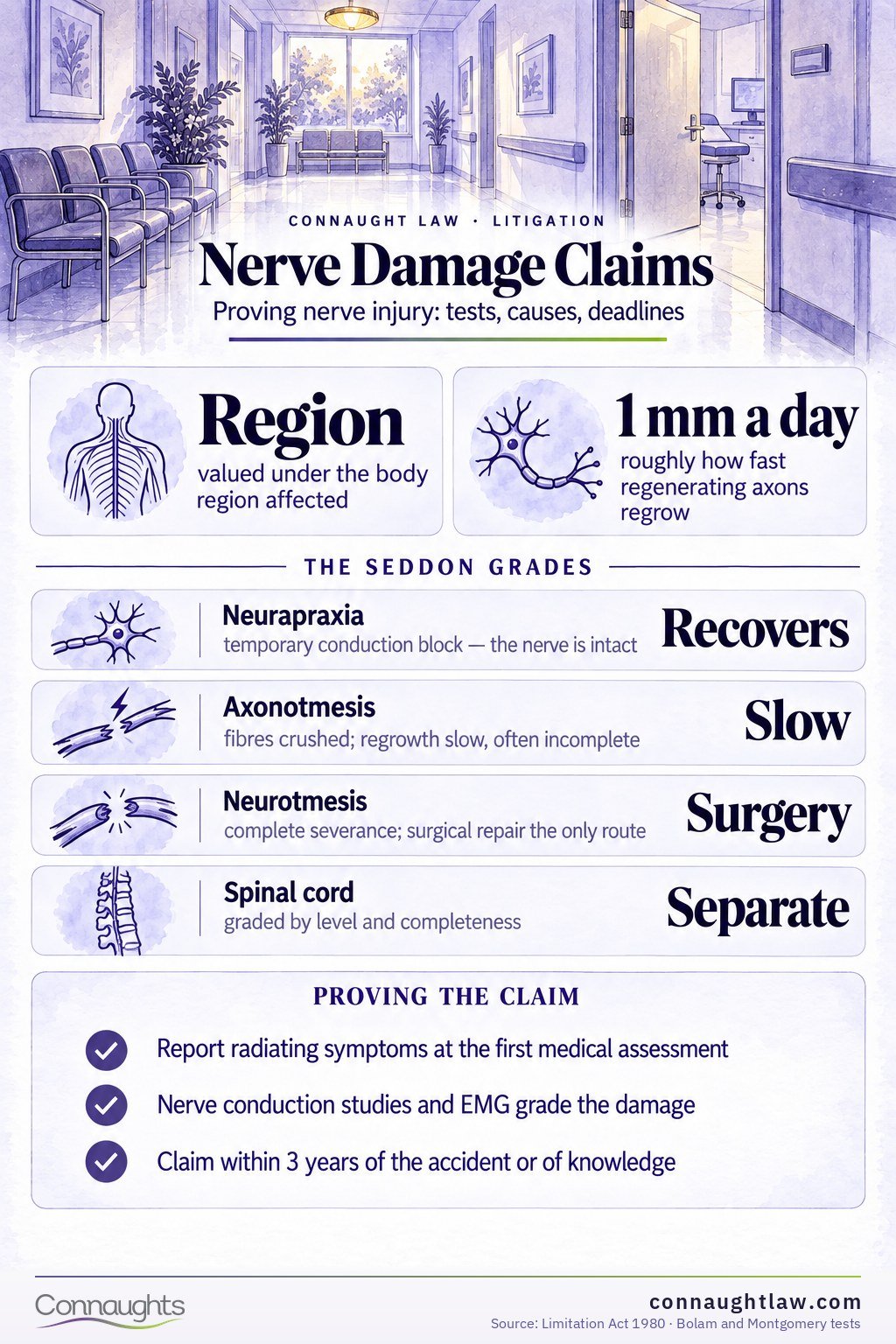
Clinicians grade peripheral nerve injuries on the Seddon classification. Neurapraxia is a temporary conduction block — the nerve is stunned but intact, and recovery over weeks to months is the norm. Axonotmesis crushes the nerve fibres while the surrounding architecture survives, so regrowth is possible but slow and often incomplete. Neurotmesis is complete severance, with little prospect of natural recovery and surgical repair the only realistic route. Spinal cord damage is graded separately, by level and completeness, from partial patterns to paraplegia and tetraplegia.
Function then defines the loss: motor damage takes strength and dexterity; sensory damage takes protective feeling, so burns and wounds go unnoticed; autonomic involvement disturbs bladder, bowel and temperature control; and neuropathic pain — burning, electric, treatment-resistant — can be the most disabling consequence of all, out of proportion to anything a scan shows.
Complex Regional Pain Syndrome (CRPS)
Complex regional pain syndrome sits beside nerve injury rather than inside it: a disproportionate pain state, sometimes following minor trauma, with its own diagnostic criteria and its own chronic pain chapter in the Judicial College Guidelines. Those brackets rise steeply with severity, and severe CRPS with poor recovery prospects is valued above many orthopaedic injuries. Where CRPS is suspected, pain medicine expertise joins the team early, because mislabelling it as simple nerve damage undervalues the claim and mistreats the patient.
Recovery timescales drive both medicine and money. Regenerating axons grow roughly a millimetre a day at best, so a nerve injured at the shoulder takes a year or more to declare what it will give back to the hand, and surgical windows matter: repairs and grafts done early outperform late ones. That biology is why competent solicitors investigate immediately but refuse to value prematurely, and why interim payments exist.
Common Causes of Nerve Injuries
Trauma leads: road collisions, falls from height, crush events and deep lacerations, with violence — stabbings and glassings severing peripheral nerves — adding a CICA route where no civil defendant can pay. Workplace exposure adds two slower mechanisms: hand-arm vibration syndrome from years of grinders, breakers and chainsaws, a prescribed industrial disease with its own HSE exposure framework, and compression syndromes — carpal tunnel above all — from sustained force, awkward postures and repetition.
The commonest presentations are the humblest: carpal tunnel syndrome, ulnar neuropathy from sustained elbow pressure, foot drop after knee and hip events. Their brackets are modest, but their earnings consequences are not — the electrician who fails a dexterity assessment and the chef who cannot feel the knife lose careers, and the losses schedule is where those claims are truly valued.
Surgical Nerve Damage Claims
Clinical settings supply the rest: nerves cut, stretched or compressed during surgery, wrong-site injections, regional anaesthetic blocks placed without heeding warning pain, casts and compartment syndrome managed too slowly. These claims run down the clinical negligence route in our medical negligence compensation guide: surgical nerve injury is a recognised complication, so the claim turns on whether technique fell below a reasonable standard, whether the damage was recognised and repaired in time, and whether the consent process ever mentioned a material nerve risk.
Cauda Equina Syndrome Claims
Cauda equina claims deserve their own emphasis because the window is so short. Red flags — saddle numbness, urinary retention or incontinence, bilateral sciatica — are supposed to trigger emergency imaging and decompression within hours, and delay converts back pain into permanent bladder, bowel and leg dysfunction. These are chronology cases: when the flags appeared, when they were recorded, when surgery happened, and what each hour of delay cost. Families should write the timeline down while memories are hours old, not months.
Legal Requirements for a Claim
The legal architecture is standard — duty, breach, causation — with nerve-specific pressure points. Accident claims follow the usual road, workplace and occupiers' rules; vibration claims turn on the Control of Vibration at Work Regulations 2005, which fix exposure action and limit values obliging assessment, tool management, rotation and health surveillance; clinical claims are governed by the Bolam and Montgomery tests for technique and consent. Causation is where defendants dig in, arguing symptoms are degenerative, diabetic or idiopathic rather than traumatic.
The answer is objective testing plus chronology: nerve conduction studies and electromyography localise and grade the damage, imaging shows structural causes, and the symptom timeline ties onset to the event. A GP record of numbness the week after the accident beats an eloquent statement two years later, every time.
Contributory arguments run smaller here than defendants hope. Continuing to work with tingling hands is not negligence when nobody warned the workforce what tingling means; ignoring a surveillance letter that spelled it out is different. The realistic risk in long-exposure cases is apportionment across several employers, handled by tracing each insurer rather than surrendering the shortfall.
The Claim Process
Process follows prognosis, within the framework set out in our personal injury claims service. Nerve recovery is measured over months and staged reviews, so serious claims are investigated early but valued late: liability evidence and interim payments first, final valuation once surgeons and neurophysiologists can say what will and will not return. Where repair, grafting or decompression surgery is realistically contemplated, the claim prices both outcomes or waits for the result.
Pain management is part of the claim as well as the treatment plan: neuropathic medication, desensitisation programmes, spinal cord stimulation in refractory cases, and psychological therapy for the depression and anxiety chronic pain reliably produces. Future treatment is costed and recovered, and a claimant engaged with pain management presents both a better prognosis and a better claim. Funding is unremarkable: conditional fee agreements carry the great majority of nerve claims, with insurance covering adverse costs.
Where paralysis results, the claim's centre of gravity moves to lifetime need: rehabilitation under the Rehabilitation Code, care regimes measured in carer-hours per day, adapted housing and vehicles, and settlements structured as a lump sum plus index-linked periodical payments. Part 36 offers concentrate minds once prognosis is stable, joint settlement meetings resolve most catastrophic claims without trial, and provisional damages hold open defined deterioration risks rather than discounting them into a guess.
Expect the defence to instruct its own neurologist and, in serious cases, to argue functional overlay — that symptoms exceed organic damage. The answer is not indignation but consistency: objective test results, treatment engagement, and describing symptoms in the same specific words to every clinician. Consistency across records is credibility, and credibility is the currency these claims are paid in.
Time Limits for Nerve Injury Claims
The Limitation Act 1980 applies its usual grid: three years from accident or knowledge, age 21 for childhood injuries, no running limit while capacity is lacking, and the date of knowledge doing real work in gradual-onset claims — vibration white finger and HAVS above all — where time runs from when the worker connected the tingling to the tools. NHS guidance on peripheral neuropathy is also a practical prompt: persistent symptoms deserve investigation for their own sake, and the records that investigation creates anchor any later claim.
Waiting is medically sensible and legally safe only when the claim is already preserved: symptoms recorded, accident reported, advice taken on the deadline. Nerve claims fail more often from thin early records than from anything that happens in litigation.
Questions about nerve damage claims
How much compensation do you get for nerve damage in the UK?
It depends on the region and function lost: lasting elbow nerve injury £20,680–£42,290, severe shoulder damage including brachial plexus £25,370–£63,450, serious hand nerve injuries £38,310–£81,790, back injuries with nerve root damage £51,230–£92,130, paraplegia £289,420–£375,540 and tetraplegia £428,850–£533,720, plus financial losses.
What is the average payout for nerve damage in the UK?
No reliable average exists. Most claims involve symptoms that largely recover and settle in the lower four-to-five-figure brackets, while permanent test-confirmed loss is valued through the regional Judicial College brackets, from about £20,680 to over £500,000.
How much is nerve damage worth after a car accident?
Tingling that resolves alongside whiplash is paid on the statutory tariff — £275 to £4,975 for accidents on or after 31 May 2025. Confirmed nerve root or brachial plexus damage is valued conventionally, typically £18,150 to £92,130 depending on region and permanence.
Is tetraplegia really worth £1.2 million or more?
Total settlements reach that scale and beyond, but as lifetime packages: the bracket of £428,850–£533,720 plus decades of care, housing, equipment and lost earnings, often paid partly as annual periodical payments for life.
Can I claim for nerve damage after surgery?
Yes, where the injury resulted from substandard technique, delayed recognition or repair, or a consent process that never mentioned a material nerve risk. Surgical nerve injury is a recognised complication, so these claims turn on expert evidence, not the outcome alone.
What is hand-arm vibration syndrome?
Progressive nerve and vascular damage from years of vibrating tools: tingling, numbness, blanching fingers and lost dexterity. Employers must assess and limit exposure, and claims run from the date you knew the symptoms were work-related.
What is cauda equina syndrome?
Compression of the nerve roots below the spinal cord, a surgical emergency signalled by saddle numbness, bladder or bowel disturbance and leg weakness. Delayed diagnosis or referral is a recurring, serious clinical negligence claim.
How is nerve damage proved?
Nerve conduction studies and EMG grade and localise the damage objectively, imaging identifies causes, and contemporaneous records tie onset to the event. Specialist neurology or plastic surgery opinion then addresses causation and prognosis.
What is the time limit for a nerve damage claim?
Three years from the accident or from knowledge in gradual-onset cases, until 21 for children, and unlimited where capacity is lacking. Early advice preserves evidence even where prognosis will take years to settle.
Tell us how it happened, which part of the body is affected and what nerve testing has shown. We’ll tell you which Judicial College chapter your injury is valued under and what the deadline is.
Get Expert Advice