
How much is tinnitus compensation? Under the Judicial College Guidelines 18th edition (April 2026), slight tinnitus alone is valued at up to £9,260, slight or occasional tinnitus with some hearing loss at £9,720 to £16,640, moderate tinnitus at £19,680 to £39,250, and severe tinnitus with noise-induced hearing loss at £39,250 to £60,160 — before financial losses are added on top. This guide sets out every current bracket, an honest answer on average payouts, employer liability for noise, tinnitus after car accidents, the medical evidence that carries weight, and time limits that run from knowledge rather than exposure.
On This Page

Understanding Tinnitus Compensation UK 2026
Tinnitus is the perception of sound with no external source: ringing, buzzing, whistling, humming or pulsing that only the sufferer hears. At its worst it disrupts sleep, concentration and mental health so severely that the NHS treats it alongside anxiety and depression, because there is no cure. Compensation law reflects that spectrum: awards turn on intrusiveness and effect on daily life, not on whether a machine can measure the sound.
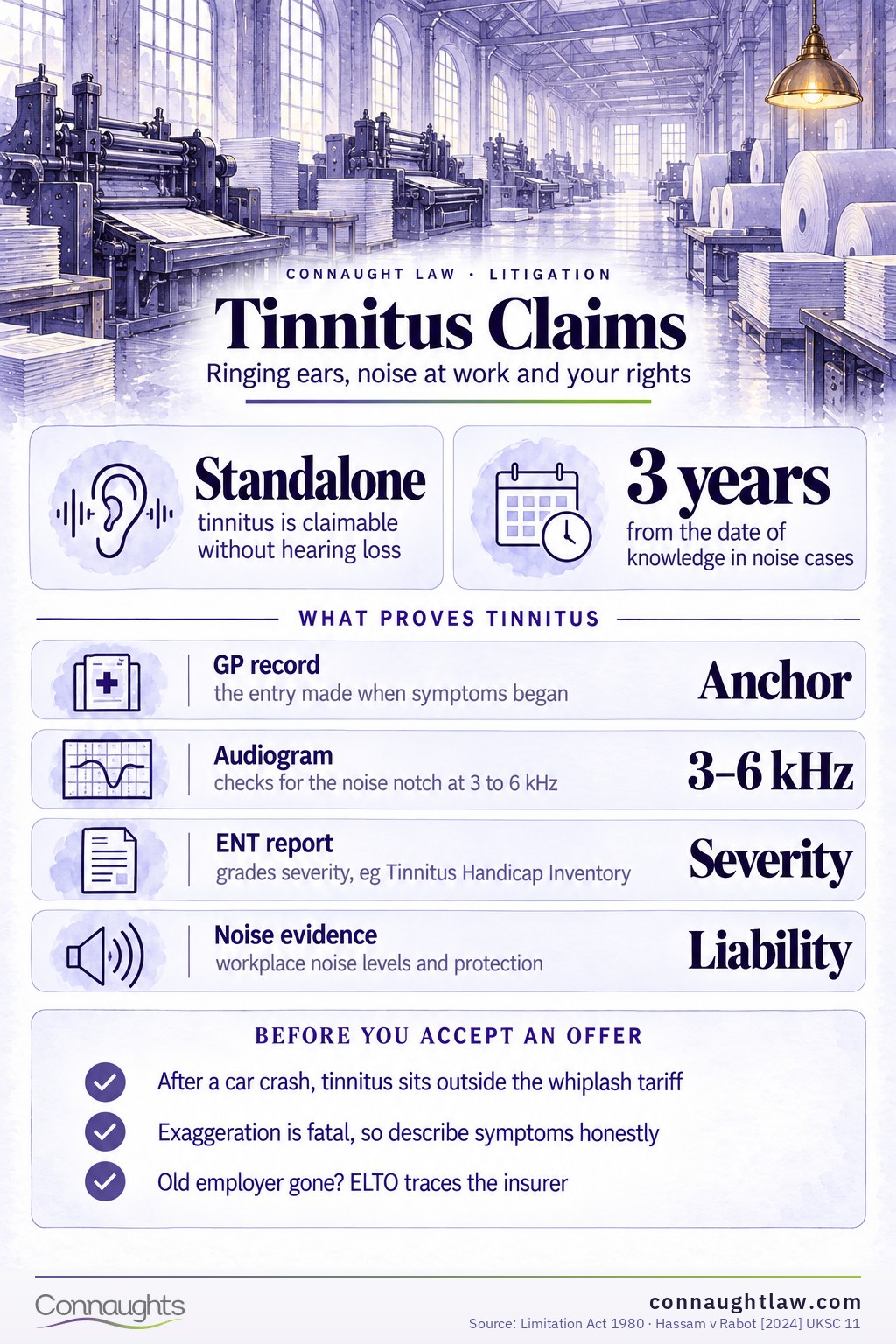
Two features distinguish tinnitus cases from most personal injury claim work. First, tinnitus is compensable on its own, without measurable hearing loss, a point long settled in noise-induced hearing loss litigation. Second, many tinnitus claims are historic: the noise exposure that caused the damage often ended decades before the symptom was linked to it, which is why limitation runs from the date of knowledge. Both features shape everything that follows, from evidence to valuation.
Service personnel are a special case. Gunfire, aircraft and vehicle noise make tinnitus among the most common service-related injuries, and negligence claims against the Ministry of Defence run alongside the Armed Forces Compensation Scheme, which pays on its own no-fault tariff for injuries caused by service since 2005, and the two routes need coordinating.
Procedure follows the cause. A single-accident tinnitus claim usually starts in the online injury portals and settles there if liability is admitted. Long-exposure noise claims run instead as industrial disease claims: with several defendant insurers, knowledge disputes and apportionment evidence, they proceed outside the portals, which is slower but built for exactly this complexity.
- Tinnitus has no objective test, so consistency across records decides credibility.
- A GP entry made when symptoms began anchors the whole claim.
- An audiogram shows whether hearing loss accompanies the tinnitus.
- Impact on sleep, concentration and work drives bracket placement.
- Diagnosed psychiatric harm is valued separately, on top.
Tinnitus Compensation Brackets for 2026
General damages for tinnitus are assessed under the hearing chapter of the Judicial College Guidelines. The 18th edition, published in April 2026, raised every bracket by roughly eight per cent over the previous edition, and grades awards by severity and by whether tinnitus appears alone or together with noise-induced hearing loss (NIHL). These are the current brackets.
Tinnitus Compensation Brackets
| Injury Category | 18th Edition Bracket | Typical Picture |
|---|---|---|
| Severe tinnitus with NIHL | £39,250 – £60,160 | Constant intrusive tinnitus dominating sleep, concentration and work |
| Moderate tinnitus and NIHL, or moderate to severe tinnitus alone | £19,680 – £39,250 | Daily interference with sleep, quiet concentration and mood |
| Mild tinnitus with some NIHL | £16,640 – £19,680 | Noticeable ringing alongside measurable noise damage |
| Mild tinnitus alone, or mild NIHL alone | Around £15,480 | One condition only, mild but persistent |
| Slight or occasional tinnitus with slight NIHL | £9,720 – £16,640 | Intermittent symptoms, mainly noticed in quiet surroundings |
| Slight NIHL or slight tinnitus alone | Up to £9,260 | Minor symptoms with limited effect on daily life |
Deafness itself is valued higher still: total loss of hearing in one ear attracts £41,370 to £60,160, total deafness £119,890 to £144,860, and total deafness with loss of speech £144,860 to £185,840. Severe cases with diagnosed psychiatric consequences can attract separate psychiatric awards in addition.
Where a claim falls within its bracket depends on how loud and constant the tinnitus is, whether it intrudes over background sound or only in quiet rooms, what it does to sleep onset and concentration, and the claimant's age, since a younger claimant faces more years of symptoms. Mild cases annoy; moderate cases interfere daily; severe cases dominate life. The bracket follows the evidence of interference, which is why the daily-impact record matters as much as the diagnosis.
Hearing Loss and Tinnitus Claims Together
Where tinnitus and hearing loss coexist, they are assessed together within a single bracket rather than added as two separate injuries, because the guidelines already grade the combined conditions. The combination still pushes a claim up the scale: severe tinnitus with significant NIHL reaches £60,160, several times the ceiling for slight tinnitus alone. Where deafness rather than tinnitus is the dominant injury, our guide to hearing loss compensation covers the deafness brackets, hearing aid costs and occupational deafness claims in detail.
Financial Losses on Top of the Brackets
General damages are only half the calculation. Financial losses are claimed on top: lost earnings and pension where noise-exposed work becomes impossible, hearing aids and maskers replaced throughout life, private treatment including tinnitus retraining therapy and cognitive behavioural therapy, and support where sleep deprivation becomes disabling. In long industrial cases these losses can exceed the injury award itself.
Average Tinnitus Compensation UK: The Honest Answer
No official average tinnitus payout exists in the UK. Courts and government publish no settlement statistics, so any precise "average" quoted online is a marketing estimate. What can be said reliably comes from the guidelines themselves: a realistic central range for the mild and moderate cases that dominate ordinary claims runs from around £15,480 to £39,250, with slight symptoms valued below £16,640 and severe tinnitus with hearing loss reaching £60,160.
There is no published official average. Guideline awards for typical mild to moderate tinnitus run from around £15,480 to £39,250 under the 18th edition, before financial losses such as earnings, treatment and hearing aids are added on top.
Averages also mislead because general damages are only one head of loss. A slight-tinnitus claim by a retired claimant may settle close to its bracket, while a moderate case that forces a machinist out of noisy work carries earnings and pension losses that dwarf the injury award. Treat any single average figure as a starting question, not an answer, and have the whole claim valued before accepting an offer.
Workplace Tinnitus Claims and Employer Liability
Workplace claims rest on the Control of Noise at Work Regulations 2005, which fix the exposure levels at which employers must act. From 80 dB(A) averaged daily exposure, information, training and hearing protection must be provided; from 85 dB(A), protection becomes mandatory and health surveillance including audiometry is required; 87 dB(A) is the absolute limit once protection is taken into account. HSE guidance treats these values as the floor of competent practice, not the ceiling.
The exposures that breach these values are ordinary ones. Grinding, cutting and pneumatic tools, bottling and canning lines, sawmills, engine rooms, commercial kitchens, live music venues and headset work in high-volume call centres all produce daily doses that competent employers measure and control. If you had to raise your voice to be heard at two metres, the environment was probably above the action values.
Noise Action Values
| Noise Exposure Level | Decibel Threshold | Required Employer Actions |
|---|---|---|
| Lower action value | 80 dB(A) daily exposure | Provide information, training and hearing protection on request |
| Upper action value | 85 dB(A) daily exposure | Mandatory hearing protection zones, health surveillance, noise control measures |
| Exposure limit value | 87 dB(A) maximum exposure | Immediate exposure reduction, enhanced controls, investigation |
| Peak sound pressure | 135–137 dB(C) peaks | Impact noise controls, alternative methods, protective equipment |
Historic Noise Exposure and Dissolved Employers
Liability commonly reaches back far beyond 2005. Employers have owed a common law duty to guard against noise damage since the early 1970s at the latest, so factory, construction, shipyard, printing and bottling-line exposure from that era still founds claims today. Where several noisy employers each contributed, responsibility is apportioned between them according to exposure, and the claim proceeds against each employer's insurer rather than failing for complexity.
Defendants also run a de minimis argument: that the measured hearing loss is too slight to count as actionable damage at all. The courts have accepted the principle but decided it on the facts, and tinnitus changes the picture, because a claimant with modest audiometric loss and genuinely intrusive tinnitus has real, compensable damage.
A dissolved employer does not end a claim. Employers' liability insurance has been compulsory since 1972, and the Employers' Liability Tracing Office database identifies the historic insurers who stand in a defunct employer's place. Defendants in these claims routinely argue that hearing loss is age-related or the tinnitus trivial, which is why the audiogram pattern and an independent ENT opinion matter more than any other evidence in the file.
If your employer ran audiometry and never told you about deterioration, that strengthens the claim and may delay your date of knowledge. If surveillance warned you years ago, the limitation clock may already be running. Take advice before assuming there is time.
Tinnitus After a Car Accident and Other Single Events
Not all tinnitus is industrial. A single event can cause it: whiplash forces disturbing the inner ear, head injuries, airbag deployment or an explosion. In road accident claims this creates a valuation quirk. Whiplash itself is capped by the statutory tariff, but tinnitus is not a tariff injury, so a claim combining both is valued on the mixed-injury approach confirmed by the Supreme Court in Hassam v Rabot [2024] UKSC 11: tariff for the whiplash, common law valuation for the tinnitus, then a step back to avoid double counting.
The practical effect is that tinnitus after a car accident is often worth more than the whiplash it accompanies. Under the whiplash payout scale for accidents on or after 31 May 2025, a nine-month whiplash prognosis is worth £965; persistent moderate tinnitus alongside it is valued in the thousands at common law. Portal insurers do not always price that distinction, which is one of the clearest reasons to take advice before accepting a pre-medical or early portal offer.
Acoustic Shock Claims After a Single Incident
Acoustic shock is a distinct single-event injury. It follows a sudden, unexpected noise close to the ear, a telephone headset spike or feedback burst being the classic examples, and produces tinnitus, hypersensitivity to sound and ear pain out of proportion to any hearing loss. In Goldscheider v Royal Opera House [2019] EWCA Civ 711, the Court of Appeal upheld a viola player's claim for acoustic shock caused by orchestra noise, confirming that the 2005 Regulations protect musicians and other performers as fully as factory workers.
Contributory negligence rarely defeats these claims. Refusing offered hearing protection can reduce an award by a modest percentage, but the primary duty to measure noise, engineer it down and enforce protection sits with the employer. A workforce culture of unworn earplugs is usually evidence against the employer, not the employee.
Medical Evidence That Wins Tinnitus Claims
Every serious tinnitus claim is built on audiometry. In noise cases the audiogram is examined for the characteristic pattern of noise damage, classically a notch in the 3 to 6 kHz range, distinguished from the smooth high-frequency decline of age-related loss. In employment cases, engineering evidence of workplace noise levels, or records showing protection was absent or unenforced, completes the liability picture.
Do not be put off by an unremarkable audiogram. Tinnitus can be disabling with modest measured loss, asymmetric or pulsatile tinnitus justifies specialist referral in its own right, and the medico-legal question is the effect on your life, not whether a chart looks dramatic. Condition and prognosis come from an ENT consultant or audiovestibular physician, who grades severity using structured measures such as the Tinnitus Handicap Inventory alongside clinical examination.
Because no scan shows tinnitus, contemporaneous records carry unusual weight: the GP entry made when symptoms started, the referral that followed, and consistency between what was reported then and what is claimed now. Treatment evidence supports both damages and credibility. The NHS pathway runs through sound enrichment, hearing aids where loss coexists, and talking therapies for the distress tinnitus causes, and the cost of future private treatment is itself recoverable.
Expect the defendant to test the claim. Insurers instruct their own ENT experts, and surveillance or social media checks are not unusual where severe disability is alleged. Exaggeration is fatal: a claim presented honestly at moderate severity is worth more than one pressed to severe and disbelieved, because a finding of fundamental dishonesty can strike out even the genuine part of a claim.
Time Limits for Tinnitus Compensation Claims
The basic rule under the Limitation Act 1980 is three years, but for tinnitus the start date is everything. Time runs from the accident or, in noise cases, from the date of knowledge: when the claimant first knew the injury was significant and attributable to noise exposure. A retired welder who connected his ringing ears to his working life only when a doctor made the link is in time, decades after the exposure ended.
Knowledge is judged objectively and argued hard by defendants. Health surveillance letters, GP entries and occupational health notes can each be said to have started the clock. The court keeps a discretion under section 33 to allow late claims, but discretion is never a plan. Children and people lacking capacity have suspended or extended periods, as in other injury claims.
Where limitation is arguable, solicitors issue protective court proceedings before the earliest possible deadline and investigate afterwards, rather than gambling on the later date being right. That single step preserves the claim whatever the court eventually decides about knowledge.
Civil compensation is not the only route. Industrial Injuries Disablement Benefit can be paid for occupational deafness after years in prescribed noisy occupations, without proving anyone was at fault, and it can run alongside a civil claim, although certain benefits are offset against overlapping heads of loss. A solicitor should check both entitlements together rather than leaving the benefit unclaimed.
Witnesses from noisy workplaces disperse, employers dissolve, and insurer records thin with every passing year. The earlier a claim is investigated, the easier liability is to prove, and needs such as hearing aids can be funded through interim payments rather than waiting for settlement.
Questions about tinnitus compensation claims
How much compensation do you get for tinnitus in the UK?
Under the Judicial College Guidelines 18th edition (April 2026), awards run from up to £9,260 for slight tinnitus, through £19,680 to £39,250 for moderate cases, to £39,250 to £60,160 where severe tinnitus combines with hearing loss. Financial losses are added on top.
What is the average tinnitus compensation payout in the UK?
No official average exists. Guideline awards for typical mild to moderate cases run from around £15,480 to £39,250, with slight symptoms valued below £16,640 and severe tinnitus with hearing loss reaching £60,160 before earnings and treatment costs.
Can I claim for tinnitus without hearing loss?
Yes. Tinnitus is compensable in its own right: mild tinnitus alone is valued at around £15,480 and slight tinnitus at up to £9,260. What matters is credible evidence of the symptom and its effect on sleep, concentration and daily life.
Can I claim for noise exposure from decades ago?
Usually yes. In noise-induced cases the three-year limitation period runs from the date you knew, or should have known, the damage was linked to noise at work, not from the exposure itself. Old factory, construction and armed forces exposure still founds claims today.
What if my old employer no longer exists?
The claim proceeds against the employer's insurer. Employers' liability cover has been compulsory since 1972, and the Employers' Liability Tracing Office database is used to identify the insurer that stands behind a dissolved company.
Is tinnitus covered by the whiplash tariff after a car accident?
No. The statutory tariff covers whiplash injuries only. Tinnitus is valued separately at common law under Hassam v Rabot [2024] UKSC 11, with an adjustment to avoid double counting, and can be worth more than the whiplash award itself.
What evidence do I need for a tinnitus claim?
An audiogram, an ENT or audiovestibular report grading severity, GP records showing when symptoms began, and in workplace cases evidence of noise levels and protection practices. Consistency across these sources is what wins the claim.
Does compensation include hearing aids and future treatment?
Yes. Awards routinely include the lifetime cost of hearing aids or maskers, tinnitus retraining therapy and cognitive behavioural therapy, alongside general damages for the injury itself.
Tell us where you worked, when the noise exposure was, and when you first noticed the ringing. We’ll tell you whether the claim is still in time and which employers or insurers can still be pursued.
Get Expert Advice