
Whiplash payout scale UK 2026 questions have one honest answer: it depends which of two systems your claim falls under. Road-accident whiplash lasting up to two years is valued by a fixed statutory tariff of £275 to £4,830 for accidents on or after 31 May 2025, slightly more with a minor psychological injury. Everything else, from longer injuries to cyclists, pedestrians and accidents at work, is valued under the Judicial College Guidelines, where awards run from a few thousand pounds to £195,970. This guide sets out both scales, the current figures, and how the claims process actually works.
On This Page

Understanding the Whiplash Payout Scale UK 2026
Whiplash is a soft-tissue injury to the neck, back or shoulders caused by sudden acceleration and deceleration, most commonly in rear-end road collisions. Symptoms range from short-lived stiffness to pain, headaches and restricted movement lasting many months. Because it is the most common injury claimed after road accidents, Parliament gave it its own compensation regime.
That regime is why so much online guidance conflicts. Two different scales exist side by side, and the figure that applies to you depends on how the injury happened, how long it lasts, and who you are. The sections below keep the two systems clearly apart, using the figures in force in 2026.
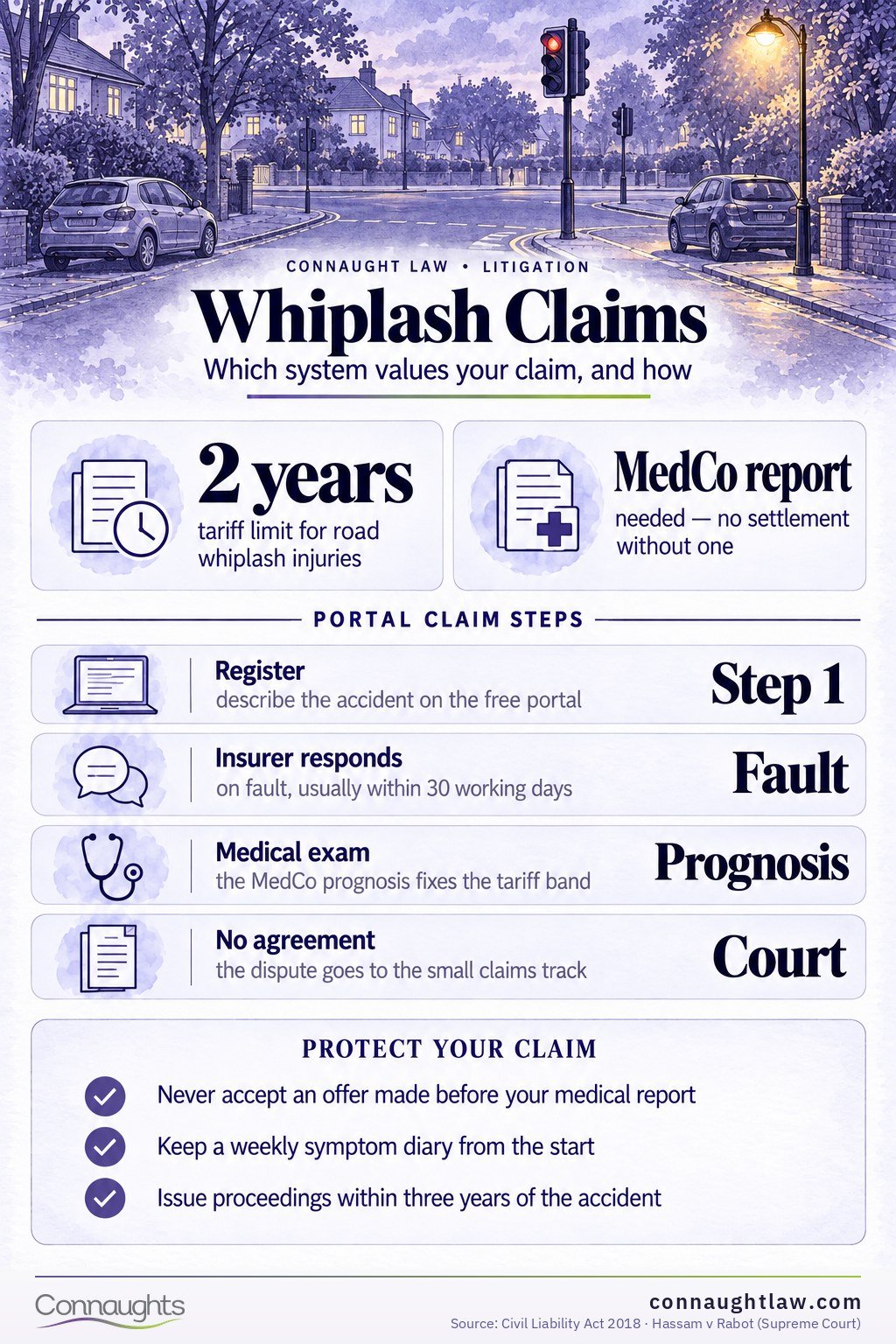
How the Whiplash Payout Scale Works: Two Systems
The Civil Liability Act 2018 created a fixed tariff for whiplash suffered by adult drivers and passengers of motor vehicles where the injury lasts no more than two years. The reform was a deliberate policy choice: whiplash claims had become so numerous that Parliament standardised awards to cut disputes and insurance costs, removing case-by-case valuation for minor road-accident whiplash altogether.
The tariff figures are set by regulations and revised after statutory reviews by the Lord Chancellor. The current figures come from the Whiplash Injury (Amendment) Regulations 2025, which uplifted the original 2021 amounts by roughly 15% to account for inflation. The tariff applies in England and Wales only; Scotland and Northern Ireland continue to value whiplash on ordinary common-law principles.
Everyone and everything else stays under the traditional approach: awards assessed by reference to the Judicial College Guidelines (JCG). That covers whiplash lasting beyond 24 months, injuries to cyclists, motorcyclists, pedestrians and horse riders, children, accidents at work, and neck injuries that go beyond soft tissue such as fractures, disc damage or chronic pain conditions.
The practical consequence is stark. A three-month whiplash injury from a car collision is worth £275 under the tariff. A comparable soft-tissue injury suffered by a cyclist, valued under the JCG, will usually settle for several times that figure. Identifying the correct system is therefore the first step in valuing any claim, and the most common source of online confusion.
Whatever the system, the strength of a claim is built in the first days after the accident. Photograph the vehicles and the scene, note witnesses, and report symptoms to a GP or pharmacist even if they seem trivial, because contemporaneous records anchor the prognosis later. A short symptom diary, recording pain, sleep disruption and missed activities week by week, costs nothing and consistently pushes settlements towards the top of the correct band. Insurers read consistency between early records and the eventual medical report as credibility, and price their offers accordingly.
The Statutory Whiplash Tariff From 31 May 2025
The tariff below applies to road-traffic accidents occurring on or after 31 May 2025, following the Lord Chancellor’s statutory review. The award is fixed by the prognosis period in your medical report, meaning how long the expert expects symptoms to last, not by how the injury feels at the date of the claim.
Tariff From 31 May 2025
| Injury duration | Whiplash only | With minor psychological injury |
|---|---|---|
| Up to 3 months | £275 | £300 |
| 3 to 6 months | £565 | £595 |
| 6 to 9 months | £965 | £1,025 |
| 9 to 12 months | £1,510 | £1,595 |
| 12 to 15 months | £2,335 | £2,435 |
| 15 to 18 months | £3,445 | £3,550 |
| 18 to 24 months | £4,830 | £4,975 |
The minor psychological injury column covers low-level travel anxiety or disturbed sleep suffered alongside the whiplash, secondary to it and falling short of a diagnosable psychiatric condition. The value is always driven by the duration of the physical whiplash, not the psychological element. Full tables and guidance are published in the Ministry of Justice tariff guidance.
The tariff covers pain and suffering only. Financial losses are added separately: lost earnings, treatment and physiotherapy costs, travel and care. A £565 tariff award can accompany a much larger claim for special damages, so keep every receipt and payslip.
Accidents Before 31 May 2025: The 2021 Tariff
The accident date, not the claim date, decides which table applies. Because adults generally have three years from the accident to issue a claim, injuries from accidents before 31 May 2025 can still be claimed well into 2028, and they remain on the original 2021 tariff below.
Tariff Before 31 May 2025
| Injury duration | Whiplash only | With minor psychological injury |
|---|---|---|
| Up to 3 months | £240 | £260 |
| 3 to 6 months | £495 | £520 |
| 6 to 9 months | £840 | £895 |
| 9 to 12 months | £1,320 | £1,390 |
| 12 to 15 months | £2,040 | £2,125 |
| 15 to 18 months | £3,005 | £3,100 |
| 18 to 24 months | £4,215 | £4,345 |
If your accident happened close to the changeover, check the date before valuing the claim: an accident on 30 May 2025 with a nine-month prognosis is worth £1,320; one day later, £1,510. Offers should always be checked against the right column.
Grade 1-4 Whiplash and Neck Injury Compensation Outside the Tariff
Where the tariff does not apply, whiplash and neck injury compensation is assessed under the Judicial College Guidelines, the brackets judges and insurers use nationwide. The current figures come from the 18th edition, published on 9 April 2026, which raised awards by roughly 8.26% over the 2024 edition to reflect Retail Prices Index inflation. Claims professionals often describe these brackets informally as whiplash Grades 1 to 4.
In practice the grades describe recognisable injury pictures. Grade 1 covers soft-tissue strain that resolves fully. Grade 2 involves longer restriction of movement, physiotherapy and disrupted work. Grade 3 typically means structural damage or chronic symptoms that never fully resolve. Grade 4 describes fractures, dislocations and spinal damage with permanent, life-altering effects.
Neck Injury Brackets
| JCG neck injury bracket (18th edition) | Award range |
|---|---|
| Minor: full recovery within about two years (Grade 1) | Up to £10,420 |
| Moderate: recovery up to five years, or acceleration of pre-existing problems (Grade 2) | £10,420 to £18,150 |
| Moderate: wrenching-type injury or disc lesion with permanent pain and stiffness (Grade 2-3) | £18,150 to £33,020 |
| Moderate: fractures or dislocations with chronic conditions left behind (Grade 3) | £33,020 to £50,850 |
| Severe: fractures or dislocations with serious soft-tissue damage (Grade 3-4) | £60,080 to £73,970 |
| Severe: serious cervical spine fractures with substantial loss of movement (Grade 4) | £86,860 to £172,970 |
| Severe: little or no neck movement with severe headaches (Grade 4) | In the region of £195,970 |
No regulation defines a Grade 1 or Grade 3 whiplash. The gradings map onto the Judicial College brackets above, and the medical evidence, not the label, determines where a claim actually lands.
These figures represent general damages for the injury itself, so a severe whiplash payout in the top brackets usually sits alongside substantial financial losses, and in those cases loss of earnings and care costs routinely exceed the injury award. Our guide to loss of earnings compensation explains how those losses are calculated and evidenced, and where symptoms extend beyond the neck into the spine, our back injury compensation guide covers the separate brackets that apply.
Average and Minimum Whiplash Payout UK
There is no meaningful single average: tariff awards are fixed by prognosis band, and most portal claims resolve in the lower bands between £275 and £1,510. The minimum whiplash payout is £275 (£300 with minor psychological injury) for accidents from 31 May 2025, or £240 for earlier accidents. Claims outside the tariff start around four figures under the Judicial College Guidelines.
Search for an average whiplash payout and you will find figures from £1,000 to £5,000, most of them meaningless because they blend two incompatible systems. For tariff claims there is no averaging to do: the award is the fixed figure for your prognosis band, and most portal claims fall in the lower bands simply because most whiplash resolves within a year.
Outside the tariff, an average is equally unhelpful because the JCG brackets span from four figures to £195,970. The honest questions are narrower. Which system applies? What prognosis period will the medical expert give? Are there injuries beyond soft tissue? Those three answers place a claim far more accurately than any advertised average.
The minimum matters just as much as the average, because it is where most claims actually sit. Whiplash that resolves within three months earns the tariff floor of £275, however painful those weeks were, and no negotiation changes a fixed band. Be wary of calculators promising precise figures without medical evidence: until a MedCo expert has examined you, any number is a guess, and often a marketing one.
Claiming Through the Official Injury Claim Portal
Tariff-band claims are designed to be run without a solicitor through the Official Injury Claim portal, the free service created for road-accident injury claims worth £5,000 or less for the injury element. The portal handles liability responses from the insurer, commissioning of the medical report, and settlement offers.
How a Portal Claim Runs, Stage by Stage
The process runs in stages: register and describe the accident; the insurer responds on fault, usually within 30 working days; a MedCo medical assessment is arranged; the report and prognosis fix the tariff band; offers are exchanged and, if agreement fails, the dispute can go to court. Straightforward claims with admitted liability commonly conclude within four to nine months, while disputed claims take considerably longer.
Where no agreement is reached, the claim is determined in the small claims track. Costs there are largely irrecoverable on both sides, which is deliberate: the reforms assume unrepresented claimants. Insurers know this, which makes a properly evidenced file, with the medical report, receipts and a clear account of the accident, the main source of negotiating strength.
Not every road-accident claim belongs in the portal. Claims for children, vulnerable road users, injuries beyond the tariff, or where the insurer disputes liability outright are dealt with through the standard claims process. See our guide to car accident compensation for how those claims run, and the government overview of making a whiplash claim.
Medical Evidence Requirements
Since the 2021 reforms it has been unlawful for insurers to settle a whiplash claim without a medical report, the ban on so-called pre-medical offers. Every claim therefore needs an examination by an accredited MedCo expert, whose prognosis period directly sets the tariff band or informs the JCG bracket.
The report records the accident mechanism, your symptoms and their progression, findings on examination, any time off work, and the expert’s prognosis: either the expected total duration of symptoms or confirmation that they have resolved. It should cover any minor psychological element at the same time; one report normally suffices, with fees fixed and recoverable at set rates and expert fees in small claims capped at £750.
Never accept an offer before your medical assessment. Early offers made before a report exists are designed to close claims cheaply, and for whiplash they are prohibited. A prognosis even one band higher changes the award, so let the evidence set the figure first.
Attend the assessment prepared: describe symptoms at their worst and their pattern since the accident, list time off work, and mention every affected activity. Underplaying symptoms at the examination is the most common way genuine claims end up undervalued. Related soft-tissue damage beyond the neck belongs in the same report; our soft tissue injury claims guide covers the wider picture.
Factors That Move Whiplash Compensation Up or Down
Adjustments Within the Tariff
Within the tariff, two mechanisms adjust the fixed figures. A court may add up to 20% where the injury is exceptionally severe or the claimant’s circumstances make it exceptionally distressing, though the uplift is applied sparingly. And where the accident caused additional non-whiplash injuries, a wrist sprain, bruising or tinnitus for example, the claim becomes a mixed injury claim.
The Supreme Court held in 2024 that courts value the tariff element and the other injuries separately, add them together, then step back and trim any overlap, so the tariff does not drag down compensation for distinct injuries.
Placement Within a JCG Bracket
Outside the tariff, the usual factors govern where in a JCG bracket an award falls: severity and duration of symptoms, intensity of treatment, the effect on work and daily life, age, and whether a pre-existing condition was accelerated. Contributory fault, such as not wearing a seatbelt, can reduce any award by an agreed percentage.
Recovery matters as much as the award. Under the Rehabilitation Code, insurers frequently fund early physiotherapy once liability is admitted, and treatment records then support the claim rather than delay it. In serious non-tariff cases, interim payments can be requested before final settlement to cover lost income and care while the prognosis stabilises.
Timing matters too. Adult personal injury claims must generally be issued within three years of the accident. Settling too early, before the prognosis is stable, is as costly as missing the deadline: once accepted, an award cannot be reopened if symptoms persist. Our personal injury team and road accident specialists advise at exactly this stage.
Frequently askedQuestions about whiplash compensation
What is the whiplash payout scale UK 2026?
It is two scales. Road-accident whiplash lasting up to two years is paid under the statutory tariff: £275 to £4,830 for accidents from 31 May 2025, or up to £4,975 with a minor psychological injury. All other whiplash-type injuries are valued under the Judicial College Guidelines, from four figures up to £195,970.
How much is whiplash worth for each prognosis period?
Under the 2025 tariff the bands run from £275 (up to 3 months) to £4,830 (18 to 24 months), each slightly higher with a minor psychological injury. The full table above sets out every band.
What is the minimum payout for whiplash in the UK?
The tariff floor: £275 for whiplash resolving within three months, or £300 with a minor psychological injury, for accidents on or after 31 May 2025. Earlier accidents sit on the 2021 tariff, where the floor is £240. Claims outside the tariff usually recover more.
What is a Grade 2 whiplash average payout?
Grade 2 is shorthand for the lower-moderate Judicial College brackets, broadly £10,420 to £18,150 where recovery takes up to five years, rising to £33,020 for disc lesions with permanent symptoms. Inside the road-accident tariff, duration alone fixes the figure regardless of grade labels.
What is a Grade 3 whiplash payout in the UK?
Grade 3 is shorthand for the upper-moderate Judicial College brackets, broadly £33,020 to £50,850 where fractures or dislocations leave chronic problems, with serious soft-tissue cases reaching £60,080 to £73,970. It only applies to claims outside the fixed road-accident tariff.
Do I get more if I also suffered anxiety after the accident?
Yes, modestly. Each tariff band pays £25 to £145 more where a minor psychological injury such as travel anxiety accompanied the whiplash. A diagnosable psychiatric condition goes further and is valued separately under the Judicial College Guidelines.
What is the average whiplash payout in the UK?
There is no meaningful single average. Tariff claims are fixed by prognosis band, and most resolve in the lower bands. Non-tariff claims span brackets from under £10,000 to £195,970. The prognosis in your medical report is a far better predictor than any advertised average.
Are physiotherapy costs included in a whiplash payout?
They are claimed on top, as special damages, alongside lost earnings and travel. Insurers often fund physiotherapy early under the Rehabilitation Code once liability is admitted, and the treatment records then support the injury valuation itself.
Do I need a medical report for a whiplash claim?
Yes. It is unlawful for insurers to settle whiplash claims without one. An accredited MedCo expert examines you and sets the prognosis period that determines your tariff band or Judicial College bracket. Never accept a pre-medical offer.
What happens if my whiplash lasts longer than two years?
The claim leaves the tariff entirely and is valued under the Judicial College Guidelines, where two-year-plus neck injuries start around the £10,420 to £18,150 bracket and rise steeply with severity. Do not settle early if symptoms are not resolving.
Tell us when the accident was, how long symptoms have lasted and what else was injured. We’ll tell you which of the two systems values your claim and whether the portal is the right route at all.
Get Expert Advice