
Back injury compensation UK claims span the widest human range in personal injury: from a lifting strain that resolves in months to spinal damage that changes every remaining day. Under the Judicial College Guidelines 18th edition (April 2026), minor back injuries settle below £16,520, moderate injuries — the tier where most herniated and bulging disc claims sit — run from £16,520 to £51,230, and severe injuries involving nerve root or spinal cord damage reach £212,670. This guide sets out the 2026 brackets, disc injury valuation, workplace and road claims, evidence, psychological injury and time limits.
On This Page

Understanding Back Injury Compensation UK 2026
Back pain is close to universal, which is exactly what makes back claims demanding: defendants meet every claim with the argument that this is life, not injury. A claim succeeds where a specific event or exposure — a lift, a collision, a fall, a system of work — caused or materially worsened an identifiable injury, and the records, imaging and expert opinion hold that line against the background noise of ordinary degeneration.
Valuation follows function over labels. The same words, "disc prolapse", can describe a nuisance or a catastrophe; what the Guidelines price is continuing pain, restriction, neurological signs, effect on work and the risk of deterioration.
What to do this week if you were hurt last week: see a doctor and name the mechanism, report the accident where systems exist — an accident book, a police report, an occupier's incident log — photograph anything that will be repaired or cleaned, and note witnesses before shifts and addresses change.
Judicial College Guidelines for Back Injuries
The Judicial College Guidelines 18th edition, published in April 2026, bands back injuries into severe, moderate and minor tiers, each graded by permanence and neurological involvement, as set out below.
Back Injury Brackets
| Band | 18th Edition Bracket | Typical Features |
|---|---|---|
| Severe (i) | £120,340 – £212,670 | Damage to spinal cord and nerve roots; incomplete paralysis, impaired bladder, bowel and sexual function |
| Severe (ii) | £97,980 – £116,820 | Nerve root damage with loss of sensation, impaired mobility and organ function |
| Severe (iii) | £51,230 – £92,130 | Disc lesions, fractures or soft tissue injuries leaving chronic conditions with severe pain and disability despite treatment |
| Moderate (i) | £36,680 – £51,230 | Compression and crush fractures, prolapsed discs requiring surgery, substantial risk of future deterioration |
| Moderate (ii) | £16,520 – £36,680 | Disturbed ligaments and muscles, prolapsed or bulging discs with continuing pain and restriction |
| Minor (i) | £10,420 – £16,520 | Full or near-full recovery without surgery within two to five years |
| Minor (ii) | £5,750 – £10,420 | Full recovery without surgery within about two years |
| Minor (iii)–(iv) | Below £5,750 | Recovery within a year or a few months, banded down to modest awards |
Most lower back injury awards fall between £5,750 and £51,230 under the 2026 Guidelines: soft tissue injuries recovering within two years attract £5,750–£10,420, lasting symptoms £16,520–£36,680, and fractures or surgically treated discs £36,680–£51,230, with lost earnings, care and treatment added on top.
Complete paralysis leaves the back chapter altogether: the 18th edition values paraplegia at £289,420 to £375,540 and tetraplegia at £428,850 to £533,720 in the spinal cord brackets, with lifetime care, accommodation and earnings packages built on top — territory our nerve damage compensation guide covers in full.
Financial losses complete every tier and dominate the serious ones: earnings during recovery or across a retrained career; NHS-pathway and private treatment including physiotherapy and surgery; care and household help; and equipment from lumbar supports to adapted vehicles.
- Brackets cover pain, suffering and loss of amenity only; earnings, care and treatment costs are claimed on top
- Position within a bracket turns on function: pain, mobility, neurological signs and work capacity, not the diagnosis label
- Marketing tables quoting "typical" back injury payouts have no legal source
- Paralysis cases leave the back chapter for the higher spinal cord brackets
Herniated, Bulging and Prolapsed Disc Compensation
Disc injuries cause more compensation confusion than any other back claim, because three names describe overlapping things and none fixes a value. Compensation follows symptoms, treatment and prognosis — not the word on the scan report.
A herniated disc — also called a prolapsed or slipped disc — occurs where the disc's soft core pushes through a tear in its outer wall, often pressing on a nerve root. A bulging disc protrudes outward without rupturing. Both can cause local pain, sciatica, numbness and weakness; both also appear on scans of people with no symptoms at all.
Herniated disc compensation in the UK typically falls in the moderate brackets: £16,520 to £36,680 where a prolapse causes continuing pain and restriction, rising to £36,680 to £51,230 where surgery such as discectomy or spinal fusion is needed or symptoms are permanent with a risk of deterioration. A herniation causing significant nerve root damage — persistent sciatica with motor weakness, or any bladder or bowel involvement — crosses into the severe brackets, running from £51,230 to £212,670 at the extreme.
Bulging disc compensation payouts follow the same logic at generally lower levels. Where a symptomatic bulge is attributable to the accident and settles within two to five years, awards sit in the minor brackets, £5,750 to £16,520; a bulge with persistent verified symptoms reaches the moderate tier. Because bulges are common on symptom-free scans, chronology decides these claims: no relevant symptoms before the accident, documented symptoms since. Where disc material compresses nerves, the disc and nerve claims travel together, valued as one injury.
Settle a disc claim only once its surgical story is finished: discectomy and fusion outcomes are assessed a year or more out, and settling before a planned operation hands the risk of failure to you and the saving to the insurer.
Workplace Back Injury Claims and Payouts
Employment supplies the steadiest caseload, governed by the Manual Handling Operations Regulations 1992: hazardous manual handling avoided where reasonably practicable, assessed where not, and reduced to the lowest level reasonably practicable. HSE guidance on back pain treats load, posture, frequency and individual capability as the assessment's core. The recurring breach patterns are familiar.
Workplace Back Injury Scenarios
| Workplace Scenario | Employer Breach | Typical Injury Outcome |
|---|---|---|
| Heavy lifting without equipment | No trolleys, hoists or mechanical aids for loads exceeding safe limits | Herniated disc, chronic lower back pain |
| Inadequate training | Insufficient manual handling instruction on technique and posture | Lumbar strain, soft tissue injury |
| Repetitive strain | Excessive workload without rest breaks or task rotation | Chronic back pain, accelerated disc degeneration |
| Defective equipment | Poorly maintained lifting apparatus failing suddenly | Acute disc prolapse, nerve compression, spinal fracture |
There is no fixed workplace payout: back injury at work claims use the same Judicial College brackets as any claim. A lifting injury with symptoms resolving inside two years sits around £5,750–£10,420; a herniated disc that ends heavy work can exceed £51,230 before lost earnings are added. The breach decides liability; the medical evidence decides the amount.
Care, warehousing, construction and delivery work dominate, and the pattern evidence is usually decisive: the risk assessment never done or never followed, the hoist broken for months, the rota that made two-person lifts impossible. Colleagues confirm patterns; documents convict them.
Cumulative Back Injuries and Manual Handling
Two workplace subtleties recur. Cumulative back claims — years of lifting rather than one event — are legally viable but need occupational medicine evidence and careful knowledge analysis, since limitation runs from when the worker connected symptoms to work. And agency status changes nothing that matters: whoever controlled the work and the workplace owes the duties, whoever issued the payslip.
Car Accident Back Injuries and the Whiplash Tariff
Road claims split at a statutory boundary. Back soft tissue injuries suffered by drivers and passengers fall within the whiplash definition: where symptoms resolve within 24 months, the fixed tariff applies, paying at most £4,830 — £4,975 with accompanying psychological injury — even at the 18-to-24-month top band for accidents on or after 31 May 2025. Our whiplash payout scale guide sets out every tariff figure, and our soft tissue injury claims guide explains the claims process.
Everything else is valued under the Guidelines above: prognoses beyond 24 months, vertebral fractures, herniated discs with neurological signs, and all injuries to cyclists, motorcyclists and pedestrians. So compensation for a herniated disc after a car accident is not a tariff matter — a disc herniation confirmed on MRI with correlating symptoms is a structural injury, valued in the moderate and severe brackets, and the gap between £4,975 and a £16,520-plus Guidelines award makes accurate diagnosis the most valuable step in the claim.
A lower back pain settlement after a car accident therefore depends on diagnosis and duration: tariff amounts of a few hundred to a few thousand pounds for occupant soft tissue symptoms resolving within 24 months; Guidelines awards of £5,750 to £16,520 where recovery runs longer; and moderate-tier awards from £16,520 upward where imaging confirms disc or vertebral damage with continuing symptoms. A genuine disc injury misdescribed as a long sprain can be trapped in the wrong system at a fraction of its value — red-flag symptoms deserve specialist imaging early, as our car accident compensation guide explains.
Uninsured Drivers and the MIB
Uninsured and untraced drivers route through the Motor Insurers' Bureau, with prompt reporting and the scheme's own deadlines. Back injuries feature heavily in MIB work because the victims are often the unprotected road users the tariff exempts, and the MIB assesses damages on the same Guidelines.
Public Liability Back Injury Claims
Occupiers and highway authorities answer for the falls that break backs: wet supermarket aisles, icy uninspected car parks, missing handrails, broken kerbs and unfenced drops. Liability turns on systems — whether inspection and response matched the risk — and the evidence is mundane and decisive: cleaning rotas, inspection logs, complaint histories, and photographs taken before the defect is quietly mended. Our slip and fall compensation guide covers these claims in detail.
Falls from even modest heights produce disproportionate spinal harm, which is why ladder, stair and platform cases populate the upper brackets. Where the fall happened at work, the workplace regimes above apply cumulatively with occupiers' duties, and the claim pleads them together.
Highway Trips and Pothole Claims
Highway trips and potholes have their own statutory rhythm: the authority owes a maintenance duty under section 41 of the Highways Act 1980, and defends under section 58 by proving a reasonable inspection system. Claims are won on the gap between the system on paper and the pothole's documented history, which is why complaint records are requested before anything else.
Back Injury Claims for Children and Older Claimants
Children's back injuries — playground falls, school sports — follow the child claim framework: litigation friends, court-approved settlements, and limitation running from 18. Older claimants deserve the opposite reassurance: a spine with pre-existing wear is not a claim-proof spine. The eggshell skull principle means defendants take victims as found, so an injury that devastates a vulnerable back is compensated for the devastation it actually caused.
Medical Evidence Requirements
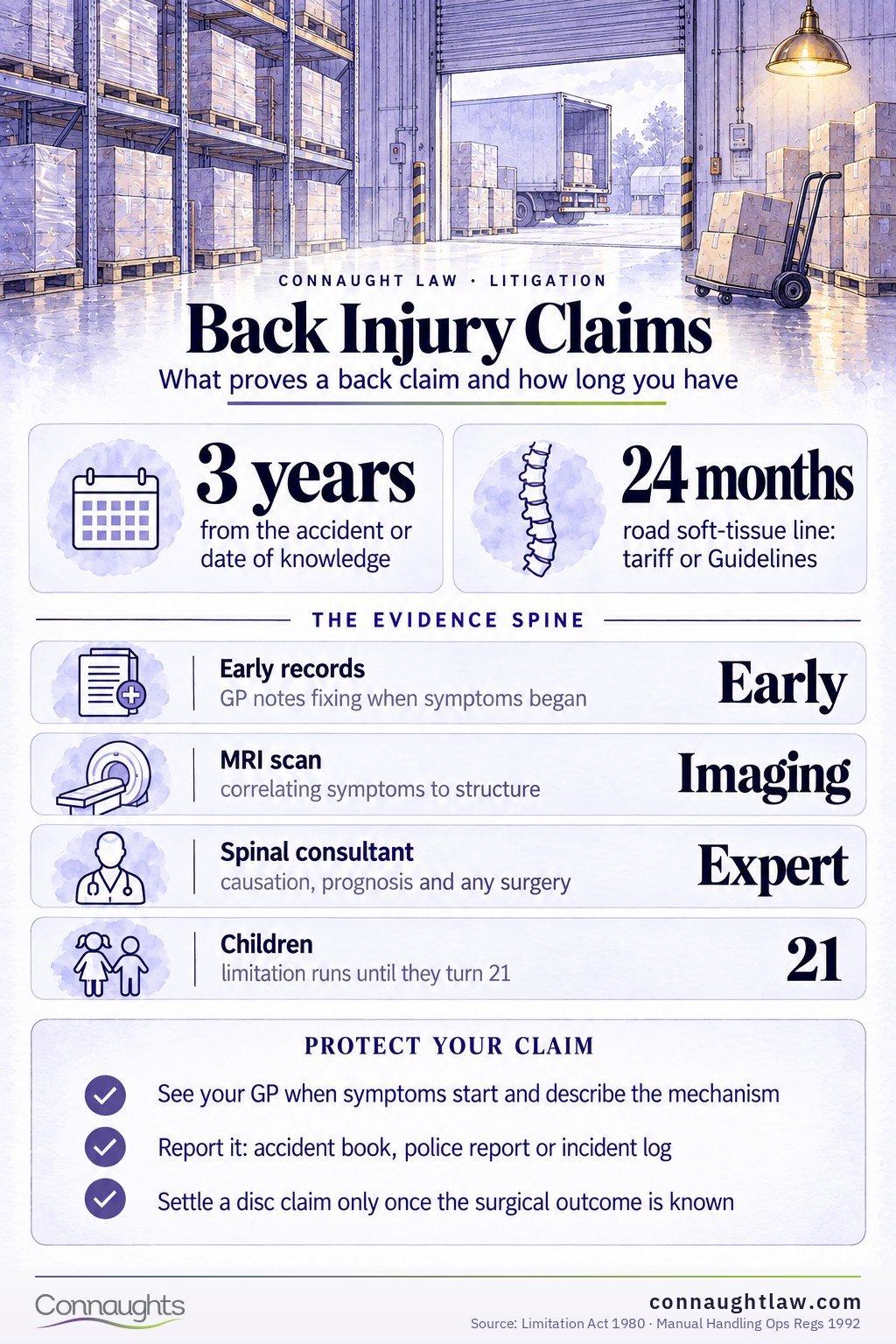
The evidential spine is consistent: contemporaneous records fixing onset, MRI correlating symptoms to structure, and a consultant orthopaedic spinal surgeon or neurosurgeon addressing causation, prognosis and any surgical future. Nerve involvement adds neurophysiology; bladder or bowel symptoms add urology; and chronic cases add pain medicine, because long-duration back pain behaves as its own condition.
Degeneration is the battleground. Age-related change appears on most adult scans, and defendants attribute everything to it; the reply is chronology and contrast — an asymptomatic working life before, documented symptoms since — and, where genuine, an acceleration valuation: the years by which the injury brought forward symptoms that degeneration would eventually have produced. Honest acceleration cases settle; overclaimed ones fund the defendant's expert.
Surveillance is routine in higher-value back litigation. Describe capabilities accurately, good days and bad: a claimant filmed carrying shopping after describing total incapacity loses everything, while one who said "I manage light bags on good days" has been corroborated. Fundamental dishonesty strikes out claims; measured honesty settles them.
Psychological Injury Recognition
Chronic back pain and mood travel together, clinically and legally. Persistent pain drives depression, anxiety and fear-avoidance that amplifies disability, and a diagnosed psychiatric condition is valued separately — £7,740 to £25,190 for moderate psychiatric injury under the 18th edition, and far more where severe — alongside the physical brackets. Pain management programmes that treat both are recoverable as treatment costs.
The practical rule is the same as for the physical injury: report it. Low mood mentioned to a GP and treated is evidence; low mood endured silently is invisible to the claim and worse for the claimant. Chronic pain that outgrows its structural cause, including fibromyalgia-pattern presentations, is compensable where the injury triggered it, but it needs the right expert team and honest presentation — these are the hardest back claims to run and the easiest to ruin with exaggeration.
Time Limits, Funding and Settlement
The Limitation Act 1980 grid applies: three years from accident or knowledge, until 21 for children, suspended where capacity is lacking, with knowledge doing real work in gradual-onset occupational cases. Cauda equina and other emergency-treatment claims run from the negligent delay, and their clinical urgency is covered in our nerve damage guide.
Interim payments and rehabilitation change the experience of a long claim: physiotherapy and pain management funded under the Rehabilitation Code, income bridged while a heavy job is impossible, and retraining begun before settlement rather than after. A claim structured this way removes the pressure to settle a serious back injury at a sprain's price. Our personal injury claim page explains each stage from first call to settlement.
Funding is standard: conditional fee agreements with after-the-event insurance carry these claims, success fees are capped and explained in writing, and costs frameworks such as the guideline hourly rates regulate what can be charged. Fee anxiety should never decide whether an injured back gets advice; obligations start only when agreements are signed.
See the GP when symptoms start, not when they peak; describe the mechanism precisely; follow the physiotherapy through. Six months of silence in the notes costs more at settlement than any other single omission, because defendants read gaps as recovery.
Questions about back injury claims
How much compensation do you get for a back injury in the UK?
Under the Judicial College Guidelines 18th edition (April 2026), minor back injuries attract up to £16,520, moderate injuries with lasting symptoms £16,520 to £51,230, and severe injuries involving nerve or spinal cord damage £51,230 to £212,670. Financial losses are added in every case.
How much compensation for a herniated disc in the UK?
Typically £16,520 to £36,680 for a prolapse with continuing pain and restriction, and £36,680 to £51,230 where surgery was needed or symptoms are permanent. Significant nerve root damage takes the claim into the severe brackets above £51,230.
What are bulging disc compensation payouts in the UK?
Usually £5,750 to £16,520 where symptoms attributable to the accident resolve within two to five years, rising into the moderate tier for persistent verified symptoms. Because bulges appear on symptom-free scans, before-and-after chronology decides these claims.
What is the average back injury at work payout?
There is no official average: workplace claims use the same Judicial College brackets as any other claim, from £5,750 for a two-year recovery to £51,230 and beyond for surgically treated or permanent injuries, plus lost earnings — often the largest element.
Is lower back pain after a car accident covered by the whiplash tariff?
For drivers and passengers, back soft tissue injuries resolving within 24 months fall under the tariff, capped at £4,975. Longer prognoses, disc and structural damage, and all cyclist, motorcyclist and pedestrian claims are valued under the full Judicial College brackets.
My scan shows degeneration — do I still have a claim?
Often yes. Degenerative findings are near universal with age. If you were symptom-free before the event and symptomatic after, the claim proceeds, where appropriate valued on the years of symptoms the injury accelerated.
What are the red flags that make a back injury an emergency?
Saddle numbness, bladder or bowel disturbance, progressive leg weakness or bilateral sciatica suggest cauda equina compression and demand emergency care immediately. Delayed treatment of these signs is itself a frequent clinical negligence claim.
How long do I have to make a back injury claim?
Three years from the accident or from knowledge in gradual-onset work cases, until 21 for children, with no running limit where capacity is lacking. The medical record you build in the first months matters more than the deadline.
Tell us how it happened, what any scan has shown and how long you have been off work. We’ll tell you which bracket applies and how to answer the degeneration argument insurers run.
Get Expert Advice