
Being suspended from work is unsettling, and it is widely misunderstood — by employers as much as employees. Suspension is not a punishment and not a finding of guilt; it is a precaution that should be used sparingly, on full pay, and only when there is no better option. This guide explains the lawful grounds for suspension, your right to be paid, how long it can last, the special rules for medical suspension, and when an unfair suspension can amount to a breach of contract you can act on.
On This Page
How Employee Suspension Works in the UK
An employer can suspend you while it investigates a serious matter, but only where there is genuine cause and no reasonable alternative — suspension is not a disciplinary sanction and does not mean you have done anything wrong. You should normally stay on full pay. There is no fixed legal maximum length, but it must be kept as short as possible and reviewed. An unreasonable suspension can breach your contract and, in some cases, support a constructive dismissal claim.
The single most important point about suspension is that it is a neutral, precautionary step and not a verdict. ACAS is clear that suspension "should not be used to discipline someone" and that it is usually best avoided if a workable alternative exists. The sections below set out when suspension is lawful, how your pay is protected, the distinct rules for medical suspension, and what you can do if a suspension is handled unfairly. For the wider picture, see our UK employment law guide.
When Can an Employer Suspend You?
There is no free-standing right to suspend. An employer needs reasonable and proper cause, and should be able to show it considered less drastic options first. In practice, suspension is usually confined to serious situations: allegations of gross misconduct where remaining at work could interfere with an investigation, a genuine health-and-safety risk, or circumstances where a person's continued presence would compromise the fairness of an inquiry or the safety of others.
Minor performance or conduct concerns rarely justify it. ACAS expects employers to look first at alternatives such as a temporary change of duties or shift, moving the person to another team, restricting access to particular systems, or allowing them to work from home, and to record why suspension was nonetheless necessary.
- A temporary change of duties or working location while the matter is investigated
- A move to a different team or reporting line to remove any conflict
- Restricting access to particular systems, files or premises rather than a full suspension
- Home or remote working, or adjusted hours, where that resolves the concern
- A short period of agreed paid leave by consent
Your Right to Pay During Suspension
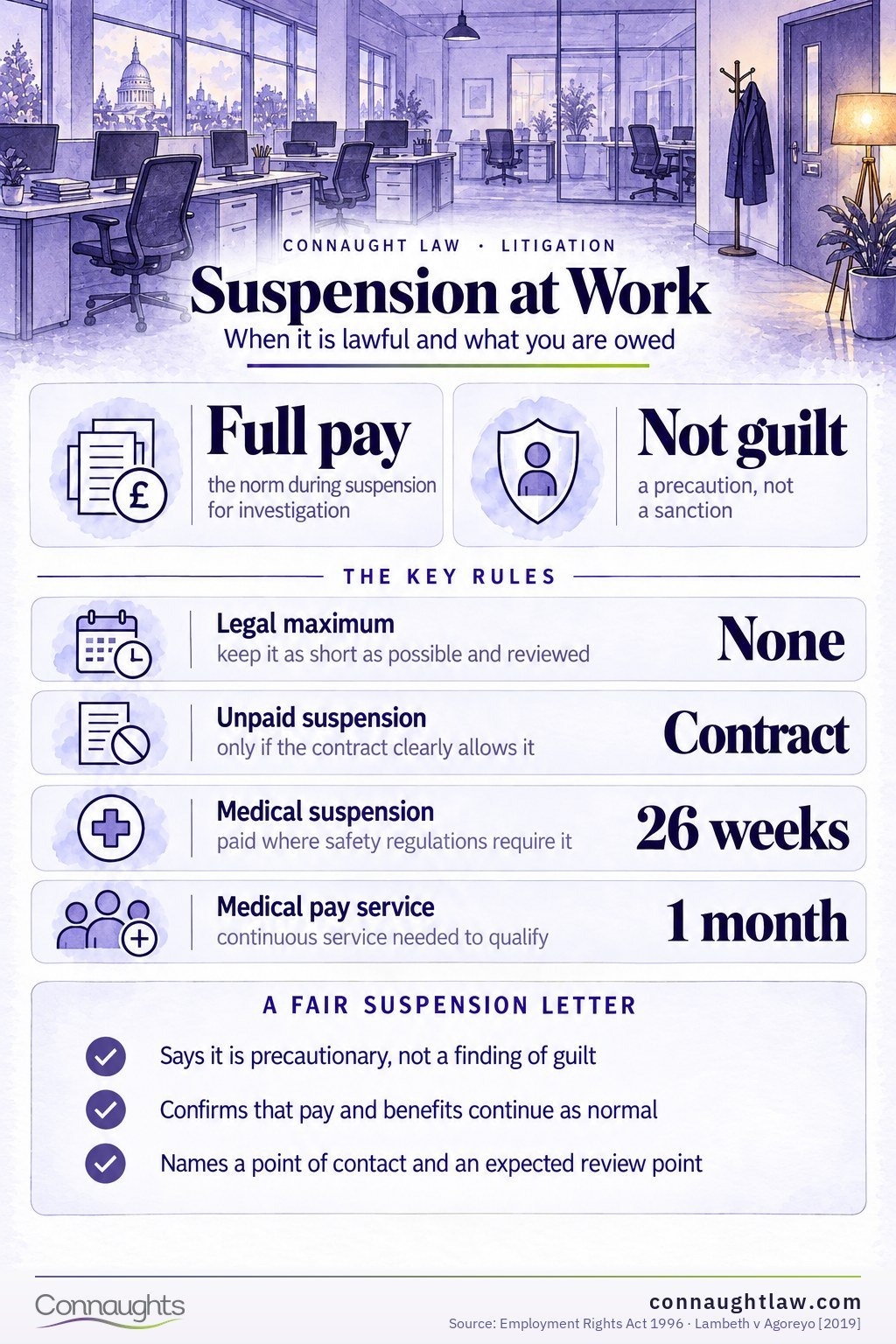
Suspension for investigation should almost always be on full pay. Because you remain employed and are ready and willing to work, your pay and contractual benefits normally continue unless your contract clearly and lawfully allows unpaid suspension. Benefits that depend on being at the workplace may pause, but core pay, pension contributions and holiday accrual generally carry on.
An employer can only withhold pay during suspension if the contract gives it a clear right to do so. Suspending you without pay where the contract does not permit it — or as a way to pressure you — is itself a serious breach that can support a claim. If your pay is stopped or reduced during a suspension, take advice quickly.
Medical Suspension: A Separate Right
"Medical suspension" in the legal sense is narrow and often confused with sickness absence. It is not about being off ill. It applies where an employer is required to suspend an employee under specific health-and-safety regulations — for example the rules on hazardous substances, ionising radiation or lead — because of exposure at work. It sits alongside the broader right to refuse genuinely unsafe work, which is a separate protection.
Where those rules apply, the Employment Rights Act 1996 gives the employee a right to be paid for up to 26 weeks of medical suspension, provided they have at least one month's continuous service. The right is lost if the employee is actually incapable of work through illness during the period, or unreasonably refuses suitable alternative work the employer offers. This is a distinct statutory entitlement and should not be confused with ordinary suspension for investigation or with sick pay.
How Long Can Suspension Last?
There is no fixed legal maximum, but that is not a licence to leave someone suspended indefinitely. A suspension must last no longer than necessary, be kept under active review, and end as soon as the reason for it falls away. A drawn-out suspension with no clear timetable is one of the clearest signs that the process has gone wrong, and it increases the legal risk to the employer.
Good practice — and increasingly what tribunals expect — is regular updates on the investigation, a realistic timeline, and attention to the suspended person's wellbeing, since suspension can be highly stressful. If your suspension is dragging on without explanation or review, that is a proper basis to raise a grievance.
What a Fair Suspension Process Looks Like
How a suspension is carried out matters as much as whether it was justified. A fair process means the decision is taken by someone with authority, for a clear reason, after alternatives have been weighed — and it is confirmed to you in writing without prejudging the outcome.
- That the suspension is precautionary, not disciplinary, and not a finding of guilt
- The general reason, without detailed allegations that could prejudge the investigation
- Confirmation that pay and benefits continue as normal
- Any reasonable limits on contacting colleagues or attending the workplace
- A point of contact for questions and support, and an expected review point
You are entitled to be kept informed as the investigation proceeds, to be accompanied at any subsequent disciplinary hearing, and to have your wellbeing considered throughout. A process that keeps you in the dark, imposes blanket contact bans without reason, or treats suspension as a foregone conclusion is one a tribunal is likely to criticise.
Challenging an Unfair Suspension
Suspension is not beyond challenge. The starting point is usually a grievance setting out why the suspension was unnecessary, disproportionate or badly handled. Where a suspension is discriminatory — targeting a protected characteristic — or is a response to whistleblowing, separate and stronger claims arise, and a serious mishandling can shade into constructive dismissal or unfair dismissal territory.
The leading case is often misunderstood. In London Borough of Lambeth v Agoreyo [2019] EWCA Civ 322, the Court of Appeal held that suspending a teacher pending investigation was not automatically a breach of contract; whether it breaches the implied term of trust and confidence depends on whether the employer had reasonable and proper cause on the facts.
So suspension is neither a rubber-stamp nor an automatic wrong. But a suspension imposed without proper cause, or handled oppressively, can breach the contract and, in a serious case, entitle an employee to resign and claim constructive dismissal. Because that is a high-risk step, it should never be taken without advice.
Two reforms affect suspension and dismissal disputes. Since 1 October 2026 the time limit for most tribunal claims is six months, up from three, for acts on or after that date. From January 2027 the qualifying period for ordinary unfair dismissal is due to fall from two years to six months; until then, the two-year qualifying period still applies.
Questions about suspension from work
Does suspension mean I have done something wrong?
No. Suspension is a precaution to allow an investigation, not a punishment or a finding of guilt. ACAS is explicit that it should not be used to discipline someone, and an employer should normally consider alternatives first. It should also be explained to you as a neutral, temporary step rather than a sanction.
Should I be paid while suspended?
Almost always, yes — on full pay. Because you remain employed and willing to work, your pay and contractual benefits continue during a suspension for investigation unless your contract clearly allows unpaid suspension. If your pay is stopped or cut without a clear contractual right, that may itself be a breach, and you should take advice.
What are valid grounds for suspending an employee?
Serious situations only: allegations of gross misconduct where remaining at work could interfere with the investigation, a genuine health-and-safety risk, or circumstances that would compromise the fairness of an inquiry or the safety of others. There must be reasonable cause and no adequate alternative — minor issues do not justify suspension.
How long can a suspension last?
There is no fixed legal maximum, but a suspension must be no longer than necessary, kept under review, and ended as soon as its reason falls away. An open-ended suspension with no timetable or updates is a warning sign, and a proper basis to raise a grievance. Medical suspension under health-and-safety rules is separately capped at 26 weeks' pay.
What is medical suspension, and is it paid?
Medical suspension is a narrow, statutory situation where an employer must suspend an employee under specific health-and-safety regulations — such as those on hazardous substances, radiation or lead — because of workplace exposure. It is not sickness absence. The Employment Rights Act 1996 gives a right to pay for up to 26 weeks, subject to one month's service and certain conditions.
Can I claim if I was suspended unfairly?
You can raise a grievance, and where a suspension is discriminatory or a response to whistleblowing, stronger claims arise. A suspension imposed without reasonable cause, or handled oppressively, can breach your contract and, in a serious case, support a constructive dismissal claim. That is a significant step, so take advice before resigning.
Tell us what you were told, whether you are still being paid in full and how long it has run. We’ll tell you whether the suspension had reasonable cause and what challenging it would actually involve.
Get Expert Advice