
If you drive, ride or deliver for a platform, your legal status decides everything — whether you get the minimum wage, paid holiday and a pension, or nothing at all. Platforms often label gig workers "self-employed," but a contract label does not settle the question; the courts look at how the relationship really works. This guide explains the three categories of worker, what the Supreme Court decided in the Uber and Deliveroo cases, the tests that determine your status, and the rights that follow if you are a "worker".
On This Page
How Gig Economy Worker Status Works
Your rights depend on which of three categories you fall into. A "worker" is entitled to the National Minimum Wage, paid holiday, rest breaks, pension auto-enrolment and protection from discrimination. A self-employed contractor gets none of those. The label in your contract does not decide it — the courts look at the reality of the relationship, especially how much control the platform has and whether you can genuinely send someone else in your place.
The gig economy sits on a fault line in employment law: the gap between what a contract says and what actually happens. Platforms have long written contracts describing their people as independent businesses, but tribunals and the Supreme Court have repeatedly looked past the wording to the working relationship. The sections below explain the three categories, the two landmark cases that shaped the law, the tests that decide status, and what worker status is actually worth. For the wider context, see our UK employment law guide.
Employee, Worker or Self-Employed?
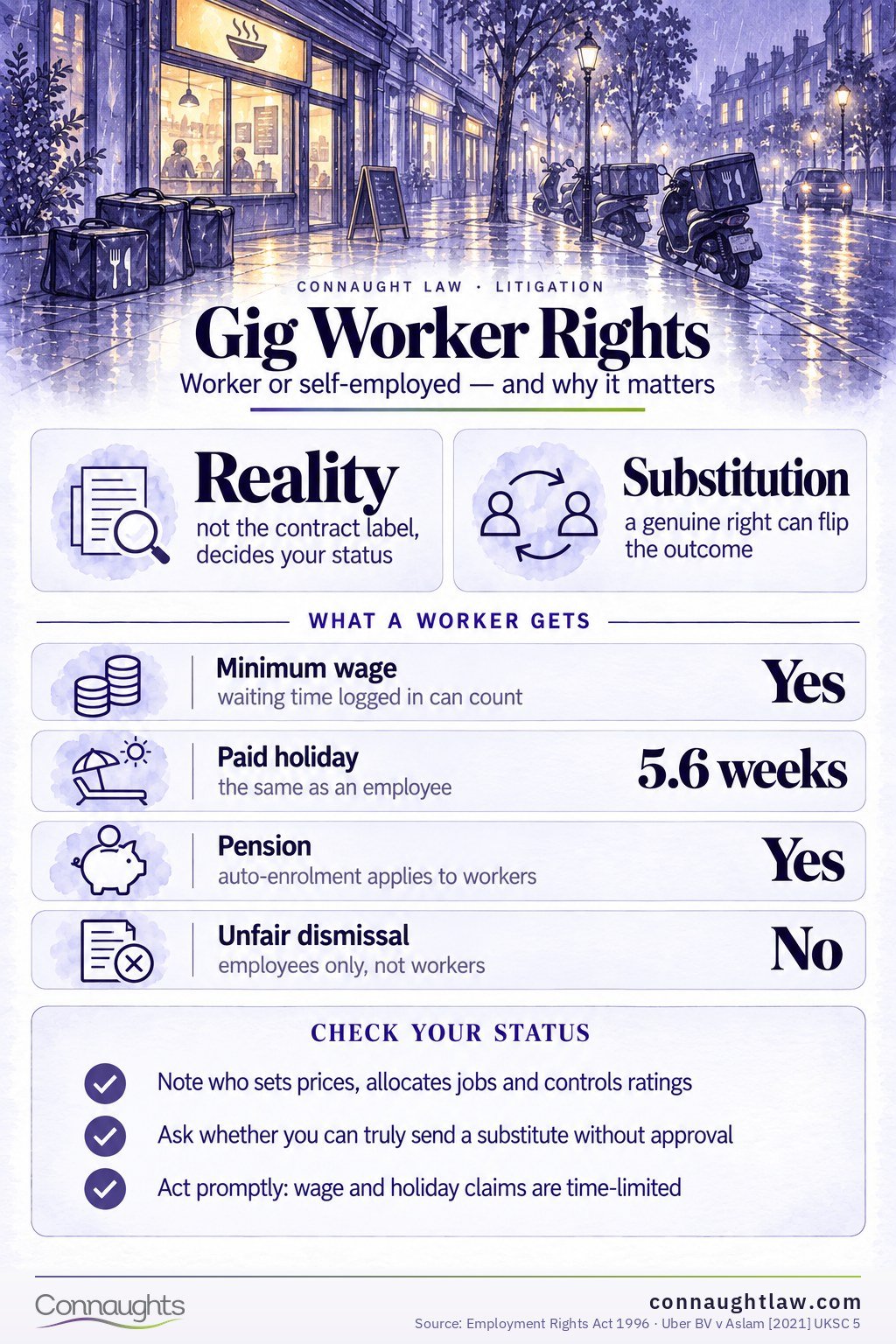
UK law recognises three categories, not two. Employees have the fullest rights, including protection from unfair dismissal and redundancy pay. Workers are an intermediate group who must perform the work largely personally but are not running a business of their own; they get core protections such as the minimum wage and paid holiday, but not unfair-dismissal rights. The genuinely self-employed are in business on their own account and have no statutory employment rights. Most gig disputes are about whether someone labelled self-employed is really a worker.
Under the Employment Rights Act 1996, a worker is someone who contracts to do work or services personally for another party, where that party is not a client or customer of a business the individual runs. It is a middle status: more protected than a self-employed contractor, less protected than an employee. Worker status is the key that unlocks the minimum wage, paid holiday and pension auto-enrolment.
What Uber and Deliveroo Decided
Two Supreme Court decisions define this area, and they came to opposite results for a revealing reason.
In Uber BV v Aslam [2021] UKSC 5, the Court held that Uber drivers are workers, not self-employed. Uber set the fares, dictated the terms, controlled drivers through the ratings system and kept passengers and drivers apart — a degree of control inconsistent with running your own business. The Court also held that a driver's working time counts from when they are logged in and available to accept trips, not only during a fare, which matters for the minimum wage.
In the Deliveroo case (IWGB v Central Arbitration Committee [2023] UKSC 43), the Court reached the opposite conclusion: the riders were not in an employment relationship. The decisive factor was a genuine, "virtually unfettered" right of substitution — riders could send someone else to do the work, without needing Deliveroo's approval — which is inconsistent with the personal service that worker status requires. The contrast shows how a single feature, substitution, can flip the outcome.
The two cases turned on control and, above all, on whether the work had to be done personally. The table below sets the decisive differences side by side.
Uber and Deliveroo Compared
| Factor | Uber — held to be workers | Deliveroo — held self-employed |
|---|---|---|
| Personal service | Drivers had to do the work themselves | Riders could freely send a substitute |
| Control | Fares, terms and conduct set by the platform | Riders free to accept or reject, with less control |
| Result | Minimum wage, paid holiday, pension | No statutory worker rights |
The Tests That Decide Your Status
Tribunals do not take the contract at face value. Following the principle in Autoclenz v Belcher, they look at the true agreement and how it works in practice. Three connected questions drive the analysis.
- Control — how far the platform dictates how, when and where you work: pricing, allocation, ratings and deactivation all count
- Personal service — whether you must do the work yourself, or can genuinely send a substitute without approval
- Mutuality of obligation — whether there is a real obligation to offer and accept work, which economic pressure can create in practice
The personal-service question is often decisive, as the contrast between Uber and Deliveroo shows. A substitution clause that exists on paper but is never really usable will not defeat worker status; a genuine, freely exercised right to send someone else may. Because the analysis is fact-sensitive and turns on your actual arrangements, two people on similar-looking contracts can end up in different categories.
Rights That Come With Worker Status
If you are a worker rather than self-employed, a set of core statutory rights follows. Where a platform has wrongly treated you as self-employed, you may be able to recover backdated pay for what you were denied, subject to time limits.
Rights by Status
| Right | Employee | Worker | Self-employed |
|---|---|---|---|
| National Minimum Wage | Yes | Yes | No |
| Paid holiday (5.6 weeks) | Yes | Yes | No |
| Rest breaks and working-time limits | Yes | Yes | No |
| Pension auto-enrolment | Yes | Yes | No |
| Protection from discrimination | Yes | Yes | No |
| Whistleblowing protection | Yes | Yes | No |
| Unfair dismissal / redundancy | Yes | No | No |
The value is often in the detail. Because Uber-type working time counts from when you are logged in and available, a claim for the minimum wage or holiday pay can cover far more hours than just active jobs. Worker status also carries health-and-safety protections: if a platform penalises you for refusing genuinely dangerous work, our guide to the right to refuse unsafe work explains where you stand. Claims for unpaid wages and holiday generally have to be brought promptly, so it is worth taking advice early rather than letting entitlements slip out of time.
Reform on the Horizon
The law here is still moving. The Employment Rights Act 2025 brings a series of reforms for lower-paid and insecure workers, phased in over 2026 and 2027 — including changes to statutory sick pay and to zero-hours arrangements — though the detail is being settled through regulations. Separately, the Government has signalled an intention to consult on simplifying employment status, potentially moving towards a clearer two-way split. None of this is settled yet, so current status still turns on the tests above.
It is often reported that unfair-dismissal protection is becoming a "day-one" right. That is not quite right: under the Employment Rights Act 2025 the qualifying period is due to fall from two years to six months, and only from January 2027. It is not in force yet, and in any case it protects employees — workers do not have ordinary unfair-dismissal rights at all.
Questions about gig economy worker status
What rights do gig economy workers have in the UK?
If you are a "worker" rather than genuinely self-employed, you are entitled to the National Minimum Wage, 5.6 weeks' paid holiday, rest breaks and working-time limits, pension auto-enrolment, and protection from discrimination and for whistleblowing. You do not get unfair-dismissal or redundancy rights — those belong to employees. Whether you are a worker depends on the reality of your arrangement, not the label in your contract.
Am I a worker or self-employed?
It turns on three questions: how much the platform controls how, when and where you work; whether you must do the work personally or can genuinely send a substitute; and whether there is a real obligation to offer and accept work. Platform-set prices, algorithmic allocation, ratings and deactivation point towards worker status. A genuine, freely usable right of substitution points away from it.
Why are Uber drivers workers but Deliveroo riders self-employed?
The key difference is personal service. In Uber BV v Aslam [2021] UKSC 5 the drivers had to do the work themselves and Uber controlled the terms, so they were workers. In the Deliveroo case [2023] UKSC 43 the riders had a genuine, virtually unfettered right to send a substitute, which is inconsistent with the personal service worker status requires — so they were self-employed.
Does my working time count while I am waiting for a job?
It can. The Supreme Court held in the Uber case that a driver's working time runs from when they are logged in to the app and available to accept trips, not only during an active fare. That matters for the minimum wage and holiday pay, because a claim can cover waiting time, not just the time spent on jobs — though the exact position depends on your particular arrangement.
Can I claim backdated holiday pay or minimum wage?
If you have been wrongly treated as self-employed when you were really a worker, you may be able to recover backdated holiday pay and any shortfall against the minimum wage. Claims for unpaid wages and holiday are subject to strict time limits, so acting promptly matters. A proper assessment of your arrangement and earnings is the starting point for working out what may be recoverable.
Will the law on gig work change soon?
Reforms are coming. The Employment Rights Act 2025 phases in changes for insecure and lower-paid workers over 2026 and 2027, and the Government has signalled it may consult on simplifying employment status. The detail is still being worked out through regulations, so for now your status is decided by the established tests of control, personal service and mutuality of obligation.
Tell us who you work for, how the work is allocated and whether you can send someone else in your place. We’ll tell you which status the tests point to and what back pay that would open up.
Get Expert Advice