
Hand and finger injury compensation is valued under the hand chapter of the Judicial College Guidelines, 18th edition (April 2026), which prices injuries by function lost rather than diagnosis. Awards run from £7,520 for moderate hand injuries, through £38,310 to £81,790 where a hand is reduced to about half its capacity, to £127,050 to £144,860 for loss of one hand — with separate brackets for the thumb and each finger. This guide sets out the verified 2026 brackets, finger and thumb values, tendon injuries, workplace and vibration claims, crush injuries, evidence and time limits.
On This Page

Understanding Hand and Finger Injury Compensation UK 2026
Hand injuries are the workplace's signature harm — caught in unguarded machinery, crushed between loads, lacerated by unsleeved blades — and everyday injuries too: car doors, falls, dog bites. In every setting the same two heads of damage apply. General damages compensate the injury itself against the Judicial College Guidelines; special damages repay lost earnings, treatment and care. Both are recovered through a single personal injury claim against whoever was responsible.
Function is why hand claims resist simple tables. Grip, pinch, dexterity, sensation and appearance interact, dominance matters, and a stiff finger a teacher barely notices can end a joiner's career. Speed of treatment matters too: tendon and nerve repairs run on surgical clocks measured in days, which is why NHS guidance on broken fingers and thumbs says never to wait and see. The brackets below are the verified starting grid; the finishing position belongs to the evidence of what these hands can no longer do.
Under the Judicial College Guidelines 18th edition (April 2026), moderate hand injuries are valued at £7,520 to £17,540, serious hand injuries at £38,310 to £81,790, and loss of one hand at £127,050 to £144,860. Finger awards run from £11,420 for amputation of a little finger to £24,760 for total loss of an index finger, loss of a thumb attracts £46,930 to £72,440, and financial losses are added on top in every case.
Judicial College Guidelines 2026: Hand Injury Compensation Brackets
The Judicial College Guidelines are the reference courts, insurers and solicitors use to value the injury element of a claim in England and Wales. The 18th edition, published on 9 April 2026, uplifted the hand chapter by around 8.26% against the April 2024 edition to reflect RPI inflation. The figures are guidance rather than a tariff — awards are placed within, and occasionally outside, the brackets on the evidence.
The table below sets out the main hand injury categories with their current 18th edition figures.
Hand Injury Brackets
| JCG Hand Injury Category | 18th Edition Bracket | What It Covers |
|---|---|---|
| Total or effective loss of both hands | £185,840 – £266,200 | Amputation or injury leaving both hands little more than useless |
| Total or effective loss of one hand | £127,050 – £144,860 | Amputation of the hand, or crushing followed by amputation of most fingers |
| Amputation of index and middle and/or ring fingers | £81,790 – £119,890 | The hand rendered of very little use, with weak remaining grip |
| Serious damage to both hands | £73,720 – £111,730 | Permanent cosmetic disability and significant loss of function in both hands |
| Serious hand injuries | £38,310 – £81,790 | Injuries reducing the hand to about 50% capacity, including several amputated fingers |
| Less serious hand injury | £19,090 – £38,310 | Severe crush injuries with significantly impaired function despite surgery |
| Moderate hand injury | £7,520 – £17,540 | Crush injuries, penetrating wounds, deep lacerations and serious soft tissue damage |
Minor hand, finger and thumb injuries — simple fractures, lacerations and soft tissue damage resolving within months — sit below the moderate bracket in the low four figures. Within every band, position turns on whether the dominant hand was injured, residual grip and pinch strength, cold sensitivity, cosmetic effect and the claimant's occupation. The same amputated finger is a different loss on a surgeon's operating hand than on a desk worker's, and the Guidelines expect valuations to reflect that.
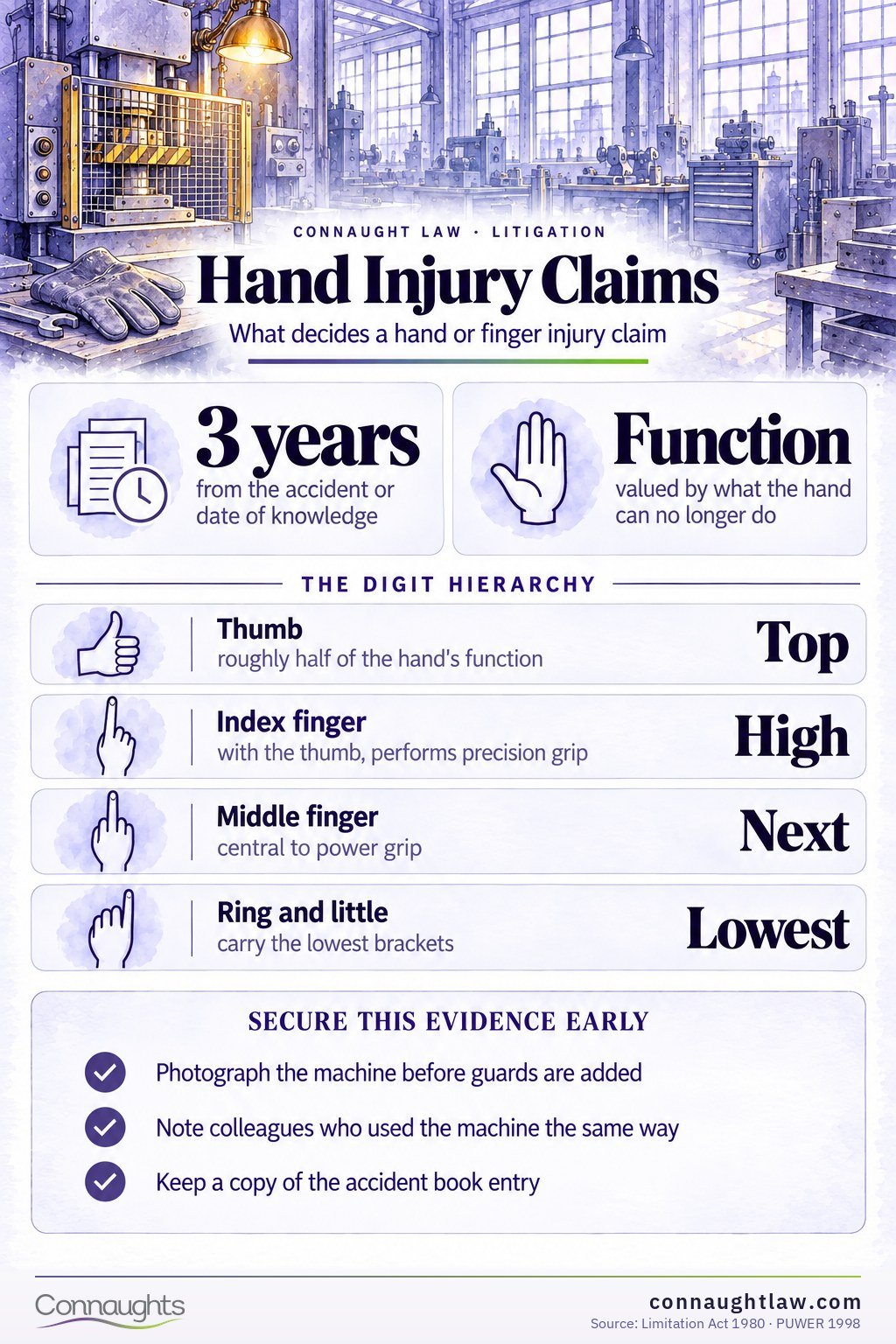
Finger Injury Compensation: The Digit Hierarchy
The Guidelines price digits by function, and the hierarchy is unsentimental: the thumb and index finger, which together perform precision grip, sit at the top; the middle finger, central to power grip, follows; the ring and little fingers carry the lowest brackets. Amputations, fractures that heal stiff, tendon damage and nerve injury each slot into the hierarchy at values shaped by what the remaining hand can still do.
These are the 18th edition finger brackets most claims turn on.
Finger Injury Brackets
| Finger Injury | 18th Edition Bracket |
|---|---|
| Severe fractures to fingers, possibly leading to partial amputations | Up to £48,540 |
| Total or partial loss of index finger | £16,080 – £24,760 |
| Serious injury to ring or middle fingers | £13,630 – £21,590 |
| Fracture of index finger with impaired grip | £12,040 – £16,170 |
| Amputation of little finger | £11,420 – £16,170 |
Partial losses sit below their full-loss equivalents: loss of part of a little finger or the terminal phalanx of a ring or middle finger attracts smaller four-figure awards, while simple finger fractures that heal straight and fully resolve fall into the minor bracket. Metacarpal and phalangeal breaks climb by what they take from grip and extension — intra-articular fractures, malunions and stiff joints move claims up the range.
Finger Tendon Injury Compensation
Tendon injuries thread through every bracket: flexor lacerations that leave fingers unable to curl, extensor injuries that will not straighten, mallet finger deformities from ruptured terminal tendons. The Guidelines value them by what returns after repair and therapy, not by the operation performed. A single-digit tendon repair with good recovery sits alongside the equivalent finger fracture; tendon damage that permanently impairs grip across the hand is valued in the moderate or less serious hand brackets, and the operation note plus the hand therapist's discharge summary carry more weight than any adjective.
Multiple Digit and Combination Injuries
Combination injuries climb faster than single-digit arithmetic suggests, because losing two fingers does not double the loss — it can eliminate grip patterns entirely. That is why amputation of the index with the middle and/or ring fingers is bracketed at £81,790 to £119,890, and why the serious and severe categories speak of hand function rather than finger counts. Honest expert assessment of the whole hand beats a digit-by-digit tally every time.
Thumb Injury Compensation: The Most Valuable Digit
The thumb is roughly half the hand's function — opposition is what separates grip from paw — so thumb injuries carry brackets that surprise claimants used to thinking in fingers. The Guidelines give the thumb its own ladder, and total loss approaches the value of several fingers together.
The current thumb brackets under the 18th edition are as follows.
Thumb Injury Brackets
| Thumb Injury | 18th Edition Bracket |
|---|---|
| Loss of a thumb | £46,930 – £72,440 |
| Very serious injury, leaving the thumb virtually useless | £25,890 – £46,250 |
| Serious injury with impaired grip and lost dexterity | £16,640 – £22,150 |
Moderate thumb injuries — fractures needing fixation, tendon or nerve damage with sensory loss but reasonable recovery — sit in the five-figure range below the serious bracket, while dislocations and simple fractures that recover fully fall towards the minor level. Surgical pathways shape outcomes and therefore awards: closed reduction, K-wire fixation, microsurgical tendon or nerve repair and, at the severe end, revision amputation and prosthetic fitting.
Treatment costs, hand therapy above all, are claimed as incurred and projected forward: splinting, scar management, desensitisation programmes and revision surgery where metalwork needs attention. Therapy compliance also protects the claim itself, since stiffness from missed rehabilitation invites an avoidable-loss argument.
Workplace Hand Injury Claims
Machinery Guarding and Employer Liability
Machinery guarding is where hand claims and health and safety law grew up together, and the modern duties remain strict: dangerous parts guarded under the Provision and Use of Work Equipment Regulations 1998, safe systems for cleaning and unblocking, lock-off procedures that are enforced rather than laminated, and training that reaches agency staff on their first shift. HSE machinery guidance treats unguarded nips and blades as the classic enforcement case, and courts treat them as the classic liability one.
Agency and new workers are over-represented in machinery files for reasons the law anticipates: induction skipped, language barriers unaddressed, supervision thinnest on the shifts that need it most. Duties are owed to whoever the work endangers, and an employer cannot outsource guarding law to a staffing agency's paperwork.
Gloves and the PPE Argument
Gloves are the PPE argument in miniature: provided but unsuitable, suitable but unenforced, enforced but degraded. Cut-resistance ratings exist for exactly the blades and swarf that cause these injuries, and an employer who issued general-purpose gloves against a rated hazard has documented the breach in its own procurement records.
The recurring defence — "he reached in himself" — rarely survives scrutiny, because guarding law exists precisely to protect people from momentary, foreseeable lapses. Contributory negligence may shave an award where instructions were flouted; it does not rescue an employer whose machine could be reached into at all.
Vibration White Finger and HAVS Claims
Hand-arm vibration syndrome and vibration white finger are the industrial-disease end of hand claims: years of grinders, breakers and polishers producing blanching attacks, numbness, tingling and lost dexterity in the cold. Employers have long owed duties to assess and control vibration exposure, and HSE hand-arm vibration guidance sets out the exposure limits and health surveillance the law expects.
Awards scale with the severity and frequency of attacks, the number of digits affected, the claimant's age and the interference with work and home life — the most serious cases reach well into five figures, while early symptom sets attract modest awards. Because symptoms develop gradually, limitation runs from the date of knowledge rather than the last exposure, claims can succeed against former employers, and apportionment between successive employers is routine rather than fatal.
Crush Injuries and Multiple Digit Loss
Crush injuries are the severe end's workhorse: presses, rollers, tailgates and pallet incidents that fracture multiple bones, destroy soft tissue and leave hands stiff, cold-sensitive and weak despite months of surgery and therapy. Multiple amputations sit in the serious hand injuries bracket or above, loss of a hand at £127,050 to £144,860, and both-hand involvement moves towards £185,840 to £266,200 — approaching the amputation levels our arm injury guide covers.
These are also prosthetics and adaptation claims: modern myoelectric and cosmetic prostheses replaced on realistic cycles, adapted tools and vehicles, home adjustments, and psychological treatment for visible, socially prominent injuries. Each is costed by experts and claimed for life, which is why severe hand claims are structured like small catastrophic claims rather than large finger claims.
Replantation and salvage surgery add a distinctive evidence layer: what was attempted in the first hours, what survived, and what staged reconstruction remains possible. Where replantation failed or was never attempted, the expert question is whether competent emergency management would have changed that — and the answer sometimes adds a clinical negligence claim to the accident claim.
Where hands are injured alongside the wrist, forearm or elbow, the claim is valued as one changed capability rather than a list of parts. Our wrist injury guide and elbow injury guide cover the adjacent brackets, and the schedule should capture the combined effect on lifting, carrying and fine work. Fragmented valuations undervalue everything they touch.
Children's hand injuries — door hinges, escalators and dog attacks, covered in our dog bite compensation guide — carry the usual protections: litigation friends, court approval, limitation running from 18, and prognosis patience while growth completes. Scarring on growing hands is reviewed late for good reason, and settlements respect that timetable.
Defence themes are familiar and answerable: pre-existing arthritis, met by the before-and-after function record; exaggeration, met by objective grip testing and consistent reporting. Defendants take claimants as they find them — a crush that devastates an already-worn hand is compensated for the devastation actually caused.
Medical Evidence in Hand Claims
Hand evidence is unusually measurable, which rewards claims built properly and punishes claims processed lazily. Assessment by a hand surgeon, supported by hand therapy records, tracks progress objectively — and settlement timing should follow that curve, because grip strength, sensory recovery and scar maturation plateau across twelve to eighteen months for serious injuries. Valuing before the plateau hands the uncertainty discount to the insurer.
- Grip and pinch dynamometry plus range-of-motion measurement, repeated over time to show objective progress or plateau
- Sensory testing and cold intolerance scoring, which anchor the invisible symptoms insurers discount most
- Good photographs of scarring and resting posture, supporting the cosmetic and psychological components
- Dominance and occupation stated from the first statement, with the job's actual physical demands evidenced
- Short video of real tasks — buttoning a shirt, holding a kettle — showing function no report captures
Occupational evidence completes the claim: tools held and forces applied, failed return-to-work attempts, and where a trade is finished, retraining costs and the permanent labour-market disadvantage a weakened dominant hand carries. Our loss of earnings guide covers that half of the claim, which in working hands regularly exceeds the injury award itself.
Cosmetic and psychological consequences run deeper than their brackets suggest, because hands are permanently on display. Scarring, deformity and amputation drive social anxiety that psychiatric evidence can value separately, and interim payments under the Rehabilitation Code can fund the splinting, scar therapy and psychological support that improve the final outcome.
Time Limits for Hand Injury Claims
The Limitation Act 1980 grid applies: three years from the accident or from the date of knowledge, three years from the 18th birthday for children, and no running limit while capacity is lacking. Gradual-onset conditions such as HAVS and other nerve damage claims run from knowledge, and machinery incidents generate RIDDOR reports and accident book entries whose prompt existence — or suspicious absence — shapes everything later.
Guards appear, blades are sleeved and signage blossoms within days of a reportable hand injury. Photographs of the machine as it was, names of colleagues who used it the same way, and a copy of the accident book entry are the three cheapest, most decisive pieces of evidence a hand claim will ever hold.
Questions about hand and finger injury claims
How much compensation do you get for a hand injury in the UK?
Under the 18th edition Judicial College Guidelines, moderate hand injuries attract £7,520 to £17,540, less serious injuries £19,090 to £38,310, serious injuries £38,310 to £81,790, and loss of one hand £127,050 to £144,860 — plus financial losses in every case.
How much compensation will I get for a finger injury?
It depends on the digit and residual function: an index finger fracture with impaired grip attracts £12,040 to £16,170, total loss of an index finger £16,080 to £24,760, and amputation of a little finger £11,420 to £16,170. Simple fractures with full recovery sit lower.
How much is a finger tendon injury claim worth?
Tendon injuries are valued by what function returns after repair and therapy. A single-digit repair with good recovery is valued like the equivalent finger injury; permanent grip impairment across the hand moves into the moderate or less serious hand brackets.
How much compensation for a thumb injury?
The thumb carries the highest digit brackets: serious injuries attract £16,640 to £22,150, very serious injuries leaving the thumb virtually useless £25,890 to £46,250, and total loss of a thumb £46,930 to £72,440 under the 18th edition Guidelines.
What if my hand was caught in an unguarded machine?
Guarding duties are strict, and reaching into a reachable danger zone is exactly what the law requires employers to prevent. These are among the strongest liability claims in personal injury; the argument is usually about valuation, not fault.
Does dominance really change the award?
Yes. The Guidelines expect injuries to the dominant hand to be valued higher within the bracket, and the earnings consequences of a damaged dominant hand in a manual trade are usually the largest element of the claim.
My employer blames me for the accident — should I still claim?
Yes. Blame-the-worker is the standard opening position and rarely survives the guarding and training evidence. At worst it produces a modest contributory deduction; it does not bar the claim.
What is the time limit for a hand injury claim?
Three years from the accident, or from knowledge in gradual-onset conditions like vibration white finger; children have until their 21st birthday, and there is no running limit while capacity is lacking. Evidence degrades far faster than the deadline.
Tell us what the machine or accident was, which digits are affected and what grip and sensation you have left. We’ll tell you which bracket applies and what evidence to secure before the site changes.
Get Expert Advice