
Elbow injury compensation in the UK is assessed under the Judicial College Guidelines 18th edition, published in April 2026, which value elbow injuries across three brackets running from strains and simple fractures that recover fully to severely disabling damage. Where a claim sits depends on surgery, residual stiffness, dominant-arm involvement and the financial losses that follow. This 2026 guide explains the current compensation brackets, tennis elbow and repetitive strain claims against employers, fracture settlements including radial head injuries, the medical evidence that matters, and the time limits that apply.
On This Page

Understanding Elbow Injury Compensation Claims
An elbow injury claim compensates two kinds of loss. General damages cover the pain, suffering and loss of amenity caused by the injury itself, valued against the Judicial College Guidelines brackets set out below. Special damages repay what the injury has cost you — lost earnings, treatment, physiotherapy, travel and care — and both are recovered through a single personal injury claim.
Elbow injuries arise across every claim type this guide covers: falls at work or in public places, road traffic collisions, and repetitive strain conditions such as tennis elbow that develop gradually through working practices. Whatever the mechanism, the legal test is the same — the injury must have been caused by another party's negligence or breach of duty, and the claim must be brought in time.
In road traffic cases — where motorcyclists and cyclists instinctively put an arm out and vehicle occupants brace against the dashboard — the claim runs against the at-fault driver's insurer. Because most elbow injury valuations exceed the £5,000 small claims limit for road traffic injuries, these claims proceed outside the fixed-tariff whiplash regime and legal costs are generally recoverable.
The elbow is where the humerus, radius and ulna meet in a joint that tolerates injury poorly. Even well-treated fractures commonly leave some stiffness, and lost extension or forearm rotation affects almost every daily task — which is why awards climb steeply once function does not fully return.
Elbow Injury Compensation Amounts: Judicial College Guidelines 2026
Under the Judicial College Guidelines 18th edition (April 2026), severely disabling elbow injuries attract £51,750 to £72,440, less severe injuries causing impaired function £20,680 to £42,290, and moderate or minor elbow injuries — including simple fractures and tennis elbow that largely recover — up to £16,640. Financial losses such as lost earnings are added on top of these figures.
The Judicial College Guidelines are the reference courts, insurers and solicitors use to value the injury element of a claim in England and Wales. The 18th edition, published on 9 April 2026, uplifted elbow brackets by around 8.26% against the April 2024 edition to reflect RPI inflation. They are guidance rather than a fixed tariff — awards are placed within the brackets on the medical evidence, consistent with the government's guidance on compensation after an accident.
The table below sets out the three elbow injury categories in the current guidelines. The sections that follow explain how tennis elbow, fractures and workplace injuries map onto them.
Elbow Injury Brackets
| JCG Elbow Injury Category | 18th Edition Bracket | What It Covers |
|---|---|---|
| Severely disabling elbow injury | £51,750 – £72,440 | Severe injuries causing significant permanent disablement, typically after extensive surgery |
| Less severe elbow injuries | £20,680 – £42,290 | Injuries causing impaired function but not involving major surgery or significant disability |
| Moderate or minor elbow injury | Up to £16,640 | Most elbow injuries — simple fractures, tennis elbow syndrome and lacerations with no permanent impairment of function |
Where a claim sits within its bracket turns on the number of operations, the completeness of recovery, dominant-arm involvement, the claimant's age and occupation, and the permanence of any restriction. Comparable ladders apply to neighbouring injuries — see our broken arm compensation and shoulder injury compensation guides where the damage extends beyond the joint — and financial losses are then added, so total settlements regularly exceed the injury bracket alone.
Is There an Average Elbow Injury Payout?
There is no official average payout for an elbow injury, because most claims settle privately and outcomes are not centrally recorded. The guideline brackets above are the only published benchmark. In practice, the majority of elbow claims — soft tissue injuries, tennis elbow and simple fractures that recover — resolve within the moderate or minor bracket, plus special damages.
Online averages and calculators also mislead because identical injuries produce different settlements. A self-employed electrician with a stiff dominant elbow loses far more income than an office worker with the same scan, and complications, slow rehabilitation or a career change all move the final figure. Treat any quoted average as orientation, not a valuation.
What Else an Elbow Injury Settlement Includes
Special damages routinely form a large share of an elbow settlement. Recoverable items include lost earnings and overtime during recovery, private physiotherapy or surgery where NHS waiting lists would delay rehabilitation, travel to appointments, and care — including help from family, valued at an hourly rate. Where restriction is permanent, future losses such as reduced earning capacity are quantified in the same settlement. Most claims are funded by no win no fee agreements; where hourly-rate work is charged, the courts' published solicitors' guideline hourly rates provide the benchmark.
Interim payments can be requested once liability is admitted, easing treatment costs or income gaps before final settlement. Most claims follow the pre-action protocol — notification to the defendant's insurer, disclosure of medical evidence, then negotiation — and the great majority settle without a court hearing.
Tennis Elbow Compensation Claims (Lateral Epicondylitis)
Tennis elbow — lateral epicondylitis — has no separate bracket in the Judicial College Guidelines; claims are valued within the elbow categories above. Most cases, where symptoms settle with physiotherapy and activity change, fall within the moderate or minor bracket of up to £16,640. Chronic epicondylitis leaving impaired function despite treatment supports the less severe bracket of £20,680 to £42,290, and only exceptional cases involving failed surgery and permanent disability approach the severely disabling range.
The condition is an overuse injury of the tendons anchoring the forearm extensor muscles to the outside of the elbow, causing pain on gripping and resisted wrist movement. Despite the name, most claims are occupational rather than sporting: repetitive gripping, twisting and forceful tool use make it one of the recognised work-related upper limb disorders covered by HSE guidance. Golfer's elbow — medial epicondylitis, on the inner side — is claimed on the same principles.
Employers owe duties under the Health and Safety at Work etc. Act 1974 to assess repetitive-strain risk and act on it — rotating tasks, providing suitable tools, allowing rest breaks and responding when symptoms are reported. Where those duties are breached and the condition is medically linked to the work, compensation is pursued as an industrial disease claim against the employer's liability insurer.
Because tennis elbow develops gradually, causation evidence matters more than in accident claims. A supportive diagnosis, an analysis of the job's physical demands, and a symptom timeline correlating with working patterns distinguish occupational epicondylitis from age-related degeneration — and the three-year limitation clock generally starts only when you knew, or ought reasonably to have known, that the condition was significant and work-related.
- Duration: conditions persisting despite treatment justify a higher bracket than cases resolving within months
- Treatment: physiotherapy-only cases sit lower than those needing injections or surgical release of the tendon
- Dominant arm: injuries to the dominant side attract more within the bracket for their greater daily impact
- Work consequences: manual workers forced to change duties or careers recover substantial future earnings losses
- Causation clarity: clear occupational exposure strengthens claims where degenerative change might otherwise be blamed
Workplace Elbow Injury Compensation and Employer Liability
Beyond repetitive strain, acute elbow injuries at work — falls from height, machinery accidents, heavy lifting and slips on poorly maintained floors — engage the same employer duties. Manual handling injuries raise training obligations under the Manual Handling Operations Regulations 1992, while defective or unguarded equipment points to breaches of the Provision and Use of Work Equipment Regulations 1998. Identifying the specific regulation breached sharpens the negligence case and often shortens the argument over liability.
Workplace claims are met by your employer's compulsory liability insurance rather than the business itself, and dismissing or penalising an employee for bringing an honest claim is unlawful. Strong claims rest on contemporaneous evidence: the accident book entry, any RIDDOR report, photographs of the scene or equipment, witness details, and records showing what training and risk assessments were — or were not — in place.
Vocational impact drives value in workplace elbow claims. A carpenter, plasterer or assembly worker who cannot grip or rotate the forearm loses more than the injury bracket suggests, and reduced earning capacity, retraining costs and lost promotion prospects are all recoverable as future losses where the evidence supports them.
Broken Elbow Compensation: Fractures and Surgical Requirements
A broken elbow usually means a fracture of the olecranon — the bony point of the elbow — the radial head, or the distal humerus where the upper arm bone forms the joint. Treatment runs from a splint or cast with early movement, through open reduction and internal fixation with plates and screws, to radial head or total elbow replacement in the most severe cases.
The guidelines classify by outcome rather than by bone. A fracture that unites well with near-full movement is valued within the moderate or minor bracket; residual stiffness or impaired function supports the less severe bracket; and permanent significant disability — failed fixation, post-traumatic arthritis or fractures needing joint replacement — moves the claim into the severely disabling range. Fractures extending up the humerus are assessed in our broken arm guide, and ulnar nerve symptoms running into the fingers may add a linked hand and finger injury element.
Olecranon and Distal Humerus Fractures
Olecranon fractures — a fall directly onto the point of the elbow, or a violent pull from the triceps — are usually displaced by the muscle itself, so most need surgical fixation with tension band wiring or a plate. The hardware sits directly under the skin and often irritates, meaning a second operation to remove it is common and should be anticipated in the settlement rather than left uncompensated.
Distal humerus fractures involve the joint surface itself and are among the hardest elbow injuries to treat, particularly in older claimants with weaker bone. Complex fixation, prolonged rehabilitation and a recognised risk of stiffness, non-union and ulnar nerve irritation mean these claims more often justify the less severe or severely disabling brackets than other elbow fractures. Elbow dislocations, with or without fracture, are assessed on the same outcome basis.
Radial Head Fracture Settlements
Radial head fractures — among the most common adult elbow fractures, typically caused by falling onto an outstretched hand — are graded by displacement using the Mason classification. An undisplaced Mason type I fracture treated in a sling with early movement usually recovers well, so settlements ordinarily fall within the moderate or minor bracket of up to £16,640, plus financial losses.
Displaced and comminuted fractures needing fixation or radial head replacement, or those combined with dislocation and ligament damage, carry a real risk of lasting stiffness and arthritis — supporting the less severe bracket of £20,680 to £42,290 or, where significant disability is permanent, the severely disabling range. Force transmitted along the forearm in the same fall can also injure the wrist, assessed separately in our wrist injury compensation guide.
Medical Evidence Requirements for Elbow Injury Claims
Every claim is valued on an independent medico-legal report from a consultant orthopaedic surgeon, prepared once recovery has plateaued. Settling before the long-term prognosis is clear risks accepting a bracket below the injury's true severity — elbow stiffness and post-traumatic arthritis often declare themselves late.
- Imaging: X-rays, CT and MRI documenting the fracture pattern or tendon damage and healing progress
- Operation notes: surgical records and hardware details evidencing severity and any future removal or revision needs
- Function: range-of-movement testing — flexion, extension and forearm rotation — and grip strength against the uninjured side
- Prognosis: consultant opinion on permanence of restriction, arthritis risk and the likelihood of further surgery
- Losses: payslips, invoices and care records supporting the special damages claim
Functional evidence matters as much as the diagnosis: two identical X-rays can justify different brackets where one claimant regains full use and the other cannot straighten the arm or grip normally. Hand dominance, occupation and daily-living impact should all be recorded in the report.
Time Limits for Elbow Injury Compensation Claims
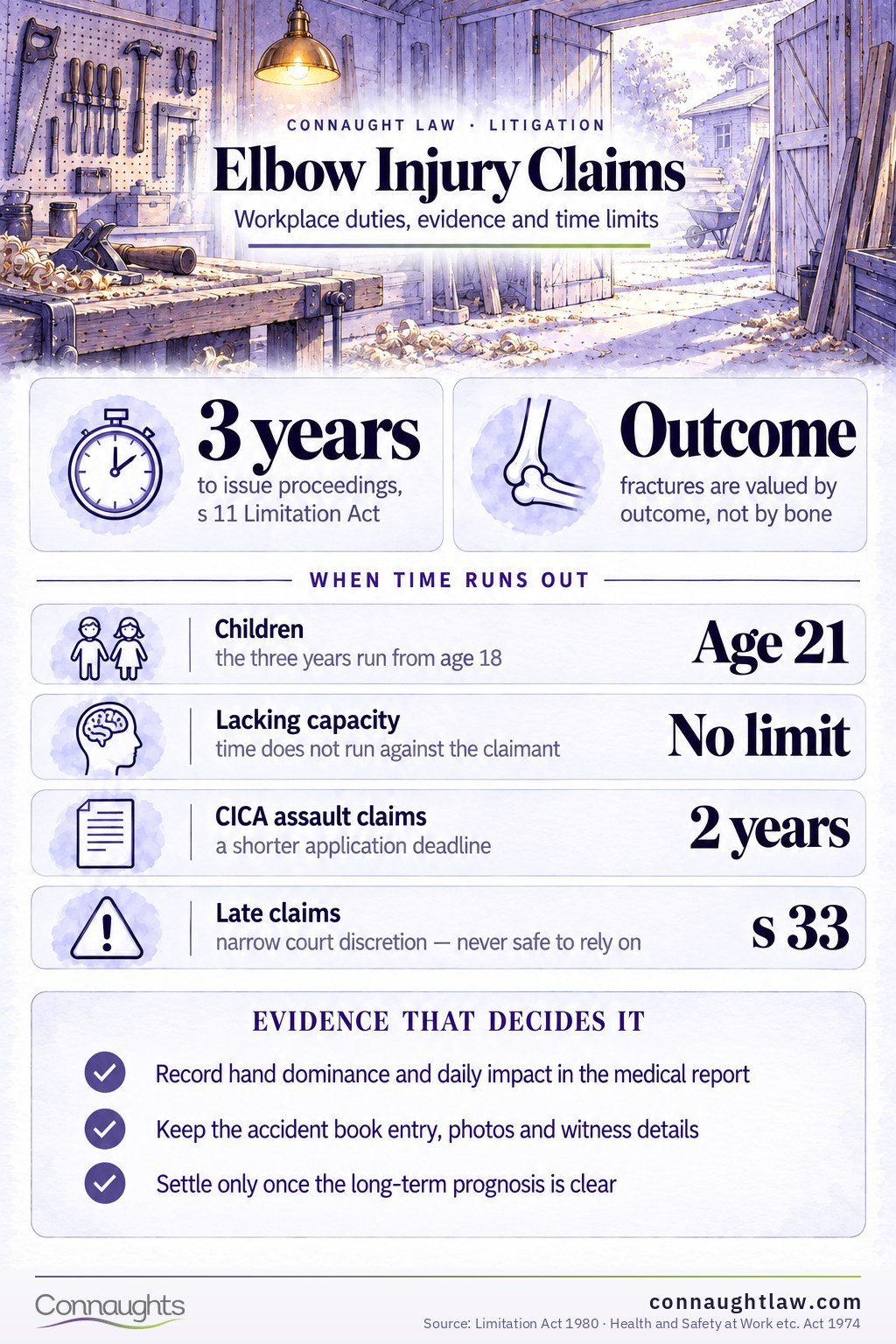
Section 11 of the Limitation Act 1980 gives three years to issue court proceedings, running from the accident or from the date of knowledge — the point at which you reasonably connected a significant injury to the defendant's fault. That later start date matters for gradual-onset conditions such as tennis elbow. Courts hold a narrow discretion under section 33 to allow late claims, but it is never safe to rely on.
Children have until their 21st birthday, because the three years run from age 18, and a parent or litigation friend can claim on their behalf at any point before then. Time does not run against claimants lacking mental capacity, and assault-related elbow injuries claimed through the Criminal Injuries Compensation Authority carry a shorter two-year application deadline.
Frequently askedQuestions about elbow injury claims
How much compensation for an elbow injury in the UK?
Under the Judicial College Guidelines 18th edition, severely disabling elbow injuries attract £51,750 to £72,440, less severe injuries with impaired function £20,680 to £42,290, and moderate or minor injuries up to £16,640 — with lost earnings and other financial losses added on top.
How much compensation for tennis elbow?
Tennis elbow is valued within the elbow brackets rather than under a separate tariff. Cases that settle with treatment fall within the moderate or minor bracket up to £16,640; chronic epicondylitis with lasting impaired function supports the less severe bracket of £20,680 to £42,290.
What is a typical radial head fracture settlement?
An undisplaced radial head fracture with good recovery ordinarily settles within the moderate or minor bracket of up to £16,640 plus financial losses. Fractures needing fixation or replacement, or leaving lasting stiffness, support the less severe bracket or higher.
How much compensation for a broken elbow requiring surgery?
Surgery alone does not fix the bracket — outcome does. A fixed fracture with good function may stay within the moderate or minor bracket, while residual stiffness supports £20,680 to £42,290 and permanent significant disability the severely disabling range.
Can I claim for an elbow injury caused by my work?
Yes, where your employer breached its duties — unsafe systems, inadequate training, defective equipment or unmanaged repetitive-strain risk — and that breach caused the injury. Claims are met by compulsory employers' liability insurance, and penalising you for an honest claim is unlawful.
Does it matter that I injured my dominant arm?
Yes. Dominant-arm elbow injuries generally attract higher awards within the applicable bracket because writing, eating, personal care and most work tasks are harder to adapt. Your medical report should record hand dominance and its practical impact.
How long do I have to claim for an elbow injury?
Three years from the accident or from the date you knew the injury was significant and linked to the defendant's fault — important for gradual-onset tennis elbow. Children have until their 21st birthday, and CICA claims carry a two-year deadline.
How long does an elbow injury claim take to settle?
Straightforward claims with admitted liability often settle within about a year. Surgical fractures, repetitive strain disputes and cases with an uncertain prognosis take longer, because settlement should wait until your long-term recovery position is medically clear.
Tell us how it happened, whether surgery was needed and how much movement you have lost — and whether it is your dominant arm. We’ll tell you which bracket applies and what to claim alongside it.
Get Expert Advice