
Shoulder injury compensation UK claims are among the most commonly misvalued online: under the Judicial College Guidelines 18th edition the severe shoulder bracket tops out at £63,450, not the six-figure sums many tables borrow from arm-amputation and paralysis chapters. Real awards run from a few thousand pounds for minor injuries to £25,370–£63,450 for severe damage, often involving the brachial plexus, with earnings, treatment and care claimed on top. This 2026 guide sets out the true brackets, rotator cuff and surgery claims, employer liability, the evidence that moves awards, and the time limits.
On This Page
Understanding Shoulder Injury Compensation UK 2026
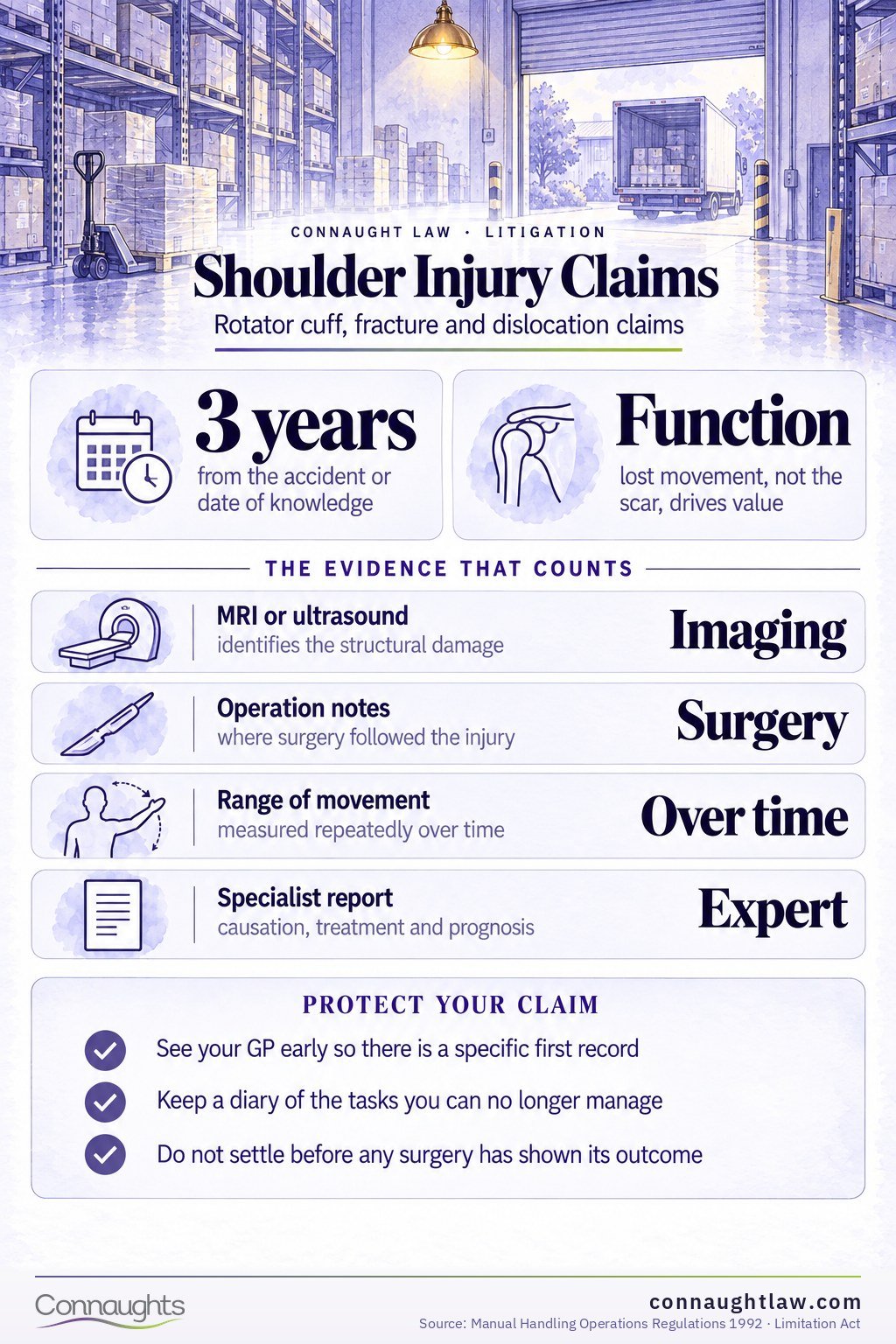
The shoulder buys its extraordinary range of movement with vulnerability. A shallow joint stabilised by the rotator cuff’s muscles and tendons is easy to strain, tear, dislocate and fracture, and hard to ignore once damaged: reaching, lifting, dressing, driving and sleeping all suffer. Because so much daily function routes through it, moderate injuries produce immoderate consequences, and claims reflect function lost, not the size of the scar.
The claimant profile is broad: electricians and decorators whose trades live overhead, warehouse and care staff lifting for a living, drivers and cyclists taking impacts through an outstretched arm or the point of the shoulder, and anyone a wet floor or missing handrail brings down. Shoulders also punish stoicism: months of "it will settle" delay diagnosis and entrench frozen shoulder, so early GP attendance — and a specific first record — serves health and evidence equally.
Misinformation is a genuine hazard in this corner of personal injury. Template tables circulate quoting six-figure sums for "severe shoulder fractures"; those figures belong to the most severe arm injuries and to paralysis, not to any shoulder bracket. Claimants anchored to them refuse fair offers and lose momentum; the figures below are the published ones.
One boundary matters before the table: shoulder soft tissue injuries suffered by drivers and passengers in road accidents fall within the statutory whiplash definition, capped by the tariff when symptoms resolve within two years — our whiplash payout scale guide sets out those fixed amounts. The brackets below govern everyone and everything else: workplace accidents, falls, cyclists, and occupant injuries beyond the tariff’s scope, as our soft tissue injury claims guide explains.
Judicial College Guidelines for Shoulder Injuries
Under the Judicial College Guidelines 18th edition (April 2026), shoulder injury payouts run from under £10,420 for minor injuries, to £10,420–£16,870 for moderate damage such as frozen shoulder, £16,870–£25,370 for serious dislocations with nerve damage, and £25,370–£63,450 for severe injuries — before financial losses are added.
The shoulder chapter of the Judicial College Guidelines, 18th edition (April 2026), grades awards as follows.
Shoulder Injury Brackets
| Injury | JCG 18th Edition Bracket |
|---|---|
| Minor – soft tissue, recovery within about a year | Up to £5,750 |
| Minor – considerable pain, recovery within about two years | £5,750 – £10,420 |
| Fracture of the clavicle | Own bracket, spanning the minor and moderate ranges |
| Moderate – frozen shoulder, soft tissue limitation persisting | £10,420 – £16,870 |
| Serious – dislocation with lower brachial plexus damage, persistent symptoms | £16,870 – £25,370 |
| Severe – often associated with brachial plexus injury and significant disability | £25,370 – £63,450 |
Bracket position follows function and time: how long symptoms genuinely lasted, what movement returned, whether surgery was needed and worked, dominance of the affected arm, and the effect on work and sleep. Where damage extends beyond the shoulder into serious arm injury, the arm chapter takes over, rising to £127,050–£172,970 for the most severe arm injuries — the honest source of the six-figure sums the internet mislabels — as our broken arm compensation guide explains.
Financial Losses on Top of the Brackets
Those losses deserve their own arithmetic. An electrician who cannot work overhead, a carer who cannot transfer patients: months of lost earnings, retraining where a trade is lost, private treatment to shortcut waiting lists, and help with daily tasks are all recoverable, and in working-age claims they routinely exceed the injury bracket itself. Our loss of earnings guide covers the evidence.
Two positioning factors punch above their weight. Dominance: a right-handed claimant’s right shoulder carries writing, tools and driving, and the Guidelines expect that reflected. And sleep: a shoulder that wakes its owner nightly for a year is not a minor injury, provided the disturbance made it into the medical records.
- The severe shoulder bracket tops out at £63,450 — six-figure "shoulder" tables are quoting arm-amputation or paralysis chapters.
- Moderate injuries such as persistent frozen shoulder sit at £10,420–£16,870.
- Serious dislocations with brachial plexus damage sit at £16,870–£25,370.
- Losses — earnings, treatment and care — are what lift a claim beyond its bracket.
Rotator Cuff Injuries and Surgery
Compensation for a shoulder injury requiring surgery usually falls between £10,420 and £25,370 under the Judicial College Guidelines 18th edition. An arthroscopic or open repair followed by good recovery is typically valued within the moderate bracket at £10,420–£16,870; surgery that leaves persistent pain or restricted movement moves into the serious bracket at £16,870–£25,370; and failed or repeated procedures causing significant lasting disability reach the severe bracket of £25,370–£63,450. Financial losses are claimed on top of whichever bracket applies.
Rotator cuff compensation follows the same logic, and there is no single average: partial tears settled with physiotherapy resolve toward the minor brackets, while most surgical rotator cuff claims sit in the £10,420–£25,370 span, positioned by how completely the repair restored movement and strength — the operation matters less than its outcome.
Rotator Cuff Claims and Surgical Outcomes
Rotator cuff damage is the workhorse of shoulder litigation, and frozen shoulder triggered by trauma — adhesive capsulitis — can outlast the original injury by a year or more, valued expressly within the moderate bracket’s language.
Treatment funding should not wait for settlement. Under the Rehabilitation Code, insurers frequently fund private imaging, physiotherapy and surgical opinions early, because faster treatment shrinks everyone’s losses, and accepting funded treatment does not commit the claimant to the insurer’s later valuation. Age, meanwhile, is no bar: cuff repairs and replacements in older claimants are routine, and so are their claims.
Prognosis discipline decides these claims. Cuff repairs are assessed after rehabilitation has run its course, not at the operation’s six-week review, and accepting an offer before the surgical outcome is known converts uncertainty into the insurer’s discount. Where a further procedure is realistically contemplated, the claim is valued with it in, or kept open until the picture settles.
Rotator Cuff Tears in Car Accidents
A rotator cuff tear from a car accident needs one classification question answered first: drivers and passengers whose soft tissue shoulder symptoms resolve within two years fall under the statutory whiplash tariff, while tears requiring surgery or lasting beyond two years are valued under the full brackets above — and cyclists, motorcyclists and pedestrians sit outside the tariff altogether. In practice, a full-thickness tear confirmed on imaging and repaired surgically is a bracket claim, not a tariff one, pursued alongside the vehicle and injury losses covered in our car accident compensation guide.
Workplace Shoulder Claims and Employer Liability
Workplace shoulder injuries divide between single accidents, falls, lifting incidents, machinery, and cumulative overuse from repetitive overhead work. The Manual Handling Operations Regulations 1992 require employers to avoid hazardous manual handling where practicable, assess what remains, and reduce the risk, and HSE guidance on musculoskeletal disorders treats shoulder loading, reach and repetition as core assessment factors. The recurring breach patterns are familiar.
Workplace Shoulder Scenarios
| Workplace Injury Scenario | Employer Duty Breached | Typical Injuries Caused |
|---|---|---|
| Repetitive Overhead Work | Inadequate job rotation, insufficient rest breaks, poor ergonomic assessment | Rotator cuff tendinopathy, impingement syndrome, bursitis |
| Heavy Lifting Accidents | Inadequate manual handling training, no mechanical aids provided | Acute rotator cuff tears, shoulder dislocations, labrum damage |
| Defective Equipment | Inadequate maintenance, unsafe machinery, equipment failure | Traumatic fractures, crush injuries, nerve damage |
| Falls from Height | Inadequate fall protection, unsafe working platforms, poor supervision | Complex fractures, dislocations, multi-ligament tears |
Cumulative claims need care on two fronts: medical causation linking the work pattern, rather than age or sport, to the pathology, and limitation, since knowledge can predate diagnosis. Single-accident claims are simpler, and the accident book entry, RIDDOR report where applicable, and photographs of the task or defect do the early heavy lifting.
Care Sector and Manual Handling Claims
The care sector deserves specific mention: patient transfers, hoisting and the physical unpredictability of the work make shoulder damage endemic, and the same manual handling framework applies with full force. Understaffed shifts that make two-person transfers a fiction are not a defence; they are the breach itself, documented in the rota.
Defective equipment claims add the work equipment regulations to the mix: hoists, ladders, guards and hand tools must be suitable, maintained and inspected, and the maintenance log, or its absence, is usually the whole liability argument. The scenario table deliberately carries no figures: workplace shoulder awards come from the same Judicial College ladder, positioned by outcome, with the earnings consequences of a manual trade doing the heavy financial lifting.
Away from work, occupiers and highway authorities answer for the falls that break shoulders: unmarked wet floors, icy car parks, broken kerbs and potholes taking cyclists down. The question repeats across venues — whether a reasonable system of inspection existed — and inspection records requested early usually answer it.
Fractures, Dislocations and Nerve Damage
Clavicle fractures, the classic cycling and motorcycling injury, carry their own bracket in the Guidelines, spanning broadly the minor and moderate shoulder ranges and positioned by displacement, fixation surgery and residual deformity or restriction. Proximal humerus fractures and fracture-dislocations are graded through the moderate to severe brackets on outcome, with post-traumatic arthritis risk and shoulder replacement surgery pushing values upward within them.
Scapular fractures and fracture-dislocations of the humeral head mark the violent end of the spectrum, usually from vehicle collisions and falls from height, and they bring the multi-injury assessment rule with them: the court values the whole orthopaedic picture together, led by the most serious element, rather than stacking brackets mechanically. The same fall on an outstretched arm frequently injures more than one joint, and our wrist injury compensation guide and elbow injury compensation guide cover the companion claims.
Recovery expectations deserve honesty. Most soft tissue shoulder injuries resolve, most cuff repairs succeed, and most clavicle fractures unite without surgery; the claims system exists for the minority that do not, and for the losses even a full recovery leaves behind.
Dislocations and Recurrent Instability
Dislocations matter beyond the emergency room because of what they leave: recurrent instability needing stabilisation surgery, and traction injury to the brachial plexus, the nerve network the Guidelines expressly link to the serious and severe brackets. Nerve conduction studies and honest grading of residual weakness separate a resolved dislocation from a £50,000 claim.
Cycling and motorcycling supply a steady share of these injuries, the instinctive outstretched arm, the direct landing on the shoulder point, and claims follow the road liability rules: driver negligence, the Highway Code hierarchy, and MIB routes for uninsured or untraced drivers, alongside bicycle accident compensation principles for cyclists.
Medical Evidence in Shoulder Claims
The evidence set is standard and decisive: MRI or ultrasound identifying the structural damage, operation notes where surgery followed, measured ranges of movement over time, and an orthopaedic shoulder specialist’s report on causation, treatment and prognosis. NHS guidance on shoulder pain maps the competent treatment pathway — physiotherapy first, imaging and injections, surgery where conservative care fails — and a claimant who followed it presents an unimpeachable history.
Functional evidence translates medicine into money. Occupational therapy assessments, functional capacity evaluations and employer statements about modified duties fix what the claimant can genuinely no longer do, and they anchor both bracket position and the earnings claim. A diary of specific defeats, the shelf not reached, the child not lifted, the shift cut short, is worth more than adjectives.
Where surgery is contemplated but declined, the reasons belong in the evidence too. A claimant entitled to decline a second operation is compensated for living with the untreated restriction; one who unreasonably refuses recommended treatment may face a mitigation argument. The distinction is navigated with the expert, not guessed.
Degeneration is the defence theme tune. Imaging in anyone past their thirties shows wear, and defendants attribute symptoms to it reflexively; the answer is the before-and-after: an asymptomatic working shoulder, an accident, and symptoms ever since. Where degeneration genuinely contributed, the claim is valued on acceleration and exacerbation, the years of symptoms brought forward, honestly assessed rather than surrendered.
A minority of shoulder injuries evolve into chronic pain conditions, complex regional pain syndrome among them, where pain outgrows the structural damage. These claims need pain medicine and psychiatric input, because the psychological component is part of the injury, and the valuation moves off the shoulder ladder into chronic pain territory.
Time Limits for Shoulder Injury Claims
The Limitation Act 1980 gives three years from the accident or, in cumulative overuse cases, from the date of knowledge that the condition was significant and work-related. Children have until 21; those lacking capacity face no running limit; and the court’s section 33 discretion for late claims is a safety net, not a strategy.
Funding and cash flow follow the personal injury norm: conditional fee agreements with adverse-costs insurance, interim payments where liability is clear and needs are pressing, and Part 36 offers deployed to put settlement pressure on a slow insurer. Our personal injury claim page explains each stage.
Timing the valuation is the last discipline. Shoulder prognoses move: a cuff repair’s outcome declares itself over a year, instability may need a second procedure, and arthritis risk matures slowly after fracture. The claim is valued when the medical evidence is stable, with interim payments carrying the meantime, and never on the insurer’s preferred schedule.
Waiting for the shoulder to settle before taking advice wastes the months when task photographs, witness details and CCTV still exist. Instruct early, preserve the evidence, and let the medical timetable, not the limitation one, decide when the claim is valued.
Questions about shoulder injury claims
How much compensation do you get for a shoulder injury in the UK?
Judicial College Guidelines 18th edition brackets run from a few thousand pounds for minor injuries, through £10,420–£16,870 for moderate damage such as frozen shoulder, to £25,370–£63,450 for severe injuries, plus financial losses. Six-figure "shoulder" figures online are borrowed from arm and paralysis chapters.
How much compensation for a shoulder injury requiring surgery?
Most surgical shoulder claims fall between £10,420 and £25,370, depending on how fully the repair restored function. Failed or repeated surgery with significant lasting disability reaches the severe bracket of £25,370–£63,450, with lost earnings and care costs added on top.
How much is a rotator cuff tear worth?
Outcome decides it: tears that recover with physiotherapy sit in the minor brackets, surgical repairs with good recovery around £10,420–£16,870, and failed repairs or permanent restriction press toward £16,870–£25,370 and beyond, with earnings and care added.
What is a broken collarbone claim worth?
Clavicle fractures carry their own Judicial College bracket, spanning broadly the minor and moderate shoulder ranges and positioned by displacement, whether fixation surgery was needed, and any lasting deformity or restriction. Losses such as time off work are claimed in addition.
Can I claim for a shoulder injury from repetitive work?
Yes, where risk assessment and job design failed to manage repetitive overhead loading and the medical evidence links the pathology to the work. Time runs from your knowledge the condition was work-related, so take advice promptly once a doctor makes the connection.
My scan shows wear and tear – does that end the claim?
No. Age-related change is near universal on imaging. If you were symptom-free before the accident and symptomatic since, the claim proceeds, valued where appropriate on the acceleration of symptoms the injury caused.
Does a dislocated shoulder justify a claim?
Often, particularly with recurrent instability, stabilisation surgery or nerve involvement. Dislocation with lower brachial plexus damage is expressly bracketed at £16,870–£25,370, and severe cases with lasting disability range up to £63,450.
When should a shoulder claim be settled?
After rehabilitation, and after any realistic surgery, has declared its outcome. Early offers price the insurer’s optimism, not your prognosis, and a settled claim cannot be reopened if the repair fails later.
What is the time limit for a shoulder injury claim?
Three years from the accident, or from knowledge in overuse cases, with the clock starting at 18 for children and suspended where capacity is lacking. Evidence quality decays much faster than the deadline, so early advice pays.
Tell us how it happened, what the scans and any surgery showed, and what movement you have lost. We’ll tell you which bracket genuinely applies and what to claim on top of it.
Get Expert Advice