
Business interruption insurance replaces the income a business loses when an insured event forces it to stop or scale back trading. It sits alongside property cover: the property section pays to repair the physical damage, while the business interruption section pays for the lost gross profit and added costs while the business gets back on its feet. Understanding what it covers means looking at the trigger, the sums insured, the indemnity period, the available extensions, and the exclusions that decide whether a claim is paid.
On This Page

What Does Business Interruption Insurance Cover in the UK?
Business interruption insurance covers the loss of income and the increased costs of working that follow an insured interruption to your trade — most commonly loss of gross profit, ongoing fixed costs such as wages and rent, and the extra expense of keeping the business running from temporary premises. Cover usually responds only once a separate trigger, typically physical damage to your property, has been met, and it runs for the indemnity period set in the policy.
What Business Interruption Insurance Covers
The core of a business interruption policy is the loss of gross profit caused by a reduction in turnover during the interruption. "Gross profit" here is an insurance definition, not the accountant's figure: it is broadly turnover less specified variable costs, calculated on the basis set out in your policy. The insurer pays the shortfall between the turnover you would have achieved and the turnover you actually achieved while trading was affected.
Alongside lost gross profit, the policy covers the increased cost of working — the reasonable extra expense of avoiding or reducing the fall in turnover. That can mean renting temporary premises, hiring replacement equipment, paying overtime, or outsourcing production. Most policies also cover additional increased cost of working, which meets extra spend that limits the loss even where it is not strictly cost-effective against the turnover it saves.
Continuing fixed costs are central to why the cover exists. Rent, salaries, loan repayments and other overheads carry on even when income stops, and the gross profit basis is designed to keep those commitments funded so the business survives the interruption. Cover for accountants' or professional fees incurred in preparing and substantiating the claim is commonly included as well. If you are weighing up whether a loss will actually be paid, our guide on how to claim business interruption insurance walks through eligibility and the claims process.
Primary Coverage Components
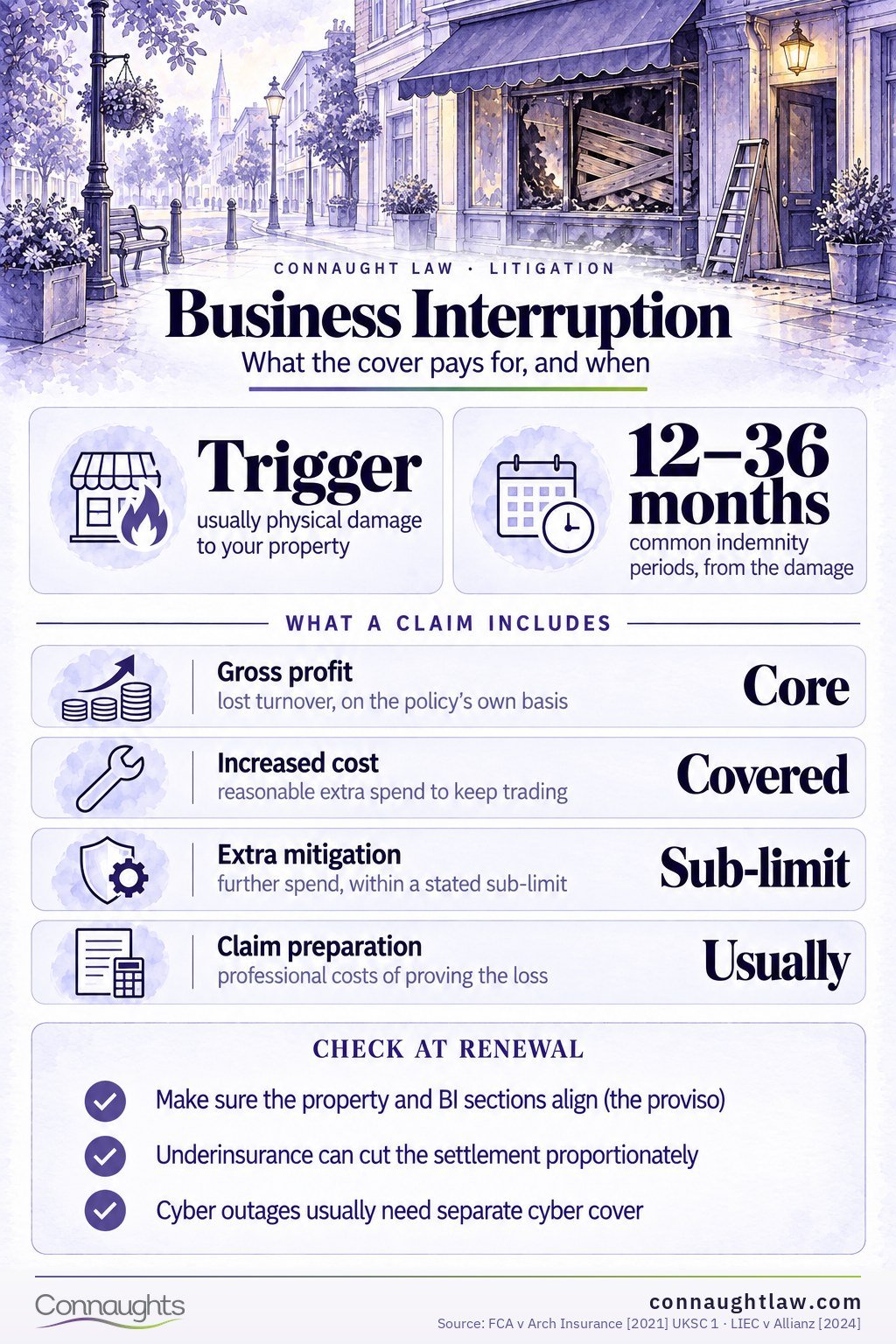
In practice a standard policy responds to four things: the loss of gross profit or revenue over the indemnity period; the increased cost of working spent to keep trading; additional increased cost of working within any policy sub-limit; and the professional fees of proving the claim. Each is measured against the policy's sums insured and the indemnity period, so the way those figures are set at renewal directly shapes what you can recover.
- Loss of gross profit: the reduction in turnover, valued on the policy's gross profit basis.
- Increased cost of working: reasonable extra spend to keep trading through the interruption.
- Additional increased cost of working: further mitigation spend, usually within a stated sub-limit.
- Claim preparation costs: professional fees for quantifying and substantiating the loss.
The Trigger: Material Damage and the Proviso
Most business interruption cover is not free-standing. It responds only when the interruption is caused by an event the policy insures against — and in the great majority of policies that means physical damage to insured property from a peril such as fire, flood, storm or escape of water. Without a valid trigger, there is nothing for the business interruption section to attach to.
This is where the material damage proviso matters. Standard wordings require that the same event has caused damage for which the property (material damage) section pays, or would pay but for a deductible. If the property claim fails — for example because the damaged item was not insured under the material damage section — the business interruption claim can fail with it, even though the trading loss is real. Checking that the two sections align is one of the most important reviews a business can carry out.
Standard Covered Perils
The perils that trigger cover mirror those in the property section: fire, explosion, storm and flood, escape of water or oil, impact, and malicious damage are typical. Some policies add wider "all risks" damage triggers. The precise list, and any excluded perils, decides whether a given interruption is covered, so the trigger wording should be read against the risks the business actually faces rather than assumed.
Policy Extensions Beyond Your Own Premises
Because disruption often starts somewhere other than your own building, policies offer extensions that widen the trigger. These usually carry their own limits and conditions, and their availability varies between insurers, so they are worth checking individually rather than assuming they are included.
Common extensions cover damage at a supplier's or customer's premises, denial or prevention of access where damage nearby stops customers reaching you, failure of public utilities such as power or water, and damage at specified locations you depend on. Notifiable-disease and "at the premises" extensions, which respond to an outbreak rather than physical damage, became the focus of the COVID-19 litigation discussed below.
Critical Extension Categories
- Suppliers and customers: loss following damage at a named or unnamed third party's premises.
- Denial or prevention of access: loss where nearby damage or an emergency blocks access to your premises.
- Public utilities: interruption caused by failure of electricity, gas, water or telecommunications.
- Notifiable disease: loss following an outbreak, subject to the specific clause wording.
Exclusions and Limitations to Check
What a policy excludes is as important as what it covers. Common exclusions and limitations turn on the trigger, the indemnity period and the sums insured, and they are the points at which otherwise valid-looking claims are most often reduced or declined.
Typical restrictions include losses with no qualifying physical-damage trigger, losses that continue beyond the indemnity period, and losses that fall foul of the material damage proviso. Wear and tear, gradual deterioration, and losses that would have occurred regardless of the insured event are generally excluded. Cyber-related interruption is increasingly carved out of traditional property-led wordings and dealt with under separate cyber cover, so businesses relying on one policy to answer a cyber outage should confirm where that risk actually sits.
Major Exclusion Categories
Read together, the main limits are: no cover without a valid trigger; no cover beyond the indemnity period; reductions for underinsurance under any average clause; and specific exclusions for cyber, contamination, or perils the property section does not insure. None of these is unusual, but each can be decisive, which is why matching the wording to the business's real exposures at renewal is the single most valuable step.
Interruption caused by a cyber-attack or IT failure is frequently excluded from standard property-led business interruption cover and addressed under a separate cyber policy. Do not assume a traditional wording will respond to a ransomware outage — confirm which policy carries the risk.
The Indemnity Period and How Long Cover Lasts
The indemnity period is the maximum length of time the policy will pay for the loss following an insured event, running from the date of the damage. It is chosen when the policy is arranged — commonly 12, 24 or 36 months — and it caps recovery regardless of how much longer the business is actually affected. If trading has not fully recovered by the end of the indemnity period, later losses fall outside the cover.
Choosing the right length is a judgement about realistic recovery, not a formality. Rebuilding premises, replacing specialist equipment, re-establishing supply chains and winning back customers can take far longer than owners expect, and a 12-month period is often too short for anything but the simplest operation. Stress-testing the indemnity period against a worst-case rebuild is one of the most useful things to review before renewal.
Factors Affecting Recovery Timeframes
How long recovery takes depends on the nature of the damage, the availability of replacement premises and equipment, planning and reinstatement timescales, and how quickly customers return. A trends clause then adjusts the settlement to reflect how the business would have performed but for the loss — accounting for growth, decline or seasonality — so the figures paid track the business's real trajectory rather than a flat historic average.
Sums Insured and Avoiding Underinsurance
Business interruption cover is priced on the declared sum insured — usually the annual gross profit, projected forward across the indemnity period. Because premiums follow the declared figure, there is a temptation to understate it, and that is where underinsurance takes hold. If the sum insured is lower than the true value at risk, an average (or condition of average) clause can reduce the payout proportionately, so a business that insured only part of its exposure recovers only part of its loss.
The declaration-linked basis is designed to reduce that risk. It asks for an accurate estimate of the coming year's gross profit and then provides an automatic uplift — commonly around a third — so genuine growth does not leave the business short, with a premium adjustment at year end. Setting the figure against current management accounts, and aligning the indemnity period with it, is the practical guard against a nasty surprise at claim time.
Coverage Calculation Best Practices
Good practice is straightforward: calculate gross profit on the policy's basis rather than the accounting definition, project it across the full indemnity period rather than a single year, review the figure annually against real accounts, and keep a broker letter or file note recording the instructions given. That record matters if the adequacy of cover is ever questioned after a loss.
If the sum insured is less than the value at risk, an average clause can cut the settlement in the same proportion as the underinsurance. Declaring gross profit accurately, on the policy's basis and across the indemnity period, is the way to avoid it.
Disputed Claims and Where the Law Now Stands
Whether a business interruption claim is paid usually turns on construction of the policy wording, and the COVID-19 pandemic produced the most significant body of case law in this area. In the FCA's test case, Financial Conduct Authority v Arch Insurance (UK) Ltd [2021] UKSC 1, the Supreme Court ruled largely in favour of policyholders on 15 January 2021, holding that qualifying disease and denial-of-access clauses could respond to pandemic losses and rejecting insurers' narrow "but for" causation arguments. The decision reshaped how non-damage extensions are read.
The law developed further for "at the premises" disease wordings. In London International Exhibition Centre plc v Allianz Insurance plc [2024] EWCA Civ 1026, the Court of Appeal held on 6 September 2024 that such clauses could also respond to COVID-19 losses; the Supreme Court refused the insurers permission to appeal in December 2024, so that ruling now stands. The practical lesson is durable well beyond the pandemic: a declined claim is not the end of the road, and coverage disputes are frequently won on careful construction of the wording. Businesses facing a refusal can challenge it, and can escalate an eligible complaint through the insurance dispute solicitors route or, where the insurer is the opponent, take advice from financial services disputes lawyers. An eligible small business can also refer the complaint to the Financial Ombudsman Service.
Frequently askedQuestions about business interruption cover
What does business interruption insurance cover in practice for UK businesses?
It covers the income a business loses when an insured event interrupts trading — principally lost gross profit and continuing fixed costs — together with the increased cost of working spent to keep the business going. Cover generally responds only once a trigger such as physical property damage is met, and pays for the indemnity period set in the policy.
What types of business interruption coverage extensions are available?
Common extensions cover loss following damage at a supplier's or customer's premises, denial or prevention of access where nearby damage blocks your premises, failure of public utilities, and, in some wordings, notifiable disease. Each carries its own limits and conditions and varies between insurers.
What does business interruption insurance typically exclude?
Typical exclusions are losses with no qualifying physical-damage trigger, losses continuing beyond the indemnity period, and losses caught by the material damage proviso. Wear and tear and gradual deterioration are excluded, and cyber-related interruption is increasingly dealt with under separate cyber cover rather than a traditional property-led policy.
How is the cost of business interruption cover worked out?
Premiums are based on the declared sum insured — usually the annual gross profit projected across the indemnity period — so the figure you declare drives both the price and what you can recover. Understating it to save premium risks an average clause reducing any payout.
What does the indemnity period mean in business interruption insurance?
It is the maximum time the policy will pay for the loss after an insured event, running from the date of damage. It is set when cover is arranged — often 12, 24 or 36 months — and caps recovery even if the business takes longer to recover, so it should reflect a realistic worst-case rebuild.
How does business interruption coverage apply to supply chain disruption?
Only where a suppliers' or customers' extension is in place. That extension responds to loss following damage at a third party's premises, usually within a separate limit, and the trigger and any named-supplier conditions must be met. Without the extension, disruption starting outside your own premises is generally not covered.
What does underinsurance mean for business interruption coverage?
Underinsurance occurs when the sum insured is less than the true value at risk. An average clause can then reduce the settlement in the same proportion, so a business that insured only part of its gross profit recovers only part of its loss. A declaration-linked basis with an automatic uplift is designed to reduce this risk.
Can a declined business interruption claim be challenged?
Yes. Many disputes turn on how the wording is construed, and the COVID-19 test cases showed that declined claims can succeed on careful construction. A refusal can be challenged directly, and an eligible business can escalate the complaint to the Financial Ombudsman Service or take legal advice on the policy.
Tell us what happened, what the policy wording says and what the insurer has offered. We’ll tell you whether the trigger and proviso are genuinely met and where the settlement is falling short.
Get Expert Advice