
Habitually resident means the place where your life is genuinely centred — where you live, work, school your children and keep your ties — assessed as a question of fact, not paperwork. The concept decides whether English courts can hear your divorce, your children case and much else besides. This guide explains the legal definition, how it differs from domicile, the evidence that proves it, and how it works for divorce jurisdiction and children after Brexit.
On This Page

Where Your Life Actually Is, as a Legal Test
Habitual residence is the law's answer to "where do you really live?" — and because it opens and closes court doors, it is argued about constantly in international families. No fixed period of residence creates it and no registration records it: courts look at the whole picture of a person's stability and integration, which makes evidence, not assertion, decisive.
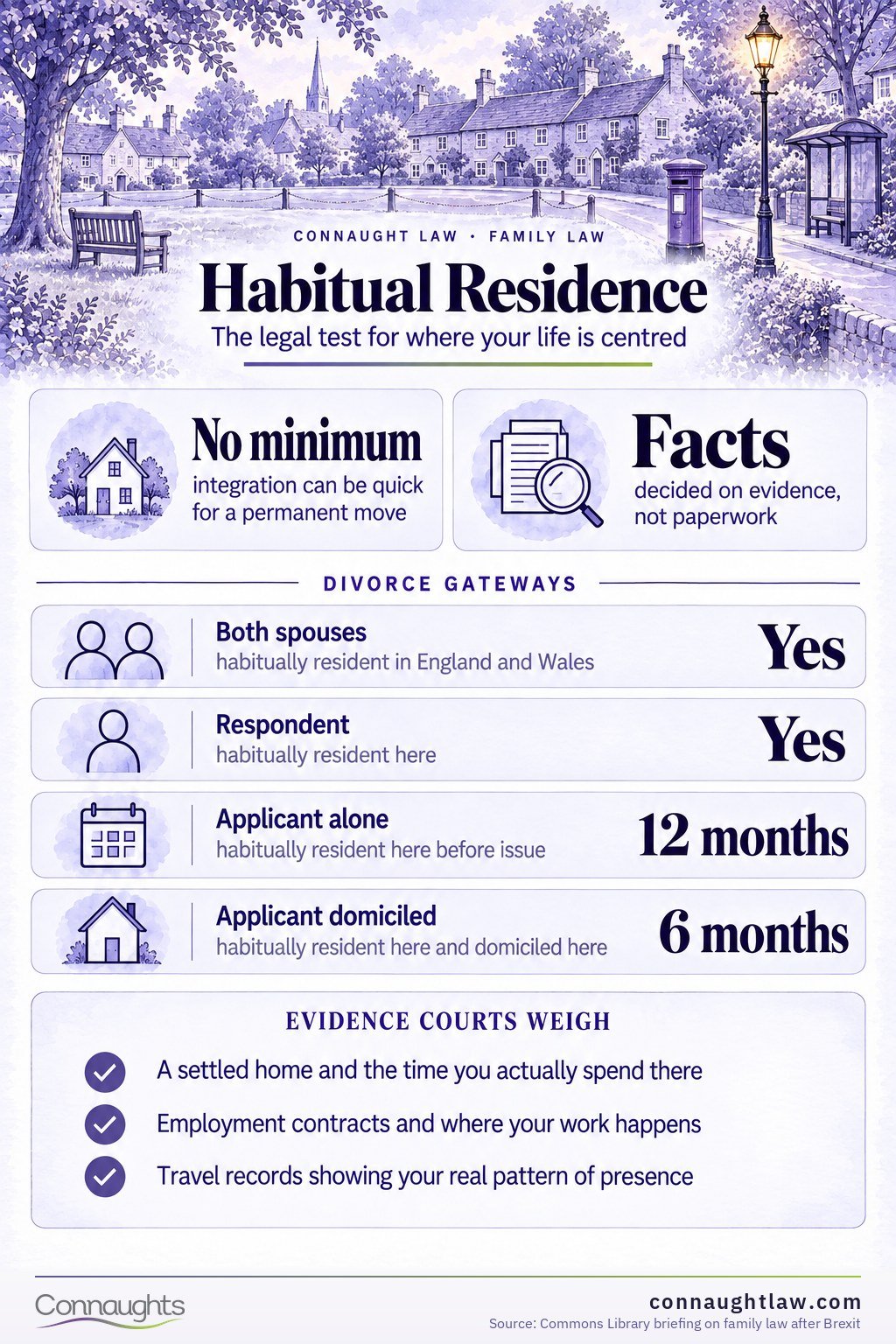
You are habitually resident where your life has its stable centre: home, work, family, schooling, finances and social ties. There is no minimum period — integration can be quick where a move is genuinely permanent — and you can hold only one habitual residence at a time for most purposes. It is a factual test the court decides on evidence.
The Legal Definition
Principles Courts Apply
The settled approach asks whether residence reflects some degree of integration in a social and family environment. Its markers: a stable home rather than temporary accommodation; the location of work or study; where children are schooled and registered with doctors; financial and administrative ties; and the intentions behind the move, weighed as facts rather than taken at face value. Presence that is temporary, forced or purely transitional — a posting explicitly ending, a holiday extended — integrates less and counts less.
Habitual Residence After Brexit
Same Concept, New Framework
Brexit replaced the EU's jurisdictional rulebook, but habitual residence survived as the workhorse concept in the domestic rules — the Commons Library briefing on family law after Brexit tracks the transition. Two practical changes matter: sole domicile now grounds divorce jurisdiction in every case, and the strict first-in-time rule for competing EU proceedings gave way to forum conveniens argument. The meaning of habitual residence itself carried over intact, with pre-Brexit case law still guiding it.
Habitual Residence and Divorce Jurisdiction
The divorce gateways are built from it: both spouses habitually resident in England and Wales, the respondent habitually resident here, or the applicant habitually resident for twelve months (six with domicile). For internationally mobile couples, where each spouse is habitually resident on the day of issue can decide which country's financial regime governs the divorce — the strategic dimension our international divorce guide develops.
When Two Courts Compete
Where both spouses could found jurisdiction in different countries, habitual residence evidence becomes the battleground: the pattern of nights, the family's base, where the children are rooted. Assembling that evidence before filing — not after the dispute erupts — is what wins forum arguments.
Domicile Is a Different Question
How the Two Diverge
Habitual residence asks where your life is now; domicile asks where your permanent home belongs in law — a stickier concept that can survive decades abroad and revives on return. An expatriate can be habitually resident in Dubai yet domiciled in England, giving English courts divorce jurisdiction through domicile alone. Tax law adds its own residence tests; do not read one regime's answer across to another.
Proving Habitual Residence
The Evidence That Decides
- Tenancy or ownership of a settled home, and time actually spent there
- Employment contracts, business ties and where the work happens
- Children's school enrolment, GP registration and clubs
- Bank accounts, tax filings and administrative registrations
- Travel records showing the pattern of presence, not just declarations of intent
Children's Habitual Residence
The Child's Own Integration
A child's habitual residence is assessed from the child's perspective — school, friendships, carers, daily rhythm — not simply inherited from either parent, and it anchors jurisdiction in children cases and the Hague abduction machinery covered in our international child arrangements guide. One parent cannot unilaterally change a child's habitual residence by wrongfully moving them: abduction does not relocate a child's legal home.
Where the Case Law Is Heading
Substance over Formality
The consistent judicial trend is factual substance over formal markers: declared intentions give way to lived patterns, hybrid and remote-working lives are assessed on where stability actually sits, and no arithmetic day-count substitutes for the integration question. For anyone whose family life spans borders, the advice writes itself — keep the records that show where your life is centred, because one day a court may ask. Note that other regimes borrow the phrase with their own rules: the benefits system's habitual residence test is a separate statutory creature from the family law concept.
Frequently askedQuestions about habitual residence
What does habitually resident mean?
The place where your life is genuinely centred — home, work, family, schooling and ties — assessed as a question of fact. It requires a degree of integration in a social and family environment, not any fixed period of residence or formal registration.
How long do you have to live somewhere to be habitually resident?
No set period. Integration can arise quickly where a move is genuinely permanent — home, job and school transplanted — and fail to arise over years of provisional presence. Courts weigh stability and integration, not a day count.
What is the difference between habitual residence and domicile?
Habitual residence is where your life is now; domicile is your permanent legal home, which can persist through decades abroad. Either can ground English divorce jurisdiction — sole domicile has been a full gateway since Brexit — and many expatriates hold one here and the other abroad.
Why does habitual residence matter in divorce?
It is the backbone of the jurisdiction gateways: whether English courts can hear the divorce turns largely on where each spouse is habitually resident at issue. For international couples that choice of forum can materially change the financial outcome.
Can a child's habitual residence change if one parent moves them?
Not by wrongful removal — abduction does not relocate a child's legal home, which is the foundation of the Hague return machinery. A child's habitual residence changes through genuine integration in a new environment, assessed from the child's own perspective.
Tell us the countries in play and how the family's time actually divides. We will assess where habitual residence sits and what evidence makes it stick.
Get Expert Advice