
When one parent is absent — uninvolved, uncontactable, or simply gone — the parent left raising the child needs to know what they can decide alone and what still legally requires the other parent. The answer turns on parental responsibility, which absence does not remove. This guide explains who holds it, the decisions you can and cannot make alone, specific issue and prohibited steps orders, and the rare routes by which parental responsibility ends.
On This Page
Absence Does Not End Parental Responsibility
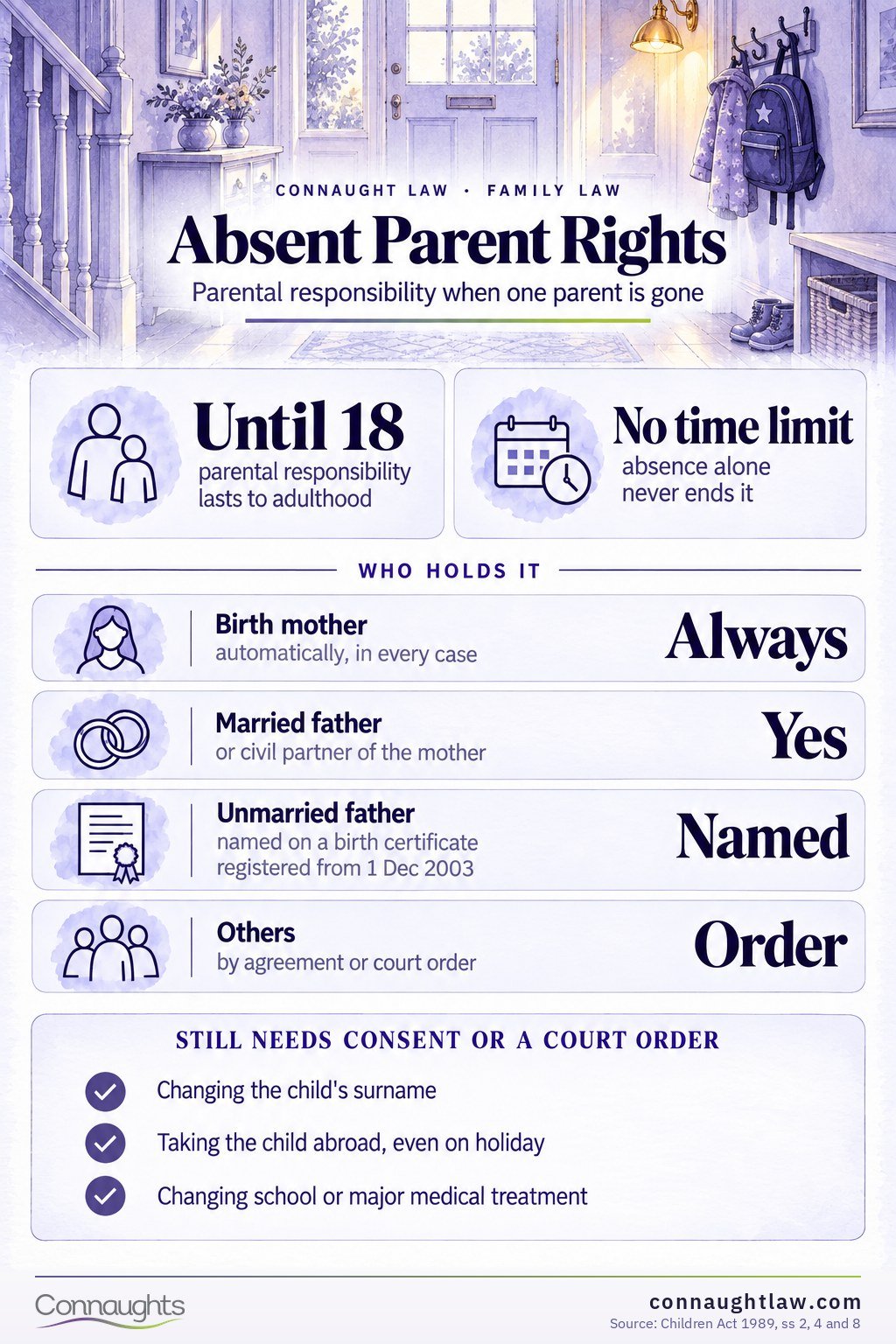
There is no rule that a father — or any parent — loses their rights after six months, a year, or any period of absence. Parental responsibility continues until the child turns 18 regardless of involvement, and only a court can remove it, in exceptional circumstances. What absence does change is the practical picture: courts increasingly let the present parent get on with day-to-day life, while the big decisions still formally require everyone with parental responsibility.
An absent parent keeps parental responsibility however long they stay away. The resident parent can make everyday decisions alone, but changing the child's surname, moving abroad, changing school and major medical choices need the other parent's consent or a court order. Courts remove parental responsibility only in exceptional cases.
Who Has Parental Responsibility
Parental responsibility is the bundle of legal rights and duties a parent holds in relation to a child — the standing to decide on schooling, medical treatment, religion, name and residence. The official guidance sets out how it arises.
How It Arises
- Every birth mother, automatically
- A father married to, or in a civil partnership with, the mother
- An unmarried father named on the birth certificate (registrations from 1 December 2003)
- By parental responsibility agreement with the mother, or by court order
- Step-parents and second female parents via agreement or order in defined cases
The Direction of Recent Reform
Parliament has been narrowing the space in which a dangerous parent can use parental responsibility as a weapon. "Jade's Law" — section 18 of the Victims and Prisoners Act 2024 — will require the Crown Court to restrict the parental responsibility of a parent convicted of murdering, or in defined cases of the manslaughter of, the other parent, through a prohibited steps order made at sentencing.
For murder the duty is absolute; where the conviction is for manslaughter the court may decline if it would not be in the interests of justice to make the order. It is not yet in force: the government has committed to implementation by the end of December 2026, and the Victims and Courts Bill before Parliament would extend restrictions to parents convicted of serious sexual offences against children.
Deciding Alone When the Other Parent Is Absent
The everyday running of a child's life — meals, bedtimes, friendships, routine healthcare, ordinary school matters — belongs to the parent the child lives with, and no consent is needed. The law reserves a short list of major decisions for everyone with parental responsibility together.
The Decisions That Still Need Consent
Changing the child's surname, removing the child from England and Wales (even for a holiday), significant elective medical treatment, and a change of school all require the agreement of everyone with parental responsibility, or a court's permission. Where the absent parent cannot be found, document your attempts to contact them — the court will want to see them before dispensing with consent.
Schools and the Absent Parent
Schools owe information rights to everyone with parental responsibility: an absent parent can request reports and be consulted on admissions, however uninvolved they are. In practice schools follow the resident parent's day-to-day instructions, and a school faced with parental conflict will ask for a court order rather than adjudicate it.
Specific Issue Orders: Getting a Decision Made
Where a major decision is blocked — the other parent objects, or simply cannot be found — a specific issue order under section 8 of the Children Act 1989 asks the court to decide that single question: the school move, the surname, the vaccination, the trip abroad. The child's welfare governs the answer.
What Courts Are Asked to Decide
The recurring applications are school choice, surname change, relocation within the UK, foreign travel and holidays, medical treatment, and religious upbringing. For an absent parent who cannot be traced, the order effectively substitutes the court's consent for theirs, unblocking passports and school admissions.
How the Application Runs
You apply on form C100 — the fee is £270 from 13 July 2026 — after a mediation information meeting unless an exemption applies, and the court applies the welfare checklist with Cafcass safeguarding checks. Evidence of your attempts to consult the absent parent, and of why your proposal serves the child, does the heavy lifting.
Prohibited Steps Orders: Stopping a Harmful Step
The mirror image of a specific issue order, a prohibited steps order forbids a parent from taking a defined step — removing the child from the country, changing their school, relocating them — without the court's consent. It is the emergency brake where an absent parent resurfaces threatening disruption, and it can be obtained urgently, without notice, where the risk justifies it.
Ending Parental Responsibility: the Exceptional Cases
Courts guard parental responsibility jealously, because it belongs to the child's welfare, not the parents' feelings. A mother's parental responsibility cannot be terminated at all short of adoption. A father's can be removed by court order, but only in exceptional circumstances — the reported cases involve serious violence or sexual offending against the child or the other parent.
Jade's Law: Restriction at Sentencing
Once in force, section 18 of the Victims and Prisoners Act 2024 will make restriction automatic where one parent is convicted of murdering the other: the sentencing Crown Court must make a prohibited steps order preventing the offender exercising parental responsibility, subject to review by the family court. Until commencement — promised by the end of December 2026 — families in this position still apply to the family court in the ordinary way.
What "Exceptional" Looks Like in the Case Law
The reported removals share a pattern: proven serious harm, no ongoing positive role for the parent in the child's life, and a real continuing risk if the legal status remains. Absence alone — even total, lifelong absence — has never met the test. A parent cannot "sign away" responsibility either; there is no form for voluntarily surrendering it, and courts refuse to treat children as obligations a parent can resign.
Applying to Remove or Restrict PR
An application to terminate or restrict parental responsibility is issued in the family court with evidence of the harm relied on — convictions, findings of fact, medical and police records. Where termination is unavailable or refused, a package of section 8 orders can achieve most of the same protection in practice: the child's arrangements, school and travel can all be locked by order. Our children team advises on which combination fits.
Money Is Separate: Maintenance Survives Everything
Removing or restricting parental responsibility does not end financial liability. Child maintenance is owed by parents as parents, through the Child Maintenance Service formula, whether or not they hold parental responsibility or ever see the child.
Frequently askedQuestions about absent parents and parental responsibility
How long does a father have to be absent to lose his rights in the UK?
There is no such period. Parental responsibility does not lapse through absence — six months, five years or a lifetime. It ends only by court order in exceptional circumstances, or adoption. What long absence does affect is the weight a court gives that parent's views in any dispute.
Does an absent father still have parental responsibility?
Yes, if he ever had it — through marriage to the mother, being on the birth certificate (from December 2003), an agreement or a court order. Absence does not remove it, so his consent is still legally required for major decisions such as a name change or moving abroad.
Can a father voluntarily give up his parental rights?
No. There is no form or procedure for surrendering parental responsibility in England and Wales. Courts refuse to end it by consent because it exists for the child's benefit. Only a court order in exceptional circumstances, or adoption, ends it — and financial liability survives even then.
What decisions can I make alone if the other parent is absent?
Everything day to day: routine schooling, ordinary medical care, activities, diet and home life. You cannot alone change the child's surname, take them to live abroad, make major elective medical decisions or change their school — those need consent from everyone with parental responsibility, or a court order.
What is Jade's Law and is it in force?
Section 18 of the Victims and Prisoners Act 2024 will require the Crown Court to restrict the parental responsibility of a parent convicted of murdering the other parent, by a prohibited steps order at sentencing. It is not yet in force; the government has committed to implementing it by the end of December 2026.
How do I get a decision unblocked if I cannot contact the other parent?
Apply for a specific issue order on form C100 (£270), evidencing your attempts to reach them. The court can dispense with the absent parent's consent and decide the school, travel or name question on the child's welfare. Urgent cases can be heard quickly.
Tell us the decision you need to make and what contact you have attempted. We will tell you whether you can proceed alone or which order unblocks it.
Get Expert Advice