
Cafcass — the Children and Family Court Advisory and Support Service — is the independent body that advises the family courts in England about children's welfare. If you are in children proceedings, Cafcass will almost certainly touch your case: safeguarding checks before the first hearing, and often a fuller report afterwards. This guide explains what Cafcass is, when it gets involved, how its assessments work, and how it differs from social services.
On This Page

The Voice of the Child in Family Proceedings
Cafcass exists to put children's interests — not either parent's case — before the court. Its officers are qualified social workers who assess families, listen to children, and advise judges on what arrangements will be safe and in the child's interests. Judges are not bound by Cafcass recommendations, but they follow them more often than not, which is why understanding the process matters to any parent in proceedings.
Cafcass gets involved automatically when a children application is issued: it runs police and social services checks and sends the court a safeguarding letter before the first hearing. Where welfare issues need deeper assessment, the court orders a section 7 report — the officer meets parents and child, then recommends arrangements.
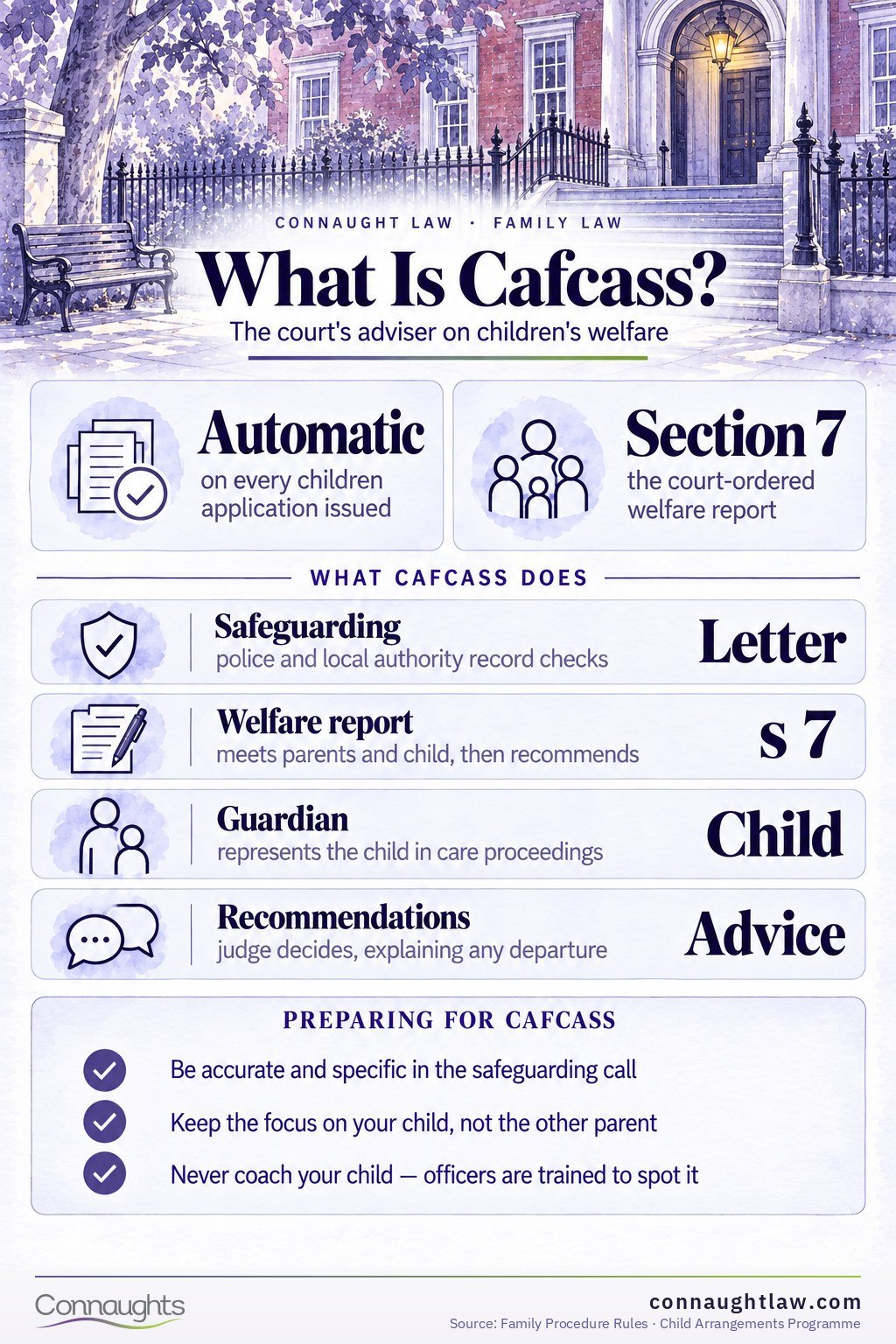
What Cafcass Is
Status and Remit
Cafcass is a non-departmental public body sponsored by the Ministry of Justice, independent of the courts, social services and the parties. It operates in England only — Wales has Cafcass Cymru — and works exclusively within family proceedings, under the framework of the Family Procedure Rules' Child Arrangements Programme.
The Officers
Family Court Advisers are qualified, registered social workers. Different roles attach to different proceedings: in private disputes between parents they safeguard and report; in care proceedings a children's guardian represents the child directly, instructing the child's solicitor.
What Cafcass Does
Core Functions
- Safeguarding checks and letters before first hearings in children cases
- Welfare reports (section 7) analysing what arrangements serve the child
- Representing children through guardians in care and complex private cases
- Advising on specific issues — dispute resolution, contact activities, enforcement
Where You Will Meet It
Private law: disputes between parents over living arrangements and time, including enforcement applications. Public law: care and supervision proceedings brought by a local authority, where the guardian role is central. Cafcass also assesses in adoption and in cases involving abuse allegations, where its safeguarding work feeds the court's decision on fact-finding.
When and How Cafcass Gets Involved
Involvement Is Court-Driven
Parents do not hire Cafcass and cannot opt out of it: involvement begins when an application is issued, and its depth is set by the court. Every C100 application triggers the safeguarding stage; anything further — a section 7 report, guardian appointment — happens because a judge orders it.
The Safeguarding Stage
Before the first hearing the officer checks police and local authority records for both adults and speaks to each parent by phone about safety issues. The result is a safeguarding letter to the court flagging any risk issues and recommending next steps. Be accurate and specific in that call — it is the court's first impression of the case.
Assessments and Reports
The Safeguarding Letter
The letter tells the court whether the case can safely proceed to agreement-focused hearings or needs risk management first — screens, separate waiting rooms, a fact-finding hearing, or local authority involvement. Where domestic abuse or harm features, Cafcass's published policies govern how it assesses impact on the child.
Section 7 Reports
A section 7 report is the deep assessment: the officer meets each parent, sees the child — usually at home or school, in age-appropriate ways — and may speak to teachers or health professionals. The report analyses the welfare checklist and ends with recommendations about where the child should live and what time they should spend with each parent. Engage openly, keep the focus on the child rather than the other parent's failings, and never coach the child: officers are trained to spot it, and it rebounds.
How Much Weight Recommendations Carry
Judges must consider the report but decide for themselves; where a court departs from a clear Cafcass recommendation it explains why. In practice most final orders track the report substantially, so the assessment period — not the final hearing — is where many cases are really decided.
Cafcass and Social Services Are Not the Same
Different Jobs, Different Powers
Cafcass advises courts within proceedings; it provides no ongoing services and has no power to remove children or start protection proceedings. Social services — the local authority — carry the statutory child protection duties, act outside court proceedings, and can bring care applications. A family can be involved with both at once, in different capacities.
How They Share Information
Cafcass checks always include local authority records, and its safeguarding letter can prompt a referral the other way where its checks reveal protection concerns. In care proceedings the two work in structured tension: the authority proposes a plan, the Cafcass guardian scrutinises it for the child. Our children team prepares parents for both relationships — and for the difference between them.
Frequently askedQuestions about Cafcass and its assessments
What is Cafcass and what does it stand for?
The Children and Family Court Advisory and Support Service — the independent public body that advises family courts in England on children's welfare in proceedings. Its officers are qualified social workers; Wales has its own service, Cafcass Cymru.
When do Cafcass get involved?
Automatically, once a children application is issued: they run safeguarding checks and write to the court before the first hearing. Deeper involvement — a section 7 report or a children's guardian — happens only when the court orders it. Parents cannot instruct or dismiss Cafcass.
What is a section 7 report?
A welfare report ordered by the court where arrangements are disputed. The Cafcass officer meets the parents, sees the child in an age-appropriate way, may consult school and health professionals, and recommends arrangements against the welfare checklist. Courts usually follow it substantially.
Do judges always follow Cafcass recommendations?
No — the decision is the judge's, and courts departing from a clear recommendation must explain why. In practice recommendations carry substantial weight, which makes engaged, child-focused participation in the assessment one of the most important stages of any case.
What is the difference between Cafcass and social services?
Cafcass advises courts inside proceedings and cannot remove children or provide services. Social services hold the statutory protection duties, work with families outside court, and can bring care proceedings. In care cases the Cafcass guardian independently scrutinises the local authority's plan.
How should I prepare for Cafcass involvement?
Be accurate in the safeguarding call, engage openly with any assessment, keep every conversation focused on your child's needs rather than the other parent's faults, and never coach your child. Officers assess insight and child-focus as much as facts.
Tell us where your proceedings have got to and what the safeguarding letter said. We will prepare you for the assessment and keep the case pointed at your child's interests.
Get Expert Advice