
A parenting plan is a written agreement between separated parents recording how you will raise your children — where they live, when they see each parent, and how decisions get made. It is not automatically legally binding, but it is the cheapest, quickest route to workable arrangements, and the courts expect you to have tried one. This guide covers what a plan should include, its legal status, and how to make one stick.
On This Page

A Written Agreement Instead of a Court Order
Most separated parents never need a judge to decide their children's arrangements. A parenting agreement — usually called a parenting plan — lets you settle the practical questions yourselves, in your children's interests, without the delay and cost of proceedings. Courts actively expect it: before most children applications you must attend a mediation information meeting, and a judge will ask what you agreed and why it failed.
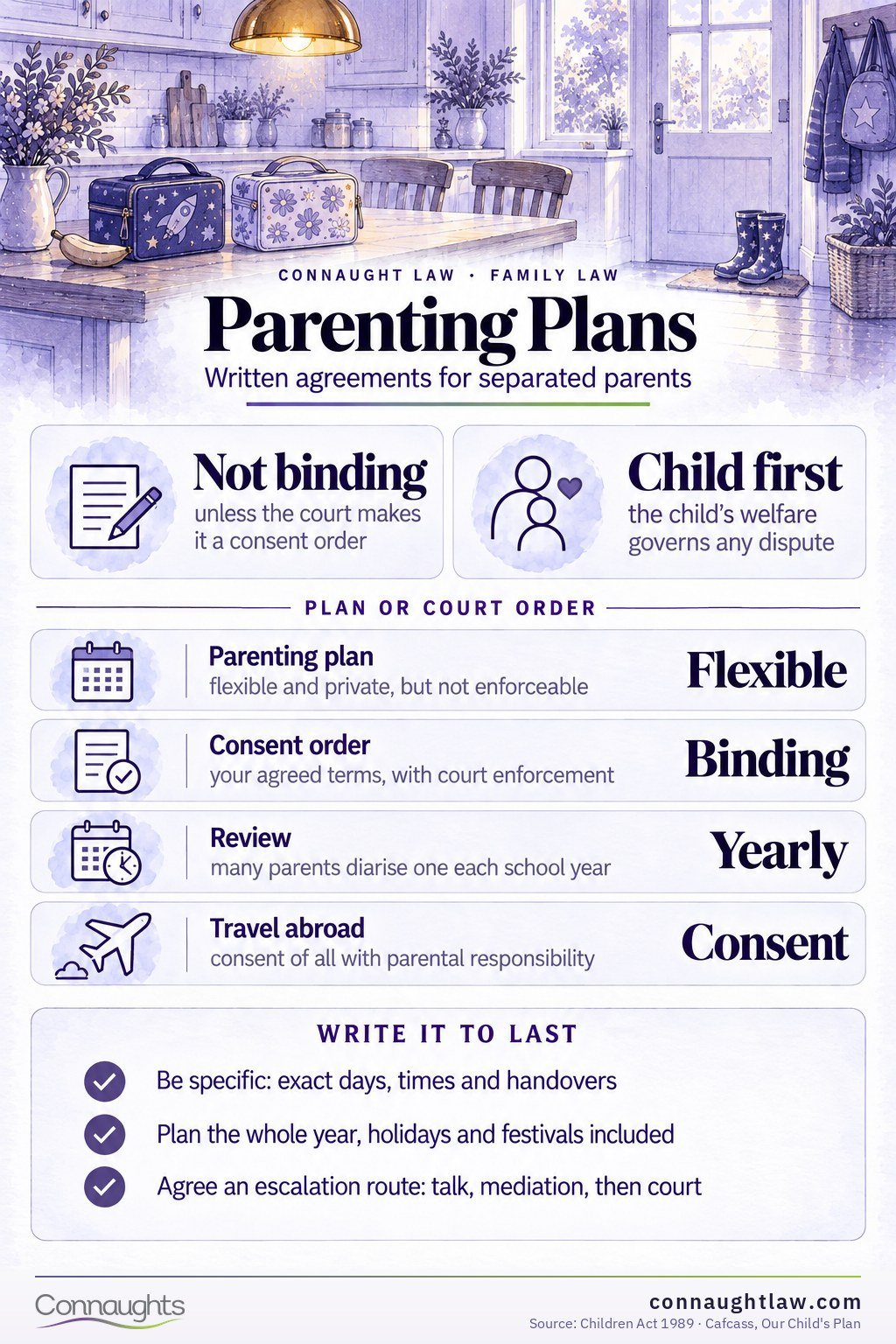
A parenting plan is not legally binding on its own. It becomes enforceable only if turned into a consent order by the court. In practice its force is real anyway: it evidences what both parents accepted as workable, and a parent who walks away from a sensible plan starts on the back foot in any later proceedings.
What a Parenting Plan Covers
A good plan answers the questions that otherwise cause the arguments: the living schedule and handovers; school-holiday and special-occasion arrangements; how school, health and religious decisions are made; communication between homes; introducing new partners; and how you will resolve disagreements before they escalate. The more precisely the flashpoints are written down, the less there is to fight about later.
The Cafcass Parenting Plan Template
You do not need to draft from a blank page. Cafcass publishes a free plan — now called Our Child’s Plan, formerly the Parenting Plan — that works through the decisions section by section, in the order courts think about them. It is completed online, with a Word version for anyone who cannot use the tool. Using it has a second advantage: if proceedings ever follow, a completed Cafcass plan shows the court you approached arrangements child-first.
Legal Status: Plan Versus Court Order
The two routes do different jobs. A plan is flexible, private and free; an order is enforceable, fixed until varied, and costs a £270 application fee (from 13 July 2026) plus any legal costs. Turning an agreed plan into a consent order gives you both — the terms you chose, with the court's enforcement powers behind them — and is worth considering where trust is thin or the stakes are high.
The Children Act 1989 Framework Behind the Plan
Plans operate in the shadow of the law. The Children Act 1989 gives both parents with parental responsibility an equal say in major decisions, and the welfare of the child — not fairness between adults — governs any dispute a court decides. The "no order" principle works in your favour: courts only make orders where an order would be better for the child than no order, which is precisely why a working plan keeps you out of court.
Writing a Plan That Actually Works
- Be specific: "alternate weekends, Friday 5pm school pickup to Sunday 6pm" beats "regular contact"
- Plan the whole year — term time, holidays, birthdays, religious festivals — not just ordinary weeks
- Build in the child's voice, age-appropriately, and revisit as they grow
- Agree a communication channel and tone; many parents fix a weekly written update
- Write the escalation route: talk, then mediation, then court as the last resort
Reviewing and Changing the Plan
Children outgrow schedules. Build a review into the plan itself — many parents diarise one each school year — and treat changes as expected rather than as betrayals. Where change talks fail, mediation is the next room, not court: the £500 family mediation voucher scheme supports child-arrangement mediations, and a mediated update costs a fraction of proceedings.
Travel and International Family Life
If one parent has family abroad, write foreign holidays into the plan: notice periods, consent letters, and copies of travel documents. Taking a child abroad needs the consent of everyone with parental responsibility — even for a holiday — unless a court order says otherwise, and our guide to international child arrangements covers relocation and abduction risks in detail.
When the Plan Starts Breaking Down
Most breakdowns are practical, not malicious — new jobs, new partners, a child pushing back against the schedule. Return to the plan's own dispute route first, and put proposals in writing. If the other parent simply stops honouring the arrangements and mediation fails, the remaining options are applying for a child arrangements order, or — where an order already exists — enforcement.
Special Situations
Plans flex to fit real families: shift-working parents can build rolling rotas; parents far apart can weight term time to one home and holidays to the other; and plans can cover step-siblings' schedules, a child's additional needs, or supervised handovers where trust has broken. Where there has been domestic abuse, a private agreement may not be safe or appropriate — take advice before negotiating directly, and note that child maintenance runs on its own statutory track separate from any plan.
Frequently askedQuestions about parenting agreements and their legal force
Is a parenting plan legally binding in the UK?
Not by itself. It becomes legally enforceable only when the court approves it as a consent order. Even unconverted, it carries weight: it records what both parents accepted as workable, and courts notice who honoured it and who walked away.
What should a parenting agreement include?
The living and contact schedule with exact times and handovers, holiday and special-occasion arrangements, how major decisions on school and health are made, communication rules between homes, arrangements for travel abroad, and an agreed route for resolving disagreements — normally discussion first, then mediation.
Do the courts expect us to try a parenting plan first?
Effectively yes. Before most children applications you must attend a mediation information and assessment meeting, and judges apply the no-order principle — they only impose an order where it would serve the child better than no order. A working agreement usually means no proceedings at all.
Can we change our parenting plan later?
Yes, by agreement at any time — plans are meant to evolve as children grow. Put changes in writing and date them. If you cannot agree, mediation is the next step, supported by the £500 family mediation voucher for child-arrangement cases.
What if the other parent ignores our parenting plan?
A plan itself cannot be enforced, so the route is mediation and, failing that, applying for a child arrangements order reflecting the plan's terms. Once an order exists, breaches can be enforced through the court on form C79.
Tell us what you have agreed and where the friction is. We will tell you whether a consent order is worth it and draft terms that survive contact with real life.
Get Expert Advice