What is Child Maintenance UK 2026: Complete Legal Guide & Coverage Breakdown

Child maintenance is the regular financial contribution the parent a child does not usually live with makes towards the child’s everyday living costs. Most separated parents arrange it privately; where they cannot, the Child Maintenance Service (CMS) calculates a binding figure using fixed percentage rates of the paying parent’s gross income. This guide explains exactly what child maintenance covers, the 2026 CMS rates and how nights of shared care change the figure, what the service costs to use, the enforcement powers behind unpaid maintenance, and the significant reforms announced in June 2025 that will reshape how payments are collected from 2027.

Understanding What Child Maintenance Is in the UK

When parents separate, both remain financially responsible for their children - the responsibility follows the child, not the relationship. Child maintenance is how the law expresses that duty in money: a regular payment from the parent the child spends less time with (the paying parent) to the parent or carer who provides the child’s main home.

The obligation exists whether or not the parents were married, whether or not the paying parent sees the child, and regardless of who ended the relationship. Maintenance and contact are legally independent: time with a child can never be conditioned on payment, and payment cannot be withheld because contact has broken down.

Three routes exist for setting the amount: a private family-based arrangement, a CMS statutory calculation, or - in limited cases - a court order. Around half of separated families use private arrangements, which cost nothing and flex easily, but only CMS calculations and court orders are enforceable if payments stop.

A family-based arrangement can be as simple or as detailed as parents want: a fixed monthly sum, direct payment of specific costs such as childcare or school uniform, or a mix of both. Nothing needs approving or registering. The sensible practice is to write the agreement down, review it annually, and use the official gov.uk child maintenance calculation guidance as the reference point both parents can accept as neutral.

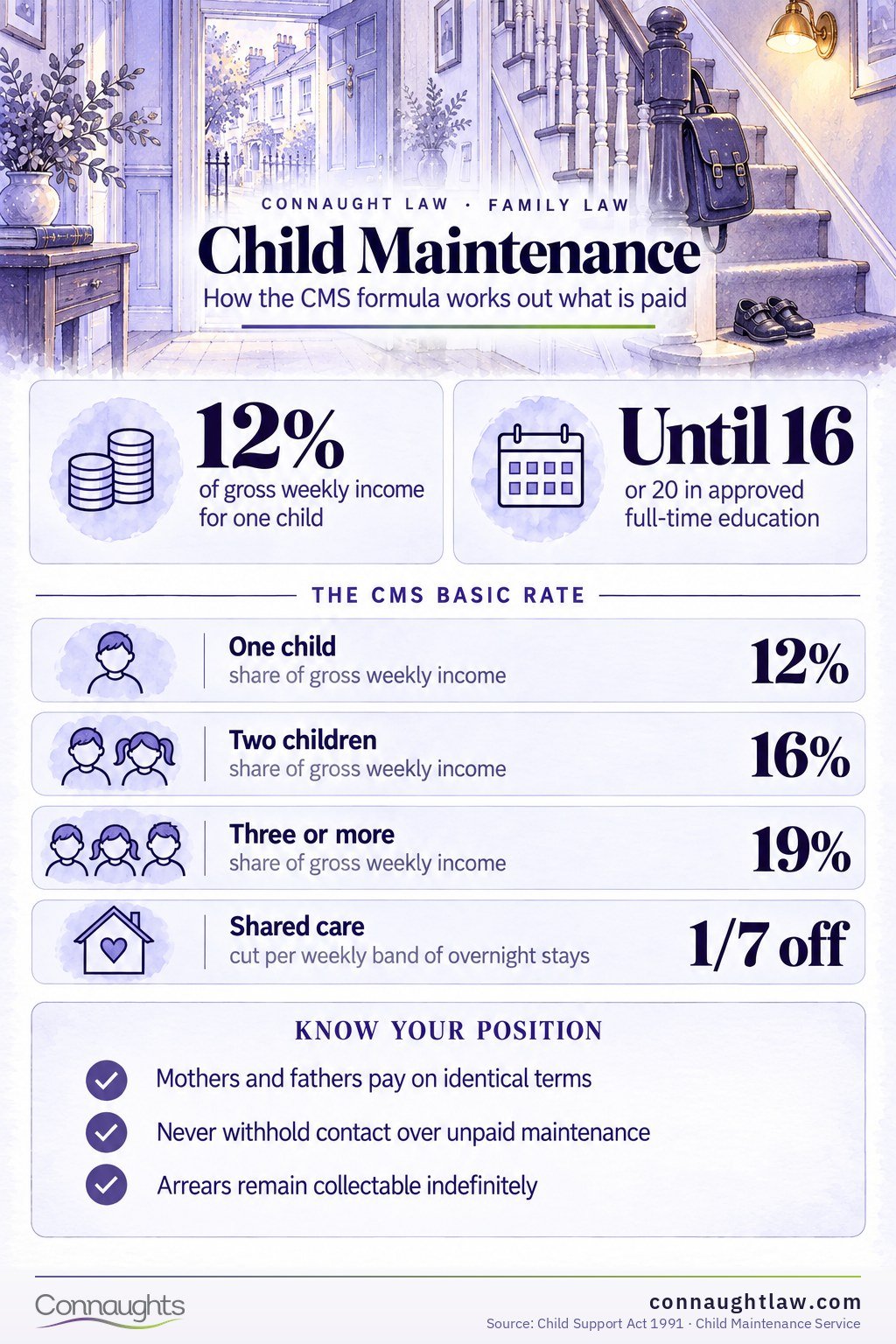
Child Maintenance Uk Infographic — Cms Rate Bands By Gross Weekly Income With Shared Care Reductions And The £3,000 A Week Cap

What Is Child Maintenance - Complete Definition 2026

Legally, child maintenance is the financial support payable for a "qualifying child" under the Child Support Act 1991 - a child under 16, or under 20 in full-time non-advanced education such as A-levels or equivalent training. Payments normally continue until the child finishes that education or Child Benefit entitlement ends.

The paying parent is the "non-resident parent" in the legislation; the receiving parent or grandparent, guardian or other carer provides the child’s main day-to-day home. Where care is shared exactly equally and both parents claim equal status, the CMS may decide neither parent is liable to the other.

What Child Maintenance Is Not

Child maintenance is separate from spousal maintenance, which supports a former spouse in their own right after divorce. It is also separate from the capital and property claims that can be made for a child under Schedule 1 of the Children Act 1989 - housing provision, lump sums for specific needs, and school fees orders sit outside the CMS formula entirely.

The statutory definition matters because it fixes who can use the CMS at all. Step-parents have no CMS liability for step-children, however long the family lived together, although courts can take a step-parent’s assumed responsibility into account in divorce financial proceedings. Biological parentage disputes are resolved through DNA testing arranged by the CMS - a parent who denies parentage pays for the test and is refunded if proved right.

Timing also matters at the start of a case. Liability under a CMS calculation runs from the effective date of the application, so delaying an application costs money that cannot be recovered later - there is no power to backdate to the date of separation. Parents relying on a family-based arrangement in the meantime should record what was paid, since informal payments before a CMS application do not create arrears credits automatically.

What Does Child Maintenance Cover - Everyday Costs Explained

Maintenance is a contribution to the ordinary costs of raising a child: housing, food, clothing, utilities, school essentials, transport and activities. The law does not itemise how a receiving parent spends it, and the CMS will not audit spending - the formula assumes the money supports the household in which the child lives.

Paying parents sometimes object that maintenance subsidises the other parent’s lifestyle. The legal answer is that a child’s standard of living cannot be separated from the home they live in - heating the house and running the car benefit the child even though the parent benefits too.

How the money interacts with the wider settlement matters too. Child maintenance runs alongside - never instead of - the property and pension division dealt with in financial orders on divorce, and it is entirely separate from spousal maintenance, which compensates a former spouse rather than supporting a child.

Costs Outside the Standard Calculation

Some expenses fall outside the basic formula. School fees can be ordered by a court, not the CMS. Costs of a child’s disability can justify a maintenance variation. Where the paying parent’s gross income exceeds the CMS cap of £3,000 per week, the receiving parent can apply to court for top-up maintenance above the statutory maximum.

Child Maintenance Law UK - Framework and 2026 Reform Direction

The statutory scheme sits in the Child Support Act 1991, heavily amended and now administered by the CMS within the Department for Work and Pensions. The current "2012 scheme" bases calculations on gross taxable income reported to HMRC, updated annually, with variations available for unearned income, notional income from assets, and special expenses.

Variations cut both ways. A receiving parent can ask the CMS to add unearned income - rent, dividends, significant savings interest - or notional income where assets over £31,250 sit producing nothing, and to look again where income appears deliberately diverted through a company. A paying parent can claim special expenses for contact travel costs, supporting other children, or servicing debts from the relationship. The full statutory machinery sits in the Child Support Act 1991.

Since February 2024 there has been no fee to apply to the CMS. Two service levels currently exist: Direct Pay, where the CMS calculates and parents transfer money between themselves free of charge, and Collect and Pay, where the CMS collects and passes on payments - charging the paying parent 20% on top and deducting 4% from the receiving parent.

The June 2025 Reforms: What Changes From 2027

Following consultation, the government confirmed in June 2025 that the service will be restructured in 2027-28. Direct Pay will be abolished: compliant cases will be encouraged towards family-based arrangements, while all other cases move onto Collect and Pay with a reduced 2% fee on each side. Non-compliant paying parents will continue to face the 20% collection charge.

The government response published in June 2025 frames the change as removing the hiding place that Direct Pay gave to quiet non-compliance - around half of Direct Pay arrangements were not paid in full and on time, but the CMS had no visibility of the shortfall until the receiving parent complained.

Key 2026 Position: Applying to the CMS is free. Direct Pay remains available and fee-free until the 2027-28 reforms take effect. Collect and Pay currently costs the paying parent an extra 20% and the receiving parent 4% of each payment. CMS rates themselves are unchanged: 12%, 16% and 19% of gross weekly income at the basic rate for one, two and three or more children.

CMS Calculation Methods and Current Rates 2026

The CMS starts with the paying parent’s gross weekly income - before tax and National Insurance, but after pension contributions - drawn from the latest HMRC tax-year information. The applicable rate then depends on the income band.

Because the figure is anchored to HMRC data, calculations are reviewed annually against the latest tax year and adjusted. Mid-year, either parent can request a recalculation where actual income has moved at least 25% from the figure in use - a threshold that catches redundancy and significant promotions but deliberately ignores smaller fluctuations. Pension contributions reduce the income counted, which is legitimate planning up to a point, but excessive contributions can be challenged as income diversion.

On income up to £100 a week, or where the paying parent receives certain benefits, a flat rate of £7 a week applies. Below £7 a week, nothing is payable. Between £100.01 and £199.99 a reduced rate phases in. The basic rate applies from £200 to £800: 12% for one child, 16% for two and 19% for three or more. Income between £800.01 and £3,000 attracts the lower "basic plus" percentages of 9%, 12% and 15% on that top slice.

How Shared Care Reduces Child Maintenance

Overnight care changes the figure. Between 52 and 103 nights a year, maintenance drops by one-seventh per child; 104 to 155 nights brings a two-sevenths reduction; 156 to 174 nights three-sevenths; and at 175 nights or more the reduction is half, plus a further £7 a week per child. The paying parent’s liability also reduces where other children live in their household.

Nights are counted from actual patterns, usually over the past twelve months, and disputes about them are common because the financial effect is real. Keeping a simple care diary aligned with any order or parenting plan avoids most arguments - the same evidence that matters in child living arrangements disputes.

Worked Example: Child Maintenance for Two Children

A paying parent grossing £600 a week with two children and 60 nights of care a year pays the basic rate of 16% - £96 - reduced by one-seventh for shared care, roughly £82 a week. The same parent earning £1,200 a week pays 16% of £800 plus 12% of the £400 above it, around £176 before any shared-care reduction.

Where the paying parent’s circumstances genuinely will not fit the formula - fluctuating self-employed profits, income taken as dividends, or complex benefit interactions - early advice pays. The difference between an unchallenged default calculation and one corrected through variation or appeal can amount to thousands of pounds a year in either direction.

Child Maintenance Court Orders and Enforcement Powers

Courts now play a limited role in routine maintenance. Consent orders can record agreed maintenance on divorce, but either parent can usually apply to the CMS once the order is a year old. Courts retain exclusive jurisdiction for top-up awards above the £3,000 weekly cap, school fees, disability costs, maintenance for children abroad, and Schedule 1 capital claims.

The twelve-month rule deserves emphasis because it surprises many divorcing parents: however carefully child maintenance is negotiated into a consent order, its protection is temporary. After a year, either parent can override the agreed figure by applying to the CMS, whose formula then displaces the order. Settlements are therefore usually structured so that capital and spousal elements do not depend on the child maintenance figure holding.

Where CMS arrears build up, enforcement is administrative first: deduction from earnings orders take maintenance straight from salary, and deduction orders reach bank accounts directly - including, since 2018, joint and business accounts. Unpaid amounts can be secured against property through liability orders and charging orders.

Persistent non-payment escalates further. The CMS can apply to disqualify a non-payer from driving or holding a passport for up to two years, and committal to prison remains the final sanction. Curfew orders were added to the toolkit under the Child Support (Enforcement) Act 2023 framework as commencement provisions are brought into force.

Decisions can also be challenged rather than just enforced. The route is mandatory reconsideration by the CMS first, then appeal to the First-tier Tribunal on calculation issues such as income figures, shared-care bands or variation refusals. Time limits are short - one month from the decision as standard - so parents who believe a calculation is wrong should act quickly rather than simply stopping payment.

International Child Maintenance and REMO Procedures

A parent moving abroad does not escape the obligation. The CMS itself can only assess paying parents habitually resident in the UK - or working abroad for UK employers, the civil service or armed forces - so cross-border cases rely on the Reciprocal Enforcement of Maintenance Orders (REMO) network instead.

Under REMO and the 2007 Hague Convention, a UK maintenance order can be registered and enforced in over 100 partner jurisdictions, and incoming foreign orders are enforced here. Applications are made free of charge through the REMO unit, though realistic timescales run to months and local enforcement quality varies by country.

Applying to the CMS itself is straightforward: contact Child Maintenance Options for a reference number, then apply online or by phone with both parents’ details and the children’s. A first calculation typically follows within a few weeks once the paying parent is traced and HMRC income is retrieved, with payments scheduled from the effective date of the application - not backdated to separation.

Where no reciprocal arrangement exists, a fresh maintenance claim may need to be issued in the country where the paying parent lives, usually with local legal advice. Preserving evidence of income and keeping UK orders up to date makes registration abroad considerably smoother.

Separated parents juggling maintenance alongside everything else can also draw on practical support: the single-parent charity Gingerbread runs a specialist helpline on child maintenance problems, and Child Maintenance Options remains the official gateway for understanding the choice between private arrangements and the statutory service.

Frequently Asked Questions

How much is child maintenance in the UK in 2026?

At the basic rate the paying parent pays 12% of gross weekly income for one child, 16% for two and 19% for three or more, on income between £200 and £800 a week. A lower 9%, 12% and 15% applies to income between £800.01 and £3,000 a week, and shared care nights reduce the figure.

Until what age is child maintenance paid?

Until the child turns 16, or up to 20 while they remain in full-time non-advanced education such as A-levels or approved training. University education does not extend statutory child maintenance, though courts can order support for students in some circumstances.

Does the CMS charge fees in 2026?

Applying is free. Direct Pay costs nothing to use. Collect and Pay currently adds 20% to what the paying parent owes and deducts 4% from what the receiving parent gets. From 2027-28 the announced reforms replace this with a 2% fee each side, keeping 20% only for non-compliant payers.

Do I still pay child maintenance if I never see my children?

Yes. The obligation arises from parentage, not contact. Equally, a parent cannot be refused contact because they have not paid - the two are legally separate, and courts take a dim view of linking them.

What happens if my ex refuses to pay child maintenance?

Move the case to Collect and Pay. The CMS can deduct from earnings or bank accounts, secure arrears against property, and apply to remove driving licences or passports for up to two years. Committal to prison is the last resort. Court-ordered maintenance is enforced through the family court instead.

Can child maintenance be changed after it is set?

Yes. The CMS reviews calculations annually against HMRC income data, and either parent can report a change of more than 25% in income mid-year. Changes in overnight care, additional children, or special expenses such as contact travel costs can also justify a recalculation or variation.

What if the paying parent earns more than £3,000 a week?

The CMS calculation is capped at £3,000 gross weekly income. Above that, the receiving parent can apply to the family court for top-up maintenance, and courts can also order school fees and additional support under Schedule 1 of the Children Act 1989.

Is child maintenance taxable or does it affect benefits?

No. Child maintenance is neither taxable income for the receiving parent nor tax-deductible for the paying parent, and received maintenance does not reduce Universal Credit or other means-tested benefits.

Expert Legal Support
Maintenance Advice

Clear guidance on CMS calculations, variations and top-up claims above the cap.

Enforcement Action

Practical routes when payments stop - from Collect and Pay to court enforcement.

Cross-Border Cases

REMO registration and international enforcement when a parent lives abroad.

For advice on child maintenance calculations, arrears or Schedule 1 claims, contact the family law team at Connaught Law for a confidential consultation.

Contact Our Family Team

Disclaimer:

The information in this blog is for general information purposes only and does not purport to be comprehensive or to provide legal advice. Whilst every effort is made to ensure the information and law is current as of the date of publication it should be stressed that, due to the passage of time, this does not necessarily reflect the present legal position. Connaught Law and authors accept no responsibility for loss that may arise from accessing or reliance on information contained in this blog. For formal advice on the current law please don't hesitate to contact Connaught Law. Legal advice is only provided pursuant to a written agreement, identified as such, and signed by the client and by or on behalf of Connaught Law.