
The adoption requirements in the UK ask two things of you: are you eligible, and can you satisfy the assessment that follows? The eligibility bar is lower than most people fear — over 21, resident here, able to come through the checks. This guide covers who can adopt, the age limit question, the home study, what adoption costs on each route, and how adopted children acquire British citizenship.
On This Page
Adoption Requirements in the UK: How the Two Routes Work
The adoption requirements UK agencies and courts apply come in two sets: the domestic rules for adopting a child already in this country, and the intercountry framework for adopting from abroad. The core of the domestic set is short — you must be over 21, resident here, and able to come through the checks and the home study. Everything beyond that is assessment, not eligibility.
In the year ending 31 March 2025, 3,040 looked-after children were adopted in England — the DfE's 2024/25 release, and a figure that has held at around 3,000 a year since 2021. Alongside that domestic route sits intercountry adoption through Hague Convention countries such as Thailand, the Philippines and Colombia; the sections below cover both.
Domestic adoption runs on eligibility plus assessment — roughly six to eight months of home study before approval. Intercountry adoption adds a second layer: the law of the child's country and the UK's recognition rules, typically 12–18 months in all. Which set applies is the first question in every case, because it changes the process, the timescale and the cost.
The Basic Requirements: Age, Residence and Checks
Who Qualifies to Adopt
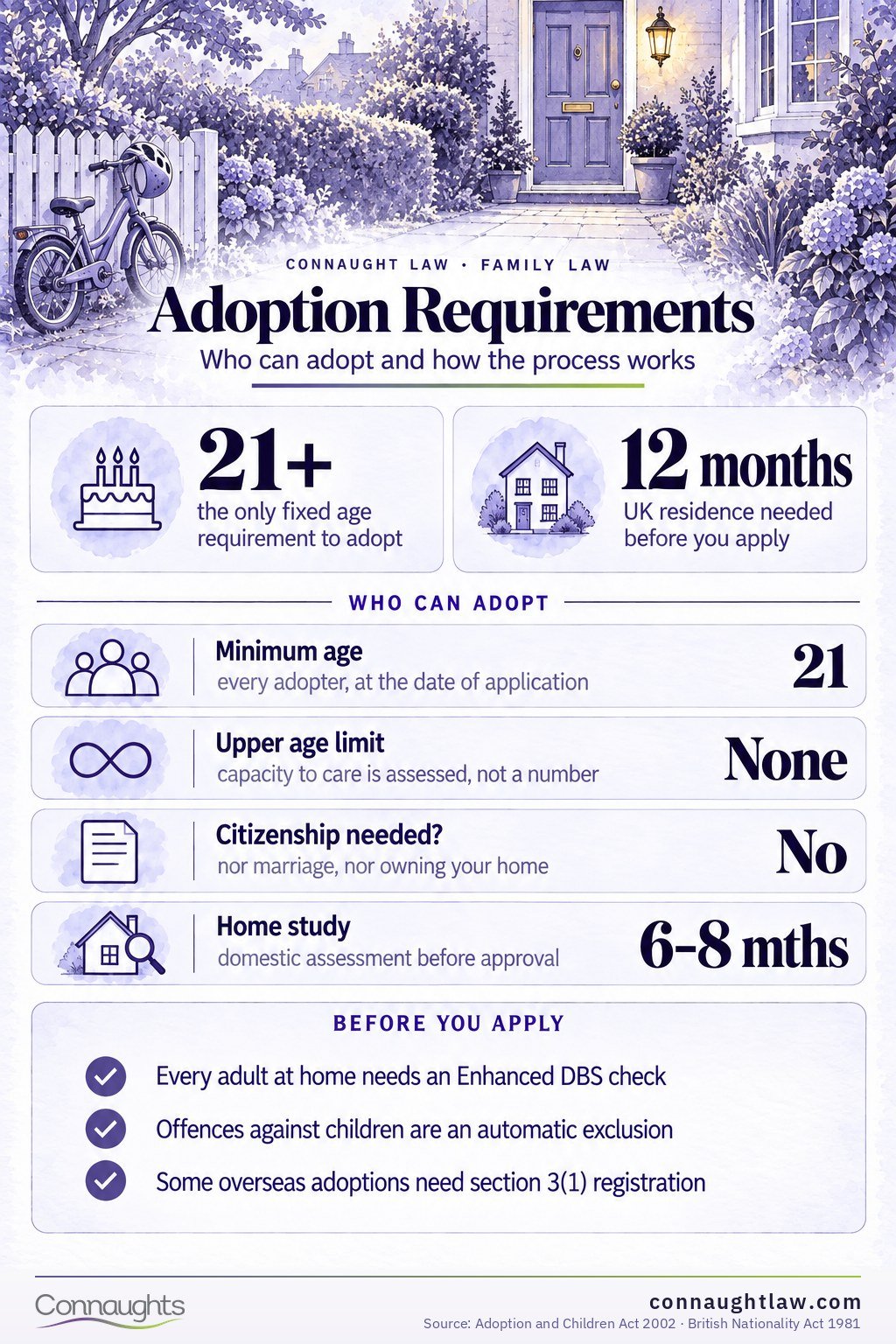
The threshold is lower than most people expect. You must be at least 21. You — or your partner — must have a permanent home in the UK, Channel Islands or Isle of Man, with at least 12 months' residence before the application. That is the eligibility list. British citizenship is not required. Marriage is not required. Owning your home is not required.
- Minimum age: 21 for every prospective adopter at the date of application
- No upper age limit: assessment looks at capacity to care for a child long-term, not the number
- Residence: a permanent home in the UK, Channel Islands or Isle of Man
- 12-month rule: continuous residence for a year before applying
- Citizenship: not required for domestic adoption
Is There an Age Limit for Adoption in the UK?
No upper limit exists in law — 21 is the only fixed age requirement. What an agency assesses is not your age but what it means for the child: your health, your energy, and your capacity to parent this particular child through to adulthood. Applicants in their forties and fifties adopt successfully every year, often for older children whose placements ask for experience more than youth.
DBS Checks and Convictions
Every adult in the household needs an Enhanced DBS check, with international police checks where you have lived abroad. Convictions for offences against children or serious sexual offences exclude you automatically — no discretion. Everything else is assessed individually: the offence, how long ago, and what has changed since. A minor, historic conviction is a conversation with your social worker, not a bar.
Health and Disability
Medical assessment looks at function, not diagnosis: can you meet a child's needs over the long term, with whatever support you use? Disability does not disqualify you, and agencies assess adjustments and support around the adult rather than the condition itself. What matters is the plan for the child, not the label attached to the parent.
British Citizenship for Adopted Children
When Citizenship Is Automatic
Two situations confer British citizenship automatically. An adoption order made by a UK court gives the child citizenship where at least one adoptive parent is British — whatever the child's nationality was before. A Hague Convention adoption completed overseas does the same, where at least one adopter is a British citizen habitually resident in the UK. In both cases the child's legal position matches a birth child's, including the ability to pass citizenship on.
Entry Clearance for Children Adopted Abroad
A child adopted overseas needs entry clearance before joining you in the UK. The application stands on three legs: the adoption's recognition status, your own immigration status, and evidence that you can support the child without recourse to public funds — with the Certificate of Eligibility at the centre of non-Hague cases. Straightforward applications are decided in roughly 4–12 weeks; complex ones take longer and reward planning over hope.
- Hague Convention route: automatic recognition, with immediate settlement for British citizen adopters
- Recognised countries: adoptions from countries listed in the 2013 Order enter on simplified procedures
- Certificate of Eligibility: required where the adoption is from a non-recognised country
- De facto adoption: long-term care relationships with established family integration
- Registration backstop: section 3(1) registration where citizenship is not automatic
Registration Where Citizenship Is Not Automatic
A child whose overseas adoption does not confer citizenship automatically can usually be registered as British under section 3(1) of the British Nationality Act 1981. Registration is discretionary: the Home Office looks for a lawful, genuine adoption and for registration to serve the child's best interests. It is the standard follow-up step for non-Hague adoptions once the family is settled in the UK.
Adopting a Child From Overseas
Adopting from overseas begins with the same UK approval — home study, panel, agency recommendation — but adds a layer on top: a Certificate of Eligibility issued by the Department for Education, evidence that the child cannot suitably be cared for in their own country, and compliance with the law of the child's home state, some of which are subject to special restrictions. Assessment fees alone typically run £12,000–£25,000 before travel and in-country legal costs. The gov.uk intercountry adoption guidance sets out the requirements country by country.
Hague Convention Adoptions
The 1993 Hague Convention determines how much legal work follows the adoption itself. An adoption completed in one of the 100+ Convention countries is recognised in UK law automatically — no re-adoption here — and the child acquires British citizenship at once where at least one adopter is a British citizen habitually resident in the UK. An adoption from a non-Convention country has no such automatic effect: unless the country is on the recognised list, the family usually faces re-adoption through a UK court after entry. Which side of that line your chosen country falls on should shape the route before you commit to it.
What Adoption Costs
Domestic Adoption: Close to Free
Domestic child adoption through UK local authorities remains essentially free, with agencies legally prohibited from charging fees under Section 95 of the Adoption and Children Act 2002. What remains for adopters themselves is modest.
The itemised costs: Enhanced DBS checks (£49.50 per adult), medical reports where an agency requires them (£50-£200), the adoption order application fee (£212 under the current court fees schedule), and adoption certificate copies (£12.50) — typically £200-£500 all in, plus travel to meetings and introductions. Where a placement order is needed first, its £570 fee is the local authority's to pay, not yours.
Intercountry Adoption: Component by Component
There is no single figure for intercountry adoption, and any headline total deserves suspicion until it is broken down. The UK assessment alone typically costs £12,000–£25,000 — the largest fixed element — and on top of it sit travel, accommodation for in-country stays, translation, authentication and legal fees in the child's home state, all of which vary sharply by country. The table below separates the components — and shows which of them actually carry fixed, published figures.
Adoption Costs Compared
| Route | Assessment | Travel and In-Country Costs | UK Court and Admin |
|---|---|---|---|
| UK Domestic Adoption | Free — agencies cannot charge | Travel to meetings and introductions only | £212 court fee, £49.50 DBS per adult, £12.50 certificate |
| Intercountry Adoption | £12,000-£25,000 | Varies sharply by country — flights, extended stays, translation, local legal fees | Same UK fees, plus Certificate of Eligibility processing |
Financial Support Available
On the adopter's side of the ledger sit means-tested adoption allowances, the Adoption and Special Guardianship Support Fund for therapeutic services, Child Benefit, Universal Credit where eligible, and Statutory Adoption Leave with pay. The inter-agency fee (£40,658 for a single-child placement from April 2026) is paid between agencies — never by adopters — so do not let that figure frighten you off a placement.
Who Can Adopt a Child in the UK
Any Family Structure, Assessed the Same Way
Single people, married couples, civil partners, unmarried couples and same-sex couples all adopt on identical criteria under the Adoption and Children Act 2002. Same-sex couples, single adopters and unmarried partners together account for a substantial share of adoptions every year. The assessment never asks what shape your family is — it asks whether this home can hold a child steady through to adulthood.
Same-Sex Couples
Equality here is complete and legally protected: identical assessment standards, identical support, identical parental rights. What a good agency will explore with you is preparation — your support network, and how you will help a child answer questions about their family with confidence. That is parenting preparation, the same as for every applicant, not a higher bar.
Adopting on Your Own
Single applicants are assessed on the same criteria, with particular weight on support networks and the practicalities of sole parenting. Some children do better in single-parent placements — especially children whose histories make one consistent attachment figure easier to manage than two. Financial stability and flexibility at work matter more here, because there is no second income and no second pair of hands.
The Adoption Process, Step by Step
Enquiry and Preparation Training
The process opens with an information session and a registration of interest, followed by mandatory preparation training: child development in care, attachment and trauma, contact with birth families, and what adoption-specific parenting will actually ask of you. Expect honesty rather than salesmanship — a good agency would rather lose you at week two than at year two.
The Home Study and Panel
The home study is the heart of the process: a social worker's visits over several months, interviews with everyone in the household, references, medicals, and a detailed report on your capacity to parent a child who has already lost one family. It concludes at adoption panel, where experienced professionals — including adoptive parents — recommend approval. Domestic assessments run about six to eight months; intercountry ones eight to twelve.
Matching, Introductions and Placement
Matching weighs your approved profile against a child's needs, background and contact arrangements. Introductions build gradually — visits, then overnight stays — before the child moves in, and the adoption order follows once the placement has settled. This is where legal advice earns its keep: family law guidance through to the order, and UK family visa solicitors where the child is entering from abroad.
Frequently askedQuestions about adopting in the UK
What are the requirements to adopt a child in the UK?
You must be 21 or over, with a permanent home in the UK, Channel Islands or Isle of Man and 12 months' residence before applying. Every adult in the household passes an Enhanced DBS check, and you complete a health assessment and home study. Citizenship, marriage and home ownership are not required.
Is there an age limit for adoption in the UK?
There is no upper age limit — 21 is the only fixed age requirement. Agencies assess what your age means for the child: health, energy, and capacity to parent through to adulthood. Applicants in their forties and fifties adopt successfully every year, particularly where older children need experienced placements.
How long does the adoption process take?
Around six to eight months from application to approval panel for domestic adoption, with matching time on top varying by child and region. Intercountry adoption typically takes 12–18 months in all, because the child's country's process and UK entry clearance run alongside the UK assessment.
How much does it cost to adopt?
Domestic adoption costs £200–£500 all in — agencies cannot charge fees, so you pay only the £212 court fee, £49.50 DBS checks, medical reports and travel. Intercountry adoption starts with a £12,000–£25,000 assessment, before travel and in-country legal costs that vary sharply by country.
Can a single person adopt in the UK?
Yes, on the same criteria as couples. Assessment focuses on your support network, work flexibility and the practicalities of sole parenting. Some children are specifically matched to single-parent homes, where one consistent attachment figure suits their history better than two parents would.
Do adopted children automatically get British citizenship?
A UK adoption order confers citizenship automatically where at least one adoptive parent is British, as does a Hague Convention adoption completed overseas by a British adopter habitually resident here. Other overseas adoptions usually need registration under section 3(1) of the British Nationality Act 1981.
Can I adopt a child from overseas?
Yes — you complete the same UK approval, plus a Certificate of Eligibility from the Department for Education, and you must comply with the child's country's law. Hague Convention adoptions are recognised automatically; others may need re-adoption in the UK. See the gov.uk country-by-country guidance linked above.
What criminal convictions prevent adoption?
Offences against children and serious sexual offences are automatic exclusions. Anything else is assessed individually — the nature of the offence, time elapsed, and evidence of change. Enhanced DBS checks are mandatory for every adult in the household, so disclose everything early rather than have it found.
Tell us where the child is, whether you have approached an agency and what your household looks like. We will tell you which route applies and what it will require of you.
Get Expert Advice