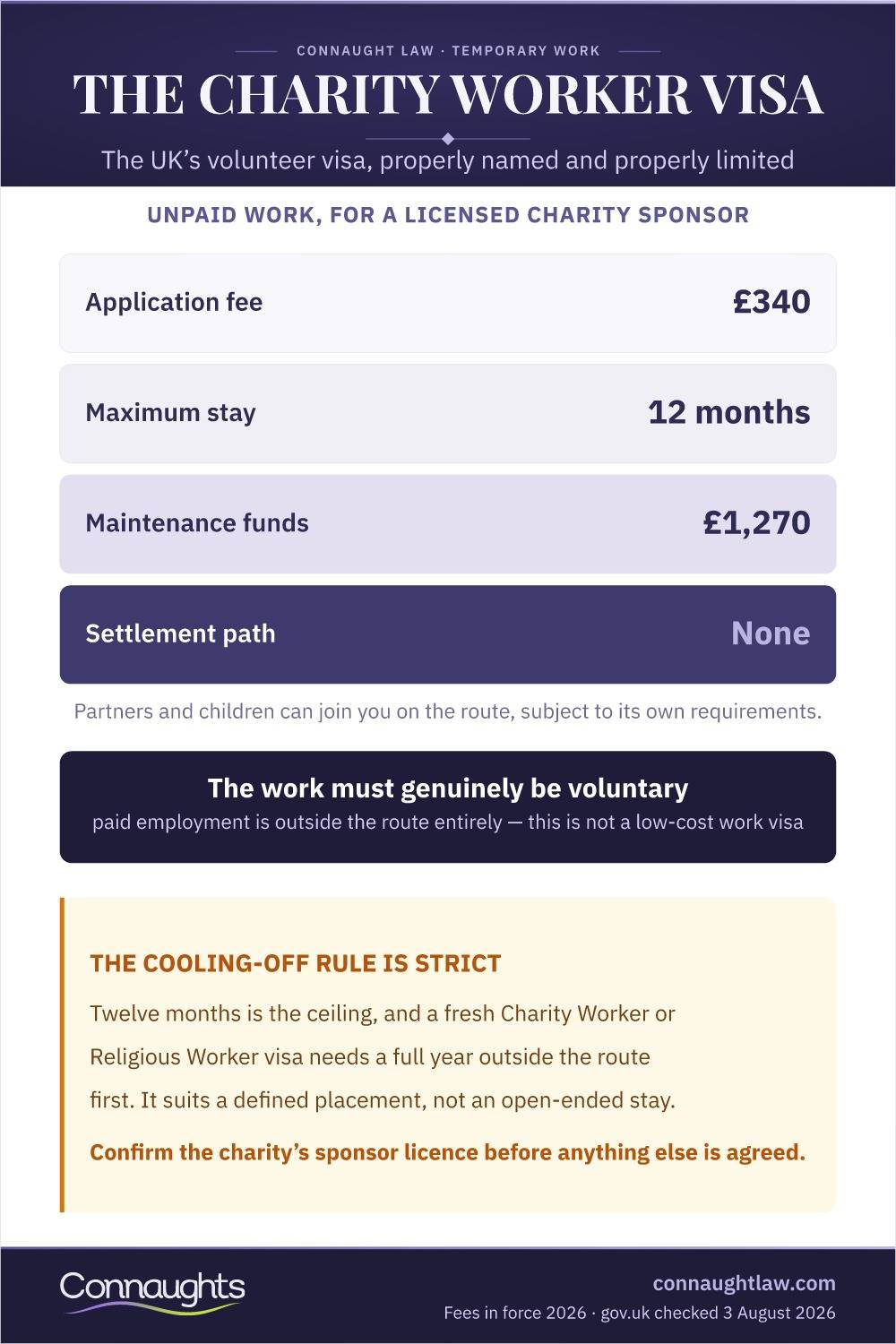
The Charity Worker visa is the UK's volunteer visa in all but name: up to twelve months of unpaid voluntary work for a licensed charity sponsor, at a £340 fee, with your partner and children able to join you. What it never becomes is permanent — the route has no settlement path and a strict cooling-off rule. This guide covers eligibility, sponsorship, the money rules and the limits, at the rates in force for 2026.
On This Page

The UK's Volunteer Visa, Properly Named
Searchers call it the UK volunteer visa; the Immigration Rules call it the Charity Worker visa (Temporary Work). Either way it does one job: it lets someone come to the UK to do unpaid voluntary work for the charity that sponsors them, for a year at most. It is one of the cheapest sponsored routes in the system — and one of the most strictly temporary.
How the Route Works
Key Features
A licensed charity assigns you a certificate of sponsorship for a defined voluntary role. You apply within three months of the assignment, pay £340 plus the health surcharge, and show £1,270 in savings unless your sponsor certifies your maintenance. You can stay up to twelve months, bring your partner and children, and extend within that ceiling — but the route leads nowhere permanent by design.
Eligible Charitable Activities
The work must be genuine volunteering that advances the sponsor's charitable purpose — fieldwork for an aid organisation, support roles in a religious charity's community programmes, unpaid positions in charitable care or education projects. What it must not be is a job in fancy dress: a role that would otherwise be a paid position, filled by an unpaid migrant, is exactly what caseworkers are trained to refuse.
Who Qualifies
What Every Applicant Must Show
Eligibility Criteria and Evidence
| Requirement | The rule | Evidence |
|---|---|---|
| Age | 18 or over when you apply | Passport or identity document |
| Sponsorship | A certificate of sponsorship assigned within the last 3 months | The CoS reference number |
| Role | Unpaid voluntary work for the sponsoring charity | The role description on the certificate |
| Funds | £1,270 held for 28 consecutive days, unless exempt | Bank statements, or the sponsor's certification |
| Cooling-off | No Charity Worker or Religious Worker visa in the last year, unless outside the UK throughout | Immigration history |
Tuberculosis Testing
Applicants from countries on the Home Office's testing list need a clear certificate from an approved clinic before applying — check yours against the TB test countries list. The certificate belongs in the application bundle from the start; chasing it after submission delays exactly the short-duration visa that can least afford delay.
Sponsorship and the Certificate
Who Can Sponsor
Only organisations holding a Temporary Worker sponsor licence in the Charity Worker category can assign certificates — typically registered charities running volunteer programmes at scale. If the organisation inviting you is not licensed, no application is possible until it becomes so; volunteering enthusiasm cannot substitute for the licence.
Checking the Register
Before planning around an offer, confirm the organisation appears on the register of licensed sponsors with the right category. It is a two-minute check that catches the most painful failure early — and worth repeating close to application, because a sponsor whose licence is suspended or revoked takes its volunteers' immigration plans down with it, as our sponsor licence revocation guide explains from the employer's side.
The Certificate Explained
The certificate of sponsorship is an electronic record, not a paper document: the charity assigns it, you receive a reference number, and the application is built on it. It stays valid for three months from assignment, which sets the application clock — and the role's start date has to sit within the same window.
What the Certificate Must Say
The certificate confirms the role, its dates, and that the work is unpaid voluntary activity for the sponsor's charitable purpose. Where the sponsor certifies maintenance, that undertaking sits on the certificate too. Errors here are the sponsor's to fix before assignment — a certificate describing the wrong role cannot be argued right afterwards.
Sponsor Responsibilities
Licensed charities carry the standard sponsor duties: record-keeping, reporting non-attendance or early departure, and keeping the role within what the certificate describes. Volunteers feel these duties indirectly — as the paperwork the charity asks for and the accuracy it insists on — but a sponsor that neglects them risks the licence every current volunteer depends on.
Applying in Practice
Online Application and Biometrics
Applications go online with identity verified through the app or a biometric appointment. Standard processing runs about three weeks for applications from outside the UK and up to eight weeks for applications made inside it, with paid faster options. In-country applicants must not leave the UK, Ireland, the Channel Islands or the Isle of Man while a decision is pending — travel withdraws the application.
What It Costs
Application Fees and Costs
| Item | Amount | Notes |
|---|---|---|
| Application fee | £340 | Same inside or outside the UK; per person, dependants included |
| Immigration health surcharge | £1,035 per year | Charged pro rata to the length of leave granted |
| Maintenance funds | £1,270 held, not spent | Waived if the sponsor certifies, or after 12 months' lawful UK residence |
Documents That Decide It
- Passport and the certificate of sponsorship reference number.
- Bank statements covering the 28-day period, with day 28 falling within 31 days of applying — unless the sponsor certifies maintenance.
- TB certificate where your country is on the testing list.
- For dependants: relationship evidence and their own funds or certification.
Maintenance and Money Rules
The £1,270 Rule
The headline figure is £1,270 in personal savings, held for at least 28 consecutive days, with day 28 falling within 31 days of the application. Dependants need their own amounts on the same holding rule: £285 for a partner, £315 for a first child and £200 for each further child. The classic failure is a balance that dips below the threshold mid-period — the 28 days restart from the dip.
When the Sponsor Certifies Instead
Two exemptions remove the savings requirement entirely: twelve months' lawful residence in the UK on a valid visa, or a sponsor undertaking on the certificate to cover your costs up to £1,270 for the first month. Large volunteer programmes certify routinely; if yours will, get that confirmed before assembling bank evidence you do not need.
What You Can and Cannot Do
Permitted Activities
Beyond the sponsored voluntary role, the route allows study (with an ATAS certificate where the course requires one) and a second job of up to 20 hours a week, provided it is in the same sector and at the same level as the sponsored work. Partners and children who join you can work — except as a sportsperson or coach — and study without restriction.
Prohibited Activities
The sponsored role itself must stay unpaid — receiving payment for it breaches the visa's core condition. Permanent employment is off-limits, as is access to public funds. These are not technicalities: paid work dressed as volunteering is a breach that follows the applicant into every future UK application, and our visa refusal team sees the consequences regularly.
Extensions, the Ceiling and What Comes After
Extensions are possible but only within the ceiling: total stay can never exceed twelve months, or the certificate period plus 14 days if shorter. There is no settlement path, and a fresh Charity Worker or Religious Worker visa needs a full year outside the route first. Volunteers who discover they want a longer UK future should compare the sponsored alternatives in our sponsorship routes directory — the move is a change of route, never an extension argument, and our business immigration team can map the switch.
Frequently askedQuestions about the charity worker visa
How long can I stay on a charity worker visa?
Up to 12 months, or the period on your certificate of sponsorship plus 14 days, whichever is shorter. You can arrive up to 14 days before the role starts, and extend within — never beyond — that 12-month ceiling.
Can I be paid for the work?
Not for the sponsored role — it must be unpaid voluntary work, and payment for it breaches the visa. The route does permit a separate second job of up to 20 hours a week in the same sector and at the same level as the sponsored role.
What funds do I need to show?
£1,270 held for 28 consecutive days, with day 28 within 31 days of applying — plus £285 for a partner, £315 for a first child and £200 per further child. The requirement is waived if your sponsor certifies maintenance or you have been in the UK lawfully for 12 months.
Which organisations can sponsor me?
Only charities holding a Temporary Worker sponsor licence in the Charity Worker category — check the organisation on the gov.uk register of licensed sponsors before planning around an offer. An unlicensed charity cannot sponsor anyone, however established its volunteer programme.
Can my family come with me?
Yes — your partner and children under 18 can apply as dependants, each paying the £340 fee and surcharge and showing their own funds unless certified. Dependants can work, except as a sportsperson or coach, and can study.
Does the charity worker visa lead to settlement?
No. Time on the route counts towards nothing permanent, and after it ends you need a year outside the Charity Worker and Religious Worker routes before holding either again. Anyone wanting a long-term UK future should plan a switch into a settlement-bearing route instead.
Tell us who your sponsoring charity is, when the role starts and who is coming with you. We'll confirm the sponsorship position, the funds you need to show and the timeline that gets you there.
Get Expert Advice